Worksheet Questions & Answers: Rational Numbers

1. Verify that:

(ii)
2. Find: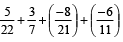
3. Find: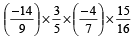
4. Write the additive inverse of:
(i) 7/19
(ii) -21/112
5. Verify that -(-p) = p for p = -11/31
6. Find: 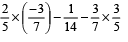
Answers
1. (i) Both expressions simplify to , which means they are the same.
(ii)Both expressions simplify to  , which means they are the same.
2. -125/462
3. 1/2
4.
(i) -7/19
(ii) 21/112
5.
We want to verify the equation -(-p) = p, where p = -11/31.
By negating a negative number, we get its positive value, so -(-p) simplifies to p.
Substituting p = -11/31 into the equation, we have:
-(-p) = -(-(-11/31))
Applying the rule of double negation, we get:
-(-p) = -(11/31)
On the right side of the equation, p = -11/31.
Comparing both sides, we see that -(-p) simplifies to -11/31, which matches the value of p.
Therefore, -(-p) = p holds true for p = -11/31.
6.
FAQs on Worksheet Questions & Answers: Rational Numbers
| 1. How do I identify whether a number is rational or irrational in Class 8 Maths? |  |
| 2. What's the difference between positive and negative rational numbers on the number line? | |
| 3. How do I add and subtract rational numbers with different denominators? | |
| 4. Why do we need to simplify rational numbers, and how does it help in exams? | |
| 5. Can I multiply and divide rational numbers using the same method, or is there a difference? | |