Solved Examples: Profit, Loss & Discount

(a) Rs. 30 lakh
(b) Rs. 8 lakh
(c) Rs. 18 lakh
(d) Rs. 24 lakh
Correct Answer is Option (d).
- Let the total property of the Alphonso be Rs.x.
- After Alphonso's death, money possessed by the family members would be
Wife = x/2, Ben = x/6, Carl =x/6, Dave =x/6- After Ben's death, money possessed by each of them would be
Alphonso's wife = x/2, Ben = 0,Ben's wife = x/6, Carl = x/6 + x/24 = 5x/24, Dave = x/6 + x/24 = 5x/24- After Carl's death, money possessed by them, Alphonso's wife has x/2, Ben has 0, Ben's wife has x/12, Carl has 0, Carl's wife has 5x/48, Dave has 5x/24 + 5x/48 = 15x/48
- After Dave's death, money possessed by them is:
Alphonso's wife has x/2 + 15x/96 = 63x/96, Ben has 0, Ben's wife has x/12, Carl's has 0, Carl's wife has 5x/48, Dave has 0 and Dave's wife has 15x/96
Now, given that 63x/96 = 1575000
x= 2400000
Alternative Method:
If total = Rs. 2,400,000 then after Alphonso's death: Widow = 1,200,000 and Ben = Carl = Dave = 400,000.
Ben dies: half (200,000) to Ben's widow; remaining 200,000 shared equally gives 100,000 each to Carl and Dave. So Carl and Dave become 500,000 each.
Carl dies: half of 500,000 = 250,000 to Carl's widow; remaining 250,000 to Dave → Dave = 500,000 + 250,000 = 750,000.
Dave dies: half of 750,000 = 375,000 to Dave's widow; remaining 375,000 to mother. Mother's total = 1,200,000 + 375,000 = 1,575,000, which matches the given.
Question 2: Two oranges, three bananas and four apples cost Rs. 15. Three oranges, two bananas and one apple cost Rs. 10. I bought 3 oranges, 3 bananas and 3 apples. How much did I pay?
(a) Rs. 10
(b) Rs. 8
(c) Rs. 15
(d) Cannot be determined
Correct Answer is Option (c).
It is given that
2O + 3B + 4A = 15 .....(1)
3O + 2B + A = 10.......(2)Add the two equations: (2O+3O) + (3B+2B) + (4A+A) = 15 + 10
5O + 5B + 5A = 25
Therefore O + B + A = 5.
Hence 3O + 3B + 3A = 3 × 5 = 15.
Question 3: A watch dealer incurs an expense of Rs. 150 for producing every watch. He also incurs an additional expenditure of Rs. 30,000, which is independent of the number of watches produced. If he is able to sell a watch during the season, he sells it for Rs. 250. If he fails to do so, he has to sell each watch for Rs. 100. If he produces 1500 watches, what is the number of watches that he must sell during the season in order to break even, given that he is able to sell all the watches produced?
(a) 500
(b) 700
(c) 800
(d) 1000
Correct Answer is Option (b).
Total cost to produce 1500 watches = 1500 × 150 + 30,000 = 225,000 + 30,000 = 255,000.
Let x be the number sold during the season at Rs. 250 each; then (1500 - x) are sold at Rs. 100 each.
Revenue = 250x + 100(1500 - x) = 250x + 150,000 - 100x = 150x + 150,000.
Break-even when revenue = total cost: 150x + 150,000 = 255,000.
150x = 105,000 ⇒ x = 700.
Question 4: A stockist wants to make some profit by selling sugar. He contemplates various methods. Which of the following would maximize his profit?
1. Sell sugar at 10% profit.
2. Use 900 g of weight instead of 1 kg.
3. Mix 10% impurities in sugar and selling sugar at cost price.
4. Increase the price by 5% and reduce weights by 5%.
(a) I or III
(b) II
(c) II, III and IV
(d) Profits are the same
Correct Answer is Option (b).
Compare profit percent in each case assuming CP of 1 kg sugar = Rs. 100.
Case I: Sell at 10% profit → profit = 10%.
Case II: Use 900 g instead of 1000 g. CP of 900 g = (100/1000) × 900 = Rs. 90. He charges Rs. 100 (customer pays for 1 kg), so profit = (100 - 90)/90 × 100% = 10/90 × 100% = 11.11%.
Case III: Mix 10% impurity; to give 1 kg, he uses 900 g sugar + 100 g impurity. Effective CP for 1 kg = (100/110) × 100 = 90.909... ≈ 90.90. Selling at Rs.100 gives profit % = (100 - 90.90)/90.90 × 100% ≈ 10.01%.
Case IV: Increase price by 5% and reduce weight by 5%. CP of 950 g = (100/1000) × 950 = Rs. 95. New price = 100 × 1.05 = 105. Profit % = (105 - 95)/95 × 100% = 10/95 × 100% ≈ 10.52%.
Maximum profit is in Case II (≈11.11%).
Question 5: A dealer offers a cash discount of 20% and still makes a profit of 20% when he further allows 16 articles to a dozen to a particularly sticky bargainer. How much per cent above the cost price were his wares listed
(a) 100%
(b) 80%
(c) 75%
(d) 66%
Correct Answer is Option (a).
Let CP of one article = x.
He makes a profit of 20% → effective selling price per article = 1.2x.
He gives 16 articles for the price of 12, so selling 16 articles at total price 12 × (price per article after discount) means per-article effective price is 12/16 = 0.75 of the labelled selling rate; this results in a 25% reduction compared to nominal unit price.
Given that after these allowances his SP per article is 1.2x, so the price before the 25% reduction (i.e., the price after cash discount but before the extra free items) must be 1.6x (since 1.6x × 0.75 = 1.2x).
This 1.6x is the price after a 20% cash discount on the marked price (MP), so MP × 0.8 = 1.6x ⇒ MP = 2x.
Therefore MP is 100% above CP.
Alternative Method:
Let the cost price = Rs 100. Since the profit is 20%, so the SP = Rs 120.
This SP = Rs 120 is arrived after giving a discount of 20%, i.e. MP = 120/0.8 = Rs 150.
Now he is selling 16 goods to a dozen, so his loss in this case = {(16-12)/16} x100 = 25%.
It means that Rs 150 were arrived after losing 25%. Hence the actual MP = 150/0.75 = Rs 200.
Hence, he has marked the MP 100% above the CP.
Question: 6 If a merchant offers a discount of 40% on the marked price of his goods and thus ends up selling at cost price, what was the % mark up?
(a) 28.57%
(b) 40%
(c) 66.66%
(d) 58.33%
Correct Answer is Option (c).
If discount is 40%, selling price = 60% of marked price (M). Given this equals cost price C.
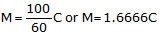
So 0.60M = C ⇒ M = C / 0.60 = (10/6)C = 1.6666... C.
Markup percentage = (M - C)/C × 100% = (0.6666... ) × 100% = 66.66%.

Question: 7 If a merchant offers a discount of 30% on the list price, then she makes a loss of 16%. What % profit or % loss will she make if she sells at a discount of 10% of the list price?
(a) 6% loss
(b) 0.8% profit
(c) 6.25% loss
(d) 8% profit
Correct Answer is Option (d).
Assume cost price = Rs.100. Let List Price = x.
With 30% discount, sale price = 0.7x. This results in loss of 16% on cost, so 0.7x = 84 (since 100 - 16% of 100 = 84).
Thus x = 84 / 0.7 = 120.
With 10% discount, sale price = 0.9 × 120 = 108.
Since cost = 100, profit = 8 → 8% profit.
Question: 8 A merchant marks his goods up by 60% and then offers a discount on the marked price. If the final selling price after the discount results in the merchant making no profit or loss, what was the percentage discount offered by the merchant?
(a) 60%
(b) 40%
(c) 37.5%
(d) Depends on the cost price
Correct Answer is Option (c).
Assume cost price = 100. Marked price = 100 + 60% of 100 = 160.
To get no profit or loss, selling price must be 100. Discount amount = 160 - 100 = 60.
Percentage discount = 60/160 × 100% = 37.5%.
Question: 9 A merchant marks his goods up by 75% above his cost price. What is the maximum % discount that he can offer so that he ends up selling at no profit or loss?
(a) 75%
(b) 46.67%
(c) 300%
(d) 42.85%
Correct Answer is Option (d).
Assume cost price = 100. Marked price = 100 + 75 = 175.
To sell at no profit no loss, selling price must be 100. Discount = 75 on 175.
Percentage discount = 75/175 × 100% = 42.857...% ≈ 42.85%.
Question: 10 A merchant marks his goods in such a way that the profit on the sale of 50 articles is equal to the selling price of 25 articles. What is his profit margin?
(a) 25%
(b) 50%
(c) 100%
(d) 66.67%
Correct Answer is Option (c).
Let selling price per article = Re.1.
Selling price of 50 articles = Rs.50.
Profit on sale of 50 articles = selling price of 25 articles = Rs.25.
So total cost for 50 articles = total selling price - profit = 50 - 25 = 25.
Cost price per article = 25/50 = 0.5. Selling price is 1, cost is 0.5 → profit per article = 0.5 on cost 0.5 = 100%.
Question: 11 Two merchants sell, each an article for Rs.1000. If Merchant A computes his profit on cost price, while Merchant B computes his profit on selling price, they end up making profits of 25% respectively. By how much is the profit made by Merchant B greater than that of Merchant A?
(a) Rs.66.67
(b) Rs.50
(c) Rs.125
(d) Rs.200
Correct Answer is Option (b).
Merchant B computes profit as 25% of selling price = 0.25 × 1000 = Rs.250.
Merchant A computes profit as 25% of cost price. Let cost price be C. Then profit = 0.25C and selling price = C + 0.25C = 1.25C = 1000 ⇒ C = 800.
Thus Merchant A's profit = 1000 - 800 = 200.
Difference = 250 - 200 = Rs.50.
Question: 12 One year payment to the servant is Rs. 200 plus one shirt. The servant leaves after 9 months and receives Rs. 120 and a shirt. What is the price of the shirt?
(a) Rs. 80
(b) Rs. 100
(c) Rs. 120
(d) Cannot be determined
Correct Answer is Option (c).
The servant worked for 9 months instead of 12 months, he should receive 9/12 of his annual payment. Let the price of 1 shirt be Rs.S. i.e.,.
However, the question states that the servant receives Rs. 120 + S where S is the price of the shirt.
By equating the two equations we get= 120 + S.
Therefore Price of the shirt S = Rs. 120.
Question: 13 If apples are bought at the rate of 30 for a rupee. How many apples must be sold for a rupee so as to gain 20%?
(a) 28
(b) 25
(c) 20
(d) 22
Correct Answer is Option (b).
The merchant makes a profit of 20%.
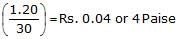
This means that the merchant sells 30 apples for Rs.1.20
Therefore, the selling price of 1 apple =
The number of apples that can be sold for Rs.1.00 = Rs..
Question: 14 A trader buys goods at a 19% discount on the label price. If he wants to make a profit of 20% after allowing a discount of 10%, by what % should his marked price be greater than the original label price?
(a) +8%
(b) -3.8%
(c) +33.33%
(d) None of these
Correct Answer is Option (a).
Let original label price = Rs.100. He buys at 19% discount → cost = 81.
To make 20% profit, selling price needed = 1.2 × 81 = 97.2.
He sells this after offering 10% discount on his new marked price M, so 0.9M = 97.2 ⇒ M = 97.2 / 0.9 = 108.
Marked price 108 is 8% more than original label price 100.
Question: 15 Rajiv sold an article for Rs.56 which cost him Rs.x. If he had gained x% on his outlay, what was his cost?
(a) Rs.40
(b) Rs.45
(c) Rs.36
(d) Rs.28
Correct Answer is Option (a).
x is the cost price of the article and x% is the profit margin.
Therefore, s.p == 56
=>= 56
So, 100x + x2 = 5600.
Solving for 'x' , we get x = 40 or x = -140. As the price cannot be a -ve quantity, x = 40. The cost price is 40 and the markup is 40.
It is usually easier to solve such questions by going back from the answer choices as it saves a considerable amount of time.
Question: 16 A trader professes to sell his goods at a loss of 8% but weighs 900 grams in place of a kg weight. Find his real loss or gain per cent.
(a) 2% loss
(b) 2.22% gain
(c) 2% gain
(d) None of these
Correct Answer is Option (b).
The trader professes to sell his goods at a loss of 8%.
Therefore, Selling Price = (100 - 8)% of Cost Price
or SP = 0.92CP
But, when he uses weights that measure only 900 grams while he claims to measure 1 kg. Hence, CP of 900gms = 0.90 * Original CP
So, he is selling goods worth 0.90CP at 0.92CP
Therefore, he makes a profit of 0.02 CP on his cost of 0.9 CP
Profit % =
i.e.,or 2.22%.

Question: 17 A merchant buys two articles for Rs.600. He sells one of them at a profit of 22% and the other at a loss of 8% and makes no profit or loss in the end. What is the selling price of the article that he sold at a loss?
(a) Rs.404.80
(b) Rs.440
(c) Rs.536.80
(d) Rs.160
Correct Answer is Option (a).
Let C1 and C2 be costs of article 1 and 2 respectively. C1 + C2 = 600.
Selling price of first article = 1.22 C1.
Selling price of second article = 0.92 C2.
Total selling price = 1.22C1 + 0.92C2 = total cost = 600 (since no overall profit or loss).
Substitute C2 = 600 - C1 into equation: 1.22C1 + 0.92(600 - C1) = 600.
Compute: 1.22C1 + 552 - 0.92C1 = 600 ⇒ 0.30C1 = 48 ⇒ C1 = 160.
Thus C2 = 440. Selling price of article 2 = 0.92 × 440 = 404.80.
Alternative Way:
Directly set up 1.22C1 + 0.92(600 - C1) = 600 and solve to get C1 = 160, C2 = 440, then SP of second = 0.92×440 = 404.80.
Question: 18 A trader makes a profit equal to the selling price of 75 articles when he sold 100 of the articles. What % profit did he make in the transaction?
(a) 33.33%
(b) 75%
(c) 300%
(d) 150%
Correct Answer is Option (c).
Let selling price of one article = S.
Selling price of 100 articles = 100S.
Profit earned = selling price of 75 articles = 75S.
Profit % =From SP = CP + Profit we have 100S = CP + 75S ⇒ CP = 25S.
Profit percent = Profit / CP × 100% = (75S / 25S) × 100% = 3 × 100% = 300%.

Question: 19 If a merchant makes a profit of 20% after giving a 20% discount, what should be his mark-up?
(a) 20%
(b) 40%
(c) 50%
(d) 60%
(e) 48%
Correct Answer is Option (c).
Assume CP = 100. Required profit 20% ⇒ SP after discount = 120.
Let marked price be M; after 20% discount, selling price = 0.80M = 120 ⇒ M = 120 / 0.8 = 150.
Markup = (M - CP)/CP × 100% = (150 - 100)/100 × 100% = 50%.
Question: 20 The Maximum Retail Price (MRP) of a product is 55% above its manufacturing cost. The product is sold through a retailer, who earns 23% profit on his purchase price. What is the profit percentage (expressed in nearest integer) for the manufacturer who sells his product to the retailer? The retailer gives 10% discount on MRP.
(a) 31%
(b) 22%
(c) 15%
(d) 13%
(e) 11%
Correct Answer is Option (d).
Key Data
- The MRP of the product is 55% above its manufacturing cost.
- The retailer sells the product after offering a discount of 10% on the MRP.
- The retailer makes a 23% profit on his purchase price.
Useful Assumption
- Assume manufacturing cost = 100 (this simplifies percentage calculations).
- Then MRP = 100 + 55% of 100 = 155.
- Retailer offers 10% discount → selling price to customer = 155 - 10% of 155 = 155 - 15.5 = 139.5.
- Retailer's selling price 139.5 equals 123% of his purchase price x (since he makes 23% profit): 1.23x = 139.5 ⇒ x = 139.5 / 1.23 = 113.4.
- So the manufacturer sold to retailer at 113.4 while his cost is 100 → manufacturer's profit = 13.4 on 100 = 13.4% ≈ 13% (nearest integer).
FAQs on Solved Examples: Profit, Loss & Discount
| 1. What is the formula to calculate profit or loss? |  |
| 2. How is profit percentage calculated? | |
| 3. What is the formula to calculate discount? | |
| 4. How is discount percentage calculated? | |
| 5. How can the selling price be calculated if the cost price and profit percentage are known? | |





