CBSE Class 10  >  Class 10 Notes  >  Mathematics (Maths)   >  HOTS Questions: Pair of Linear Equations in Two Variables

HOTS Questions: Pair of Linear Equations in Two Variables

Q1. If two of the roots of f(x) = x3 - 5x2 - 16x + 80 are equal in magnitude but opposite in sign, then find all of its zeroes.

Sol: Let α and β are the two zeroes which are equal in magnitude but opposite in sign.
∴ α + β = 0
(Let the third zero is γ)
Sum of zeroes of
f(x)= α + β + γ =  -(-5)1 = 5
∴ γ = 5  [α + β = 0]
Product of zeroes

= αβγ = -801 ⇒ 5 × αβ = -80 [∵ γ = 5]

∴  αβ = -805 = -16

⇒ - α2 = -16 [α + β = 0 ⇒ β = - α]

⇒ α2 = 16 ⇒ α = ± 4

α = ± 4 ⇒ β = ∓ 4    

[∴ β = -α]

Thus, the zeroes are : [± 4, ∓ 4, and 5]

Q2. Solve : 

3x + 2y = 13

5x - 3y = 9

Sol : Given equations:

3x + 2y = 13

5x - 3y = 9

Let 1x = p and 1y = q

The equations become:

3p + 2q = 13 ...(i)

5p - 3q = 9 ...(ii)

From equation (i):

2q = 13 - 3p

q = 13 - 3p2

Substitute q into equation (ii):

5p - 3( 13 - 3p2 ) = 9

Multiply through by 2 to eliminate the fraction:

10p - (39 - 9p) = 18

19p = 57

p = 3

Solve for q:

q = 13 - 92 = 42 = 2

Back-substitute for x and y:

x = 1p = 13

y = 1q = 12

Final Answer:

x = 13 , y = 12


Q3. Solve : 

8x + 2y + 32x - y = 3

12x + 2y - 62x - y = 1

Hint: Put x + 2y = p and 2x - y = q

Sol:  Given equations:
8x + 2y32x - y = 3
12x + 2y - 62x - y = 1

Let:
x + 2y = p, 2x - y = q

Substituting:
8p3q = 3 ...(1)
12p - 6q = 1  ...(2)

Eliminating fractions:
8q + 3p = 3pq  ...(3)
12q - 6p = pq  ...(4)

From (4):
pq = 12q - 6p

Substitute pq in (3):
8q + 3p = 3(12q - 6p)
8q + 3p = 36q - 18p
21p = 28q
p = 4q3

Substitute p into (1):
8p3q = 3
6q3q = 3
q = 3

Substitute q = 3 into p:
p = 4 × 33 = 4

Back-substitute:
x + 2y = 4, 2x - y = 3
Solving gives: x = 2, y = 1

Final Answer: x = 2, y = 1


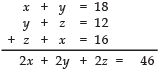
Q4. Solve : x + y = 18 ; y + z  = 12 ;  z + x = 16.
Sol: Adding the three equations, we get
HOTS Questions: Pair of Linear Equations in Two Variables
⇒ x + y + z  = 23
Now, (x + y + z = 23) - (x + y = 18)
⇒ z = 5 (x + y + z = 23) - (y + z = 12)
⇒ x = 11 (x + y + z = 23) - (z + x = 16)
⇒ y = 7  
Thus, x = 11, y = 7 and z = 5

Q5. Solve: x + y - 32 = x + 2y - 43 = 3x + y11
Sol: 

From x + y - 32 = 3x + y11
⇒ 11(x + y - 3) = 2(3x + y) ⇒ 5x + 9y = 33    ...(1)
From x + 2y - 43 = 3x + y11
⇒ 11(x + 2y - 4) = 3(3x + y)
⇒ 2x + 9y = 44        ...(2)
Solving (1) and (2), we get x = 3 and y = 2

The document HOTS Questions: Pair of Linear Equations in Two Variables is a part of the Class 10 Course Mathematics (Maths) Class 10.
All you need of Class 10 at this link: Class 10

FAQs on HOTS Questions: Pair of Linear Equations in Two Variables

1. What are the methods to solve a pair of linear equations in two variables?
Ans.The methods to solve a pair of linear equations in two variables include the substitution method, elimination method, and graphical method. In the substitution method, one equation is solved for one variable, and that expression is substituted into the other equation. In the elimination method, the equations are manipulated to eliminate one variable, allowing for direct solving of the other variable. The graphical method involves plotting both equations on a graph to find their point of intersection, which represents the solution.
2. How do you determine if a pair of linear equations has no solution, one solution, or infinitely many solutions?
Ans.A pair of linear equations can be analyzed based on their slopes and intercepts. If the equations represent two parallel lines, they have no solution (inconsistent). If they intersect at a single point, they have one solution (independent). If they are the same line (coincident), they have infinitely many solutions (dependent). This can be checked by comparing the ratios of the coefficients of the variables and the constant terms.
3. Can you explain the graphical representation of a pair of linear equations?
Ans.The graphical representation of a pair of linear equations involves plotting each equation on a coordinate plane. The x-axis and y-axis represent the two variables. The point where the two lines intersect indicates the solution of the equations. If the lines are parallel, they will never intersect, indicating no solution. If they coincide, they overlap completely, indicating infinitely many solutions.
4. What are the real-life applications of solving pairs of linear equations?
Ans.Solving pairs of linear equations has several real-life applications, such as in business for profit and loss calculations, in physics for motion and forces, and in finance for budgeting and investment planning. For example, if a business wants to determine the optimal price and quantity to maximize profits, they can use linear equations to model the relationship between price, demand, and revenue.
5. How can you solve a pair of linear equations using the elimination method step by step?
Ans.To solve a pair of linear equations using the elimination method, follow these steps: 1. Write down the equations in standard form (Ax + By = C). 2. Multiply one or both equations by suitable numbers so that the coefficients of one of the variables are the same or opposites. 3. Add or subtract the equations to eliminate that variable. 4. Solve for the remaining variable. 5. Substitute the value of the solved variable back into one of the original equations to find the value of the other variable. 6. Check the solution by substituting both values back into the original equations.
Explore Courses for Class 10 exam
Get EduRev Notes directly in your Google search
Related Searches
Viva Questions, Objective type Questions, HOTS Questions: Pair of Linear Equations in Two Variables, shortcuts and tricks, MCQs, Exam, practice quizzes, HOTS Questions: Pair of Linear Equations in Two Variables, study material, HOTS Questions: Pair of Linear Equations in Two Variables, Extra Questions, past year papers, mock tests for examination, ppt, Previous Year Questions with Solutions, video lectures, Free, pdf , Sample Paper, Important questions, Semester Notes, Summary;