NEET Exam  >  NEET Notes  >  Physics Class 11  >  DC Pandey Solutions: First Law of Thermodynamics - 1

DC Pandey Solutions: First Law of Thermodynamics - 1

Introductory Exercise 18.1

Ques 1: A gas in a cylinder is held at a constant pressure of 1.7 × 10⁵ Pa and is cooled and compressed from 1.20 m3 to 0.8 m3. The internal energy of the gas decreases by 1.1 × 10⁵ J.
(a) Find the work done by the gas. 
(b) Find the magnitude of the heat flow into or out of the gas, and state the direction o f heat flow. 
(c) Does it matter whether or not the gas is ideal ?
Sol: (a) Work done by gas under constant pressure is
W = PΔV = P(Vf - Vi)
= (1.7 × 10⁵ Pa)(0.8 - 1.20) m3
= (1.7 × 10⁵)(-0.40) m3
= -6.8 × 10⁴ J
(Negative sign shows work is done on the gas, not by the gas.)
(b) By the first law, Q = ΔU + W
= (-1.1 × 10⁵ J) + (-6.8 × 10⁴ J)
= -1.78 × 10⁵ J
So the magnitude of heat flow is 1.78 × 10⁵ J and Q is negative. Therefore net heat flows out of the gas (heat leaves the gas).
(c) The first law (ΔU = Q - W) holds for any macroscopic thermodynamic system, ideal or non-ideal. What differs is how ΔU depends on state variables: for an ideal gas ΔU depends only on temperature, while for a real gas ΔU can also depend on volume and intermolecular forces. But the numerical application of the first law above does not require the gas to be ideal.

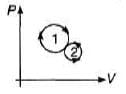
Ques 2: A thermodynamic system undergoes a cyclic process as shown in figure.

Introductory Exercise 18.1


(a) over one complete cycle, does the system do positive or negative work. 
(b) over one complete cycle, does heat flow into or out of the system. 
(c) In each of the loops 1 and 2, does heat flow into or out of the system.
Sol: (a) For a closed cycle on a P-V diagram, the work done by the system equals the area enclosed by the cycle, taken positive when the cycle is traversed clockwise. Here loop 1 is traversed clockwise, so W1 is positive. Loop 2 is traversed anticlockwise, so W2 is negative. The net work is the algebraic sum Wnet = W1 + W2, and from the figure the net enclosed area is positive. Hence net work done by the system over the complete cycle is positive.

Introductory Exercise 18.1

(b) For a complete cycle ΔU = 0, so Qnet = Wnet. Since Wnet is positive, Qnet is also positive. Thus, over the full cycle, heat flows into the system.

(c) In each separate closed loop ΔU = 0 for that loop, so Q = W for that loop. Therefore:

• Loop 1: W1 > 0 so Q1 > 0 - heat flows into the system during loop 1.
• Loop 2: W2 < 0="" so="" />2 < 0="" -="" heat="" flows="" out="" of="" the="" system="" during="" loop="" />

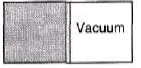
Ques 3: A well insulated box contains a partition dividing the box into two equal volumes as shown in figure. Initially the left hand side contains an ideal monoatomic gas and the other half is a vacuum. The partition is suddenly removed so that the gas now is contained throughout the entire box.

Introductory Exercise 18.1

(a) Does the temperature of the gas change? 
(b) Does the internal energy of the system change? 
(c) Does the gas work?
Sol:  The process described is a free expansion into vacuum. The box is insulated, so Q = 0. There is no external pressure to be overcome during the sudden removal of the partition, so W = 0. By the first law, ΔU = Q - W = 0. For an ideal monoatomic gas U depends only on temperature, so ΔU = 0 implies ΔT = 0. Thus:
• Temperature does not change.
• Internal energy does not change.
• The gas does no work during the free expansion into vacuum.
(Note: For a real (non-ideal) gas small temperature changes can occur during free expansion, but for an ideal gas temperature remains unchanged.)


Ques 4: How many moles of helium at temperature 300 K and 1.00 atm pressure are needed to make the internal energy of the gas 100 J?
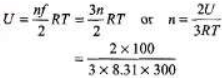
Sol: Helium is monoatomic, so degrees of freedom f = 3. For an ideal monoatomic gas, internal energy U = (f/2) n R T = (3/2) n R T.
Therefore n = (2U) / (3 R T).
Using R = 8.314 J mol-1 K-1, U = 100 J, T = 300 K:
n = (2 × 100 J) / (3 × 8.314 J mol-1 K-1 × 300 K)
= 200 / (3 × 2494.2) ≈ 200 / 7482.6 ≈ 2.67 × 10⁻² mol.


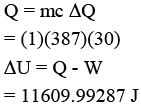
Ques 5: A 1.0 kg bar of copper is heated at atmospheric pressure (1.01 × 10⁵ N/m2). If its temperature increases from 20°C to 50°C, calculate the change in its internal energy. α = 7.0 × 10⁻⁶ per°C, ρ = 8.92 × 10³ kg/m3 and c =387 J/kg-°C
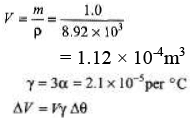
Sol:  Initial volume Vi = m / ρ = 1.0 kg / (8.92 × 10³ kg m-3) = 1.12 × 10⁻⁴ m3.
Change in temperature ΔT = 50 - 20 = 30 °C.
Change in internal energy (neglecting work of expansion in the definition of internal energy change) is given by ΔU = m c ΔT:
ΔU = (1.0 kg)(387 J kg-1 °C-1)(30 °C) = 11 610 J ≈ 1.16 × 10⁴ J.
Work done against atmospheric pressure due to volume expansion:
Linear expansion coefficient α given → approximate volume expansion coefficient β ≈ 3α = 3 × 7.0 × 10-6 = 2.1 × 10⁻⁵ °C-1.
ΔV = β Vi ΔT = (2.1 × 10⁻⁵)(1.12 × 10⁻⁴ m3)(30) = 7.056 × 10⁻⁸ m3.
W = P ΔV = (1.01 × 10⁵ N m-2)(7.056 × 10⁻⁸ m3) ≈ 7.13 × 10⁻³ J.
The work is negligible compared with the internal energy change. If needed, the heat supplied would be Q = ΔU + W ≈ 11 610 J + 7.13 × 10⁻³ J ≈ 11 610 J. The requested change in internal energy is 1.161 × 10⁴ J.


The document DC Pandey Solutions: First Law of Thermodynamics - 1 is a part of the NEET Course Physics Class 11.
All you need of NEET at this link: NEET

FAQs on DC Pandey Solutions: First Law of Thermodynamics - 1

1. What is the first law of thermodynamics?
Ans. The first law of thermodynamics, also known as the law of energy conservation, states that energy cannot be created or destroyed in a closed system. It can only be transferred or converted from one form to another.
2. How does the first law of thermodynamics relate to the given article on DC Pandey solutions?
Ans. The first law of thermodynamics is fundamental to understanding and solving problems related to thermodynamics. In the context of the given article on DC Pandey solutions, the first law helps in analyzing and explaining the concepts and problems related to the first law of thermodynamics as discussed in the textbook.
3. Can you provide an example that demonstrates the application of the first law of thermodynamics?
Ans. Sure! Let's consider a simple example of a gas-filled balloon. When the balloon is heated, the gas molecules inside gain energy, causing an increase in temperature and pressure. According to the first law of thermodynamics, the energy supplied to the system (balloon) in the form of heat is used to increase the internal energy of the gas molecules, resulting in an increase in temperature and pressure.
4. What are some common misconceptions about the first law of thermodynamics?
Ans. One common misconception is that the first law allows for the creation of energy. However, the first law states that energy cannot be created or destroyed, only transferred or converted. Another misconception is that the first law applies only to mechanical systems, whereas it is applicable to all forms of energy, including heat, work, and internal energy.
5. How is the first law of thermodynamics related to the concept of energy conservation?
Ans. The first law of thermodynamics is closely related to the concept of energy conservation. It states that the total energy of a closed system remains constant, meaning that energy cannot be created or destroyed. This principle aligns with the broader concept of energy conservation, which states that the total energy in the universe is constant.
Explore Courses for NEET exam
Get EduRev Notes directly in your Google search
Related Searches
Summary, DC Pandey Solutions: First Law of Thermodynamics - 1, video lectures, Objective type Questions, Free, DC Pandey Solutions: First Law of Thermodynamics - 1, DC Pandey Solutions: First Law of Thermodynamics - 1, mock tests for examination, Previous Year Questions with Solutions, practice quizzes, ppt, Exam, Viva Questions, pdf , Sample Paper, MCQs, Semester Notes, Extra Questions, Important questions, study material, shortcuts and tricks, past year papers;