Previous Year: Short Questions with Answers - India's External Relations

Previous Year Questions 2025
Q.1. Arrange the following in chronological order of their happening: (1 Mark)
(i) India-China War
(ii) India's first test of a nuclear device
(iii) Terrorists attack on World Trade Centre in America
(iv) The Anti-Ballistic Missile Treaty
(A) (i), (ii), (iii), (iv)
(B) (ii), (iv), (iii), (i)
(C) (iv), (i), (iii), (ii)
(D) (i), (iv), (ii), (iii)
Ans: (D)
Explanation: The correct chronological order is: India-China War (1962), the Anti-Ballistic Missile Treaty between the US and USSR (1972), India's first nuclear test (1974), and the World Trade Centre attacks in the USA (2001). Therefore option (D) - (i), (iv), (ii), (iii) - is correct because it places the events in their historical sequence by year.
Q.2. Choose the correct statement about India's nuclear policy from the statements given below: (1 Mark)
(A) India's nuclear programme was started in 1952 under the guidance of Homi J. Bhabha.
(B) India was in support of the NPT.
(C) Now India has made it clear that the policy of 'no first use' can be reviewed.
(D) Nehru was not against nuclear weapons.
Ans: (C)
Explanation: India's declared nuclear doctrine has maintained a no first use posture, but recent official statements indicate that this policy can be reviewed depending on strategic circumstances. Statement (A) is incorrect because India's nuclear programme began in the late 1940s under the scientific guidance of Homi J. Bhabha; (B) is incorrect because India rejected the Nuclear Non-Proliferation Treaty as discriminatory; (D) is misleading since Nehru promoted peaceful uses of nuclear energy while being cautious about weapons.
Q.3. Which political party of India wanted India to follow a pro-US foreign policy? (1 Mark)
(A) Bharatiya Jan Sangh
(B) Communist Party
(C) Socialist Party
(D) Congress Party
Ans: (A)
Explanation: The Bharatiya Jan Sangh (and parties like the Swatantra Party) opposed communist influence and favoured closer ties with the United States and its allies. The Communist Party supported closer relations with the USSR, while the Congress pursued a policy of non-alignment.
Q.4. Who among the following believed that India should be more friendly with the bloc led by the US at the time of formulation of India's foreign policy? (1 Mark)
(A) Sardar Patel
(B) B.R. Ambedkar
(C) J.P. Narayan
(D) Lal Bahadur Shastri
Ans: (B)
Explanation: Dr B.R. Ambedkar expressed views favouring closer ties with the pro-democracy bloc led by the United States during the early Cold War period. Other leaders, such as Nehru, favoured non-alignment.
Q.5. Analyse the impact of Chinese invasion on India in 1962. (2 Marks)
Ans: The 1962 Chinese invasion had political, military and diplomatic consequences for India. Politically, it caused national humiliation, led to the resignation of Defence Minister V. Krishna Menon and prompted criticism of government preparedness. Militarily, it exposed weaknesses in India's defence and triggered a large-scale programme of modernising the armed forces. Diplomatically, India sought defence assistance from the US and UK and revised aspects of its strategic outlook to prevent future vulnerabilities.
Q.6. Explain the role of Panchsheel Agreement in building the relationship between India and China. (2 Marks)
Ans: The Panchsheel Agreement, signed on 29 April 1954 by Prime Minister Nehru and Premier Zhou Enlai, set out the Five Principles of Peaceful Coexistence. These principles - mutual respect for sovereignty and territorial integrity, non-aggression, non-interference, equality and peaceful coexistence - were intended to build trust and a cooperative framework between India and China. In practice, however, differences over Tibet and border issues later strained the relationship.
Q.7. Highlight any four important features of the Nuclear Policy of India. (4 Marks)
Ans: India's nuclear policy includes the following key features.
1. India emphasises the use of nuclear energy for peaceful purposes while developing technical self-reliance in nuclear science.
2. It adheres to a no first use doctrine, maintaining that nuclear weapons would be used only in retaliation.
3. India advocates a policy of credible minimum deterrence, keeping forces sufficient to deter aggression without engaging in an arms race.
4. India regards treaties such as the NPT and CTBT as discriminatory and has called for non-discriminatory, verifiable nuclear disarmament, while resisting agreements that perpetuate unequal privileges for a few states.
Q.8. Highlight any four features of India's foreign policy. (4 Marks)
Ans: Four prominent features of India's post-independence foreign policy are:
1. Non-alignment: Avoiding formal military alliance with either Cold War bloc while maintaining independent judgement.
2. Preservation of sovereignty and territorial integrity: A priority shaped by the anti-colonial struggle.
3. Support for Afro-Asian unity and decolonisation: India promoted solidarity among newly independent states, as seen in the 1955 Bandung Conference.
4. Commitment to international peace: Emphasising peaceful settlement of disputes and support for collective security mechanisms consistent with Article 51 of the Directive Principles.
Q.9. Analyse the relations between India and Bangladesh. (4 Marks)
Ans: India-Bangladesh relations began with strong Indian support for Bangladesh's liberation in 1971. India provided political backing, material assistance and shelter to millions of refugees, and intervened militarily when the humanitarian crisis intensified.The surrender of Pakistani forces led to Bangladesh's independence, after which India and Bangladesh developed friendly relations based on cooperation and shared interests. The 1971 episode strengthened India's regional position and created a long-term partnership based on geography, culture and shared security concerns.
Q.10. Read the following passage carefully and answer the questions based on it: (4 Marks)
"Tibet is one of the major issues that historically caused tension between India and China. From time to time in history, China had claimed administrative control over Tibet and from time to time, Tibet was independent too. In 1950, China took over the control of Tibet. Large sections of the Tibetan population opposed this takeover. The Tibetan leader accompanied the Chinese Premier during his official visit to India in 1956."
(i) Where is the plateau of Tibet situated?
(A) Central Asia
(B) East Asia
(C) In the East of China
(D) In the West of India
Ans: (A)
Explanation: Tibet is geographically located on the high plateau region of Central Asia. The passage refers to Tibet as a plateau in that broader Central Asian area.
(ii) Choose the name of the Chinese leader that came to India in 1956 as the Chinese Premier.
(A) Mao
(B) Dalai Lama
(C) Zhou Enlai
(D) Hu-Zintao
Ans: (C)
Explanation: The Chinese Premier who visited India in 1956 was Zhou Enlai. The Dalai Lama accompanied him during that visit.
(iii) In which year was the 'Panchsheel agreement' signed between India and China?
(A) 1952
(B) 1953
(C) 1954
(D) 1955
Ans: (C)
Explanation: The Panchsheel joint declaration was signed by Prime Minister Nehru and Premier Zhou Enlai on 29 April 1954, giving rise to the Five Principles of Peaceful Coexistence.
(iv) From which country did Dalai Lama ask for asylum?
(A) Nepal
(B) Bhutan
(C) India
(D) China
Ans: (C)
Explanation: After the 1959 uprising in Tibet, the Dalai Lama fled across the Himalayan border and sought political asylum in India, which granted him refuge.
Q.11. Read the following passage carefully and answer the questions based on it: (4 Marks)
India advocated non-alignment as the ideal foreign policy approach. This was a difficult balancing act and sometimes the balance did not appear perfect. In 1956 when Britain attacked Egypt over the Suez Canal issue, India led the world protest against this neo-colonial invasion. But in the same year when the USSR invaded Hungary, India did not join its public condemnation. Despite such a situation, by and large India did take an independent stand on various international issues and could get aid and assistance from members of both the blocs.
(i) Who among the following leaders had played a crucial role in the formulation and implementation of India's foreign policy?
(A) Jawaharlal Nehru
(B) Sardar Patel
(C) Mahatma Gandhi
(D) Subhas Chandra Bose
Ans: (A)
Explanation: Jawaharlal Nehru, as the first Prime Minister and also the country's Foreign Minister for many years, played a central role in shaping India's foreign policy and in promoting the policy of non-alignment.
(ii) In which city was the first summit of NAM held in September 1961?
(A) New Delhi
(B) Belgrade
(C) Cairo
(D) Bombay
Ans: (B)
Explanation: The First Summit of the Non-Aligned Movement was held in Belgrade in September 1961, following momentum from the 1955 Bandung Conference.
(iii) Identify the two blocs from whom India wanted to keep a distance.
(A) USA and France
(B) USSR and France
(C) USA and USSR
(D) USA and China
Ans: (C)
Explanation: During the Cold War, the two major rival blocs were led by the United States and the Soviet Union (USSR). India's non-alignment aimed to remain independent of both these blocs.
(iv) Which one of the following countries was a supporter of the Non-Aligned Movement?
(A) Pakistan
(B) China
(C) Japan
(D) Egypt
Ans: (D)
Explanation: Egypt, under President Gamal Abdel Nasser, was one of the leading founding countries of the Non-Aligned Movement and a strong supporter of its goals.
Q.12. Study the cartoon given below and answer the questions based on it : (4 Marks)
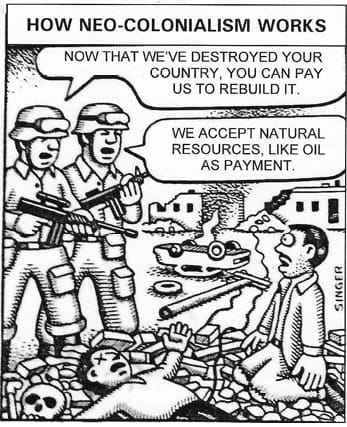
(i) Which country has attacked any other country to have control on the Oil resources?
(A) India
(B) Pakistan
(C) United States of America
(D) United Kingdom
Ans: (C)
Explanation: The cartoon points to the United States of America, which has been frequently associated with military intervention in oil-rich regions to secure strategic access to energy resources.
(ii) Which one of the following countries is rich in the Oil resource?
(A) Saudi Arabia
(B) Japan
(C) Italy
(D) Vietnam
Ans: (A)
Explanation: Saudi Arabia is one of the world's leading oil producers and holds very large proven oil reserves, making it the correct choice.
(iii) Which one of the following is an example of a war for getting control of the natural resources like oil?
(A) Indo-China War 1962
(B) Indo-Pak War 1971
(C) Gulf War
(D) Second World War
Ans: (C)
Explanation: The Gulf War (and related interventions in Iraq) is widely discussed as a conflict in which control of oil resources and strategic energy routes was a major factor.
(iv) Which one of the following is the most appropriate message given by the cartoon?
(A) Oil is an important resource for developed countries.
(B) Oil is cheap for making payment.
(C) Big powers can attack the small countries to grab oil resources.
(D) Oil producing countries need the help of big powers.
Ans: (C)
Explanation: The cartoon criticises how powerful nations may use military force or coercion to control strategic resources such as oil, making option (C) the most appropriate message.
Q.13. Highlight any four Directive Principles of State Policy that have been included in the Constitution of India for International peace and security. (4 Marks)
Ans: Article 51 of the Indian Constitution directs the State to:
1. Promote international peace and security.
2. Maintain just and honourable relations between nations.
3. Foster respect for international law and treaty obligations in dealings between organised peoples.
4. Encourage the settlement of international disputes by arbitration rather than use of force. These directives reflect India's constitutional commitment to peaceful conduct in international affairs.
Q.14. Describe any four contributions made by India to promote international peace and security. (4 Marks)
Ans: India has promoted international peace and security through:
1. Leadership in the Non-Aligned Movement, which offered newly independent states a third option apart from Cold War alignments.
2. Large contributions of personnel and logistical support to United Nations peacekeeping missions across different regions.
3. Vocal opposition to neo-colonial interventions, for example leading protests against the 1956 invasion of Egypt.
4. Support for decolonisation and anti-racism movements, including opposition to apartheid in South Africa and backing national liberation struggles.
Previous Year Questions 2024
Q.1. Highlight the role of Jawaharlal Nehru in the foreign policy of India.
Ans: Role of Jawaharlal Nehru in the foreign policy of India.
Jawaharlal Nehru played a very important role in making the foreign policy of India.
All his efforts were aimed at:
(i) protecting territory integrity
(ii) promoting rapid economic development
(iii) preserving the hard earned sovereignty
(iv) achieving the objectives through the strategy of non-alignment.
Q.2. (a) Suggest any two measures to improve India's relations with Pakistan.
OR
(b) Suggest any two measures to improve Indo-China relations.
Ans: (a) Measures to improve India's relations with Pakistan:
(i) People-to-people contacts and cultural exchange programmes should be promoted to build mutual understanding.
(ii) Trade and economic links should be restored and expanded to create interdependence and shared interests.
(iii) Diplomatic channels should be kept open with regular dialogue at multiple levels.
OR
(b) Measures to improve Indo-China relations:
(i) Continued negotiations and confidence-building measures to resolve and manage border disputes peacefully.
(ii) Regular meetings of military and diplomatic personnel to maintain peace along the Line of Actual Control (LAC).
(iii) Expand mutual trade and people-to-people exchanges.
(iv) Adopt practical confidence-building steps such as communication hotlines and joint mechanisms for dispute management.
Q.3. "India has maintained good relations with Russia after the end of Cold War." Justify the statement with four examples.
Ans: Examples that justify continued India-Russia ties after the Cold War include:
(i) A sustained political and strategic partnership based on mutual trust and shared views on a multipolar world order.
(ii) The 2001 Indo-Russian Strategic Partnership formalised long-term cooperation.
(iii) Continued defence cooperation, including joint exercises and major procurement of military hardware from Russia.
(iv) Collaboration in civil nuclear energy, space research and energy supplies, with agreements to expand trade and investment targets in the coming years.
Previous Year Questions 2023
Q.1. Read the following passage carefully and answer the questions that follow:
India conducted a series of nuclear tests demonstrating its capacity to use nuclear energy for military purposes. After this ,Pakistan also conducted tests. International Community imposed sanctions on both India and Pakistan which were subsequently waived. India opposed the international treaties aimed at non-proliferation.
(i) In which year did India conduct series of nuclear tests?
(a) 1971
(b) 1985
(c) 1992
(d) 1998
(ii) Identify the treaty that India refused to sign.
(a) Comprehensive Test Ban Treaty
(b) Shimla Agreement
(c) Panchsheel Agreement
(d) Indus waters Treaty
(iii) In the beginning. India wanted to generate nuclear energy for_______________.
(a) peaceful purpose
(b) making atomic bombs.
(c) competing with the super powers.
(d) ensuring its security.
(iv) Under whose guidance did India initiate its nuclear programme?
(a) C.V. Raman
(b) Homi J. Bhabha
(c) A.P.J. Abdul Kalam
(d) K. Kasturirangan
Ans: (i) (d) 1998 - India carried out a series of nuclear tests in May 1998.
(ii) (a) Comprehensive Test Ban Treaty - India did not sign the CTBT at the time, viewing some non-proliferation measures as discriminatory.
(iii) (a) peaceful purpose - Initially, India stressed the development of nuclear energy for peaceful and developmental uses.
(iv) (b) Homi J. Bhabha - The nuclear programme in India was initiated under the scientific leadership of Homi J. Bhabha.
Q.2. Explain any four features of India-Israel relations.
Ans: India -Israel relations:
(i) Historical and culture ties between India and Israel go back from time immemorial.
(ii) Diplomatic Relations officially started from 1992 when Israeli embassy established in India.
(iii) Heads of both the state have paid visits to each other's country.
(iv) The two nations have started cooperated in various fields like cultural exchange, security & Defence, counter terrorism, space research , water and energy and agriculture developments.
Q.3. "India's impressive technological growth in recent years has made the country an attractive partner of US." Support the statement giving any four examples.
Ans: Examples that show why the US finds India an attractive technological partner include:
1. A large share of India's software and IT exports goes to the US market, making India a key supplier of IT services.
2. Indians form a significant portion of technical staff in major US firms, signalling deep human-resource links.
3. Tens of thousands of Indian professionals work in US technology hubs such as Silicon Valley, fostering innovation networks.
4. Indian entrepreneurs and the diaspora have founded a notable share of high-tech startups, strengthening collaborative ventures between the two countries.
Q.4. Why was the period of India's first nuclear test a difficult period in its domestic politics? Explain.
Ans: It was a difficult period in India's democratic politics because:
(i) Prices were rising due to the Arab-Israel war of 1973.
(ii) There was a hike in oil prices.
(iii) India was facing difficulties on the economic front.
(iv) Many agitations were going on in the country.
(v) India faced a railway strike in May 1974.
Previous Year Questions 2022
Q.1. Highlight any four areas of cooperation between India and Russia.
Ans: Four important areas of India-Russia cooperation are:
(i) Politics and strategic partnership, rooted in historical ties dating to the Soviet period and continuing as a Special Strategic Relationship.
(ii) Defence and security cooperation, including major military supplies and regular high-level consultations.
(iii) Joint military exercises such as the tri-services exercise INDRA, which deepen interoperability.
(iv) Economic collaboration, civil nuclear energy, space cooperation and plans to expand bilateral investment and trade targets in the coming years.
Q.2. In which way did the policy of Non-Alignment serve India's interests?
Ans: Non-Alignment served India by allowing independent decision-making free of formal alliance obligations. It enabled India to receive aid and cooperation from both blocs, balance pressures from competing powers, and pursue policies that best served national interests rather than those of any single superpower.
Q.3. Highlight the contribution made by Pt. Jawaharlal Nehru to the foreign policy of India.
Or
Highlight any two aspects of the Indian foreign policy which were greatly influenced by Pt. Jawaharlal Nehru.
Ans: Contributions of Nehru include:
(i) Leadership in establishing and promoting the Non-Aligned Movement.
(ii) Emphasis on developing nuclear energy for peaceful purposes while advocating disarmament.
(iii) Strong opposition to racism and colonialism and active support for decolonisation.
(iv) Promotion of the Panchsheel principles of peaceful coexistence in international relations.
Q.4. Mention any four Directive Principles of State Policy for the promotion of international peace and security.
Ans: Directive principles of State policy for the promotion of international peace and security: The state shall endeavour to :
(i) promote international peace and security.
(ii) Maintain just and honourable relations between nations.
(iii) foster respect for international law and treaty obligations in the dealings of organised people with one another.
(iv) Encourage settlement of international disputes by arbitrations.
Q.5. Write 'True' or 'False' against each of these statements :
(i) Non-alignment allowed India to gain assistance both from USA and USSR.
(ii) India's relationship with her neighbours has been strained from the beginning.
(iii) The Cold War has affected the relationship between India and Pakistan.
(iv) The Treaty of Peace and Friendship in 1971 was the result of India's closeness to USA.
Ans:
(i) True - Non-alignment enabled India to receive assistance from both blocs at different times.
(ii) True - India's neighbourhood relations have often been complex and occasionally strained.
(iii) True - Cold War dynamics influenced India-Pakistan relations and regional alignments.
(iv) False - The 1971 Treaty of Peace and Friendship (between India and the Soviet Union) reflected closer India-USSR ties, not closeness to the USA.
Q.6. Explain the relevance of NAM in the contemporary scenario.
Ans: The relevance of NAM :
(i) Against racial discrimination
(ii) disarmament
(iii) Respect for human rights and dignity
(iv) Opposition to counter neo-colonialism
(v) Maintain environmental balance
(vi) New Economic Order
(vii) To curb terrorism
Q.7. Assess the main contribution of the NonAligned Movement to the newly independent countries.
Ans: Contribution of the Non-Aligned Movement :
(i) provided a third option of not joining the Cold war politics.
(ii) Newly independent countries were able to take international decisions and stances that served their interests.
(iii) They were able to balance both the Superpowers.
(iv) They were able to preserve their sovereignty and independence.
Q.8. How did the Sino-Indian conflict affect the opposition also?
Ans: The Sino-Indian conflict contributed to a split in the Communist movement in India. Differences over whether to support the Soviet line or the Chinese position led to a split that produced the Communist Party of India (Marxist). Political alignments and arrests of leaders followed, reflecting the conflict's domestic political effects.
Q.9. Which two differences between India and China led to an army conflict in 1962?
Ans: The two differences were:
(i) India supporting liberation of Tibet and giving political asylum to Tibetan spiritual leader, Dalai Lama.
(ii) Border area dispute in the regions of Aksai Chin and NEFA.
Q.10. Identify any two aspects of India's foreign policy that you would like to retain and two that you would like to change, if you were to become a decision maker. Give reasons to support your position.
Ans: Two aspects of Indian policy worth supporting are :
(i) India has always been a peace loving country and helped in restoration of peace in countries like Korea, China, etc.
(ii) India has never aligned to any of the military blocs of the world and has played a vital role in establishment of NAM.
Two aspects of Indian policy worth changing are:
(i) The wars waged by India against neighbours in spite of having a peaceful image put a question mark on India's ability to keep neighbours in control.
(ii) The purpose of establishment of SAARC got under water with the regular conflicts with China and a SAARC country like Pakistan.
Q.11. How the aim of India to respect the sovereignty of other countries did find an echo in the Directive Principles of the State Policy?
Ans: Aim of India to respect the sovereignty of other countries did find an echo in the directive principles of the State policy : Article 51 of the Indian Constitution lays down some directive principles of State policy on 'promotion of international peace and security.' "The state shall endeavour to -
(a) promote international peace and security
(b) Maintain just and honourable relations between nations
(c) foster respect for international law and treaty obligations in the dealings of organised people with one another; and
(d) Encourage settlement of international disputes by arbitration."
Q.12. Describe any four issues of conflict between India and China.
Ans: The main areas of conflict are:
(i) Removing of historical buffer between India and China by invasion of Tibet by China.
(ii) Suppressing of Tibetan culture by the Chinese.
(iii) Claiming Aksai Chin and NEFA as a part of China.
(iv) Non-acceptance of any discussions and deliberations on the matter by the Chinese leaders.
Q.13. Describe any two major issues of conflict between India and Pakistan leading to war of 1971.
Ans:
(i) The support extended to freedom struggle of East pakistan.
(ii) India had to bear the burden of lakhs of refugees.
Q.14. "The conduct of foreign affairs is an outcome of a two-way interaction between domestic compulsions and prevailing international climate. Take one example from India's external relations in the 1960s to substantiate your answer.
Ans: The Sino-Indian War of 1962 illustrates how domestic and international factors interact. Border claims over Aksai Chin and NEFA, China's consolidation of control and road building in disputed areas, and domestic concerns about security pushed India to seek military assistance from the US and UK. International alignments and the regional power balance thus influenced India's foreign policy responses, showing the two-way interaction between internal pressures and global circumstances.
Q.15. Does India's foreign policy reflect her desire to be an important regional power? Argue your case with the Bangladesh War of 1971 as an example.
Ans: Yes. India's active support for the Bangladesh liberation movement in 1971 demonstrates its capacity and willingness to act as a regional power. By providing political backing, humanitarian aid and military intervention when the refugee crisis and repression intensified, India shaped the outcome in South Asia. The victory and the subsequent Shimla Agreement (1972) consolidated India's regional influence and showed how foreign policy can be used to protect national security and regional stability.
Q.16. Explain India's Nuclear Policy.
Or
Explain any four important features of India's Nuclear Policy.
Ans: Key features of India's nuclear policy are:
(i) A declared no first use posture (nuclear weapons not to be used as the first step in conflict).
(ii) Advocacy for global, verifiable and non-discriminatory nuclear disarmament.
(iii) Opposition to treaties perceived as discriminatory, such as the NPT, unless they are fair to all states.
(iv) Demonstration of technical capability, for example through India's 1974 nuclear test described as a peaceful explosion.
Q.17. Why was the nuclear test conducted by India criticised?
Ans: India's nuclear test attracted criticism domestically and internationally because it came at a time of economic difficulty, including global inflation and rising oil prices after the 1973 Arab-Israeli war. Critics argued that such tests could worsen economic pressures and invite diplomatic and trade sanctions from other countries.
FAQs on Previous Year: Short Questions with Answers - India's External Relations
| 1. What are the key objectives of India's foreign policy? |  |
| 2. How does India engage with its neighboring countries? | |
| 3. What is the significance of India's 'Act East' policy? | |
| 4. How does India address global issues through its foreign relations? | |
| 5. What role does economic diplomacy play in India's external relations? | |