Previous Year: Short Questions with Answers - Challenges to and Restoration of Congress System

Previous Year Questions 2025
Q1: Identify the main reason for the split in Congress Party in 1969. (1 Mark)
(A) Change in the ideology of Congress Party
(B) Dominance of the Congress Syndicate
(C) Difference of opinion among the opposition parties
(D) Opposition parties came together.
Answer: (B) Dominance of the Congress Syndicate
Solution: The primary cause of the split was the factional rivalry between Indira Gandhi and the 'Syndicate', a group of powerful organizational leaders who sought to control the party and its policy direction.
Q.2. Identify and choose the incorrect pair: (1 Mark)
(A) Lal Bahadur Shastri - Jai Jawan Jai Kisan
(B) Indira Gandhi - Garibi Hatao
(C) Syndicate - A group of powerful opposition leaders against Indira Gandhi.
(D) Grand Alliance - Formed by all Non-Congress Parties
Answer: (C) Syndicate - A group of powerful opposition leaders against Indira Gandhi.
Solution: The Syndicate was an informal group of powerful and influential leaders within the Congress party, not an opposition group, although they later opposed Indira Gandhi from within.
Q.3. In which year did the Congress Party split? (1 Mark)
(A) 1966
(B) 1967
(C) 1968
(D) 1969.
Answer: (D) 1969
Solution: The Congress party formally split in November 1969 into the Congress (O) led by the Syndicate and the Congress (R) led by Indira Gandhi following the Presidential election crisis.
Q.4. "The 1960s were labelled as the 'dangerous decade' in India." Explain any two reasons for this. (2 Marks)
Answer: The 1960s were termed 'dangerous' because unresolved problems like acute poverty, inequality, and communal divisions threatened the survival of India's democratic project. Additionally, the country faced a double crisis of political succession after the deaths of Nehru and Shastri, alongside severe economic distress and a food crisis.
These challenges created serious doubts about political stability and economic survival. The decade tested the resilience of India's democratic institutions.
Q.5. Describe any two circumstances that favoured Indira Gandhi to become Prime Minister after the death of Lal Bahadur Shastri. (2 Marks)
Answer: Indira Gandhi secured the Prime Ministership by defeating Morarji Desai in a secret ballot with more than two-thirds support from Congress MPs. Senior leaders backed her because they believed her political inexperience would make her dependent on them for guidance, allowing the Syndicate to maintain its influence.
Her selection was initially seen as a compromise choice by party elders. However, she soon emerged as a strong and independent political leader.
Q.6. Justify the abolition of Privy Purses by Indira Gandhi. (2 Marks)
Answer: Indira Gandhi justified the move by arguing that hereditary privileges were incompatible with the constitutional principles of equality and social justice. Abolishing the privy purse was a key part of her socialist agenda to reduce economic disparities and gain support among the disadvantaged sections of society.
Q.7. Analyse any two outcomes of the defeat of the official Congress candidate for the Presidential elections in 1969. (2 Marks)
Answer: First, the defeat of N. Sanjeeva Reddy led to the formal split of the Congress party into Congress (O) and Congress (R). Second, it established Indira Gandhi's supreme authority, as she successfully challenged the Syndicate by supporting the victorious independent candidate V.V. Giri through a "conscience vote".
This episode marked a decisive shift in power within the Congress. It permanently weakened the authority of the party organisation over the Prime Minister.
Q.8. Analyse any four factors that enhanced the popularity of Indira Gandhi in the early 1970s.
Answer: Four major factors contributed to her rise:
1. Positive Slogan: Her slogan "Garibi Hatao" (Remove Poverty) created a massive nationwide support base among Dalits, Adivasis, women, and the poor.
2. Socialist Policies: Bold initiatives like the nationalisation of fourteen private banks and the abolition of privy purses projected her as a pro-poor leader.
3. 1971 War Victory: Her statesmanship during the Indo-Pak war and the creation of Bangladesh boosted her image as a strong nationalist leader.
4. Restoration of Dominance: Sweeping victories in the 1971 Lok Sabha and 1972 State Assembly elections restored Congress dominance under her singular leadership.
Together, these factors transformed Indira Gandhi into a mass leader. They consolidated her dominance over Indian politics during the early 1970s.
Q.9. Analyse any four reasons for the split in the Congress Party in 1969. (4 Marks)
Answer: The 1969 split was driven by several critical factors:
1. Syndicate Rivalry: A power struggle erupted between Indira Gandhi and the Syndicate, who expected her to remain a figurehead.
2. Presidential Election: The Syndicate nominated Sanjeeva Reddy for President against Indira's wishes; she retaliated by supporting V.V. Giri as an independent.
3. Ideological Shift: Indira Gandhi framed the conflict as an ideological struggle between socialists (pro-poor) and conservatives (pro-rich).
4. Assertion of Independence: By choosing advisors outside the party and launching the Ten-Point Programme, she sidelined the organizational bosses, leading to her formal expulsion.
The split reflected deep ideological and organizational contradictions within the Congress. It fundamentally altered the structure of Indian party politics.
Q.10. Analyse any two important political happenings in India before the fifth general elections. (4 Marks)
Answer: Two significant happenings were:
1. The 1969 Congress Split: The party divided into Congress (O) and Congress (R), leaving Indira Gandhi's government as a minority dependent on issue-based support from the CPI and DMK.
2. Dissolution of Lok Sabha: In a surprising and bold move, Indira Gandhi recommended the dissolution of the Lok Sabha in December 1970 to seek a fresh mandate for her socialist programmes, rather than continuing as a minority government. This led to the early 1971 elections where she sought a decisive majority.
These developments prepared the ground for a decisive electoral contest. They allowed Indira Gandhi to seek popular legitimacy for her policies.
Q.11. Analyse any two major reasons for the split of the Congress Party in 1969. (4 Marks)
Answer: The formal split of the Congress party in 1969 into the Congress (Organisation) and the Congress (Requisitionists) was driven by the following two major reasons:
1. Factional Rivalry with the 'Syndicate': The Syndicate was an informal group of powerful, influential organizational leaders within the Congress who had ensured Indira Gandhi's election as Prime Minister, expecting her to be dependent on their guidance. However, Gandhi asserted her independence by choosing advisors from outside the party and slowly sidelining these leaders, leading to an intense internal power struggle.
2. The 1969 Presidential Election and Ideological Divide: Rivalry turned into a showdown during the 1969 Presidential election when the Syndicate nominated N. Sanjeeva Reddy, while Gandhi encouraged V.V. Giri to contest as an independent. She framed the contest as an ideological struggle between "pro-poor" socialists and "pro-rich" conservatives. Her call for a "conscience vote" led to the defeat of the official candidate and her subsequent expulsion from the party by the Congress President.
Q.12. Analyse any two reasons for considering the fourth General Elections a landmark in electoral history. (4 Marks)
Answer: The 1967 elections are considered a landmark because:
1. Political Earthquake: For the first time, Congress faced the electorate without Nehru and suffered its lowest tally of seats and votes, proving it could be defeated.
2. Loss of States: Congress lost majority in nine states across the country, leading to the rise of coalition (SVD) governments and the first-ever majority for a regional party, the DMK, in Madras. This marked the end of the old 'Congress System' and the beginning of intense political competition.
The elections shattered the myth of Congress invincibility. They ushered in a new era of competitive and coalition politics.
Q.13. Describe any four steps taken by Indira Gandhi to eradicate poverty (Garibi Hatao) in India. (4 Marks)
Answer: To implement the "Garibi Hatao" agenda, her government took the following steps:
1. Land Reforms: She vigorously campaigned for implementing existing land reform laws and undertook further land ceiling legislation.
2. Public Sector Growth: She focused on expanding the public sector to generate employment and reduce the concentration of wealth.
3. Wealth Redistribution: Her government proposed ceilings on urban property and income to remove disparities.
4. Abolishing Privileges: She successfully abolished privy purses and princely privileges, redirecting resources toward social welfare for the disadvantaged.
These measures strengthened the pro-poor image of the government. They also redefined the role of the state in promoting social justice.
Q.14. In the given Political outline map of India, four states have been marked as (A), (B), (C) and (D). (4 Marks)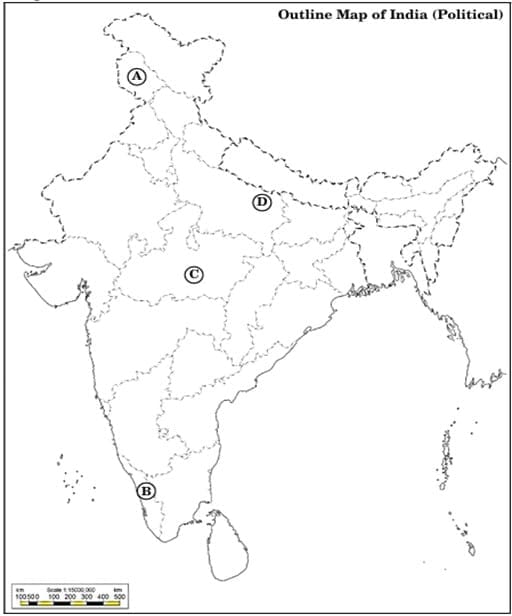 Identify these states on the basis of the information given below and write their correct names in your answer book along with the respective serial numbers of the information used and the concerned alphabets shown in the map as per the format that follows : (4 Marks)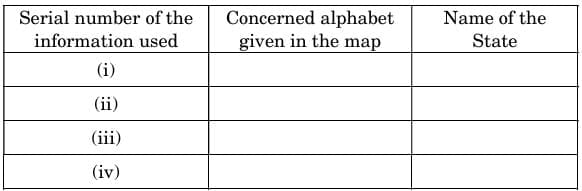
(i) The state associated with the communist leader A.K. Gopalan.
Answer: Kerala (D): The state associated with communist leader A.K. Gopalan.
(ii) The state to which Rafi Ahmed Kidwai, first Minister for Communications belonged.
Answer: Uttar Pradesh (C): The state to which Rafi Ahmed Kidwai, the first Minister for Communications, belonged.
(iii) The state where Congress Party was dominant from 1952 to 1967.
Answer: Maharashtra/Rajasthan (B): States where the Congress Party maintained dominance from 1952 to 1967.
(iv) The state where National Conference came into power in 1952.
Answer: Jammu & Kashmir (A): The state where the National Conference came into power in 1952
Previous Year Questions 2024
Q.1. After the death of Lal Bahadur Shastri, there was an intense competition for the post of Prime Minister between Indira Gandhi and which one of the following?
(A) Morarji Desai
(B) K. Kamraj
(C) S. Nijalingappa
(D) V.V. Giri
Answer: (A) Morarji Desai
Solution: After Shastri's sudden demise in 1966, the Congress faced a leadership contest where Indira Gandhi defeated Morarji Desai in a secret ballot.
Q.2. Identify the false statement from the following related to Lal Bahadur Shastri.
(A) He worked as the General Secretary of the Congress Party till 1966.
(B) He was in the Union Cabinet for a short period of three years.
(C) He resigned from the Union Cabinet taking responsibility for a Railway accident.
(D) He gave the famous slogan 'Jai Jawan Jai Kisan'.
Answer: (A) He worked as the General Secretary of the Congress Party till 1966.
Solution: This is false because Shastri served as the Prime Minister of India from 1964 until his death in January 1966; he was not the General Secretary during that time.
Q.3. Which of the following problems did India face before the 4th general elections?
(i) Failure of monsoon
(ii) Food crisis
(iii) Heavy rainfall
(iv) Depletion of foreign exchange reserves
Choose the correct option.
(A) (i), (ii)
(B) (iii), (iv)
(C) (i), (ii), (iv)
(D) (ii), (iii), (iv)
Answer: (C) (i), (ii), (iv)
Solution: The period before 1967 was fraught with grave economic crisis resulting from successive monsoon failures, widespread drought, serious food shortages, and depletion of foreign exchange reserves.
Q.4. In the following question, a statement of Assertion (A) is followed by a statement of Reason (R). Choose the correct option as answer. (1 Marks)
Assertion (A): People started protesting against the increase in prices of essential commodities, food scarcity and growing unemployment before the fourth General elections in India.
Reason (R): Failure of monsoons, widespread drought, decline in agricultural production and serious food shortage caused the problem.
(A) Both the Assertion (A) and the Reason (R) are correct and the Reason (R) is the correct explanation of the Assertion (A).
(B) Both the Assertion (A) and the Reason (R) are correct, but the Reason (R) is not the correct explanation of the Assertion (A).
(C) The Assertion (A) is correct, but the Reason (R) is incorrect.
(D) The Assertion (A) is incorrect, but the Reason (R) is correct.
Answer: (A) Both the Assertion (A) and the Reason (R) are correct and the Reason (R) is the correct explanation of the Assertion (A).
Solution: The economic situation triggered by monsoon failures led directly to price rises and food scarcity, which in turn caused the public to organize bandhs and protests across the country.
Q.5. Who led the march to the Parliament in 1975?
(A) Jagjivan Ram
(B) S.K. Patil
(C) Charu Majumdar
(D) Jayaprakash Narayan
Answer: (D) Jayaprakash Narayan
Solution: Jayaprakash Narayan (JP) was the prominent socialist leader who led the mass movement and agitations against the Congress government, culminating in the 1975 protests.
Q.6. Which incident paved the path to form the Janata Party?
(A) movement
(B) Presidential Election of 1969
(C) Declaration of Emergency in 1975
(D) Railway Strike, 1974
Answer: (C) Declaration of Emergency in 1975
Solution: The political crisis and the subsequent declaration of Emergency in 1975 threatened constitutional democracy and united opposition forces, eventually leading to the formation of the Janata Party.
Q.7. Indira Gandhi initiated many policies under her leadership. Which one among the following was not a part of her policies?
(A) Abolition of privy purses
(B) Nationalisation of banks
(C) No use of nuclear power
(D) Land reforms
Answer: (C) No use of nuclear power
Solution: This statement is incorrect as Indira Gandhi is credited with overseeing India's nuclear tests and environmental protection policies during her tenure.
Q.8. Explain the meaning of the term 'defection' in politics.
Answer: If an elected representative leaves the party on whose symbol he/she was elected and joins another party, it is called defection.
Q.9. Describe any four circumstances that led to protests against the Congress Government during 1974-1975.
Answer: Factors:
(i) Price rise.
(ii) High inflation rate and low industrial growth
(iii) Freezing of salaries which caused dissatisfaction among government employees
(iv) Gujarat and Bihar Movement
(v) Railway strike of 1974.
(vi) Conflict with judiciary.
Q.10. Explain any two reasons to consider the year 1967 as a landmark year in India's political and electoral history. (2 Marks)
Answer: The 1967 elections are considered a landmark because they significantly challenged Congress dominance for the first time. First, the Congress lost its majority in nine states, leading to the rise of coalition governments. Second, even at the center, Congress secured its lowest tally of seats since 1952, with many top cabinet ministers facing defeat.
Q.11. Explain the functioning of the Congress Party as a social coalition. (2 Marks)
Answer: Under the "Congress system," the party functioned as a broad social coalition by accommodating diverse classes, castes, and ideologies within its structure. It acted as a "rainbow-like" formation that could absorb various internal tensions and conflicts, allowing different social groups to find representation and negotiate their interests within the party framework.
Q.12. State any two effects of imposing national emergency. (2 Marks)
Answer: One major effect of the Emergency was that spaces for democratic expression and people's aspirations shrank significantly as the government assumed unprecedented authority. Additionally, the Emergency led to a political crisis that threatened the very existence of constitutional democracy in the country, resulting in the suspension of various civil liberties and rights.
Q.13. Highlight any four outcomes of the mid-term elections of 1980 in India. (4 Marks)
Answer: The mid-term elections of 1980 marked the return of Indira Gandhi and the restoration of the Congress. First, the Congress (R) establishment won a massive victory, proving its claim as the "real" Congress. Second, the opposition's "Grand Alliance" proved to be a failure, as their combined tally of seats remained very low. Third, Indira Gandhi was seen as a strong nationalist leader who provided stability compared to the fragmented Janata rule. Fourth, the dominance of the Congress was restored across most states, although the new party structure relied more heavily on the popularity of a supreme leader rather than institutionalized factions.
Q.14. How was the Congress party transformed into a social coalition of classes and castes in the 20th century? Explain. (4 Marks)
Answer: The transformation of the Congress party involved a shift in its social base and ideological orientation. Initially, the Congress was a federal and democratic organization that accommodated diverse viewpoints. However, in the early 1970s, Indira Gandhi reinvented the party by focusing on a socialist agenda to build an independent support base. She utilized the "Garibi Hatao" slogan to attract disadvantaged groups, specifically landless laborers, Dalits, Adivasis, minorities, and women. Consequently, the party transformed from a broad-based ideological formation into a populist organization that relied on the support of these specific social sections and the personal popularity of the supreme leader.
Q.15. Study the cartoon given below and answer the questions that follow: (4 Marks)
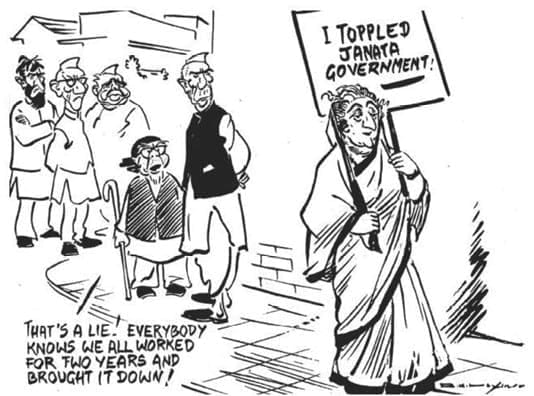 (i) Identify and name the leader who toppled the Janata Government.
Answer: According to general political history associated with this period, the leader who withdrew support to topple the government was Charan Singh.
(ii) Identify and name the Prime Minister of the Janata Party Government shown in the cartoon.
Answer: The Prime Minister of the Janata Party government shown in the cartoon is Morarji Desai.
(iii) Highlight any two reasons for the defeat of the Janata Party in 1980.
Answer: One reason for the defeat was the lack of a coherent political programme and direction within the coalition. Second, internal factionalism and leadership rivalries made the party appear unstable to the electorate, allowing Indira Gandhi to campaign effectively on the promise of a stable government.
Q.16. Describe any two lessons learnt from the emergency imposed in 1975. (4 Marks)
Answer: The Emergency period provided critical lessons regarding the resilience of Indian democracy. First, it demonstrated the strength of constitutional democracy, showing that while it could be threatened by autocratic tendencies, the system eventually corrected itself through the electoral process. Second, it highlighted the danger of highly centralized and populist politics that turn political ideology into mere electoral discourse without genuine policy implementation. The era showed that the shrinkage of spaces for democratic expression leads to volcanic eruptions of public protest, emphasizing that a healthy democracy requires the institutional capacity to absorb social tensions and accommodate diverse opinions rather than suppressing them.
Previous Year Questions 2023
Q.1. In which year was the first coalition government formed in India and why?
Answer: First Coalition government was formed in the year 1989. As the Congress party could not win a clear majority of seats in Lok Sabha. V.P. Singh formed the Coalition government with the help of specific National Front and Janata Dal alliance of BJP and the Left Front. Or Even if a candidate mentions about a State govt, the marks should be award For example At state level , first coalition governments were formed in 1967 in states viz. Because no single party could win the majority.
Previous Year Questions 2022
Q.1. State any two reasons for imposing an emergency by the Government in 1975.
Answer:
(i) The Constitution simply mentioned 'internal disturbances' as the reason for declaring emergency. The government argued that in a democracy, the opposition parties must allow the elected ruling party to govern according to its policies. It felt that frequent recourse to agitations, protests and collective action are not good for democracy.
(ii) Supporters of Indira Gandhi also held that in a democracy, you cannot continuously have extra-parliamentary politics targeting the government. This leads to instability and distracts the administration from its routine task of ensuring development.
Q.2. In 1966, who contested against Indira Gandhi for the post of the Prime Minister from among Congress MPs?
Answer: Morarji Desai
Q.3. After the death of Lal Bahadur Shastri, which two leaders of Congress Party contested against each other to become leader of Congress Parliamentary Party?
Answer: After the death of Lal Bahadur Shastri, there was an intense competition between two leaders. They were - Morarji Desai and Indira Gandhi
Q.4. Who represented Congress (O) and Congress (R) after the split of Congress Party?
Answer: Congress (O) was represented by the Syndicate and Congress (R) was represented by Indira Gandhi.
Q.5. What is meant by the term 'Congress Syndicate'?
Answer: Congress Syndicate refers to a group of popular and influential leaders within the Congress.
Q.6. Which theoretical argument did Ram Manohar Lohia give in defence on non Congressism?
Answer: Congress rule was undemocratic and opposed to the interest of ordinary and poor people; therefore, the coming together of the non- Congress parties was necessary for reclaiming democracy for the people.
Q.7. Which of these statements about the 1967 elections is/are correct?
(i) Congress won the Lok Sabha elections but lost the Assembly elections in many states.
(ii) Congress lost both Lok Sabha and Assembly elections.
(iii) Congress lost majority in the Lok Sabha but formed a coalition government with the support of some other parties.
(iv) Congress retained power at the Centre with an increased majority.
Answer:
(i) True
(ii) False
(iii) True
(iv) False
Q.7. What was the slogan of Indira Gandhi during the elections of 1971?
Answer: Garibi Hatao
Q.8. Name the leaders who gave the following slogAnswer:
(i) Jai Jawan, Jai Kisan
(ii) Garibi Hatao
Answer:
(i) Lal Bahadur Shastri
(ii) Indira Gandhi
Q.9. Which of the following statement about thevGrand Alliance 1971 is correct?
The Grand Alliance..........
(i) was formed by non-Communist, non-Congressvparties.
(ii) had a clear political and ideological programme.
(iii) was formed by all non-Congress parties.
Answer: (i) was formed by non-Communist, non-Congress parties.
Q.10. Which major factor was responsible for the dramatic victory of Indira Gandhi in 1971 elections?
Answer: Indira gave the slogan of "Garibi Hatao" to attract the voters belonging to the poor class, peasants, labourers, landless farmers and other weaker sections of the society.
Q.11. Whom would you identify with the following slogans / phrases?
(i) Jai Jawan, Jai Kisan
(ii) Indira Hatao!
(iii) Garibi Hatao!
Answer:
(i) Lal Bahadur Shastri
(ii) Grand Alliance
(iii) Indira Gandhi
Q.12. What was 'Samyukt Vidhayak Dal'? What was its role in the formation of coalitions?
Answer: The Samyukt Vidhayak Dal (SVD) was formed in Bihar by coalition of SSP, PSP, CPS and Jana Sangh to oppose Congress. The formation of SVD led the foundation for formation of coalition governments in the country both at the Central and the State level.
Q.13. What is the importance of the year 1967 in the history of Indian politics?
Answer: The year 1967, brought the 'Political Earthquake' where, for the first time after independence, the popularity of the Congress Party declined and bagged less number of seats as compared to those bagged in the previous elections.
Q.14. Examine the challenge of political succession after the death of Jawaharlal Nehru.
Answer: The decade of 1960s is referred to as the 'dangerous decade' in Indian politics. The reasons for this being no solutions found for poverty, inequality, regionalism, communalism, etc. The disintegration of country and disintegration of democracy were looking as the likely events. Political instability arose after demise of Jawaharlal Nehru with two questions in place:
a) 'Who after Nehru?'
b) 'What after Nehru?'
Q.15. Write a note on Prime Ministerial tenure of Lal Bahadur Shastri.
Answer: Lal Bahadur Shastri was unopposed and unanimously chosen as the leader of Congress Parliamentary Party and became the second Prime Minister of India (1964-1966). Prior to becoming Prime Minster, he was a cabinet member for three years and belonged to the state of Uttar Pradesh. India faced the after effects of the economic crisis that arose during the Sino-Indian War of 1962. India defeated Pakistan under his courageous leadership in 1964. His tenure also witnessed many droughts and famines making the lives of the farmers miserable. This led to the criticism of his slogan 'Jai Jawan Jai Kisan' as the problems of the farmers remained unsolved. He passed away while his visit to Tashkent (erstwhile USSR) to sign peace treaty with Pakistan.
Q.16. What does 'defection' stand for in Indian politics? Highlight any two demerits of this practice.
Answer: Defection is a situation where an elected representative leaves the party on whose ticket he/she had been elected.Demerits of defection are:
(i) It makes and breaks the government.
(ii) The scenario of "Aaya Ram, Gaya Ram" developed with many persons switching the parties very frequently.
Q.17. How should a political party resolve its internal differences? Here are some suggestions. Think of each and list out their advantages and shortcomings.
(i) Follow the footsteps of the party president.
(ii) Listen to the majority group.
(iii) Secret ballot voting on every issue.
(iv) Consult the senior and the experienced leaders of the party.
Answer:
(i) Following the footsteps of party inculcates discipline and unity in the party. However, it develops a sense of dictatorship or autocracy in the mind of the leader.
(ii) Listening to the majority group maintains democracy within the party. However, it creates factions within the party.
(iii) Secret ballot voting on every issue strengthens the democratic setup of the party. However, it delays the process of decision making process within the party.
(iv) Consulting the senior and the experienced leaders of the party provides experienced guidance for the steps to be taken by the party. However, the shortcoming of this is that there is a stoppage to new ideas and innovations.
Q.18. What does the term 'Syndicate' mean in the context of the Congress party of the sixties? What role did the Syndicate play in the Congress party?
Answer: The term 'Syndicate' referred to a group of popular and influential leaders within the Congress. The Syndicate consisted of experienced major leaders who played a major role in the installation of Indira Gandhi as the Prime Minister by ensuing her elections as the leader of the Parliamentary Party. They expected her to depend on them for guidance and advice. Soon Indira Gandhi started to assert her position in the party as well as in the government. She introduced a number of reforms. The Syndicate, though agreed to give consent to these reforms, had serious reservations about the same.
Q.19. How did the factional rivalry between the Syndicate and Indira Gandhi resulted in the split of Congress in 1969?
Answer: Split of Congress in 1969:
(i) Left wing orientation programme of Indira. he got the Congress Working Committee to adopt a Ten Point Programme in May 1967. This programme included social control of banks, nationalisation of General Insurance, and ceiling on urban property.
(ii) Selection of V.V. Giri as the President against Syndicate interest towards N. Sanjeeva Reddy.
(iii) Abolition of privy purse
(iv) Side-lined Syndicate - In November 1969, the Congress group led by the 'Syndicate' came to be referred to as the Congress (Organisation) and the group led by Indira Gandhi came to be called the Congress (Requisitionists).
Q.20. Explain any two reasons for the popularity of Indira Gandhi during 1971 elections.
Or
Analyse any three factors which enhanced the popularity of Indira Gandhi in the early 1970s.
Or
What were the factors that led to the popularity of Indira Gandhi's government in the early 1970's?
Answer: Factors that led to the popularity of Indira Gandhi's government in the early 1970's:-
(i) Indira Gandhi won 1971 elections decisively. Soon after 1971 elections, a major crisis broke out in East Pakistan resulting in the formation of Bangladesh. This crisis was followed by Indo-Pak War of 1971. India had a decisive victory in that War and Pakistani forces were forced to surrender in front of Indian forces. These events added to the popularity of Indira Gandhi. Even the opposition parties admired her statesmanship.
(ii) Her party swept through all State Assembly elections held in 1972.
(iii) Due to the socialist orientation, she was seen as a protectorate of the poor and the under privileged.
Q.21. With which objectives DMK made its entry into Indian politics?
Answer: DMK made its entry into Indian politics:
(i) First, it demanded the restoration of the original name of Kallakudi railway station which had been renamed Dalmiapuram, after an industrial house from the North. Indian economic and cultural symbols.
(ii) The third agitation was against the craft education scheme of the State government, which it alleged was linked to the Brahmanical social outlook. It also agitated against making Hindi the country's official language.
FAQs on Previous Year: Short Questions with Answers - Challenges to and Restoration of Congress System
| 1. What were the main challenges faced by the Congress party during the 1960s and 1970s? |  |
| 2. How did the Emergency (1975-1977) impact the Congress system in India? | |
| 3. What were the key factors that contributed to the restoration of the Congress system in the late 1970s? | |
| 4. What role did regional parties play in challenging the Congress system during this period? | |
| 5. What were the consequences of the Congress party's electoral defeat in 1977 for Indian politics? | |