Long Questions With Answers(Part - 1) - Legislature

Q. 1. Describe the composition of Indian Parliament.
Ans. All legislative powers of the Union government are vested in the Parliament. Laws made by Parliament apply to the whole of India. The Parliament meets at New Delhi, the national capital.
Composition: Article 79 of the Constitution provides for a bicameral Parliament for the Union. The Parliament consists of the President and two Houses: the Council of States (Rajya Sabha) and the House of the People (Lok Sabha).
(1) Rajya Sabha: The Rajya Sabha is the Upper House of Parliament. Key points about its composition and functioning are:
- The maximum strength of the Rajya Sabha is 250 members.
- The President nominates 12 members who have special knowledge or practical experience in literature, science, art and social service.
- The remaining members are elected by the elected members of State Legislative Assemblies by a system of proportional representation through the single transferable vote; this is an indirect election.
- Representation of States is based on population. In the present arrangement the Rajya Sabha has 245 members (233 elected + 12 nominated).
- The Rajya Sabha is a permanent House and is not subject to dissolution. One-third of its members retire every two years. Each member's term is six years.
(2) Lok Sabha: The Lok Sabha is the Lower House of Parliament. Important features are:
- The maximum size provided by the Constitution was up to 552 members (originally up to 530 representatives of States, up to 20 from Union Territories and up to 2 nominated Anglo-Indian members).
- The two nominated Anglo-Indian seats were removed by the 104th Constitutional Amendment Act, 2020. As a result, the present practical maximum is 550 (530 + 20), though the actual strength depends on elections and delimitations.
- Currently the Lok Sabha has 543 elected members.
- Members of the Lok Sabha are directly elected by the people for a term of five years. The President may dissolve the Lok Sabha earlier and call for fresh elections.
- The Lok Sabha elects a Speaker and a Deputy Speaker from among its members to preside over its proceedings.
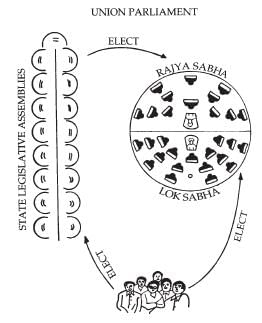
Session of the Parliament: The President summons sessions of Parliament and may call both Houses on the same or different dates. By convention, there are at least two sessions in a year and the interval between the last sitting of one session and the first sitting of the next session must not exceed six months. Thus, Parliament meets regularly to carry out its business.
Q. 2. Discuss the powers and functions of Indian Parliament.
Or
Discuss financial and judicial functions of Parliament.
Ans. Parliament has a wide range of powers. These include law-making, financial control, control over the executive, judicial functions, electoral functions and the power to amend the Constitution.
Below are the main powers explained in simple terms:
1. Legislative Powers.
- Parliament can make laws for the whole country on subjects listed in the Union List and the Concurrent List.
- In certain situations (for example, during a national emergency) Parliament can legislate on State subjects.
- Parliament also legislates for Union Territories and on residuary subjects (matters not mentioned in any list).
- A bill, after being passed by both Houses, is sent to the President for assent. Except in the case of money bills, the President may return a bill for reconsideration. If Parliament passes it again, the President must give assent.
2. Financial Powers.
- Parliament controls the nation's finances. The government must place the annual budget before Parliament for discussion and approval.
- No tax may be imposed and public money cannot be spent without parliamentary sanction.
- Money bills originate in the Lok Sabha. The President must give assent to money bills after they are passed by Parliament.
3. Control over the Executive: Parliament controls the executive in several ways:
- Ministers, including the Prime Minister, are drawn from Parliament and remain members while holding office.
- Ministers are collectively and individually responsible to Parliament for their policies and administration.
- Members may question ministers, demand information and seek explanations about government work.
- An adjournment motion can be used to draw urgent attention to important matters of public concern.
- Discussions on the budget and other debates provide opportunities to scrutinise government departments and policies.
- The Lok Sabha can remove the government by adopting a no-confidence motion. Rejection of key financial measures or defeat on crucial bills may also force the government to resign.
4. Judicial Powers: Parliament has certain judicial functions under the Constitution:
- It can impeach and remove the President for violation of the Constitution.
- It can remove the Vice-President from office after following the prescribed procedure.
- Judges of the Supreme Court and High Courts can be removed by Parliament through the impeachment process for proved misbehaviour or incapacity.
5. Electoral Powers.
- Elected members of Parliament take part in the election of the President of India.
- The Vice-President is elected by the members of both Houses of Parliament.
6. Power to Amend the Constitution: Parliament initiates and passes constitutional amendments. Certain amendments require not only a special majority in Parliament but also ratification by a specified number of state legislatures.
Position of Parliament: Parliament is a central institution of Indian democracy and represents the nation as a whole. However, it is not an absolute sovereign body like the British Parliament. Limitations include:
- Division of powers between Centre and States prevents Parliament from legislating on State subjects during normal times.
- Parliament cannot enact laws that violate Fundamental Rights guaranteed by the Constitution.
- Certain constitutional amendments require state ratification; Parliament cannot amend the Constitution entirely on its own.
- The Constitution is the supreme law of the land and binds Parliament.
- The judiciary, through judicial review, can declare parliamentary laws void if they contravene constitutional provisions.
Q. 3. Describe the composition, powers and functions of the Rajya Sabha.
Ans. The legislative authority of the Union is vested in Parliament, which comprises two Houses: the Rajya Sabha (Council of States) and the Lok Sabha (House of the People). Below are key features of the Rajya Sabha.
Composition: The Rajya Sabha may have up to 250 members. Of these:
- Up to 12 members are nominated by the President for their special knowledge or practical experience in literature, science, art and social service.
- The remaining members represent States and Union Territories. State representatives are elected by the elected members of State Legislative Assemblies by proportional representation through the single transferable vote; this is an indirect method of election.
- Representation of States is determined by population. At present, the Rajya Sabha has 245 members: 233 representing States, 4 representing Union Territories and 12 nominated by the President.
Term: The Rajya Sabha is a permanent House and is not subject to dissolution. Members are elected for six years and one-third of the members retire every two years, which ensures continuity.
Qualifications for membership" A candidate for election to the Rajya Sabha must:
- Be a citizen of India.
- Be at least 30 years of age.
- Be an elector in the State from which he or she is seeking election and have ordinarily resided in that State for at least six months prior to nomination.
- Possess any other qualifications that Parliament may prescribe by law.
- Not hold an office of profit under the Government of India or any State government, unless permitted by law.
Chairman and Deputy Chairman of the Rajya Sabha: The Vice-President of India is the ex-officio Chairman of the Rajya Sabha. The Rajya Sabha elects a Deputy Chairman from among its members who presides when the Chairman is absent or when the Vice-President is acting as President. (Note: The office-holder may change with elections and appointments.)
Quorum: As per the Constitution (and until Parliament provides otherwise), the quorum to constitute a meeting of either House is one-tenth of the total number of members of that House. If at any time during a sitting there is no quorum, the Chairman must either adjourn the House or suspend the sitting until a quorum is present.
FAQs on Long Questions With Answers(Part - 1) - Legislature
| 1. What is the role of the legislature in humanities/arts? |  |
| 2. How does the legislature contribute to the growth of humanities/arts education? | |
| 3. Can the legislature influence the cultural landscape of a country? | |
| 4. How does the legislature protect the rights of artists and creators? | |
| 5. How can the legislature support the preservation of cultural heritage? | |