Commerce Exam  >  Commerce Notes  >  Accountancy Class 12  >  Change in Profit-Sharing Ratio Among the Existing Partners (Part -1)

Change in Profit-Sharing Ratio Among the Existing Partners (Part -1) | Accountancy Class 12 - Commerce PDF Download

Page No 4.37:

Question 1: A and B are sharing profits and losses equally. With effect from 1st April, 2019, they agree to share profits in the ratio of 4 : 3. Calculate individual partner's gain or sacrifice due to the change in ratio.

Ans:
Old Ratio (A and B) = 1 : 1
New Ratio (A and B) = 4 : 3
Sacrificing (or Gaining) Ratio = New Share - Old Share (expressed with a common denominator to show gains or sacrifices clearly).


Working:

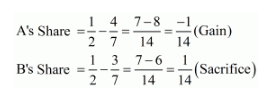
Old share of A = 1/2 = 7/14

New share of A = 4/7 = 8/14

A's change = 8/14 - 7/14 = 1/14 (A gains 1/14).

Old share of B = 1/2 = 7/14

New share of B = 3/7 = 6/14

B's change = 6/14 - 7/14 = -1/14 (B sacrifices 1/14).

∴ A's Gain = 1/14

B's Sacrifice = 1/14

Page No 4.37:

Question 2: X, Y and Z are sharing profits and losses in the ratio of 5 : 3 : 2. With effect from 1st April, 2019, they decide to share profits and losses in the ratio of 5 : 2 : 3. Calculate each partner's gain or sacrifice due to the change in ratio.

Ans:
Old Ratio (X, Y and Z) = 5 : 3 : 2 (total 10 parts)
New Ratio (X, Y and Z) = 5 : 2 : 3 (total 10 parts)
Sacrificing (or Gaining) Ratio = New Share - Old Share.


Working:

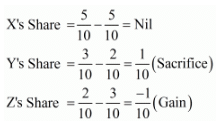
X: Old = 5/10, New = 5/10 → Change = 0 (no gain or sacrifice).

Y: Old = 3/10, New = 2/10 → Change = 2/10 - 3/10 = -1/10 (Y sacrifices 1/10).

Z: Old = 2/10, New = 3/10 → Change = 3/10 - 2/10 = 1/10 (Z gains 1/10).

∴ Z's Gain = 1/10

Y's Sacrifice = 1/10

Page No 4.37:

Question 3: X, Y and Z are sharing profits and losses in the ratio of 5 : 3 : 2. With effect from 1st April, 2019, they decide to share profits and losses equally. Calculate each partner's gain or sacrifice due to the change in ratio.

Ans:
Old Ratio (X, Y and Z) = 5 : 3 : 2 (total 10 parts)
New Ratio (X, Y and Z) = 1 : 1 : 1 (equal shares)
Sacrificing (or Gaining) Ratio = New Share - Old Share.


Working (use a common denominator 30 for clarity):

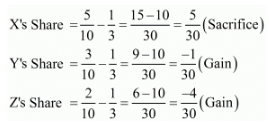
Old shares: X = 5/10 = 15/30, Y = 3/10 = 9/30, Z = 2/10 = 6/30.

New shares: each = 1/3 = 10/30.

Changes:

X: 10/30 - 15/30 = -5/30 (X sacrifices 5/30).

Y: 10/30 - 9/30 = 1/30 (Y gains 1/30).

Z: 10/30 - 6/30 = 4/30 (Z gains 4/30).

∴ Y's Gain = 1/30

Z's Gain = 4/30

X's Sacrifice = 5/30

Page No 4.37:

Question 4: A, B and C are partners sharing profits and losses in the ratio of 5 : 4 : 1. Calculate new profit-sharing ratio, sacrificing ratio and gaining ratio in each of the following cases:
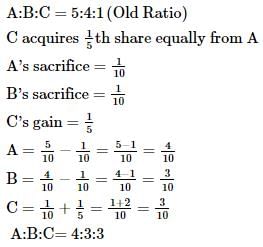
Case 1. C acquires 1/5th share from A.
Case 2. C acquires 1/5th share equally form A and B.
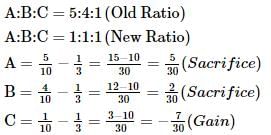
Case 3. A, B and C will share future profits and losses equally.
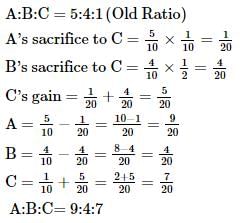
Case 4. C acquires 1/10th share of A and 1/2 share of B.

Ans:
Old Ratio A : B : C = 5 : 4 : 1 (total 10 parts). For each case we compute the transfers and then give new ratios and sacrifice/gain.
Case 1:
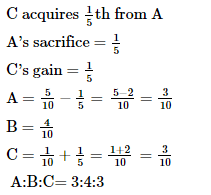
Interpretation: C acquires 1/5th (i.e., 1/5 of the total profit) from A.
Amount transferred = 1/5 = 2/10 parts (since total parts = 10).
New A = 5/10 - 2/10 = 3/10.
New B = 4/10 (unchanged).
New C = 1/10 + 2/10 = 3/10.
New Ratio = 3 : 4 : 3.
Sacrifices/Gains: A sacrifices 2/10, B 0, C gains 2/10.

Case 2:

Interpretation: C acquires 1/5th share of the total equally from A and B → each gives 1/10 part.

New A = 5/10 - 1/10 = 4/10.

New B = 4/10 - 1/10 = 3/10.

New C = 1/10 + 2/10 = 3/10.

New Ratio = 4 : 3 : 3.

Sacrifices/Gains: A sacrifices 1/10, B sacrifices 1/10, C gains 2/10.


Case 3:

All share equally in future → each = 1/3.

Using common denominator 30 for precision: Old A = 15/30, B = 12/30, C = 3/30; New each = 10/30.

Changes: A = 10/30 - 15/30 = -5/30 (A sacrifices 5/30).

B = 10/30 - 12/30 = -2/30 (B sacrifices 2/30).

C = 10/30 - 3/30 = 7/30 (C gains 7/30).

New Ratio = 1 : 1 : 1.


Case 4:

Interpretation: C acquires one-tenth of A's share and one-half of B's share (i.e., fractions of the respective partners' original shares).

Calculation of amounts transferred:

One-tenth of A's share = (1/10) × (5/10) = 5/100 = 1/20 (of total).

One-half of B's share = (1/2) × (4/10) = 2/10 = 1/5 (of total).

Total transfer to C = 1/20 + 1/5 = 1/20 + 4/20 = 5/20 = 1/4.

Convert original shares to twentieths: A = 10/20, B = 8/20, C = 2/20.

New A = 10/20 - 1/20 = 9/20.

New B = 8/20 - 4/20 = 4/20.

New C = 2/20 + 5/20 = 7/20.

New Ratio = 9 : 4 : 7.

Sacrifices/Gains: A sacrifices 1/20, B sacrifices 4/20, C gains 5/20.


Page No 4.37:

Question 5: A, B and C shared profits and losses in the ratio of 3 : 2 : 1 respectively. With effect from 1st April, 2019, they agreed to share profits equally. The goodwill of the firm was valued at ₹ 18,000. Pass necessary Journal entries when: (a) Goodwill is adjusted through Partners' Capital Accounts; and (b) Goodwill is raised and written off.

Ans:
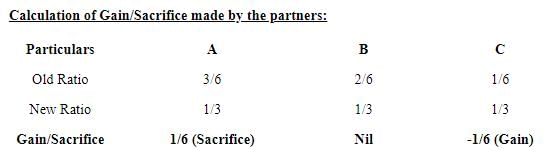
Old Ratio = 3 : 2 : 1 (total 6 parts).
New Ratio = 1 : 1 : 1 (each = 2/6).
Changes in shares (in sixths):
A: Old 3/6 → New 2/6 → Change = -1/6 (A sacrifices 1/6).
B: Old 2/6 → New 2/6 → Change = 0 (B no change).
C: Old 1/6 → New 2/6 → Change = +1/6 (C gains 1/6).
Goodwill = ₹ 18,000.
Amount corresponding to 1/6 = 18,000 × (1/6) = ₹ 3,000.
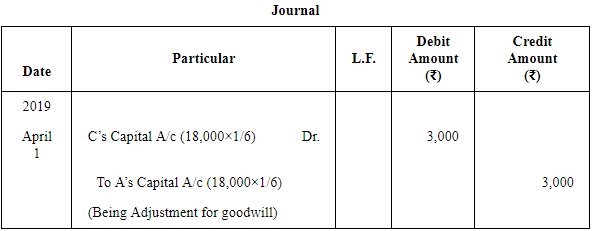
Case (a) Goodwill adjusted through Partners' Capital Accounts:
Explanation: The sacrificing partner(s) pay the gaining partner(s) through capital accounts. Here A sacrifices ₹ 3,000 which is payable to C who gains ₹ 3,000. B is unaffected.
Journal entry (transfer through capitals) is shown below:


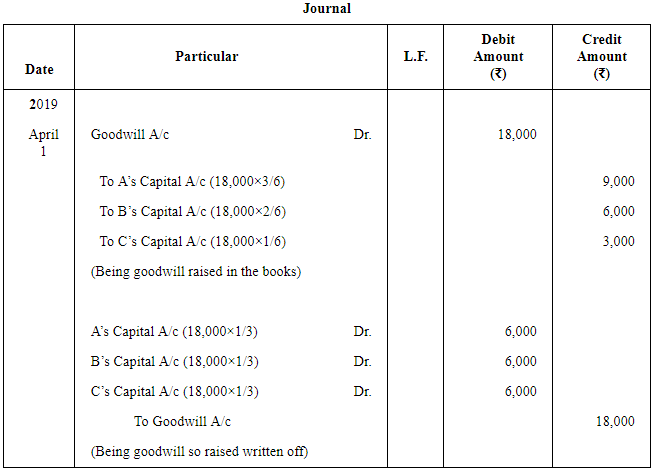
Case (b) Goodwill is raised and written off:

Explanation: When goodwill is raised and then written off, the net effect is that the gaining partner receives the amount from sacrificing partner(s) but the entries are passed through the Goodwill account. The calculation of amounts is the same (₹ 3,000). The necessary journal entries that show raising and subsequent writing off of goodwill are given below:

Change in Profit-Sharing Ratio Among the Existing Partners (Part -1)

(The images above show the formal journal entries for raising and writing off goodwill with amounts distributed in the appropriate ratio.)

Page No 4.38:

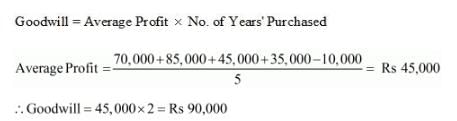
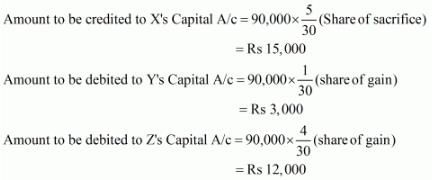
Question 6: X, Y and Z are partners sharing profits and losses in the ratio of 5 : 3 : 2. From 1st April, 2018, they decided to share profits and losses equally. The Partnership Deed provides that in the event of any change in the profit-sharing ratio, the goodwill should be valued at two years' purchase of the average profit of the preceding five years. The profits and losses of the preceding years ended 31st March are:

Change in Profit-Sharing Ratio Among the Existing Partners (Part -1)

You are required to calculate goodwill and make a journal entry.

Ans:

Solution summary and steps (working details shown in images):

1. Calculate total profit (taking losses as negative) for the five years and find the average profit.

Change in Profit-Sharing Ratio Among the Existing Partners (Part -1)

Working Notes and adjustments are shown in detail in the images below:

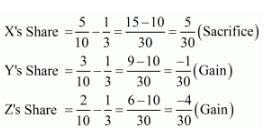
WN 1 Calculation of Sacrificing (or Gaining) Ratio

Old Ratio (X, Y and Z) = 5 : 3 : 2

New Ratio (X, Y and Z) = 1 : 1 : 1

Sacrificing (or Gaining) Ratio = New - Old as shown in the working image.


WN 2 Calculation of Goodwill

Change in Profit-Sharing Ratio Among the Existing Partners (Part -1)

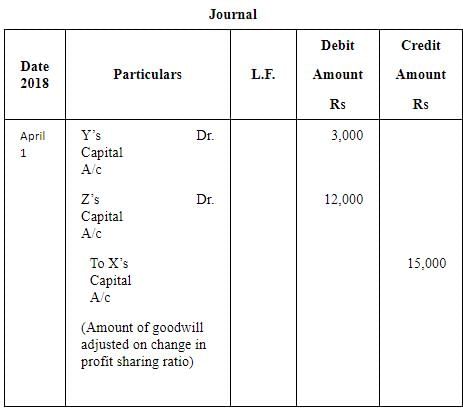
WN 3 Adjustment of Goodwill

Change in Profit-Sharing Ratio Among the Existing Partners (Part -1)

Page No 4.38:

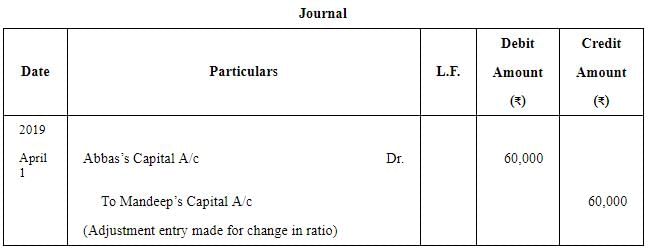
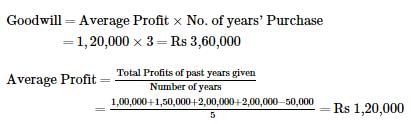
Question 7: Mandeep, Vinod and Abbas are partners sharing profits and losses in the ratio of 3 : 2 : 1. From 1st April, 2019 they decided to share profits equally. The Partnership Deed provides that in the event of any change in profit-sharing ratio, goodwill shall be valued at three years' purchase of average profit of last five years. The profits and losses of past five years are:
Profit - Year ended 31st March, 2015 - ₹ 1,00,000; 2016 - ₹ 1,50,000; 2018 - ₹ 2,00,000; 2019 - ₹ 2,00,000.
Loss - Year ended 31st March, 2017 - ₹ 50,000.
Pass the Journal entry showing the working.

Ans:
Steps to solution (detailed working shown in the images):
1. Add five years' profits (treat losses as negative) and compute average profit.
2. Goodwill = Average profit × 3 (three years' purchase as per deed).
3. Determine gain or sacrifice on change from 3 : 2 : 1 to 1 : 1 : 1 and allocate goodwill accordingly.

Change in Profit-Sharing Ratio Among the Existing Partners (Part -1)

Working Notes:

WN1: Calculation of Sacrifice or Gain
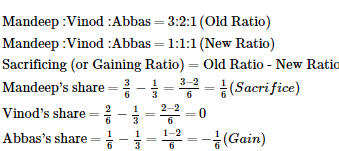
Change in Profit-Sharing Ratio Among the Existing Partners (Part -1)

WN2: Valuation of Goodwill

Change in Profit-Sharing Ratio Among the Existing Partners (Part -1)

WN3: Adjustment of Goodwill

Change in Profit-Sharing Ratio Among the Existing Partners (Part -1)

Page No 4.38:

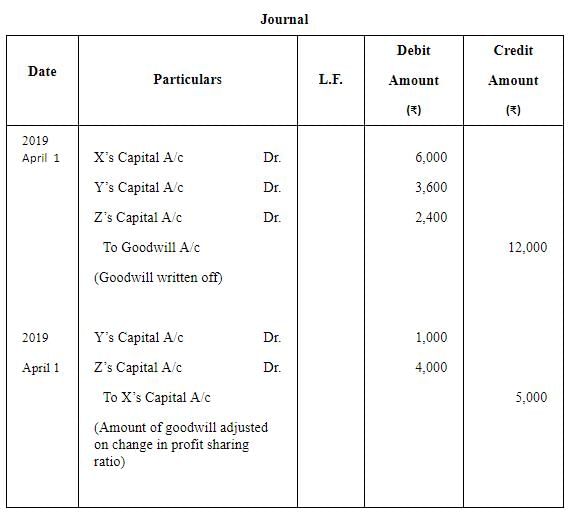
Question 8: X, Y and Z are partners sharing profits and losses in the ratio of 5 : 3 : 2, decided to share future profits and losses equally with effect from 1st April, 2019. On that date, the goodwill appeared in the books at ₹ 12,000. But it was revalued at ₹ 30,000. Pass Journal entries assuming that goodwill will not appear in the books of account.

Ans:
Summary of approach:
1. Existing goodwill in books = ₹ 12,000. Revalued goodwill = ₹ 30,000. Since goodwill will not remain on the books, the net increase (₹ 30,000 - ₹ 12,000 = ₹ 18,000) must be adjusted among partners according to the gaining/sacrificing ratio arising from the change of profit-sharing ratio.
2. Determine the gaining/sacrificing ratio for change from 5 : 3 : 2 to 1 : 1 : 1.
3. Write off the existing goodwill of ₹ 12,000 among old partners in the old ratio and then adjust the additional goodwill ₹ 18,000 between sacrificing and gaining partners as per the computed gaining/sacrificing ratio. The combined journal entries for writing off old goodwill and adjusting the revaluation are shown below.

Change in Profit-Sharing Ratio Among the Existing Partners (Part -1)

Working Notes:

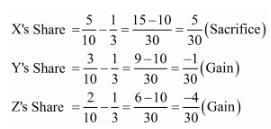
WN 1 Calculation of Sacrificing (or Gaining) Ratio

Old Ratio (X, Y and Z) = 5 : 3 : 2

New Ratio (X, Y and Z) = 1 : 1 : 1

Sacrificing (or Gaining) Ratio = Old - New as shown in the working image.


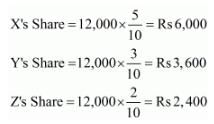
WN 2 Writing off of Old Goodwill

Change in Profit-Sharing Ratio Among the Existing Partners (Part -1)

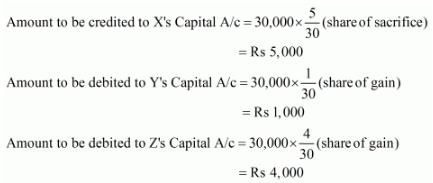
WN 3 Adjustment of Goodwill

Change in Profit-Sharing Ratio Among the Existing Partners (Part -1)

Page No 4.38:

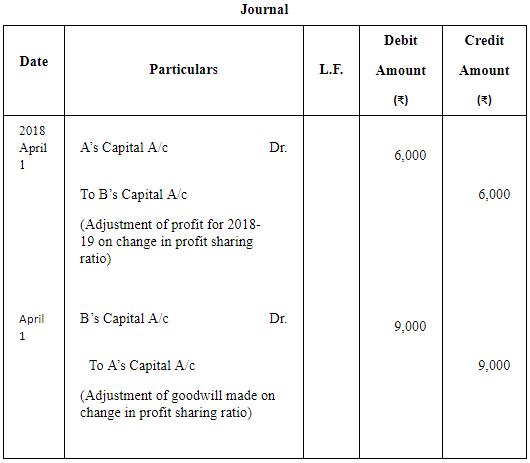
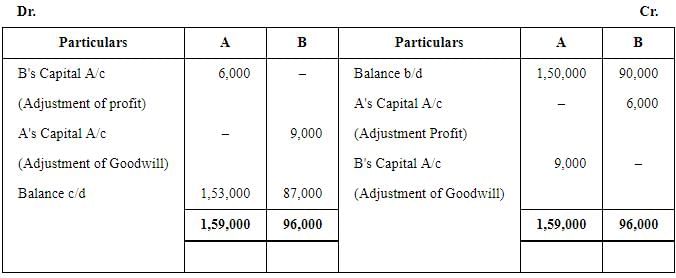
Question 9: A and B are partners in a firm sharing profits in the ratio of 2 : 1. They decided with effect from 1st April, 2018, that they would share profits in the ratio of 3 : 2. But, this decision was taken after the profit for the year ended 31st March, 2019 of ₹ 90,000 was distributed in the old ratio.

The profits for the year ended 31st March, 2017 and 2018 were ₹ 60,000 and ₹ 75,000 respectively. It was decided that Goodwill Account will not be opened in the books of the firm and necessary adjustment be made through Capital Accounts which on 31st March, 2019 stood at ₹ 1,50,000 for A and ₹ 90,000 for B.
Pass necessary Journal entries and prepare Capital Accounts. 

Ans:
Outline of solution and steps (full working and ledger presentation shown in images):
1. Calculate the gain or sacrifice by moving from old ratio 2 : 1 to new ratio 3 : 2.
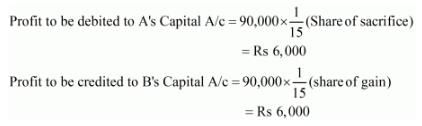
2. Re-distribute the profit of ₹ 90,000 for year ended 31st March, 2019 according to the new ratio and compute the difference already distributed in the old ratio. Adjust the difference through partners' capital accounts.
3. Goodwill is not to be opened; therefore, adjustment due to past profits (if any) are also passed through capitals as required. The calculations, journal entries and updated capital accounts are shown below.

Change in Profit-Sharing Ratio Among the Existing Partners (Part -1)

Partners' Capital AccountsChange in Profit-Sharing Ratio Among the Existing Partners (Part -1)

Working Notes:

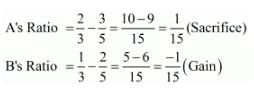
WN 1 Calculation of Sacrificing (or Gaining) Ratio

Old Ratio (A and B) = 2 : 1

New Ratio (A and B) = 3 : 2

Sacrificing (or Gaining) Ratio = Old - New as shown in the working image.

Change in Profit-Sharing Ratio Among the Existing Partners (Part -1)

WN 2 Adjustment of Profit for 2016-17

Change in Profit-Sharing Ratio Among the Existing Partners (Part -1)

WN 3 Calculation of New Goodwill

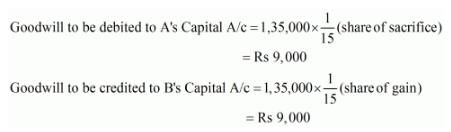
Goodwill = Profit of 2014-15 + Profit of 2015-16 = 60,000 + 75,000 = ₹ 1,35,000 (as per working note).

WN 4 Adjustment of Goodwill

Change in Profit-Sharing Ratio Among the Existing Partners (Part -1)

Page No 4.38:

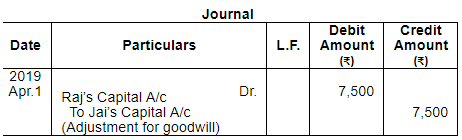
Question 10: Jai and Raj are partners sharing profits in the ratio of 3 : 2. With effect from 1st April, 2019, they decided to share profits equally. Goodwill appeared in the books at ₹ 25,000. As on 1st April, 2019, it was valued at ₹ 1,00,000. They decided to carry goodwill in the books of the firm.

Pass the Journal entry giving effect to the above.

Ans:
Calculation and approach:
Old Ratio = 3 : 2. New Ratio = 1 : 1.
Existing goodwill in books = ₹ 25,000. Revalued goodwill = ₹ 1,00,000.
Increase in goodwill to be recognised = ₹ 1,00,000 - ₹ 25,000 = ₹ 75,000.
Since goodwill is to be carried in the books, the additional goodwill (₹ 75,000) is to be raised in the books and the corresponding credit is given to partners in their gaining ratio on change of profit-sharing.
Working note and the precise journal entry are shown below:

Change in Profit-Sharing Ratio Among the Existing Partners (Part -1)

Working Notes:

Calculation of Gaining/Sacrificing Ratio
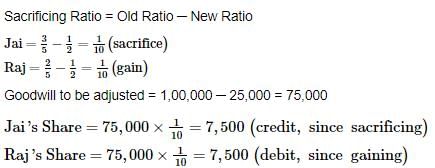
Change in Profit-Sharing Ratio Among the Existing Partners (Part -1)
The document Change in Profit-Sharing Ratio Among the Existing Partners (Part -1) | Accountancy Class 12 - Commerce is a part of the Commerce Course Accountancy Class 12.
All you need of Commerce at this link: Commerce
43 videos|226 docs|37 tests

FAQs on Change in Profit-Sharing Ratio Among the Existing Partners (Part -1) - Accountancy Class 12 - Commerce

1. What is profit-sharing ratio among partners?
Ans. Profit-sharing ratio among partners refers to the proportion in which the profits or losses of a partnership business are distributed among the partners. It determines the share of each partner in the profits or losses based on the agreed ratio.
2. How is the profit-sharing ratio determined among partners?
Ans. The profit-sharing ratio among partners is usually determined based on the agreement between the partners. It can be decided at the time of forming the partnership or can be amended later through mutual consent. Factors such as capital contribution, expertise, experience, and effort put in by each partner may be considered while determining the profit-sharing ratio.
3. What happens when there is a change in the profit-sharing ratio among partners?
Ans. When there is a change in the profit-sharing ratio among partners, it means that the distribution of profits or losses among the partners will be altered. The partner whose ratio has increased will receive a higher share of profits, while the partner whose ratio has decreased will receive a lower share. This change can be due to various reasons such as changes in capital contribution, changes in responsibilities, or changes in the partnership agreement.
4. Can the profit-sharing ratio among partners be changed without their consent?
Ans. No, the profit-sharing ratio among partners cannot be changed without their consent. Any change in the profit-sharing ratio requires mutual agreement and consent from all the partners. This ensures fairness and transparency in the distribution of profits or losses among the partners. It is important for all partners to be involved in the decision-making process and agree upon any changes in the profit-sharing ratio.
5. Are there any tax implications associated with a change in the profit-sharing ratio among partners?
Ans. Yes, there can be tax implications associated with a change in the profit-sharing ratio among partners. When the profit-sharing ratio is changed, it may lead to a redistribution of profits among the partners. This can affect their individual tax liabilities as the share of profits received by each partner may change. It is advisable for partners to consult with a tax professional or accountant to understand the tax implications and ensure compliance with applicable tax laws when making changes to the profit-sharing ratio.
Related Searches

practice quizzes

,

video lectures

,

shortcuts and tricks

,

Viva Questions

,

Semester Notes

,

Previous Year Questions with Solutions

,

past year papers

,

Free

,

Change in Profit-Sharing Ratio Among the Existing Partners (Part -1) | Accountancy Class 12 - Commerce

,

Change in Profit-Sharing Ratio Among the Existing Partners (Part -1) | Accountancy Class 12 - Commerce

,

pdf

,

Sample Paper

,

Objective type Questions

,

mock tests for examination

,

ppt

,

Important questions

,

Summary

,

Exam

,

study material

,

Extra Questions

,

MCQs

,

Change in Profit-Sharing Ratio Among the Existing Partners (Part -1) | Accountancy Class 12 - Commerce

;