Long Questions With Answers - National Income And Related Aggregates

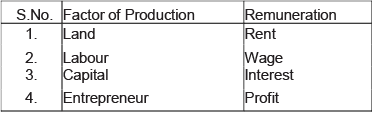
Q.1. What are the four factors of production and what are the remunerations to each of these called?
Ans. Following are the four factors of production and their respective remunerations:
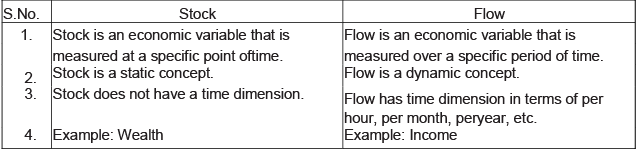
Q.2. Distinguish between stock and flow. Between net investment and capital, which is a stock and which is a flow? Compare net investment and capital with flow of water into a tank.
Ans. Following are the points of difference between stock and flow:
Net investment and capital:
- Capital is a stock because it is the accumulated value of produced assets at a point in time.
- Net investment is a flow because it is the amount by which the capital stock increases (or decreases) over a period of time after accounting for depreciation.
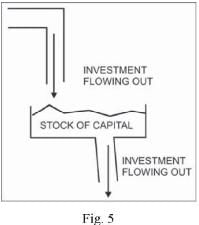
Analogy - water tank:
- Capital is like the water standing in the tank at a given moment (a stock).
- Net investment is like the net flow of water into the tank during a time period - inflow minus outflow - which changes the water level (capital) over that period.
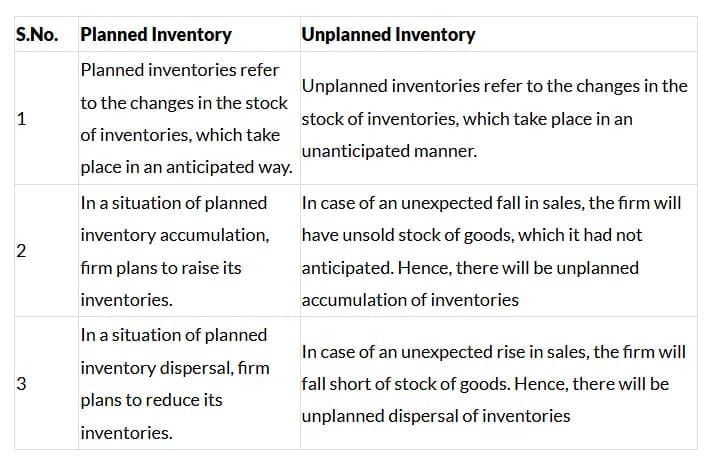
Q.3. What is the difference between planned and unplanned inventory accumulation? Write down the relation between change in inventories and value added of a firm.
Ans. The change in inventories may be planned or unplanned. Following points explain the difference between the two:
Relation between change in inventories and value added:
Value added of a firm equals the value of sales plus the change in inventories minus the value of intermediate goods used.
In formula form:
Gross Value Added (GVA) = Value of sales (V) + Change in inventories (A) - Value of intermediate goods (Z).
That is, GVA = V + A - Z.
The change in inventories (opening minus closing stock or vice versa depending on sign convention) is treated as part of production because it reflects goods produced but not yet sold in the accounting period.
Q.4. Suppose the GDP at market price of a country in a particular year was ' 1,100 crores. Net Factor Income from Abroad was ' 100 crores.The value of indirect taxes - subsidies was ' 150 crores and National Income was ' 850 crores. Calculate the aggregate value of depreciation.
Ans. The following information is given:
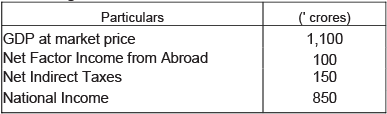
We use the relation between GDP at market price (GDPmp) and Net National Product at factor cost (NNPfc), which here is stated as National Income:
NNPfc = GDPmp + Net Factor Income from Abroad - Net Indirect Taxes - Depreciation.
Substitute the given values:
850 = 1,100 + 100 - 150 - Depreciation
Compute the terms on the right: 1,100 + 100 - 150 = 1,050
So, 850 = 1,050 - Depreciation
Rearrange: Depreciation = 1,050 - 850 = 200
Therefore, aggregate depreciation = ' 200 crores.
Q.5. Net National Product at Factor Cost of a particular country in a year is ' 1,900 crores. There are no interest payments made by the households to the firms/ government, or by the firms/ governments to the households. The Personal Disposable Income of the households is ' 1,200 crores. The personal income taxes paid by them ' 600 crores and the value of retained earnings of the firms and government is valued at' 200 crores. What is the value of transfer payments made by the government and firms to the households?
Ans. The following information is given:
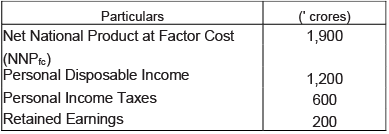
Use the identity relating Personal Disposable Income (PDI) to Net National Product at factor cost (NNPfc):
PDI = NNPfc - Retained Earnings - Personal Taxes + Transfer Payments.
Substitute the values:
1,200 = 1,900 - 200 - 600 + Transfer Payments
Compute the known terms: 1,900 - 200 - 600 = 1,100
So, 1,200 = 1,100 + Transfer Payments
Therefore, Transfer Payments = 1,200 - 1,100 = 100
Hence, transfer payments = ' 100 crores.
Q.6. From the following data, calculate Personal Income and Personal Disposable Income.
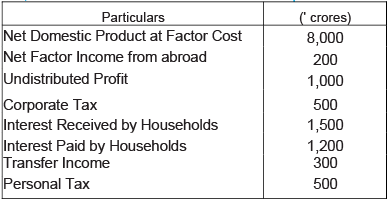
Ans. Personal Income
We use the standard conversion from domestic/national aggregates to personal income. The items typically included (as used in the original computation) give the following arithmetic:
Personal Income = Net Domestic Product at Factor Cost + Net Factor Income from Abroad - Undistributed Profit - Corporate Tax + Interest Received by Households + Transfer Income - Interest Paid by Households.
Substituting the numerical values given in the exercise (as in the original working):
Personal Income = 8,000 + 200 - 1,000 - 500 + 1,500 + 300 - 1,200 = 7,300
Personal Disposable Income = Personal Income - Personal Tax
= 7,300 - 500 = 6,800
Therefore, Personal Income = ' 7,300 crores and Personal Disposable Income = ' 6,800 crores.
Q.7. Distinguish between the following giving suitable examples in support of your answer:
(i) Domestic product and national product
(ii) Intermediate product and final product
Ans. (i) Domestic product and national product Domestic product is defined as the market value of all the final goods and services produced by the factors of production located in the country during a period of one year.
On the other hand, national product is the market value of all the final goods and services produced by the factors of production located in the country during a period of one year plus Net Factor Income from Abroad (NFIA). NFIA is the difference between the incomes of residents for factor services to the rest of the world and payments to the factor services of non-residents in the domestic territory during a period of one year.
National Product = Domestic Product + NFIA
Example: If the domestic product is ' 5,000 and Net Factor Income from Abroad is ' 100, then the National product will be:
National Product = ' 5000 + ' 100 = ' 5100
(ii) Intermediate product and final product Intermediate products are those products which are not meant for final consumption. These are raw materials used in the production of other goods and services.
Final products are those products which are ready for consumption or capital formation by final users.
Example: A chair is a final good, but wood, cane, foam, cloth, etc. used to produce chair are all intermediary goods.
Q.8. Explain the circular flow of an open economy.
Ans. Four-sector economy model is also known as an open economy model. The circular flow in this type ' of economy can be explained with the help of the following diagram:
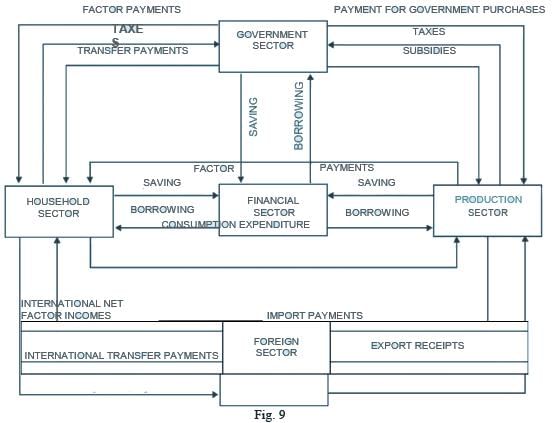
The open economy (four-sector) circular flow consists of Households, Firms (production sector), Government and the Foreign sector. The income-expenditure identity is:
Y = C + I + G + (X - M)
Where:
Y = National income or output
C = Private consumption expenditure
I = Investment expenditure by firms
G = Government expenditure
X = Exports
M = Imports
Flows between sectors:
- Households supply factor services and receive factor incomes (wages, rent, interest, profit). They spend on consumption, pay taxes and may receive transfers. Households save or borrow via the financial sector.
- Firms produce goods and services, sell to households, government and foreign buyers, and pay factor incomes to households. Firms invest and interact with financial markets.
- Government collects taxes, buys goods and services, pays wages and transfers, and borrows or lends in financial markets.
- Foreign sector buys exports from domestic firms and supplies imports; net exports (X - M) are injections or leakages depending on sign. Factor payments to/from abroad are also part of the circular flow.
Overall, total production equals total expenditure, and total payments to factors equal total income generated in production.
Q.9. With the help of a circular flow model, show that income and expenditure flows are equal.
Ans. The aggregate final expenditure of an economy is always equal to the aggregate factor payments (or incomes) because of the circular flow of income. The final expenditure and aggregate factor payments are two sides of the same coin. The firms hire or purchase factor services from households and use them to produce goods and services. Factor payments made by the firms become factor incomes in the hands of households. Households spend their income on purchase of goods and services which are produced by firms. Expenditure by household implies income to the firms. Thus, the income of economy goes through the two sectors, firms and households, in a circular way. This is represented in the following figure:
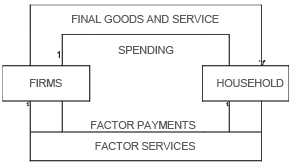
In the two-sector circular flow (households and firms):
- Firms pay factor incomes to households for labour, land, capital and entrepreneurship.
- Households use that income to buy goods and services produced by firms.
Thus, every rupee spent by households on goods and services becomes income for firms, and every rupee paid by firms to factors becomes income for households. Hence aggregate expenditure equals aggregate income by construction. If there are injections (investment, government spending, exports) and leakages (savings, taxes, imports), equilibrium requires injections = leakages for the circular flow to be balanced.
Q.10. Will the following be included in domestic factor income of India? Give reasons for your answer.
(i) Profits earned by a foreign bank from its branches in India
(ii) Scholarships given by Government of India
(iii) Profits earned by a resident of India from his company in Singapore
(iv) Salaries received by Indians working in American Embassy in India
Ans. (i) Profits earned by a foreign bank from its branches in India will not be included in domestic factor income of India because it is the factor income of a foreign country or it is the income of nonresident in India.
(ii) Scholarships given by the government of India will not be included in domestic factor income because it is a transfer payment and does not contribute to the flow of goods and services.
(iii) Profits earned by a resident of India from his company in Singapore will not be included in domestic factor income of India because it is the income of the resident earned abroad.
(iv) Salaries received by Indians working in American Embassy in India will be included in domestic factor income of India because it is the income of the normal residents of India, earned within the domestic territory of India.
Q.11. How will you treat the following while estimating domestic product of India?
(i) Rent received by a Indian resident from his property in Singapore
(ii) Salaries to Indians working in Japanese Embassy in India
(iii) Profits earned by a branch of an American Bank in India
(iv) Salaries paid to Koreans working in Indian Embassy in Korea
Ans. (i) Rent received by a resident Indian from his property in Singapore will not be included in domestic product of India as this income is earned outside the domestic (economic) territory of India.
(ii) Salaries to Indians working in Japanese Embassy in India will not be a part of domestic product of India as embassy of Japan in India is not a part of domestic territory of India. Hence, this income is not earned within the domestic territory of India.
(iii) Profits earned by a branch of an American Bank in India will be included in domestic product of India as the branch of American bank is located within the domestic territory of India. Thus, it is the income earned within the domestic territory of India.
(iv) Salaries paid to Koreans working in Indian Embassy in Korea will be a part of domestic product of India because this income is earned within the domestic territory of India. Indian embassy in Korea is treated as located within the domestic territory of India.
Q.12. Giving reasons explain how should the following be treated in estimation of National Income:
(i) Expenditure by a firm on payment of fees to a chartered accountant
(ii) Payment of a corporate tax by a firm
(iii)Purchase of refrigerator by a firm for own use.
Ans. (i) Payment of fees to a chartered accountant by a firm is an income of a professional and hence, it will be included in National Income while its estimation.
(ii) Corporate tax is included in the National Income as a part of corporate profit, not separately
(iii)Expenditure on purchasing a refrigerator for use by a firm will be included while estimating National Income because the refrigerator is purchased by the firm for final use.
Q.13. Giving reasons explain how should the following be treated in estimation of National Income:
(i) Payment of interest by a firm to a bank
(ii) Payment of interest by a bank to an individual
(iii)Payment of interest by an individual to a bank
Ans. (i) The firm borrows from the bank to undertake productive activities. Hence, payment of interest by a firm to a bank will be included in National Income as the cost of borrowing funds.
(ii) Payment of interest by a bank to an individual will be included in National Income as the bank uses the individual's savings for productive purpose, that is, for lending further to earn interest.
(iii)Payment of interest by an individual to a bank will be included in National Income if the individual has taken loan for productive purpose. However, if the individual has taken loan from bank for consumption purpose, the interest paid shall not be included in National Income
Q.14. Distinguish between 'real' gross domestic product and 'nominal' gross domestic product.Which of these is a better index of welfare of the people and why?
Ans. Following are the points of distinction between real and nominal Gross Domestic Product (GDP):
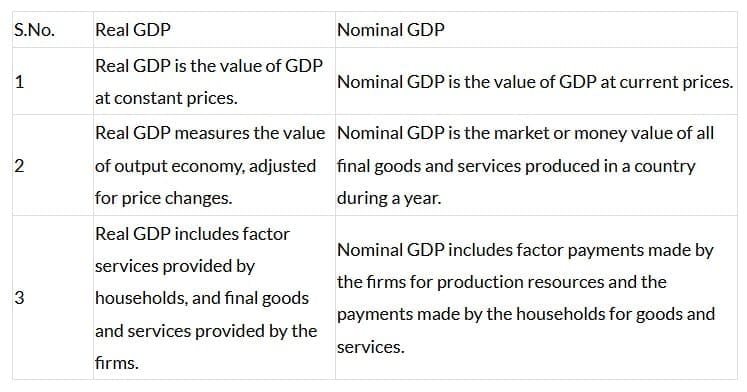
Real GDP is the better index for comparing welfare over time because it removes the effect of price changes (inflation or deflation). An increase in real GDP indicates a genuine increase in the production of goods and services and hence potential rise in income and employment. Nominal GDP can rise merely because prices have risen, even when production remains unchanged, so it does not reliably indicate changes in real welfare.
FAQs on Long Questions With Answers - National Income And Related Aggregates
| 1. What is national income and why is it important? |  |
| 2. How is national income calculated? | |
| 3. What are the components of national income? | |
| 4. How does national income affect the economy? | |
| 5. What are the limitations of national income as an economic indicator? | |