Short Question Answers : Origin of Continents and Oceans

Q. 1. Who and when proposed the continental drift-theory ?
Ans. Alfred Wegener proposed the continental drift theory in 1912.
Q. 2. Name the original super continent. When was it formed ?
Ans. The original super continent was named PANGAEA. It began to split around 200 million years ago.
Q. 3. Name the Northern Continent split from Pangea.
Ans. The northern continent that split from Pangea was Laurasia (also referred to as Angara Land).
Q. 4. Name the Southern Continent split from Pangea.
Ans. The southern continent that separated from Pangea was Gondwana Land.
Q. 5. Name the landmasses included in the Gondwanaland.
Ans. Gondwanaland included the southern landmasses whose sediments match with India's Gondwana system - Africa, Falkland Island, Madagascar, Antarctica and Australia.
Q. 6. Name the gold bearing areas of Africa and South America.
Ans. The gold-bearing areas are the Ghana coast in Africa and parts of Brazil in South America.
Q. 7. What do you mean by Polar Wandering ?
Ans. Polar wandering is the apparent change in the position of the Earth's magnetic poles relative to the continents over geological time. Studies of the permanent magnetism recorded in rocks show these changes and help reconstruct past positions of continents.
Q. 8. What do you mean by sea-floor spreading ?
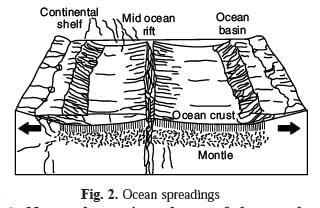
Ans. Sea-floor spreading is the process by which new oceanic crust is formed at mid-ocean ridges as molten material rises and solidifies, and then moves away from the ridge, causing the ocean floor to widen.
Q. 9. What is the cause of plate movement ?
Ans. Plate movement is driven by thermal convection currents in the mantle beneath the crust; these currents cause the rigid lithospheric plates to move slowly over geological time.
Q. 10. Who proposed that convection currents are the cause of plate movement ?
Ans. Arthur Holmes in the 1930s discussed the possibility of convection currents operating in the mantle portion.
Q. 11. How many major plates are there on the earth's crust ?
Ans. There are seven major tectonic plates on the Earth's lithosphere.
Q. 12. What was the cause of formation of Himalayas ?
Ans. The Himalayas were formed by the collision of the Indian Plate with the Eurasian Plate, which pushed up the crust to create the mountain range.
Q. 13. What do you mean by Tillite ? Where are these found ?
Ans. Tillite is a sedimentary rock formed from the compacted deposits of glacial debris (till). Thick tillite beds occur at the base of the Gondwana sedimentary sequence in India. Counterparts of these Gondwana-type sediments and their tillites are found in several southern landmasses such as Africa, the Falkland Islands, Madagascar, Antarctica and Australia. The widespread presence of similar tillites provides clear evidence of extensive past glaciation and supports the idea that these landmasses were once joined.
Q. 14. Where are Placer deposits found ?
Ans. Placer deposits are concentrations of heavy minerals, such as gold, found in alluvial or beach sediments. Rich placer deposits of gold occur on the Ghana coast in West Africa, yet the immediate source rocks are absent there. Gold-bearing veins are known in Brazil, which supports the view that the Ghana gold placers may have been derived from the same source region when the two continents were adjacent.
Q. 15. What do you mean by Lemuria ?
Ans. Lemuria was a hypothetical landmass proposed to explain the disjunct distribution of certain land animals and plants, for example lemurs, found in India, Madagascar and Africa. Early naturalists suggested a contiguous land connection (called Lemuria) linking these regions to account for such similar distributions.
Q. 16. Describe the two main types of plates.
Ans. The two main types of tectonic plates are:
(1) Oceanic plates - These are associated with ocean basins; they are generally thinner and denser and are composed mainly of oceanic crust (for example, the Pacific Plate).
(2) Continental plates - These carry continental crust, are generally thicker and less dense (for example, the Eurasian Plate).
The lithosphere is divided into seven major plates. Their boundaries are often marked by young fold mountains, ocean trenches and faults.
Q. 17. What do you mean by convergence of plates ?
Ans. Convergence of plates occurs when two tectonic plates move towards each other. Where one plate is forced beneath another, a subduction zone forms. Convergence may occur in three ways:
(i) Between a continental and an oceanic plate (often producing volcanic mountain chains).
(ii) Between two oceanic plates (forming island arcs and trenches).
(iii) Between two continental plates (producing major mountain ranges by crustal shortening).
Q. 18. What is Pangea ?
Ans. Pangea was the super continent that began to split around 200 million years ago.
Q. 19. What is meant by sea floor spreading ?
Ans. The mid-oceanic ridges are raised rift zones on the ocean floor where molten material rises and erupts as lava. This lava cools to form new oceanic crust, which then moves away from the ridge, causing the ocean basin to widen - a process known as sea-floor spreading. The idea of sea-floor spreading was proposed in the early 1960s (Dietz 1961; Hess 1962) and it forms a key part of the theory of plate tectonics.
Q. 20. Name the major plates of the earth.
Ans. There are seven major plates :
(i) Antarctica and the surrounding oceanic plate
(ii) North American plate
(iii) South American plate
(iv) Pacific plate
(v) India-Australia-New Zealand plate
(vi) Africa with the eastern Atlantic floor plate
(vii) Eurasia and the adjacent oceanic plate.
Q. 21. What is Pangea ? When was it evolved ? Name the landmasses constituting it. Describe the breaking up of Pangea.
Ans. Pangea was the super continent that began to split around 200 million years ago into Laurasia (northern) and Gondwanaland (southern). Later these broke into smaller continents that exist today. India started moving northward about 200 million years ago and collided with Asia about 40-50 million years ago.
Q. 22. What do you mean by Jig-Saw-fit ? Describe the similarities found on the east and west coasts of Atlantic Ocean. What do these suggest ?
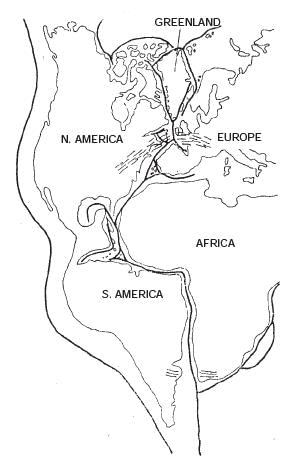
Ans. Jig-saw fit means that the coastlines of continents on opposite sides of an ocean can be fitted together like pieces of a jigsaw puzzle, suggesting they were once joined.
Examples of similarities between the east and west coasts of the Atlantic Ocean include:
(i) The Gulf of Guinea fits into the curve near Cape São Roque of Brazil, and the shoulder of Africa matches the Gulf of Mexico; western Europe and the eastern coast of North America (with Greenland) also fit together.
(ii) Gold deposits occur on the Ghana coast (Africa) and in Brazil (South America).
(iii) Similar glacial deposits and tillites are found across the landmasses of Gondwana.
All these similarities suggest that these continents were once contiguous and have since drifted apart.
FAQs on Short Question Answers : Origin of Continents and Oceans
| 1. What is the theory of continental drift? |  |
| 2. How do scientists study the movement of continents? | |
| 3. What evidence supports the theory of continental drift? | |
| 4. How does the movement of continents affect the Earth's climate? | |
| 5. Can continents collide or move closer together in the future? | |