Math Past Year Paper with Solution - 2019, Class 10

Section A
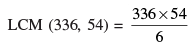
Q 1. If HCF (336, 54) = 6, find LCM (336, 54).
Sol.
Use the relation LCM × HCF = product of the two numbers.
LCM(336, 54) × 6 = 336 × 54
LCM(336, 54) = (336 × 54) / 6
LCM(336, 54) = 336 × 9
LCM(336, 54) = 3024
Q 2. Find the nature of roots of the quadratic equation 2x2 - 4x + 3 = 0.
Sol.
Compute the discriminant D = b2 - 4ac.
a = 2, b = -4, c = 3
D = (-4)2 - 4·2·3
D = 16 - 24
D = -8
Since D < 0, the quadratic has no real roots; it has two non-real (complex) conjugate roots.
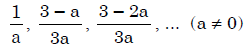
Q 3. Find the common difference of the Arithmetic Progression (A.P.)
Sol.
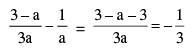
The common difference of an A.P. is the difference between any two successive terms.
Identify any two consecutive terms from the given A.P. (see the figures above).
d = (second term) - (first term)
Compute d using two successive terms shown in the images.
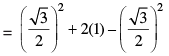
Q 4. Evaluate : sin2 60o + 2 tan 45o - cos2 30o
Or
If sin A = 3/4 , calculate sec A.
Sol.
Use standard trigonometric values:
sin 60° = √$\frac{3}{2}$, so sin260° = $\frac{3}{4}$.
tan 45° = 1, so 2 tan 45° = 2.
cos 30° = √$\frac{3}{2}$, so cos230° = $\frac{3}{4}$.
Therefore sin260° + 2 tan 45° - cos230° = ($\frac{3}{4}$) + 2 - ($\frac{3}{4}$)
= 2
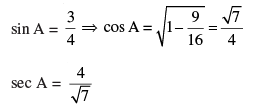
Alternate (OR) problem Sol.
Given sin A = $\frac{3}{4}$.
cos A = √(1 - sin2A) = √(1 - $\frac{9}{16}$) = √($\frac{7}{16}$) = √7 / 4.
sec A = 1 / cos A = $ \frac{4} { \sqrt{7}} = \frac{(4√7)} {7}$ (rationalised).
Q 5. Write the coordinates of a point P on the x-axis which is equidistant from points A(- 2, 0) and B(6, 0).
Sol.
Points on the x-axis have y = 0. A point equidistant from A and B on the x-axis must be the midpoint of AB.
Midpoint coordinates = ((x1 + x2)/2, (y1 + y2)/2)
= ((-2 + 6)/2, (0 + 0)/2)
= (4/2, 0)
= (2, 0)
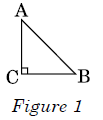
Q 6. In Figure 1, ABC is an isosceles triangle right angled at C with AC = 4 cm. Find the length of AB.
Sol.
In an isosceles right triangle right-angled at C, the two legs are equal: AC = BC = 4 cm.
Use Pythagoras: AB2 = AC2 + BC2
AB2 = 42 + 42 = 16 + 16 = 32
AB = √32 = 4√2 cm
OR
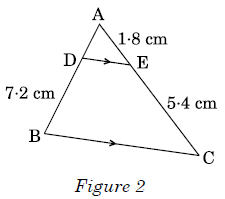
In Figure 2, DE || BC. Find the length of side AD, given that AE = 1·8 cm, BD = 7·2 cm and CE = 5·4 cm.
Sol.
When DE ∥ BC, by basic proportionality (Thales) theorem:
AD / DB = AE / EC
Substitute AE = 1·8, EC = 5·4, DB = 7·2.
AD / 7·2 = 1·8 / 5·4
1·8 / 5·4 = 1 / 3
AD = 7·2 × (1/3)
AD = 2·4 cm
Section B
Q 7. Write the smallest number which is divisible by both 306 and 657.
Sol.
The smallest number divisible by both is their LCM.
Prime factorisation:
306 = 2 × 32 × 17
657 = 32 × 73
LCM = 2 × 32 × 17 × 73
17 × 73 = 1241
LCM = 2 × 9 × 1241 = 18 × 1241 = 22338
Q 8. Find a relation between x and y if the points A(x, y), B(- 4, 6) and C(- 2, 3) are collinear.
Sol.
Three points are collinear if the area of triangle formed by them is zero.
Use determinant formula: x(6 - 3) + (-4)(3 - y) + (-2)(y - 6) = 0
3x - 12 + 4y - 2y + 12 = 0
3x + 2y = 0
Hence the required relation is 3x + 2y = 0.
OR
Find the area of a triangle whose vertices are given as (1, - 1) (- 4, 6) and (- 3, - 5).
Sol.
Area = (1/2) × |x1(y2 - y3) + x2(y3 - y1) + x3(y1 - y2)|
= (1/2) × |1(6 - (-5)) + (-4)((-5) - (-1)) + (-3)((-1) - 6)|
= (1/2) × |1×11 + (-4)×(-4) + (-3)×(-7)|
= (1/2) × |11 + 16 + 21|
= (1/2) × 48
= 24 square units
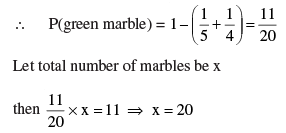
Q 9. The probability of selecting a blue marble at random from a jar that contains only blue, black and green marbles is 1/5. The probability of selecting a black marble at random from the same jar is 1/4. If the jar contains 11 green marbles, find the total number of marbles in the jar.
Sol.
P(blue) = 1/5, P(black) = 1/4.
P(green) = 1 - (1/5 + 1/4) = 1 - (9/20) = 11/20.
If number of green marbles = 11, then (11/20) × N = 11, where N is total number of marbles.
N = 11 × (20/11) = 20.
Total number of marbles = 20.
Q 10. Find the value(s) of k so that the pair of equations x + 2y = 5 and 3x + ky + 15 = 0 has a unique solution.
Sol.
Two linear equations have a unique solution when their coefficient determinant ≠ 0.
Determinant = |1 2; 3 k| = 1·k - 2·3 = k - 6.
For unique solution, k - 6 ≠ 0
Hence k ≠ 6.
Q 11. The larger of two supplementary angles exceeds the smaller by 18o. Find the angles.
Sol.
Let the larger angle be x°.
Then the smaller angle = 180° - x°.
Given x - (180 - x) = 18
2x - 180 = 18
2x = 198
x = 99°
The two angles are 99° and 81°.
OR
Sumit is 3 times as old as his son. Five years later, he shall be two and a half times as old as his son. How old is Sumit at present?
Sol.
Let son's present age = x years.
Sumit's present age = 3x years.
After 5 years: Sumit = 3x + 5, Son = x + 5.
Given 3x + 5 = (5/2)(x + 5)
Multiply both sides by 2: 6x + 10 = 5x + 25
x = 15
Sumit's present age = 3x = 45 years.
Q 12. Find the mode of the following frequency distribution :

Sol.
The modal class is the class with maximum frequency. From the table (see image) the maximum frequency is 50 and the modal class is 35-40.
Mode formula for grouped data:
Mode = l + [(f1 - f0)/(2f1 - f0 - f2)] × h
where l = lower limit of modal class, f1 = frequency of modal class, f0 = frequency of previous class, f2 = frequency of next class, h = class width.
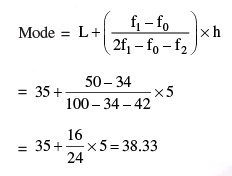
Substitute the values from the table shown above to compute the numeric value of the mode.
Section C
Q 13. Prove that 2 + 5 √3 is an irrational number, given that √3 is an irrational number
Sol.
Assume, for contradiction, that 2 + 5√3 is rational.
Then (2 + 5√3) - 2 = 5√3 is rational.
But 5 is rational, so √3 = (5√3)/5 would be rational.
This contradicts the given fact that √3 is irrational.
Therefore 2 + 5√3 is irrational.
Alternate concise contradiction method.
If 2 + 5√3 were rational then √3 would be rational; contradiction. Hence 2 + 5√3 is irrational.
OR
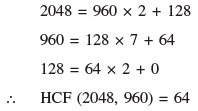
Using Euclid's Algorithm, find the HCF of 2048 and 960.
Sol.
Apply Euclid's algorithm:
2048 = 960 × 2 + 128
960 = 128 × 7 + 64
128 = 64 × 2 + 0
HCF = 64
Q 14. Two right triangles ABC and DBC are drawn on the same hypotenuse BC and on the same side of BC. If AC and BD intersect at P, prove that AP × PC = BP × DP.
Sol.
By Thales theorem, points A, B, C, D lie on a circle with BC as diameter because ∠ABC and ∠DBC are right angles (angles subtended by diameter are right angles).
AC and BD are chords of this circle and they intersect at point P.
For two chords intersecting inside a circle, the product of the segments of one chord equals the product of the segments of the other chord.
Therefore AP × PC = BP × DP.
OR
Diagonals of a trapezium PQRS intersect each other at the point O, PQ || RS and PQ = 3RS. Find the ratio of the areas of triangles POQ and ROS.
Sol.
In trapezium PQRS with PQ ∥ RS, triangles POQ and ROS are similar (corresponding angles equal).
The similarity ratio of corresponding sides equals PQ : RS = 3 : 1.
Ratio of areas = (ratio of corresponding sides)2 = 32 : 12 = 9 : 1.
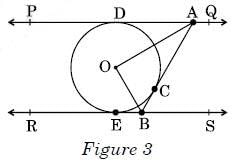
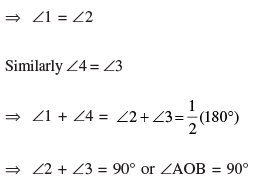
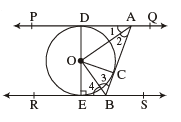
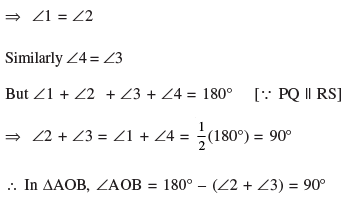
Q 15. In Figure 3, PQ and RS are two parallel tangents to a circle with centre O and another tangent AB with the point of contact C intersecting PQ at A and RS at B. Prove that ∠ AOB = 90o.
Sol.
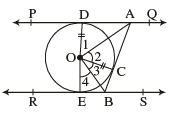
Let D and E be the points of contact of the parallel tangents PQ and RS respectively.
OD ⟂ PQ and OE ⟂ RS because radius to point of contact is perpendicular to tangent.
Since PQ ∥ RS, OD ∥ OE.
Consider triangles AOC and AOD. OC = OD (both are radii), AO is common, ∠OCA = ∠ODA = 90°.
Thus triangles AOC and AOD are congruent, giving corresponding angle equalities that imply OA is symmetric about OC.
Similarly, using triangles BOC and BOE, we get BO is symmetric about OC.
Hence OA and OB are perpendicular to each other.
Therefore ∠AOB = 90°.
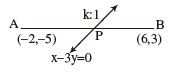
Q 16. Find the ratio in which the line x - 3y = 0 divides the line segment joining the points (- 2, - 5) and (6, 3). Find the coordinates of the point of intersection.
Sol.
Let the line x - 3y = 0 intersect AB where A(-2, -5) and B(6, 3) in the ratio k : 1, measured from A to B.
Coordinates of the point P dividing internally in ratio k : 1 are:
P = ((k·6 + (-2))/(k + 1), (k·3 + (-5))/(k + 1)).
P must satisfy x - 3y = 0, i.e., x = 3y.
((6k - 2)/(k + 1)) = 3((3k - 5)/(k + 1)).
6k - 2 = 9k - 15
13 = 3k
k = 13/3
Ratio = 13 : 3 (internal division).
Now find coordinates:
y = (3k - 5)/(k + 1) = ((13/3)·3 - 5)/((13/3) + 1) = (13 - 5)/((13 + 3)/3) = 8/(16/3) = 3/2.
x = 3y = 9/2.
Point of intersection = (9/2, 3/2).
Q 17. Evaluate :

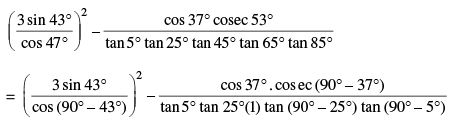
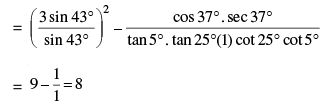
Sol.
Refer to the algebraic expressions shown in the images above.
Use standard algebraic identities and simplification steps as shown in the figures to evaluate the expressions exactly.
Substitute numerical values if any are provided in the images and simplify accordingly to obtain the final value(s).
Q 18. In Figure 4, a square OABC is inscribed in a quadrant OPBQ. If OA = 15 cm, find the area of the shaded region. (Use π = 3·14)
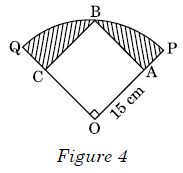
Sol.
Let side of the square = s = OA = 15 cm.
The corner opposite O of the square is at (s, s) and lies on the quarter circle of radius R, so R = √(s2 + s2) = s√2.
R = 15√2.
Area of quadrant = (1/4)πR2 = (1/4)π( (15√2)2 ) = (1/4)π(152·2) = (1/4)π·450 = (π·450)/4 = (π·225)/2.
Area of square = s2 = 225 cm2.
Shaded area = Area of quadrant - Area of square
= 225(π/2 - 1).
Using π = 3·14: π/2 = 1·57.
Shaded area = 225(1·57 - 1) = 225 × 0·57 = 128·25 cm2.
OR
In Figure 5, ABCD is a square with side 2√2 cm and inscribed in a circle. Find the area of the shaded region. (Use π = 3·14)
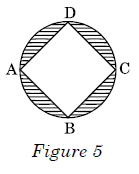
Sol.
Side of square a = 2√2 cm.
Diagonal of square = a√2 = 2√2 × √2 = 4 cm, which is the diameter of the circle.
Radius r = 2 cm.
Area of circle = πr2 = π × 4 = 12·56 (using π = 3·14).
Area of square = a2 = (2√2)2 = 8 cm2.
Shaded area = Area of circle - Area of square = 12·56 - 8 = 4·56 cm2.
Q 19. A solid is in the form of a cylinder with hemispherical ends. The total height of the solid is 20 cm and the diameter of the cylinder is 7 cm. Find the total volume of the solid. (Use π = 22/7)
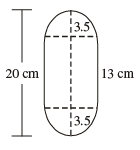
Sol.
Let the radius r = diameter/2 = 7/2 = 3·5 cm.
The two hemispheres together form a sphere of radius r.
Height of the cylindrical part = total height - diameter of hemisphere ends = 20 - 7 = 13 cm.
Volume of cylinder = π r2 h = (22/7) × (7/2)2 × 13
= (22/7) × (49/4) × 13
= 22 × 7 × 13 / 4
= 2002 / 4 = 500·5 cm3.
Volume of sphere (two hemispheres) = (4/3)π r3
= (4/3) × (22/7) × (343/8)
= 539/3 ≈ 179·6667 cm3.
Total volume = 500·5 + 179·6667 ≈ 680·1667 cm3.
Q 20. The marks obtained by 100 students in an examination are given below :

Find the mean marks of the students.
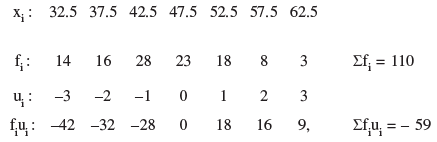

Sol.
Use the grouped data mean formula (assumed-mean or direct method) as illustrated in the images.
On carrying out the required calculations with N = 100 (see working in the figures), the mean marks ≈ 44·55.
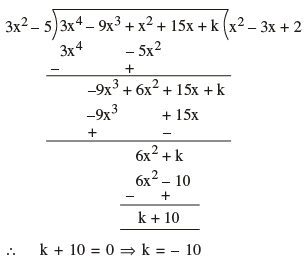
Q 21. For what value of k, is the polynomial f(x) = 3x4 - 9x3 + x2 + 15x + k completely divisible by 3x2 - 5 ?
Sol.
If 3x2 - 5 divides f(x) completely, then the roots r of 3x2 - 5 = 0 must satisfy f(r) = 0.
From 3x2 - 5 = 0, we have r2 = 5/3.
Compute f(r): f(r) = 3r4 - 9r3 + r2 + 15r + k.
But r4 = (r2)2 = (5/3)2 = 25/9, and r3 = r·r2 = r·(5/3).
So f(r) = 3·(25/9) - 9·(5/3)·r + (5/3) + 15r + k.
Simplify the r terms: -9·(5/3)·r + 15r = (-15r + 15r) = 0.
Constant terms: 3·(25/9) + 5/3 = 25/3 + 5/3 = 30/3 = 10.
Therefore f(r) = 10 + k.
For f(r) = 0 we need 10 + k = 0.
Thus k = -10.
OR
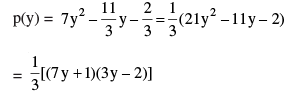
Find the zeroes of the quadratic polynomial shown in the image and verify the relationship between the zeroes and the coefficients.
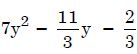
Sol.
Follow the factorisation shown in the images to obtain the zeroes (for the particular quadratic pictured the zeroes are 2/3 and -1/7).
Sum and product of zeroes verify the relations with coefficients as shown in the figures (sum = -b/a, product = c/a).
Q 22. Write all the values of p for which the quadratic equation x2 + px + 16 = 0 has equal roots. Find the roots of the equation so obtained.
Sol.
Equal roots occur when discriminant D = p2 - 4·1·16 = 0.
p2 - 64 = 0
p2 = 64
p = ±8.
For p = 8: x2 + 8x + 16 = 0 ⇒ (x + 4)2 = 0 ⇒ x = -4 (double root).
For p = -8: x2 - 8x + 16 = 0 ⇒ (x - 4)2 = 0 ⇒ x = 4 (double root).
Section D
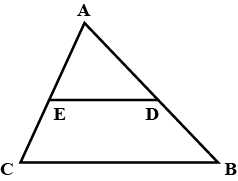
Q 23. If a line is drawn parallel to one side of a triangle to intersect the other two sides in distinct points, then prove that the other two sides are divided in the same ratio.
Sol.
Given DE ∥ BC in triangle ABC, where D is on AB and E is on AC.
Consider ΔAED and ΔACB.
∠AED = ∠ACB (corresponding angles)
∠ADE = ∠ABC (corresponding angles)
∠EAD is common to both triangles.
Therefore ΔAED ∼ ΔACB by AAA similarity.
From similarity, AE / AC = AD / AB.
Write AE/AC = AD/AB.
Replace AC by AE + EC and AB by AD + DB to get:
AE/(AE + EC) = AD/(AD + DB).
Cross-multiply and simplify to obtain EC / AE = BD / AD.
Hence EC : AE = BD : AD, which means the two sides AB and AC are divided in the same ratio.
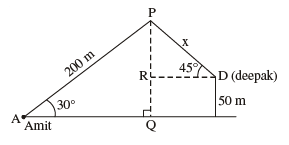
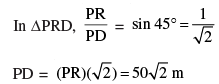
Q 24. Amit, standing on a horizontal plane, finds a bird flying at a distance of 200 m from him at an elevation of 30o. Deepak standing on the roof of a 50 m high building, finds the angle of elevation of the same bird to be 45o. Amit and Deepak are on opposite sides of the bird. Find the distance of the bird from Deepak.
Sol.
Interpret the distance 200 m as the straight-line (slant) distance from Amit to the bird at elevation 30°.
Let the bird's height above ground be H.
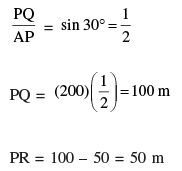
H = 200 · sin 30° = 200 × 1/2 = 100 m.
Horizontal distance from Amit to the bird = 200 · cos 30° = 200 × (√3/2) = 100√3 m (not needed further).
Deepak is on top of a building of height 50 m and sees the bird with angle of elevation 45°.
If the horizontal distance from Deepak to the bird is d, then tan 45° = (H - 50)/d = 1.
So d = H - 50 = 100 - 50 = 50 m.
Distance of the bird from Deepak (slant distance) = √(d2 + (H - 50)2) = √(502 + 502) = 50√2 m ≈ 70·71 m.
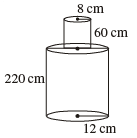
Q 25. A solid iron pole consists of a cylinder of height 220 cm and base diameter 24 cm, which is surmounted by another cylinder of height 60 cm and radius 8 cm. Find the mass of the pole, given that 1 cm3 of iron has approximately 8 gm mass. (Use π = 3·14)
Sol.
First cylinder: radius = 12 cm (diameter 24 cm), height = 220 cm.
Volume1 = π × 122 × 220 = 3·14 × 144 × 220 = 99 475·2 cm3.
Second (top) cylinder: radius = 8 cm, height = 60 cm.
Volume2 = π × 82 × 60 = 3·14 × 64 × 60 = 12 057·6 cm3.
Total volume = 99 475·2 + 12 057·6 = 111 532·8 cm3.
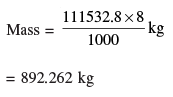
Mass = total volume × 8 gm/cm3 = 111 532·8 × 8 = 892 262·4 g = 892·2624 kg = 892·26 kg (approx).
Q 26. Construct an equilateral ΔABC with each side 5 cm. Then construct another triangle whose sides are 2/3 times the corresponding sides of ΔABC
OR
Draw two concentric circles of radii 2 cm and 5 cm. Take a point P on the outer circle and construct a pair of tangents PA and PB to the smaller circle. Measure PA.
Sol.
Construction steps (first problem):
Draw a segment of length 5 cm. With the ends as centres and radius 5 cm draw two arcs intersecting at the third vertex. Join to form equilateral ΔABC.
To construct the similar triangle with scale factor 2/3, multiply each side by 2/3 using proportional construction (or use centre of similarity at one vertex and take rays with lengths 2/3 of the corresponding sides).
For the alternate construction (two concentric circles of radii 2 cm and 5 cm): draw concentric circles with given radii, take P on outer circle, draw tangents from P to the smaller circle using standard tangent construction. Measure PA; PA ≈ 4·5 cm (approx) as obtained by construction.
Q 27. Change the following data into 'less than type' distribution and draw its ogive :


Sol.
Convert the class-interval frequency table into a cumulative 'less than' frequency table.
Plot the points: (upper class boundary, cumulative frequency) as shown: (40, 7), (50, 12), (60, 20), (70, 30), (80, 36), (90, 42) and (100, 50).
Join the plotted points smoothly to obtain the less-than ogive.
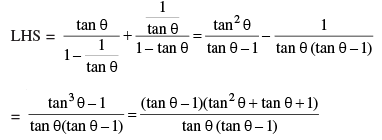
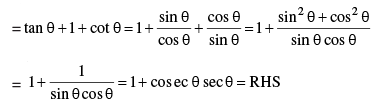
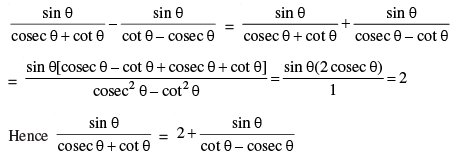
Q 28. Prove that :

OR
Prove that :

Sol.
Follow the algebraic/manipulative steps shown in the images to prove the identities. The images display the sequence of algebraic transformations and the final equality; verify each equality line-by-line as shown.
For the alternate forms and the third case depicted in the images, consider the substitution or factorisation steps given and complete the proof accordingly.
Q 29. Which term of the Arithmetic Progression -7, -12, -17, -22, ... will be -82? Is -100 any term of the A.P. ? Give a reason for your answer.
Sol.
General term of A.P.: an = a + (n - 1)d, where a = -7, d = -5.
Put an = -82.
-82 = -7 + (n - 1)(-5)
-82 + 7 = -5(n - 1)
-75 = -5(n - 1)
n - 1 = 15
n = 16.
So -82 is the 16th term.
For -100:
-100 = -7 + (m - 1)(-5)
-93 = -5(m - 1)
m - 1 = 18·6 (not an integer)
Therefore -100 is not a term of the A.P. because the position is not a positive integer.
OR
How many terms of the Arithmetic Progression 45, 39, 33, ... must be taken so that their sum is 180? Explain the double answer.
Sol.
Here a = 45, d = -6, Sn = 180.
Sn = n/2 [2a + (n - 1)d] = 180.
n/2 [90 + (n - 1)(-6)] = 180.
n[90 - 6(n - 1)] = 360.
n[96 - 6n] = 360.
-6n2 + 96n - 360 = 0.
Divide by -6: n2 - 16n + 60 = 0.
(n - 10)(n - 6) = 0.
So n = 10 or n = 6. Both are valid and correspond to taking 10 terms or 6 terms whose sums each equal 180 (explaining the double answer).
Q 30. In a class test, the sum of Arun's marks in Hindi and English is 30. Had he got 2 marks more in Hindi and 3 marks less in English, the product of the marks would have been 210. Find his marks in the two subjects.
Sol.
Let marks in Hindi = x, marks in English = 30 - x.
After the change: (x + 2)(30 - x - 3) = 210.
(x + 2)(27 - x) = 210.
27x - x2 + 54 - 2x = 210.
-x2 + 25x + 54 - 210 = 0.
-x2 + 25x - 156 = 0.
x2 - 25x + 156 = 0.
Factor: (x - 13)(x - 12) = 0.
x = 13 or x = 12.
If x = 13, English = 17.
If x = 12, English = 18.
Hence possible marks (Hindi, English) are (13, 17) or (12, 18).
FAQs on Math Past Year Paper with Solution - 2019, Class 10
| 1. What is the format of the Class 10 Math Past Year Paper with Solution for 2019? |  |
| 2. How many questions are included in each section of the Class 10 Math Past Year Paper with Solution for 2019? | |
| 3. Are the solutions provided for all the questions in the Class 10 Math Past Year Paper with Solution for 2019? | |
| 4. Can the Class 10 Math Past Year Paper with Solution for 2019 be used for exam preparation? | |
| 5. Where can I find the Class 10 Math Past Year Paper with Solution for 2019? | |


