Overview: Magnetic Effects of Electric Current


Magnetism
Magnetism is a phenomenon by which materials such as iron, nickel and cobalt exert attractive or repulsive forces on other materials. A magnet attracts iron or iron-like substances. Electric currents produce magnetic effects; conversely, moving magnets can produce electric effects. Devices such as electromagnets, electric motors and electric generators exploit these relationships between electricity and magnetism. A simple demonstration of the magnetic effect of an electric current is that a compass needle placed near a current-carrying conductor gets deflected.
Properties of Magnets
- Every magnet has two ends called poles: the North pole and the South pole.
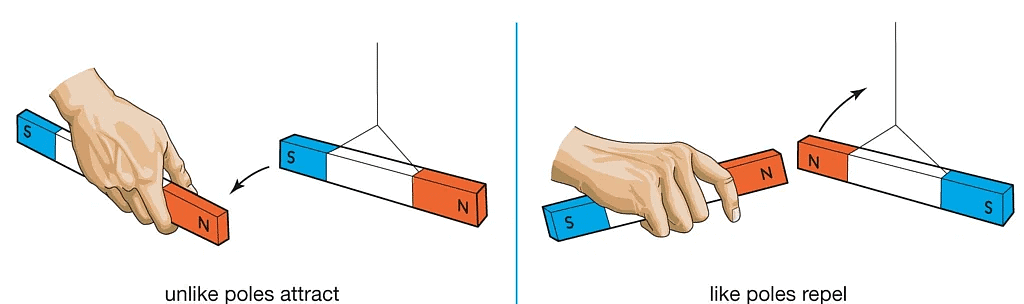
- Like poles repel each other and unlike poles attract each other.
- A freely suspended bar magnet aligns itself approximately in the north-south direction with its north pole pointing towards the geographic north.
- Magnets can be permanent (retain magnetism) or temporary/electromagnets (magnetism appears only when current flows).
Characteristics of Magnetic Field Lines
- Magnetic field lines originate from the North pole of a magnet and terminate at the South pole outside the magnet.
- Magnetic field lines are continuous closed curves; inside the magnet they go from South to North, completing the loop.
- Field lines never intersect each other.
- The closeness (density) of magnetic field lines indicates the relative strength of the magnetic field at that region: field lines closer together mean a stronger field.
- Field lines around simple magnets and current arrangements can be sketched to show direction and relative strength.
Magnetic Field of a Bar Magnet and Magnetic Effect of Electric Current
Hans Christian Oersted observed that an electric current produces a magnetic field. This fundamental discovery links electricity and magnetism and leads to the study of magnetic fields created by currents in conductors.
- Around a straight current-carrying conductor, magnetic field lines form concentric circles centred on the conductor.
- The direction of these circular magnetic field lines can be found by the Right Hand Thumb Rule (also called right-hand grip rule): if the thumb of the right hand points in the direction of the conventional current, the curled fingers show the direction of the magnetic field lines.
- The magnetic field strength around a straight conductor depends directly on the current and decreases with distance from the conductor. Qualitatively, magnetic field ∝ current (I) and decreases as distance (r) from the conductor increases.
Magnetic Field due to a Circular Current Loop
- A circular loop carrying current produces magnetic field lines that are concentric in the plane of the loop and form loops that pass through the centre of the ring.
- The magnetic field at the centre of a single circular loop is stronger when the current is larger and when the loop radius is smaller.
- For many turns (a coil), fields due to each turn add up and give a stronger field along the axis of the coil.
Solenoid
- A solenoid is a long coil of many circular turns of insulated wire wound closely in a cylindrical form.
- The magnetic field inside a long solenoid is nearly uniform and its field lines are almost parallel; outside, the field resembles that of a bar magnet.
- Inside the solenoid, field lines run from South to North, and outside from North to South.
- Placing a soft iron core inside a solenoid increases the magnetic field strength; this arrangement is used to make strong electromagnets.
Electromagnets versus Permanent Magnets
- Electromagnets become magnets when electric current flows through the coil; they can be switched on or off, their strength and polarity can be changed by varying current and winding.
- Permanent magnets retain their magnetism without a current and have a fixed polarity and strength under normal conditions.
- Electromagnets are widely used where variable magnetic force is needed (e.g., cranes for lifting scrap, electric bells, relays); permanent magnets are used where a constant field is required (e.g., refrigerator magnets, compass needles).
Force on a Current-Carrying Conductor in a Magnetic Field
André-Marie Ampère proposed that a magnetic field exerts a force on a current-carrying conductor placed in it. The magnitude and direction of this force depend on the current, the magnetic field and their relative orientation.
- The force on a straight conductor of length L carrying current I in a magnetic field of flux density B is given by F = B I L sinθ, where θ is the angle between the direction of current and the magnetic field.
- The force is maximal when the conductor is perpendicular to the magnetic field (θ = 90°) and zero when it is parallel (θ = 0°).
- If the direction of current is reversed, the direction of force is also reversed.
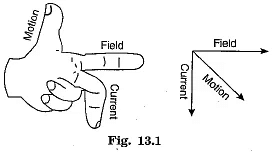
- The Fleming's Left Hand Rule helps determine the direction of force: hold the thumb, forefinger and middle finger of the left hand at right angles; the forefinger indicates the magnetic field (from North to South), the middle finger indicates the direction of current (from positive to negative conventional current), and the thumb the direction of force (motion) on the conductor.
Electric Motors
An electric motor converts electrical energy into mechanical energy using the magnetic force on a current-carrying coil placed in a magnetic field.
- A typical simple motor has a rectangular coil of insulated copper wire placed between poles of a magnet. When current flows through the coil, forces on the two sides of the coil produce a torque and cause rotation.
- A split-ring commutator is used in a DC motor to reverse the direction of current in the coil every half turn; this reversal ensures the torque acts in the same rotational sense and the coil continues to rotate.
- Permanent magnets or electromagnets can provide the stationary magnetic field (stator); the rotating part with windings is the armature (rotor).
Electric Generators
An electric generator converts mechanical energy into electrical energy by rotating a coil in a magnetic field and using electromagnetic induction to produce an induced emf.
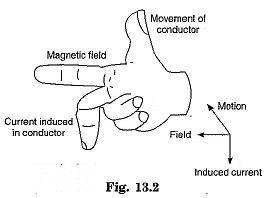
- When a rectangular coil rotates in a magnetic field, the magnetic flux through the coil changes with time; according to Faraday's law of electromagnetic induction, this changing flux induces an emf in the coil.
- If the coil is connected to external circuit through slip rings, the output is alternating current (AC). If a split-ring commutator is used, the output is direct current (DC).
- Generators are the primary sources of electrical energy in power stations: mechanical energy (from turbines driven by water, steam, wind, etc.) is converted into electrical energy.
Domestic Electric Circuits and Safety
- Domestic wiring typically uses three wires: live (carries current to the appliance), neutral (returns current to the supply), and earth (or ground) (safety path for fault current).
- In India the usual supply between live and neutral is about 220 V (single-phase). Colour codes commonly used are live - red, neutral - black, earth - green.
- Safety devices include:
- Fuse: a thin wire that melts when excessive current flows, breaking the circuit and preventing overheating and fire.
- Miniature Circuit Breaker (MCB): an automatic switch that trips when current exceeds a safe limit and can be reset after the fault is cleared.
- Earth wire: provides a low resistance path to earth so that in case of insulation failure, dangerous currents are diverted away from users, reducing risk of electric shock.
Proper wiring, earthing and the use of safety devices help prevent electrical accidents in homes and buildings.
Summary
The magnetic effects of electric current form the basis of many electrical devices. Current-carrying conductors produce magnetic fields whose direction can be determined by the right-hand rule. Coils and solenoids produce strong fields that can be used as electromagnets. A conductor in a magnetic field experiences a force; this principle powers motors. Conversely, changing magnetic flux through a coil induces an emf; this principle operates in generators. Understanding these concepts and following safe domestic wiring practices are essential for both applications and safety.
FAQs on Overview: Magnetic Effects of Electric Current
| 1. What is magnetism? |  |
| 2. What are the magnetic effects of electric current? | |
| 3. How does an electromagnet work? | |
| 4. What is the relationship between magnetism and electricity? | |
| 5. How are magnetic fields produced by electric currents used in everyday life? | |





