NCERT Exemplar: Magnetic Effects of Electric Current

Multiple Choice Questions
Q.1. Choose the incorrect statement from the following regarding magnetic lines of field
(a) The direction of magnetic field at a point is taken to be the direction in which the north pole of a magnetic compass needle points
(b) Magnetic field lines are closed curves
(c) If magnetic field lines are parallel and equidistant, they represent zero field strength
(d) Relative strength of magnetic field is shown by the degree of closeness of the field lines
Ans: (c)
Explanation: Parallel and equidistant magnetic field lines indicate a uniform magnetic field of constant, non-zero strength, not a zero field. The closeness of field lines shows the relative strength - closer lines mean stronger field. Statements (a), (b) and (d) are correct: a compass needle shows the field direction, magnetic lines form closed curves, and the degree of closeness represents relative field strength.
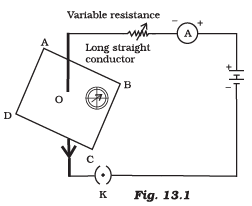
Q.2. If the key in the arrangement (Figure 13.1) is taken out (the circuit is made open) and magnetic field lines are drawn over the horizontal plane ABCD, the lines are
(a) concentric circles
(b) elliptical in shape
(c) straight lines parallel to each other
(d) concentric circles near the point O but of elliptical shapes as we go away from it
Ans: (c)
Explanation: When the key is removed the circuit is open and no current flows in the wire. Therefore no circular magnetic field is produced by the conductor. Only the Earth's magnetic field (approximately uniform over a small region) remains, and its field lines on the horizontal plane appear as straight, parallel lines. Thus option (c) is correct.
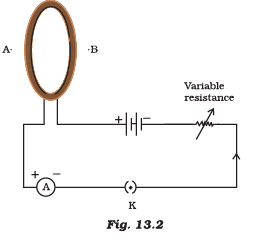
Q.3. A circular loop placed in a plane perpendicular to the plane of paper carries a current when the key is ON. The current as seen from points A and B (in the plane of paper and on the axis of the coil) is anti clockwise and clockwise respectively. The magnetic field lines point from B to A. The N-pole of the resultant magnet is on the face close to
(a) A
(b) B
(c) A if the current is small, and B if the current is large
(d) B if the current is small and A if the current is large
Ans: (a)
Explanation: Using the right-hand rule for a circular current loop: when the current is seen as anticlockwise from A, the face at A behaves as the north pole. The given directions (anticlockwise at A and clockwise at B) and the stated field direction from B to A confirm that the face nearer to A is the N-pole. The result is independent of the current magnitude, so option (a) is correct.
Q.4. For a current in a long straight solenoid N- and S-poles are created at the two ends. Among the following statements, the incorrect statement is
(a) The field lines inside the solenoid are in the form of straight lines which indicates that the magnetic field is the same at all points inside the solenoid
(b) The strong magnetic field produced inside the solenoid can be used to magnetise a piece of magnetic material like soft iron, when placed inside the coil
(c) The pattern of the magnetic field associated with the solenoid is different from the pattern of the magnetic field around a bar magnet
(d) The N- and S-poles exchange position when the direction of current through the solenoid is reversed
Ans: (c)
Explanation: The magnetic field pattern of a long solenoid closely resembles that of a bar magnet: straight, nearly uniform field lines inside and curved lines outside forming a dipole pattern. Thus statement (c) is incorrect. Statements (a), (b) and (d) are correct: the internal field is approximately uniform, soft iron placed inside becomes strongly magnetised, and reversing current reverses the poles.
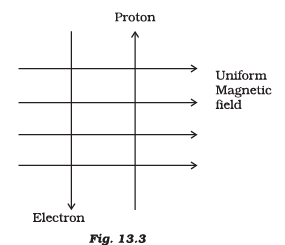
Q.5. A uniform magnetic field exists in the plane of paper pointing from left to right as shown in Figure 13.3. In the field an electron and a proton move as shown. The electron and the proton experience
(a) forces both pointing into the plane of paper
(b) forces both pointing out of the plane of paper
(c) forces pointing into the plane of paper and out of the plane of paper, respectively
(d) force pointing opposite and along the direction of the uniform magnetic field respectively
Ans: (a)
Explanation: The magnetic force on a charged particle is given by q(v × B). For the given directions of velocity and field (as shown in the figure), the cross product gives a force into the plane for the proton (positive charge). An electron (negative charge) experiences force in the direction opposite to q(v × B); with its given velocity this also results in a force into the plane. Hence both forces point into the plane, so option (a) is correct.
Q.6. Commercial electric motors do not use
(a) an electromagnet to rotate the armature
(b) effectively large number of turns of conducting wire in the current carrying coil
(c) a permanent magnet to rotate the armature
(d) a soft iron core on which the coil is wound
Ans: (c)
Explanation: Modern commercial motors generally use field coils (electromagnets) rather than permanent magnets to produce the required magnetic field; this allows stronger and controllable fields and better performance. They do use many turns of wire and soft iron cores to enhance the magnetic effect. Therefore option (c) is not used in most commercial motors.
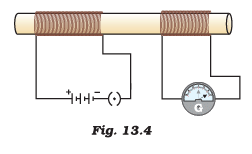
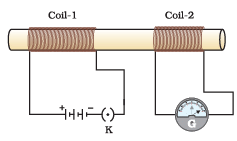
Q.7. In the arrangement shown in Figure 13.4 there are two coils wound on a non-conducting cylindrical rod. Initially the key is not inserted. Then the key is inserted and later removed. Then
(a) the deflection in the galvanometer remains zero throughout
(b) there is a momentary deflection in the galvanometer but it dies out shortly and there is no effect when the key is removed
(c) there are momentary galvanometer deflections that die out shortly; the deflections are in the same direction
(d) there are momentary galvanometer deflections that die out shortly; the deflections are in opposite directions
Ans: (d)
Explanation: When the key is inserted the current in the primary coil changes from zero to a steady value, producing a changing magnetic flux through the secondary coil and a momentary induced current in one direction (a galvanometer deflection). When the key is later removed the flux changes in the opposite sense and a momentary induced current appears in the opposite direction. Both deflections are transient and then die out, so option (d) is correct.
Q.8. Choose the incorrect statement
(a) Fleming's right-hand rule is a simple rule to know the direction of induced current
(b) The right-hand thumb rule is used to find the direction of magnetic fields due to current carrying conductors
(c) The difference between the direct and alternating currents is that the direct current always flows in one direction, whereas the alternating current reverses its direction periodically
(d) In India, the AC changes direction after every 1/50 second
Ans: (d)
Explanation: The AC mains in India has frequency 50 Hz, so one full cycle takes 1/50 s (0.02 s). However, the direction of current reverses twice during each cycle, so the direction actually changes every 1/100 s (0.01 s). Thus the statement that AC changes direction after every 1/50 s is incorrect. Statements (a), (b) and (c) are correct.
Q.9. A constant current flows in a horizontal wire in the plane of the paper from east to west as shown in Figure 13.5. The direction of magnetic field at a point will be North to South
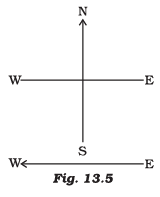
(a) directly above the wire
(b) directly below the wire
(c) at a point located in the plane of the paper, on the north side of the wire
(d) at a point located in the plane of the paper, on the south side of the wire
Ans: (b)
Explanation: Apply the right-hand thumb rule: thumb points in direction of current (east to west) and curled fingers show field direction. Directly below the wire the magnetic field points from north to south. Hence option (b) is correct.
Q.10. The strength of magnetic field inside a long current carrying straight solenoid is
(a) more at the ends than at the centre
(b) minimum in the middle
(c) same at all points
(d) found to increase from one end to the other
Ans: (c)
Explanation: For a long solenoid the magnetic field in the central region is approximately uniform and nearly the same at all interior points. Edge effects near the ends cause some variation there, but inside a long solenoid the field strength is effectively the same throughout the interior.
Q.11. To convert an AC generator into DC generator
(a) split-ring type commutator must be used
(b) slip rings and brushes must be used
(c) a stronger magnetic field has to be used
(d) a rectangular wire loop has to be used
Ans: (a)
Explanation: An AC generator uses slip rings which deliver alternating current to the external circuit. To obtain direct current in the external circuit, a split-ring commutator is used; it reverses the connection to the rotating coil every half turn so that the external current flows in one direction only. Thus option (a) is correct.
Q.12. The most important safety method used for protecting home appliances from short circuiting or overloading is
(a) earthing
(b) use of fuse
(c) use of stabilizers
(d) use of electric meter
Ans: (b)
Explanation: A fuse placed in series with an appliance melts (opens the circuit) when the current exceeds its rated value, protecting appliances from damage due to short circuits or overloading. Earthing and stabilizers are also safety measures, but the primary protection against excessive current is the fuse, so option (b) is the most appropriate choice.
Short Answer Type Questions
Q.13. A magnetic compass needle is placed in the plane of paper near point A as shown in Figure 13.6. In which plane should a straight current carrying conductor be placed so that it passes through A and there is no change in the deflection of the compass? Under what condition is the deflection maximum and why?
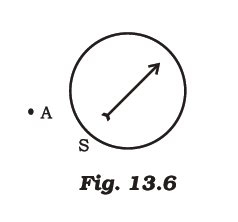
Ans: Place the straight current-carrying conductor in the plane of the paper so that it passes through A and produces a magnetic field at A directed perpendicular to the plane (vertical). In this arrangement the field produced by the conductor is vertical and does not affect the horizontal compass needle, so there is no change in its deflection. The deflection is maximum when the conductor is perpendicular to the plane of the paper (i.e. the wire comes out of or goes into the plane). Then the magnetic field at A lies in the plane of the paper and adds vectorially to the Earth's horizontal field, producing the largest change in the needle's direction.
Q.14. Under what conditions permanent electromagnet is obtained if a current carrying solenoid is used? Support your answer with the help of a labelled circuit diagram.
Ans: To obtain a permanent magnet using a solenoid you need:
- A solenoid wound with many turns of wire and connected to a steady DC source so that a strong magnetic field is produced.
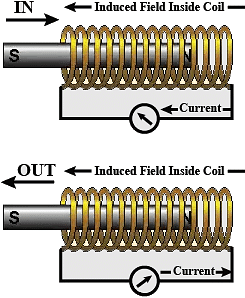
- A bar of a hard ferromagnetic material (such as hardened steel) placed inside the solenoid; this material must have high retentivity so that it retains magnetisation after the current is switched off.
- Appropriate magnetising current and, if required, a suitable treatment to set the magnetism in the bar.
The circuit diagram shows a DC source, a switch and the solenoid with the ferromagnetic rod inside (refer to the given figure). When DC flows through the coil the bar is magnetised; if the bar has permanent-magnet properties it will retain much of this magnetisation when the current is removed.
Q.15. AB is a current carrying conductor in the plane of the paper as shown in Figure 13.7. What are the directions of magnetic fields produced by it at points P and Q? Given r1 > r2, where will the strength of the magnetic field be larger?
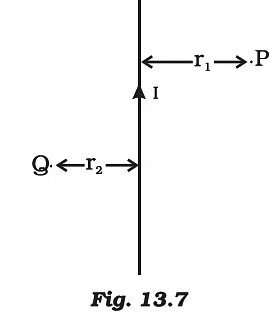
Ans: Using the right-hand thumb rule:
- At point P the magnetic field is into the plane of the paper.
- At point Q the magnetic field is out of the plane of the paper.
Since magnetic field magnitude around a long straight conductor varies inversely with distance from the wire (B ∝ 1/r), and r1 > r2, the field strength at Q (closer to the wire) is larger than at P.
Q.16. A magnetic compass shows a deflection when placed near a current carrying wire. How will the deflection of the compass get affected if the current in the wire is increased? Support your answer with a reason.
Ans: The deflection of the compass will increase. Reason: The magnetic field produced by the straight current-carrying conductor is directly proportional to the current. Increasing the current increases the magnetic field at the compass position, so the needle experiences a larger torque and deflects more.
Q.17. It is established that an electric current through a metallic conductor produces a magnetic field around it. Is there a similar magnetic field produced around a thin beam of moving (i) alpha particles, (ii) neutrons?
Justify your answer.
Ans:
(i) Alpha particles are positively charged; a beam of moving alpha particles constitutes an electric current and therefore produces a magnetic field around it.
(ii) Neutrons are electrically neutral; a beam of neutrons does not constitute an electric current, and so it does not produce a macroscopic magnetic field in the same way. (Note: details of intrinsic magnetic moments of neutrons are beyond the scope of this class.)
Q.18. What does the direction of thumb indicate in the right-hand thumb rule. In what way this rule is different from Fleming's left-hand rule?
Ans: In the right-hand thumb rule the thumb shows the direction of the electric current in a straight conductor, while the curled fingers show the direction of the magnetic field lines around the conductor. Fleming's left-hand rule is different: it is used to find the direction of the force (motion) on a current-carrying conductor placed in an external magnetic field - the thumb gives the direction of force (motion), the first finger the magnetic field, and the second finger the current.
Q.19. Meena draws magnetic field lines of field close to the axis of a current carrying circular loop. As she moves away from the centre of the circular loop, she observes that the lines keep on diverging. How will you explain her observation?
Ans: Divergence of the field lines as one moves away from the centre shows that the magnetic field strength decreases with distance from the loop. The degree of closeness of field lines represents field strength - lines spreading out means the field becomes weaker further from the coil.
Q.20. What does the divergence of magnetic field lines near the ends of a current carrying straight solenoid indicate?
Ans: The divergence of field lines near and beyond the ends of a solenoid indicates a fall in the magnetic field strength in those regions. Inside the solenoid the lines are close and nearly parallel (strong and uniform field); near the ends they spread out showing the field weakens and becomes non-uniform.
Q.21. Name four appliances wherein an electric motor, a rotating device that converts electrical energy to mechanical energy, is used as an important component. In what respect motors are different from generators?
Ans: Examples: electric fans, mixers/grinders, washing machines and computer hard-disk drives (or vacuum cleaners, refrigerators, etc.). Motors convert electrical energy into mechanical energy, whereas generators convert mechanical energy into electrical energy.
Q.22. What is the role of the two conducting stationary brushes in a simple electric motor?
Ans: The two stationary brushes provide an electrical connection between the external DC source and the rotating split-ring commutator. They press against the split rings so that current is supplied to the rotating coil while still allowing the coil to turn. In short, brushes conduct current to and from the rotating part of the motor.
Q.23. What is the difference between a direct current and an alternating current? How many times does AC used in India change direction in one second?
Ans: Direct current (DC) flows steadily in one direction only. Alternating current (AC) reverses its direction periodically. The AC mains in India has frequency 50 Hz; in each cycle the direction changes twice, so the current changes direction 2 × 50 = 100 times per second.
Q.24. What is the role of fuse, used in series with any electrical appliance? Why should a fuse with defined rating not be replaced by one with a larger rating?
Ans: A fuse is a safety device placed in series with an appliance; it melts and opens the circuit when the current exceeds its rated value, thereby protecting the appliance and wiring from damage due to short-circuit or overload. Replacing a fuse with a higher-rated one defeats this protection: the fuse would not blow for dangerous currents and the appliance or wiring could be damaged or cause fire. Therefore a blown fuse must be replaced only with one of the same rating.
Long Answer Type Questions
Q.25. Why does a magnetic compass needle pointing North and South in the absence of a nearby magnet get deflected when a bar magnet or a current carrying loop is brought near it. Describe some salient features of magnetic lines of field concept.Ans: The compass needle aligns along the resultant magnetic field at its location. In the absence of nearby magnets it points along the Earth's magnetic field (approximately north-south). When a bar magnet or a current-carrying loop is brought near, these produce their own magnetic field which adds vectorially to the Earth's field at the compass position. The resultant field has a different direction and magnitude, so the needle deflects.
Salient features of magnetic field lines:
- Magnetic field at a point has both direction and magnitude; field lines show the direction at each point.
- Field lines form continuous closed curves; outside a magnet they are drawn from the north pole to the south pole.
- Two magnetic field lines never intersect.
- The closeness of field lines indicates field strength - closer lines mean a stronger field.
- Field lines are nearly straight and parallel inside a long solenoid (uniform field) and spread out near the ends showing weakening of the field.
Q.26. With the help of a labelled circuit diagram illustrate the pattern of field lines of the magnetic field around a current carrying straight long conducting wire. How is the right hand thumb rule useful to find direction of magnetic field associated with a current carrying conductor?
Ans: The magnetic field around a long straight current-carrying wire forms concentric circles centred on the wire; the plane of each circle is perpendicular to the wire (refer to the figure below). The right-hand thumb rule gives the direction of these circular field lines: if you hold the wire with your right hand so that the thumb points in the direction of current, the curled fingers show the direction of the magnetic field around the wire.
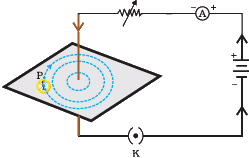
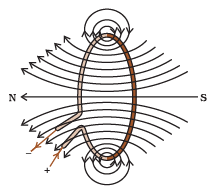
Q.27. Explain with the help of a labelled diagram the distribution of magnetic field due to a current through a circular loop. Why is it that if a current carrying coil has n turns the field produced at any point is n times as large as that produced by a single turn?
Ans: The magnetic field lines due to a circular current loop emerge from one side of the loop, converge near the axis, and form patterns similar to that of a magnetic dipole (see figure). At the centre of the loop the magnetic field is strong and approximately along the axis; as we move away from the centre the field decreases and the field lines spread out.
If the coil has N closely spaced turns, each turn carries the same current and produces a magnetic field of the same direction at the given point. By superposition, the total field is the sum of fields due to individual turns, so the field produced by N turns is N times the field produced by one turn (B ∝ N).
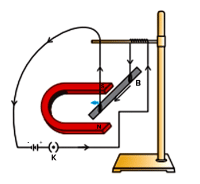
Q.28. Describe the activity that shows that a current-carrying conductor experiences a force perpendicular to its length and the external magnetic field. How does Fleming's left-hand rule help us to find the direction of the force acting on the current carrying conductor?
Ans:
Activity for a current-carrying conductor:
- Suspend a small conducting rod horizontally from a stand so it can swing freely.
- Place a strong magnet so that its field is approximately vertical at the rod (north pole below and south pole above, or vice versa).
- Connect the rod in series with a battery, a switch and a rheostat so current can be passed through the rod.
- Switch on and pass current along the rod; the rod is observed to experience a sideways force and moves. Reversing the current or reversing the magnet poles reverses the direction of motion.
Fleming's left-hand rule: Stretch the thumb, first finger and second finger of the left hand mutually perpendicular. The first finger indicates the direction of the magnetic field, the second finger the direction of the electric current, and the thumb the direction of the force (motion) on the conductor. This rule gives the direction of the force which is perpendicular to both the current and the magnetic field.
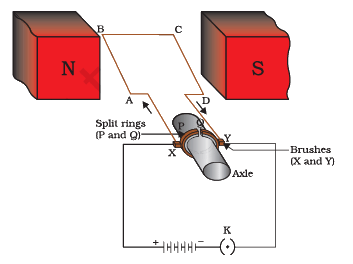
Q.29. Draw a labelled circuit diagram of a simple electric motor and explain its working. In what way these simple electric motors are diffferent from commercial motors?
Ans: Principle: A rectangular coil carrying current, placed in a magnetic field, experiences forces on its sides that produce a torque and make the coil rotate. Key parts are permanent magnets (or field coils), an armature (rectangular coil on an axle), a split-ring commutator and brushes (refer to figure).
Working:
- When current flows through the coil, opposite forces act on its opposite sides due to the magnetic field, producing a torque that rotates the coil.
- When the coil rotates through 90°, the commutator reverses the connection of the coil to the external circuit so that the direction of current in the coil reverses; this keeps the torque in the same rotational sense and ensures continuous rotation.
- Brushes provide current to the rotating commutator while allowing it to turn.
Difference from commercial motors: Simple demonstration motors often use permanent magnets for the field, whereas commercial motors usually use field coils (electromagnets) and have many refinements (better bearings, multiple coils, improved commutation or use of electronic controllers) to provide stronger, more efficient and controllable torque for practical use.
Q.30. Explain the phenomenon of electromagnetic induction. Describe an experiment to show that a current is set up in a closed loop when an external magnetic field passing through the loop increases or decreases.
Ans: Electromagnetic induction is the production of an electromotive force (emf) in a conductor when the magnetic flux linked with it changes. A changing magnetic flux through a closed loop induces an emf and, if the loop is closed, a current.
Experiment: Two coils (coil-1 and coil-2) are wound on a common non-conducting cylindrical former. Coil-1 is connected to a battery with a key; coil-2 is connected to a galvanometer (refer to figure).
When the key is closed, the current in coil-1 rises rapidly and the magnetic flux through coil-2 changes; the galvanometer shows a momentary deflection indicating an induced current in coil-2. When the key is opened, the flux through coil-2 changes again in the opposite sense and the galvanometer deflects momentarily in the opposite direction. If the current in coil-1 is steady, there is no induced current in coil-2. These observations show that a changing external magnetic field linked with a closed loop induces a current in that loop.
Q.31. Describe the working of an AC generator with the help of a labelled circuit diagram. What changes must be made in the arrangement to convert it to a DC generator?
Ans:
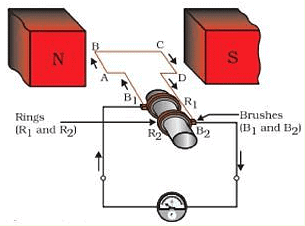
- In an AC generator a coil is rotated in a magnetic field. As the coil turns, the magnetic flux through the coil changes and an emf is induced; the direction of the induced emf reverses every half turn, producing alternating current in the external circuit.
- When the coil side AB moves down and CD moves up (or vice versa), the directions of induced currents in the arms reverse after half a rotation, so the external current alternates between B2→B1 and B1→B2, and so on.
To convert an AC generator into a DC generator, replace the slip rings by a split-ring commutator. The split commutator reverses the connection to the external circuit every half turn so that the external output is unidirectional (direct current) even though the induced emf in the coil alternates.
Q.32. Draw an appropriate schematic diagram showing common domestic circuits and discuss the importance of fuse. Why is it that a burnt out fuse should be replaced by another fuse of identical rating?
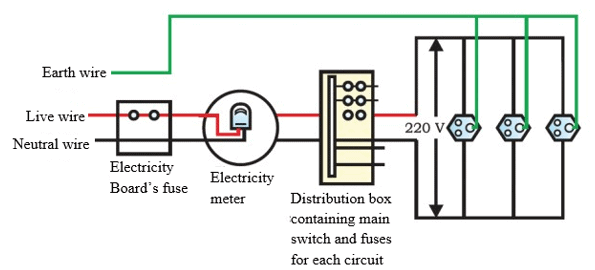
- A schematic diagram for common domestic circuit is shown (line, neutral, switches, fuse, and earthing connections as appropriate):
- Importance of fuse: A fuse is a simple and important safety device that protects circuits and appliances from excessive current due to short circuits or overloads. When the current exceeds the fuse rating, the fuse wire melts and interrupts the circuit, preventing damage and reducing the risk of fire.
- A burnt fuse should be replaced only by another fuse of the identical rating because the rating is chosen to protect the wiring and appliances. A higher-rated fuse would not blow at dangerous currents and so would fail to protect the circuit; a lower-rated fuse might blow under normal operation. Thus identical rating ensures correct protection.
FAQs on NCERT Exemplar: Magnetic Effects of Electric Current
| 1. What is the right-hand thumb rule and how do I use it to find magnetic field direction? |  |
| 2. Why does a current-carrying wire experience force in a magnetic field? | |
| 3. How do I calculate the strength of magnetic field produced by a straight wire carrying current? | |
| 4. What's the difference between a solenoid and a simple coil in terms of magnetic properties? | |
| 5. How does increasing the number of turns in a coil affect its magnetic field strength? | |





