Short Notes: Power-sharing


Introduction
Democracy requires not only regular elections but also arrangements that enable different social groups and institutions to share power. Power-sharing means the distribution of authority among different social groups and among various organs and levels of government so that citizens of diverse groups can participate in governance and no single group can dominate permanently. Effective power-sharing helps maintain stability, prevents conflict, and strengthens the legitimacy of government.
Power-sharing in Belgium and Sri Lanka
Belgium
- Belgium has a complex ethnic and linguistic composition: about 59% of the population live in the Flemish region (where Dutch is the main language), 40% live in the Wallonia region (where French is the main language), and about 1% speak German.
- In Brussels roughly 80% speak French and 20% speak Dutch.
- There were historical tensions because French-speaking groups were relatively more powerful economically and politically than Dutch-speaking groups.
- To reduce conflict the country evolved arrangements of power-sharing that give both communities a stake in political decision making.
Sri Lanka
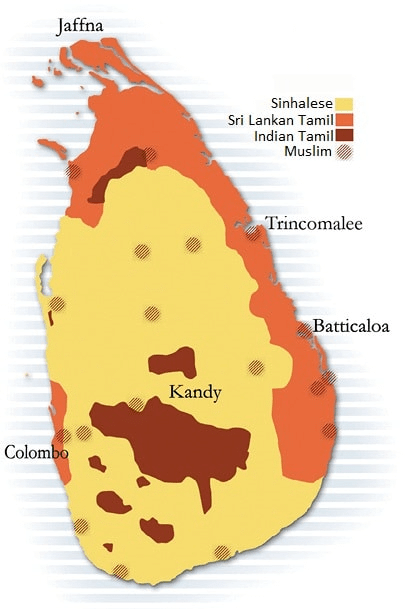
- Sri Lanka has a diverse population: Sinhala-speaking people are about 74%, Tamil-speaking about 18%, and Christians are around 7%.
- Most Sinhala speakers are Buddhists, while Tamils are mainly Hindus or Muslims.
- Differences in language, religion and regional concentration of communities created political tensions, especially when one community's preferences were translated into government policy without adequate safeguards for minorities.
Majoritarianism in Sri Lanka
The situations in Belgium and Sri Lanka were similar in being multi-ethnic and multilingual, but the outcomes differed because of the political choices made. In Sri Lanka the majority community adopted policies that established their dominance rather than accommodating minorities.
- The Sinhala majority dominated government and adopted majoritarian measures to assert cultural and political supremacy.
- The Official Language Act of 1956 (commonly known as the "Sinhala Only" Act) made Sinhala the only official language, creating immediate disadvantages for Tamil speakers in administration and public employment.
- Other preferential policies favoured the majority and measures were also taken to protect and promote Buddhism.
- Result: growing distrust and conflict between communities, a sense of alienation among Sri Lankan Tamils, denial of equal rights, and prolonged struggles for autonomy which ultimately led to a civil war.
- The conflict had severe social, cultural and economic consequences for the country and the armed struggle formally ended in 2009.
Accommodation in Belgium
Belgium adopted a policy of accommodation to manage differences and avoid major conflict. The principal features of this approach are listed below.
- At the national level there is a practice of having an equal number of Dutch and French-speaking ministers in the central government to ensure representation of both communities.
- Belgium evolved into a federal structure in which regional governments have substantial powers; the state governments are not subordinate in all matters to the central government.
- There are community governments that manage cultural, educational and linguistic affairs for their respective communities.
- In Brussels there is a special arrangement with government institutions that ensure equal representation of both language communities despite the city's mixed population.
- Results: these arrangements prevented serious civic strife between the two major linguistic communities and avoided a lasting division on linguistic lines.
- Because of its stable accommodation among communities, Brussels later became the headquarters of the European Union, highlighting the success of its power-sharing model.
Why power-sharing is desirable?
Two main reasons make power-sharing an important democratic principle: prudential reasons and moral reasons.
- Prudential reasons: Power-sharing reduces the likelihood of conflict between social groups by giving each group a stake in political decisions. It increases the stability of the political order, prevents the unfair use of authority by a single majority, and helps in the integration of diverse societies.
- Moral reasons: Power-sharing is intrinsic to the spirit of democracy because it recognises the equal worth of all citizens. A legitimate government is one in which citizens from different groups have a meaningful role in governance and decision making through participation and representation, not merely domination by the majority.
Forms of power-sharing
Among different organs of government (horizontal distribution)
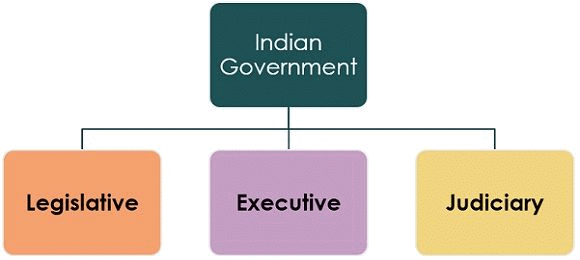
The horizontal distribution of power refers to the separation and balance among the legislature, executive and judiciary. This arrangement prevents concentration of power in one organ and provides mutual checks and balances.
- Example: In India, the Constitution provides a separation of powers and checks and balances so that the legislature makes laws, the executive implements them, and the judiciary interprets laws and protects fundamental rights.
- Horizontal power-sharing reduces arbitrary action and makes government accountable to the people.
Among governments at different levels (vertical distribution)
- Vertical distribution of power divides authority between central and regional (state) governments.
- Federal arrangements allow local or regional governments to make decisions on matters of local importance while the national government handles issues that affect the entire country.
- Such decentralisation helps ethnic, linguistic or regional groups to govern their own affairs and reduces separatist pressures.
Among different social groups
- Power can be shared by giving representation and autonomy to different religious, linguistic or ethnic groups.
- Examples include community governments, proportional representation in legislatures and guaranteed posts for minorities in public offices.
- Belgium's arrangements for language communities illustrate this form of power-sharing.
Influence of political parties, pressure groups and movements
- Political parties and interest groups influence who exercises power and how it is exercised.
- Power-sharing can be strengthened when parties and groups negotiate, form coalitions, and include minority demands in policy making.
- Conversely, when dominant parties ignore minority voices, it reduces the inclusiveness of government and can lead to conflict.
Key terms
- Power-sharing: Arrangements that distribute political power among different social groups, levels and institutions to ensure inclusive governance.
- Majoritarianism: A political approach where the majority community or party imposes its will without adequate protection for minorities.
- Accommodation: Policies or institutional arrangements designed to give different groups a stake in governance and reduce conflict (for example, federalism, proportional representation, community governments).
- Consociationalism: A form of accommodation in deeply divided societies where elites from different segments share power by mutual agreement (the term describes Belgium's approach and is useful for understanding similar arrangements).
Conclusion
Power-sharing is a central feature of stable, inclusive democracies. It may be achieved by dividing power among institutions, levels of government and social groups, and by encouraging participation from different communities. The contrast between Belgium and Sri Lanka shows that institutional choices matter: accommodation and shared arrangements can prevent conflict, while majoritarian policies that exclude minorities can fuel distrust and violence. Designing appropriate power-sharing mechanisms is therefore essential for peace, stability and democratic legitimacy.
FAQs on Short Notes: Power-sharing
| 1. What is power-sharing in the context of political systems? |  |
| 2. How does power-sharing work in Belgium and Sri Lanka? | |
| 3. What is majoritarianism and how does it relate to power-sharing? | |
| 4. How does Belgium accommodate power-sharing between linguistic and regional groups? | |
| 5. Why is power-sharing desirable in a political system? | |





