CBSE Class 10  >  Class 10 Notes  >  Mathematics (Maths)   >  NCERT Exemplar: Some Applications of Trigonometry

NCERT Exemplar: Some Applications of Trigonometry

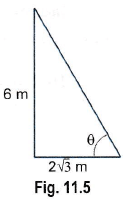
Q.1. If a pole 6 m high casts a shadow 2√3 m long on the ground, find the Sun's elevation.
Ans:
 

NCERT Exemplar: Some Applications of Trigonometry

NCERT Exemplar: Some Applications of Trigonometry
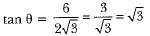
tan θ = opposite/adjacent = 6/(2√3)
= 6/(2√3) = 3/√3 = √3
∴ θ = 60°


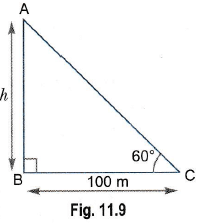
Q.2. If the angle of elevation of a tower from a distance of 100 m from its foot is 60°, then what will be the height of the tower?
NCERT Exemplar: Some Applications of Trigonometry
Ans: Let h be the height of the tower.
NCERT Exemplar: Some Applications of Trigonometry

tan 60° = h/100
⇒ √3 = h/100
⇒ h = 100√3 m


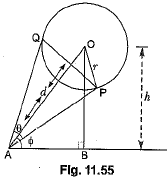
Q.3. A spherical balloon of radius r subtends an angle θ at the eye of an observer. If the angle of elevation of its centre is φ, find the height of the centre of the balloon.
Ans:
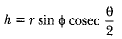
In Fig. 11.55, O is the centre of the balloon, whose radius OP = r and ∠PAQ = θ. Also, ∠OAB = φ. Let the height of the centre of the balloon be h. Thus OB = h.
In ΔOAP, we have

NCERT Exemplar: Some Applications of Trigonometry

NCERT Exemplar: Some Applications of Trigonometry
Also in ΔOAB,
NCERT Exemplar: Some Applications of Trigonometry
 ...(ii)
From (i) and (ii), we get
NCERT Exemplar: Some Applications of Trigonometry
 or 

NCERT Exemplar: Some Applications of Trigonometry


Q.4. If the angle of elevation of a cloud from a point h metres above a lake is α and the angle of depression of its reflection in the lake is β, prove that the height of the cloud is

NCERT Exemplar: Some Applications of Trigonometry

Ans:
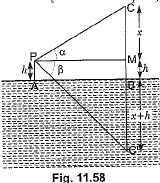
Let AB be the surface of the lake and let P be a point of observation (Fig. 11.58) such that AP = h metres. Let C be the position of the cloud and C' be its reflection in the lake. Then, CB = C'B. Let PM be perpendicular from P on CB. Then, ∠CPM = α and ∠MPC' = β. Let CM = x.
NCERT Exemplar: Some Applications of Trigonometry
Then, CB = CM + MB = CM + PA = x + h
In ΔCPM, we have
NCERT Exemplar: Some Applications of Trigonometry
 

NCERT Exemplar: Some Applications of Trigonometry

⇒ AB = x cot α
In ΔPMC', we have
NCERT Exemplar: Some Applications of Trigonometry
 

NCERT Exemplar: Some Applications of Trigonometry

⇒ AB = (x + 2h) cotβ ...(ii)
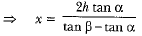
From (i) and (ii), we have

NCERT Exemplar: Some Applications of Trigonometry

NCERT Exemplar: Some Applications of Trigonometry

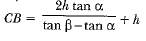
Hence, the height CB of the cloud is given by
CB = x + h ⇒
NCERT Exemplar: Some Applications of Trigonometry

NCERT Exemplar: Some Applications of Trigonometry


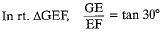
Q.5. The lower window of a house is at a height of 2 m above the ground and its upper window is 4 m vertically above the lower window. At a certain instant, the angles of elevation of a balloon from these windows are observed to be 60° and 30° respectively. Find the height of the balloon above the ground.
Ans:
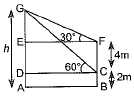
Let the height of balloon above ground be h m and let the horizontal distance from the windows to the balloon be x m.
Lower window is at 2 m above ground and upper window is at 2 + 4 = 6 m above ground.
In right-angled triangle formed with the lower window,
NCERT Exemplar: Some Applications of Trigonometry

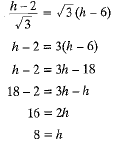
tan 60° = (h - 2)/x = √3 ⇒ h - 2 = x√3 ...(i)
NCERT Exemplar: Some Applications of Trigonometry
 In right-angled triangle formed with the upper window,
NCERT Exemplar: Some Applications of Trigonometry

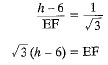
tan 30° = (h - 6)/x = 1/√3 ⇒ h - 6 = x/√3 ...(ii)
Subtract (ii) from (i):
(h - 2) - (h - 6) = x√3 - x/√3
⇒ 4 = x(√3 - 1/√3) = x(2/√3)
⇒ x = 4 × (√3/2) = 2√3 m
Use (i): h - 2 = x√3 = 2√3 × √3 = 2 × 3 = 6
⇒ h = 8 m
NCERT Exemplar: Some Applications of Trigonometry

NCERT Exemplar: Some Applications of Trigonometry

Height of the balloon above the ground is 8 m.
The document NCERT Exemplar: Some Applications of Trigonometry is a part of the Class 10 Course Mathematics (Maths) Class 10.
All you need of Class 10 at this link: Class 10

FAQs on NCERT Exemplar: Some Applications of Trigonometry

1. What are some real-life applications of trigonometry?
Ans. Trigonometry has various applications in real life, such as determining the height of a building or a tree using angles and distances, calculating distances between two objects using angles of elevation or depression, navigation and satellite communication systems, analyzing waveforms in physics and engineering, and designing structures like bridges and towers.
2. How do we use trigonometry to calculate the distance between two objects?
Ans. To calculate the distance between two objects using trigonometry, we can use the concept of angles of elevation or depression. By measuring the angle of elevation or depression from a known point, and knowing the height of the observer, we can use trigonometric ratios to calculate the distance between the objects. The formula commonly used is distance = height / tan(angle).
3. What is the importance of trigonometry in navigation and satellite communication systems?
Ans. Trigonometry plays a crucial role in navigation and satellite communication systems. Using trigonometric calculations, navigators and satellite systems can determine their exact location, calculate distances between different points on the Earth's surface, and plan routes for ships, airplanes, or satellites. Trigonometry helps in accurately positioning and tracking satellites, ensuring effective communication and navigation.
4. How is trigonometry used in analyzing waveforms in physics and engineering?
Ans. Trigonometry is extensively used in analyzing waveforms in physics and engineering. It helps in understanding and describing various wave phenomena, such as amplitude, frequency, and phase shift. Trigonometric functions like sine and cosine are used to model and analyze periodic waveforms. Trigonometry also helps in determining the relationships between different wave parameters and solving complex wave equations.
5. In what ways is trigonometry used in designing structures like bridges and towers?
Ans. Trigonometry plays a crucial role in designing structures like bridges and towers. Engineers use trigonometric calculations to determine the angles and lengths of various components, such as beams and supports, to ensure stability and structural integrity. Trigonometry helps in analyzing forces acting on the structure, calculating load-bearing capacities, and optimizing the design for maximum strength and safety.
Explore Courses for Class 10 exam
Get EduRev Notes directly in your Google search
Related Searches
shortcuts and tricks, Sample Paper, ppt, Extra Questions, Semester Notes, Previous Year Questions with Solutions, NCERT Exemplar: Some Applications of Trigonometry, video lectures, Free, NCERT Exemplar: Some Applications of Trigonometry, past year papers, Exam, Important questions, Objective type Questions, practice quizzes, MCQs, mock tests for examination, Viva Questions, study material, NCERT Exemplar: Some Applications of Trigonometry, Summary, pdf ;