NEET Previous Year Questions (2014-2025): Magnetism & Matter


2024
Q1: Match List I with List II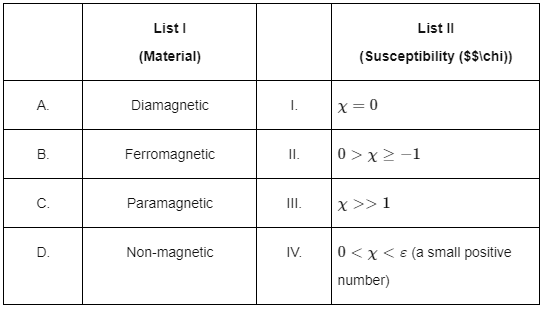
Choose the correct answer from the options given below.
(a) A-II, B-III, C-IV, D-I
(b) A-II, B-I, C-III, D-IV
(c) A-III, B-II, C-I, D-IV
(d)A-IV, B-III, C-II, D-I [2024]
Ans: (a)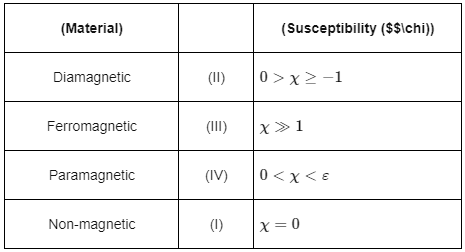
To match the magnetic materials with their respective magnetic susceptibilities, we must understand the characteristics of each type of material regarding its magnetic behavior. Here are the implications of each type:
Diamagnetic Materials: These materials are repelled by magnetic fields. The susceptibility (χ) of diamagnetic materials is negative but very small, near zero. Therefore, x >-z and closer to zero, reflects this property.
Ferromagnetic Materials: They have a very high, positive susceptibility because these materials can be permanently magnetized. Their susceptibility (x) is much greater than one (x>>1).
Paramagnetic Materials: These materials are weakly attracted by a magnetic field, and their susceptibility is positive. However, the value of x for paramagnetic materials is small but greater than zero (0 < x < ε), where ε represents a small positive value.
Non-magnetic Materials: For materials that are considered non-magnetic, the susceptibility (x) is zero (x = 0), as they are neither attracted nor repelled by magnetic fields.
Let's match these descriptions with the given List II in your question:
Diamagnetic (A) matches with 0 > x ≥ - 1 (II).
Ferromagnetic (B) corresponds to x >> 1 (III).
Paramagnetic (C) should be aligned with 0 <x < ε (IV).
Non-magnetic (D) clearly fits x = 0 (I).
Therefore, the correct answer matches:
A-II, B-III, C-IV, D-I.
This aligns with Option A.
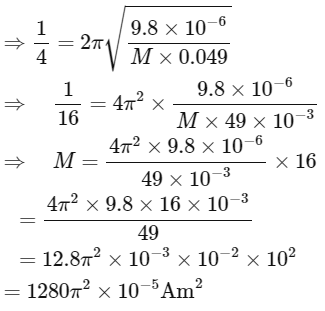
Q2: In a uniform magnetic field of 0.049T, a magnetic needle performs 20 complete oscillations in 5 seconds as shown. The moment of inertia of the needle is 9.8 × 10⁻⁶ kgm2. If the magnitude of magnetic moment of the needle is x × 10-5Am2, then the value of 'x' is :
(a) 5π2
(b) 128π2
(c) 50π2
(d) 1280π2 [2024]
Ans: (d)
Time period of Oscillation, 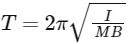
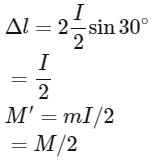
Q3: An iron bar of length L has magnetic moment M. It is bent at the middle of its length such that the two arms make an angle 60∘ with each other. The magnetic moment of this new magnet is :
(a) M
(b) M / 2
(c) 2M
(d) M / √3 [2024]
Ans: (b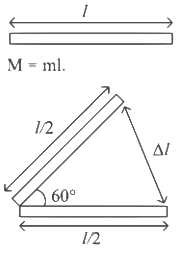
2020
Q.1. An iron rod of susceptibility 599 is subjected to a magnetising field of 1200 A m-1. The permeability of the material of the rod is : (2020)(μ0 = 4π×10-7 T mA-1)
A: 2.4π×10-5 T m A-1
B: 2.4π×10-7 T m A-1
C: 2.4π×10-4 T m A-1
D: 8.0×10⁻⁵ T m A-1
Ans: C
xm = 599, μ0 = 4π × 10-7
H = 1200 A/m, μ = ?
μ = μ0 (1 + xm)
= 4π × 10-7 (1 + 599)
= 4π × 10-7 × 600
= 24π × 10-5
μ = 2.4π × 10-4 TmA-1
2019
Q.2. At a point A on the earth's surface the angle of dip σ = + 25°. At a point B on the earth's surface the angle of dip, σ = - 25°. We can interpret that : (2019)
A: A and B are both located in the northern hemisphere.
B: A is located in the southern hemisphere and B is located in the northern hemisphere.
C: A is located in the northern hemisphere and B is located in the southern hemisphere.
D: A and B are both located in the southern hemisphere.
Ans: C
Solution:
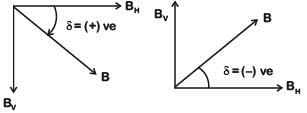
point A is located in the Northern hemisphere and point B is located in the southern hemisphere.
basically, angle of dip is the angle made by resultant earth's magnetic field from horizontal.
- angle of dip at equator is considered as zero.
- angle of dip in northern hemisphere is considered as positive.
- angle o dip in southern hemisphere is considered as negative.
here, at point A on the earth's surface,
angle of dip is +25° (i.e., positive) so, point A is located in the Northern hemisphere
and point B on the earth's surface, angle of dip is -25° (i.e., negative) so, point B is located in he southern hemisphere.
2018
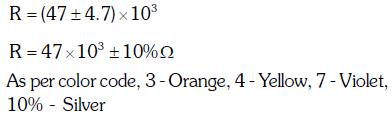
Q.3. A carbon resistor (47 + 4.7) kΩ is to be marked with rings of different colours for its identification. The colour code sequence will be :- (2018)
A: Violet - Yellow - Orange - Silver
B: Yellow - Violet - Orange - Silver
C: Yellow - Green - Violet - Gold
D: Green - Orange - Violet - Gold
Ans: B
Solution:
2017
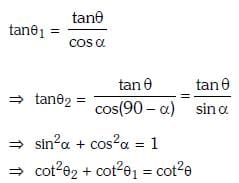
Q.4. If θ1 and θ2 be the apparent angles of dip observed in two vertical planes at right angles to each other, then the true angle of dip θ is given by :- (2017)
A:
B:
C:
D:
Ans: D
Solution:
2016
Q.5. The magnetic susceptibility negative for (2016)
A: paramagnetic and ferromagnetic materials
B: diamagnetic material only
C: paramagnetic material only
D: ferromagnetic material only
Ans: B
Solution:
μr = 1 + x
so, μr is negative if and only if x is negative and x is negative only for diamagnetic materials.
There is no Question for NEET 2021
FAQs on NEET Previous Year Questions (2014-2025): Magnetism & Matter
| 1. What are the most important formulas and concepts for magnetism and matter that come in NEET exams? |  |
| 2. How do I solve previous year NEET questions on magnetic field and force on current-carrying conductors? | |
| 3. What's the difference between magnetic induction and magnetic intensity in NEET Physics? | |
| 4. Why do some materials become magnetic while others don't-what's the CBSE explanation for diamagnetism, paramagnetism, and ferromagnetism? | |
| 5. How do I identify and solve questions about Earth's magnetic field, magnetic declination, and dip angle from previous year NEET papers? | |





