Q1: Given below are two statements: Statement I: Like nitrogen that can form ammonia, arsenic can form arsine. Statement II: Antimony cannot form antimony pentoxide. In the light of the above statements, choose the most appropriate answer from the options given below: (a) Statement I is correct but Statement II is incorrect (b) Statement I is incorrect but Statement II is correct (c) Both Statement I and Statement II are correct (d) Both Statement I and Statement II are incorrect
Solution:
Ans: (a)
Statement I: "Like nitrogen that can form ammonia, arsenic can form arsine." This statement is correct because arsenic, like nitrogen, can react with hydrogen to form arsine (AsH3). This is due to arsenic's chemical similarity to nitrogen as both belong to the same group in the periodic table.
Statement II: "Antimony cannot form antimony pentoxide." This statement is incorrect because antimony can form antimony pentoxide (Sb2O5) when it exhibits its +5 oxidation state. This is consistent with the behavior of group 15 elements. Therefore, Statement I is correct, but Statement II is incorrect.
Correct Answer: Option A) Statement I is correct but Statement II is incorrect.
2024
Q1: Among Group 16 elements, which one does NOT show -2 oxidation state? (NEET 2024) (a) O (b) Se (c) Te (d) Po
Solution:
Ans: (d)
Group 16 elements (chalcogens) include O, S, Se, Te, Po.
These elements usually show -2 oxidation state because they have six valence electrons and can gain two electrons to achieve noble gas configuration.
Oxygen (O): Being the most electronegative, it predominantly exists in -2 oxidation state (e.g., H₂O, SO₂).
Selenium (Se) and Tellurium (Te): Also exhibit -2 oxidation state (e.g., H₂Se, H₂Te).
Polonium (Po): Being more metallic in nature, it does not stabilize the -2 oxidation state. Instead, it commonly shows +2 and +4 oxidation states (e.g., PoCl₂, PoO₂).
Therefore, Polonium (Po) does not exhibit -2 oxidation state → Correct Answer: (d).
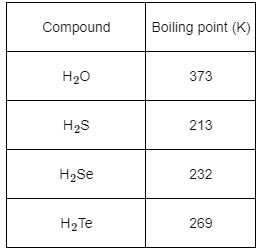
Q2: Given below are two statements: (NEET 2024) Statement I: The boiling point of hydrides of Group 16 elements follows the order: H₂O > H₂Te > H₂Se > H₂S. Statement II: On the basis of molecular mass, H₂O is expected to have a lower boiling point than the other members of the group, but due to the presence of extensive H-bonding in H₂O, it has a higher boiling point. In light of the above statements, choose the correct answer from the options given below: (a) Both Statement I and Statement II are false. (b) Statement I is true and Statement II is false. (c) Statement I is false but Statement II is true. (d) Both Statement I and Statement II are true.
Solution:
Ans: (d)
Statement I: The boiling points of hydrides of Group 16 elements (H₂O, H₂Te, H₂Se, and H₂S) are influenced by factors such as molecular mass and intermolecular forces. H₂O has the highest boiling point in this series due to hydrogen bonding.
The order of boiling points is: H₂O > H₂Te > H₂Se > H₂S. This is because, although H₂Te and H₂Se have higher molecular masses than H₂O, the hydrogen bonding in H₂O causes it to have a much higher boiling point. Thus, Statement I is true.
Statement II: The molecular mass of H₂O is lower than that of H₂Te, H₂Se, and H₂S, so based on molecular mass alone, H₂O should have a lower boiling point. However, due to hydrogen bonding, which is a strong intermolecular force, H₂O has a higher boiling point than expected. This is why Statement II is true. Thus, both Statement I and Statement II are true.
Q3: The products A and B obtained in the following reactions, respectively, are: (NEET 2024)
ROH + PCl₃ → 3 RCl + A ROH + PCl₅ → RCl + HCl + B (a) POCl₃ and H₃PO₄ (b) H₃PO₄ and POCl₃ (c) H₃PO₃ and POCl₃ (d) POCl₃ and H₃PO₃
Solution:
Ans: (c)
The reaction of ROH (alcohol) with PCl₃ (phosphorus trichloride) leads to the formation of RCl (alkyl chloride) and H₃PO₃ (phosphorous acid) as a product A. The phosphorus trichloride reacts with alcohol to produce H₃PO₃ and RCl.
The reaction of ROH (alcohol) with PCl₅ (phosphorus pentachloride) leads to the formation of RCl (alkyl chloride), HCl (hydrochloric acid), and POCl₃ (phosphoryl chloride) as product B. Thus, A is H₃PO₃ and B is POCl₃.
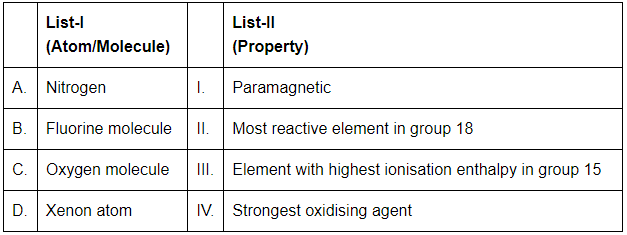
Q4: Match List-I with List-II: (NEET 2024)
Identify the correct answer from the options given below: (a) A- III, B-I, C-IV, D-II (b) A-I, B-IV, C-III, D-II (c) A-II, B-IV, C-I, D-II (d) A-III, B-IV, C-I, D-II
Solution:
Ans: (d)
A. Nitrogen, Property III: Element with highest ionisation enthalpy in group 15. Nitrogen has the highest ionization enthalpy in group 15 because it has a half-filled stable configuration in its valence shell (2s² 2p³). This stability makes it more difficult to remove electrons compared to other elements in the same group.
B. Fluorine molecule, Property IV: Strongest oxidising agent. Fluorine is the most electronegative element, which makes it the strongest oxidizing agent. It readily accepts electrons to form fluoride ions (F⁻), making it a powerful oxidizing agent.
C. Oxygen molecule, Property I: Paramagnetic. Oxygen (O₂) has two unpaired electrons in its molecular orbitals, which makes it paramagnetic. This means it is attracted by a magnetic field.
D. Xenon atom, Property II: Most reactive element in group 18. Xenon is one of the noble gases, but among the noble gases, it is the most reactive. It can form compounds like xenon hexafluoride (XeF₆) under certain conditions.
Thus, the correct matching is: A-III, B-IV, C-I, D-II Therefore, the correct answer is (D).
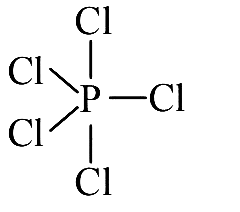
Q5: Identify the incorrect statement about PCl₅: (NEET 2024) (a) PCl₅ possesses two different Cl-P-Cl bond angles. (b) All five P-Cl bonds are identical in length. (c) PCl₅ exhibits sp³d hybridization. (d) PCl₅ consists of five P-Cl (sigma) bonds.
Solution:
Ans: (b)
Statement (a): PCl₅ has a trigonal bipyramidal structure with two different bond angles (90° between axial and equatorial positions, 120° between equatorial positions). Hence, Statement (a) is correct.
Statement (b): The axial P-Cl bonds are slightly longer than the equatorial P-Cl bonds in PCl₅. Therefore, Statement (b) is incorrect.
Statement (c): The central phosphorus atom in PCl₅ is sp³d hybridized due to the five bonding pairs of electrons, forming a trigonal bipyramidal geometry. Hence, Statement (c) is correct.
Statement (d): PCl₅ consists of five sigma bonds (P-Cl). Hence, Statement (d) is correct.
Thus, the incorrect statement is (b).
Q6: Identify the incorrect statement from the following: (NEET 2024) (a) The acidic strength of HX (X = F, Cl, Br, and I) follows the order: HF > HCl > HBr > HI (b) Fluorine exhibits -1 oxidation state, whereas other halogens exhibit +1, +3, +5, and +7 oxidation states also. (c) The enthalpy of dissociation of F₂ is smaller than that of Cl₂. (d) Fluorine is a stronger oxidizing agent than chlorine.
Solution:
Ans: (a) (a) The acidic strength of HX (X = F, Cl, Br, and I) follows the order: HF > HCl > HBr > HI This statement is incorrect. The acidic strength of hydrohalic acids (HX) generally increases as we go down the group in the periodic table. This is because the bond strength between H and X decreases as we move from fluorine to iodine. Since the bond between hydrogen and iodine (HI) is the weakest, HI is the strongest acid, not HF. The correct order of acidic strength is HI > HBr > HCl > HF.
(b) Fluorine exhibits -1 oxidation state, whereas other halogens exhibit +1, +3, +5, and +7 oxidation states also. This statement is correct. Fluorine always exhibits a -1 oxidation state because it is the most electronegative element, whereas the other halogens (Cl, Br, I) can exhibit positive oxidation states (e.g., +1 in compounds like ClF, +3 in compounds like ClO₂, +5 in compounds like ClO₃⁻, and +7 in compounds like Cl₂O₇).
(c) The enthalpy of dissociation of F₂ is smaller than that of Cl₂. This statement is incorrect. The bond dissociation enthalpy of F₂ is much higher than that of Cl₂ due to the small size of fluorine atoms and the high repulsion between them in the F₂ molecule. In contrast, Cl₂ has a lower bond dissociation enthalpy due to its larger atomic size and less repulsion.
(d) Fluorine is a stronger oxidizing agent than chlorine. This statement is correct. Fluorine is the strongest oxidizing agent because it is the most electronegative element. It readily accepts electrons, while chlorine is a weaker oxidizing agent in comparison.
Conclusion: The incorrect statement is (a). The correct order of acidic strength is HI > HBr > HCl > HF, not HF > HCl > HBr > HI. Therefore, the correct answer is (a).
Q7: Identify the incorrect statement: (NEET 2024) (a) PEt₃ and AsPh₃ as ligands can form dπ-dπ bonds with transition metals. (b) The N-N single bond is as strong as the P-P single bond. (c) Nitrogen has a unique ability to form pπ-pπ multiple bonds with nitrogen, carbon, and oxygen. (d) Nitrogen cannot form dπ-pπ bonds as other heavier elements of its group.
Solution:
Ans: (b)
Statement (a): PEt₃ (triethylphosphine) and AsPh₃ (triphenylarsine) as ligands can indeed form dπ-dπ bonds with transition metals. These ligands have lone pairs on the phosphorus and arsenic atoms that can participate in back-donation to empty d-orbitals on the transition metal. Hence, Statement (a) is correct.
Statement (b): The N-N single bond is not as strong as the P-P single bond. The N-N bond is weaker due to the small size of nitrogen and the lone pair-electron repulsion in the nitrogen atoms. In contrast, the P-P bond is stronger due to less repulsion between the lone pairs on the phosphorus atoms. Hence, Statement (b) is incorrect.
Statement (c): Nitrogen does indeed have a unique ability to form pπ-pπ multiple bonds with other elements such as nitrogen, carbon, and oxygen. For example, nitrogen forms double and triple bonds with carbon and oxygen, as in N≡N and C=O. Hence, Statement (c) is correct.
Statement (d): Nitrogen cannot form dπ-pπ bonds, as it does not have accessible low-lying d-orbitals in its valence shell, unlike heavier elements in the same group (such as phosphorus and arsenic). Hence, Statement (d) is correct.
Thus, the incorrect statement is (b).
2023
Q1: Given below are two statements : one is labelled as Assertion A and the other is labelled as Reason R. Assertion A : Helium is used to dilute oxygen in diving apparatus. Reason R : Helium has high solubility in O. In the light of the above statements, choose the correct answer from the options given below: (a) Both A and R are true but R is NOT the correct explanation of A. (b) A is true but R is false. (c) A is false but R is true. (d) Both A and R are true and R is the correct explanation of A. (NEET 2023)
Solution:
Ans: (b) Assertion is true because He has low solubility in blood.(NCERT)
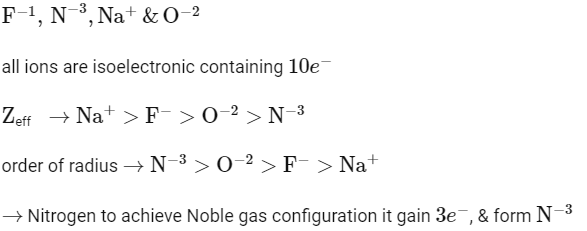
Q.2. The element expected to form largest ion to achieve the nearest noble gas configuration is (NEET 2023) (a) F (b) N (c) Na (d) O
Solution:
Ans: (b)
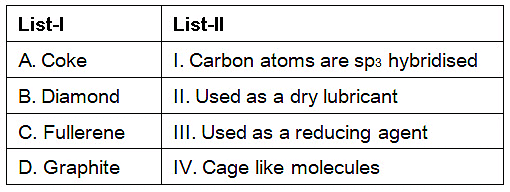
Q3: Match List-I with List-II. (NEET 2023)
Choose the correct answer from the options given below: (a) A-II, B-IV, C-I, D-III (b) A-IV, B-I, C-II, D-III (c) A-III, B-I, C-IV, D-II (d) A-III, B-IV, C-I, D-II
Solution:
Ans: (c)
Coke is largely used as a reducing agent in metallurgy.
In diamond, each carbon atom undergoes sp3 hybridisation and linked to four other carbon atoms by using hybridised orbitals in tetrahedral fashion.
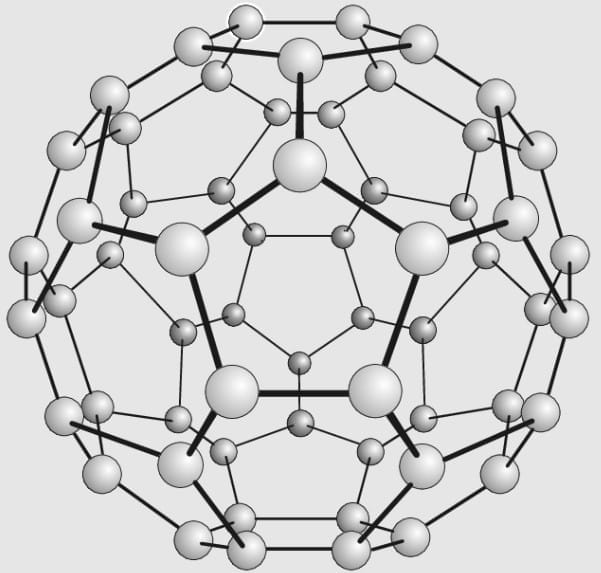
Buckminsterfullerene contains six membered and five membered rings and hence is a cage like molecule.
Graphite is very soft and slippery. Hence, it is used as a dry lubricant in machines running at high temperature.
Q4: Match List-I with List-II: (NEET 2023)
Choose the correct answer from the options given below. (a) A-I, B-III, C-II, D-IV (b) A-III, B-IV, C-I, D-II (c) A-I, B-III, C-IV, D-II (d) A-III, B-IV, C-II, D-I
Solution:
Ans: (b)
2022
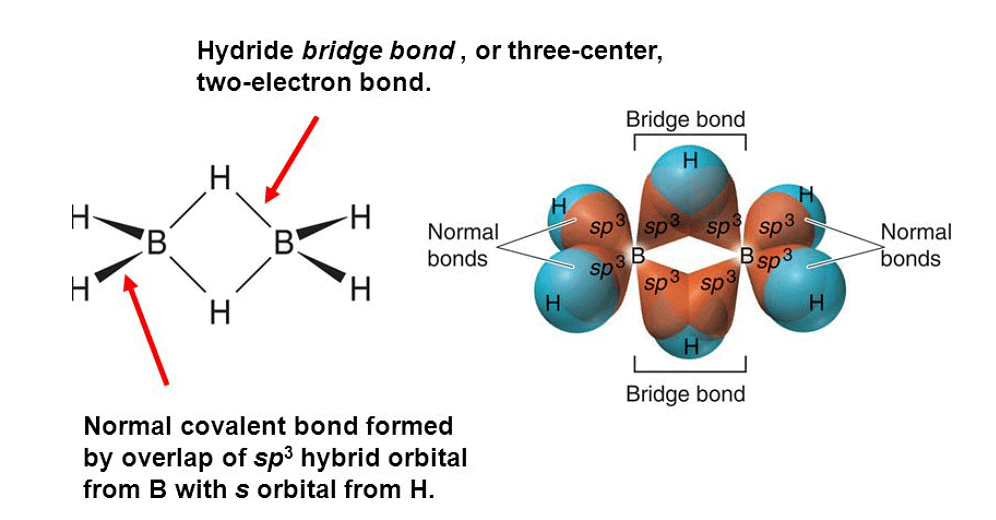
Q1: Which of the following statement is not correct about diborane? (NEET 2022 Phase 1) (a) The four terminal Hydrogen atoms and the two Boron atoms lie in one plane. (b) Both the Boron atoms are sp2 hybridised. (c) There are two 3-centre-2-eIectron bonds. (d) The four terminal B-H bonds are two centre two electron bonds.
Solution:
Ans: (b) In diborane both the boran atoms are sp3 hybridized.
Q2: Given below are two statements Statement I : The boiling points of the following hydrides of group 16 elements increases in the order - H2O < H2S < H2Se < H2Te Statement II : The boiling points of these hydrides increase with increase in molar mass. In the light of the above statements, choose the most appropriate answer from the options given below : (a) Both Statement I and Statement II are correct (b) Both Statement I and Statement II are incorrect (c) Statement I is correct but Statement II is incorrect (d) Statement I is incorrect but Statement II is correct (NEET 2022 Phase 1)
Solution:
Ans: (b)
The boiling points of these hybrids not exactly increases with increase in molar mass.
H2O has maximum boiling point due to intermolecular hydrogen bonding.
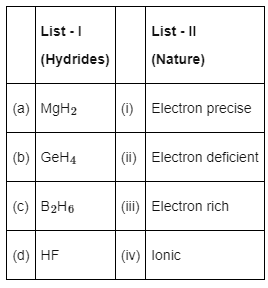
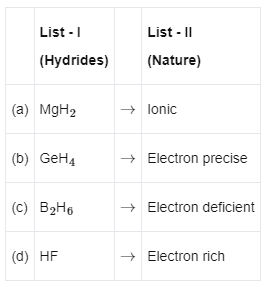
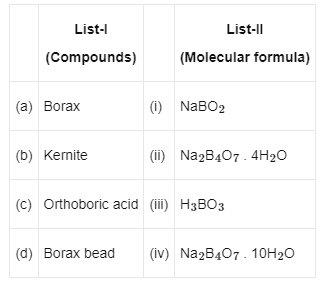
Q3: Match List-I with List-II. (NEET 2022 Phase 1)
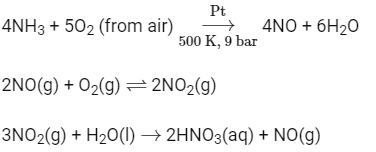
Q5: Which of the following reactions is a part of the large scale industrial preparation of nitric acid? (NEET 2022 Phase 2)
(a)
(b)
(c)
(d)
Solution:
Ans: (c)
This is industrial method of preparation of nitric acid.
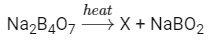
Q6: in the above reaction the product "X" is : (a) NaB3O5 (b) H3BO3 (c) B2O3 (d) Na2B2O5 (NEET 2022 Phase 2)
Solution:
Ans: (c)
Product X is B2O3
2021
Q1: Statement I: Acid strength increases in the order given as HF << HCl << HBr << HI. Statement II: As the size of the elements F, Cl, Br, I increase down the group, the bond strength of HF, HCI, HBr, and HI decreases and so the acid strength increases. In the light of the above statements, choose the correct answer from the options given below. (NEET 2021) (a) Statement I is correct but Statement II is false. (b) Statement I is incorrect but Statement II is true. (c) Both Statement I and Statement II are true. (d) Both Statement I and Statement II are false.
Solution:
Ans: (b) In the modern periodic table, moving down the group as the size of halogen atom increases, the H - X bond length also increases as a result the bond enthalpy decreases. Hence, the acidic strength also increases. So, the correct order of acidic strength is HI > HBr > HCl > HF
Q2: Noble gases are named because of their inertness towards reactivity. Identify an incorrect statement about them. (a) Noble gases have large positive values of electron gain enthalpy (b) Noble gases are sparingly soluble in water (c) Noble gases have very high melting and boiling points (d) Noble gases have weak dispersion forces (NEET 2021)
Solution:
Ans: (c) Nobles gases have weak interatomic forces (van der Waals' forces). So, they have low melting and boiling points.
Q3: In which one of the following arrangements the given sequence is not strictly according to the properties indicated against it? (NEET 2021) (a) NH3 < PH3 <AsH3 < SbH3 : Increasing acidic character (b) CO2 < SiO2 < SnO2 < PbO2 : Increasing oxidizing power (c) HF < HCl < HBr < HI : Increasing acidic strength (d) H2O < H2S < H2Se < H2Te : Increasing pKa values
Solution:
Ans: (d) Stronger is the acid, lower is the value of pKa. On moving down the group, bond dissociation enthalpy of hydrides of group 16 elements decreases hence acidity increases and pKa value decreases. Correct order of pKa value will be H2O > H2S > H2Se > H2Te
2020
Q1: Which of the following is not correct about carbon monoxide? (NEET 2020) (a) The carboxyhaemoglobin (haemoglobin bound to CO) is less stable than oxyhaemoglobin. (b) It is produced due to incomplete combustion. (d) It forms carboxyhaemoglobin. (d) It reduces oxygen carrying ability of blood.
Solution:
Ans: (a) The carboxyhaemoglobin is about 300 times more stable than oxyhaemoglobin.
Q2: Identify the correct statements from the following: (NEET 2020) (a) CO2(g) is used as refrigerant for ice-cream and frozen food. (b) The structure of C60 contains twelve six carbon rings and twenty five carbon rings. (c) ZSM-5, a type of zeolite, is used to convert alcohols into gasoline. (d) CO is colourless and odourless gas. (a) (b) and (c) only (b) (c) and (d) only (c) (a), (b) and (c) only (d) (a) and (c) only
Solution:
Ans: (b) Dry ice is used as refrigerant. C60 contains 20 six membered ring, 12 five membered rings. In the presence of a zeolite catalyst (HZSM-5), ethanol, methanol and larger alcohols can be converted into gasoline at 300-400 C. CO, is a tasteless, colorless, and odorless gas.
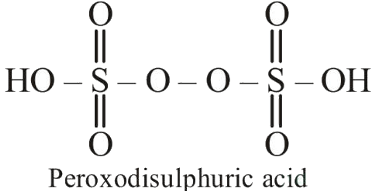
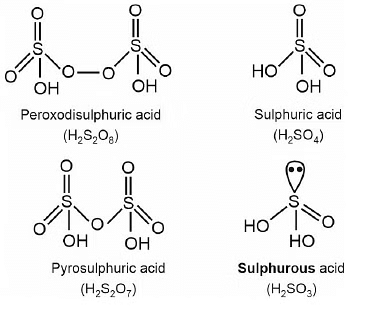
Q3: Which of the following oxoacid of sulphur has -O-O- linkage? (NEET 2020) (a) H2S2O8, peroxodisulphuric acid (b) H2S2O7, pyrosulphuric acid (c) H2SO3, sulphurous acid (d) H2SO4, sulphuric acid
Solution:
Ans: (a)
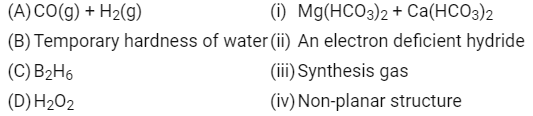
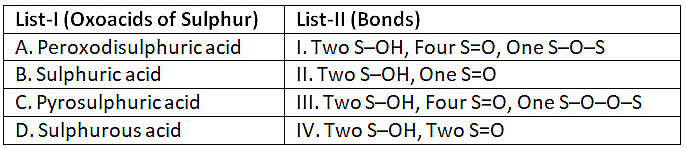
Q4: Match the following and identify the correct option. (NEET 2020)
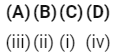
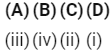
Which of the following is correct option? (a)
(b)
(c)
(d)
Solution:
Ans: (d)
Mixture of CO and H2 gases is known as water gas or synthesis gas.
Temporary hardness of water is due to bicarbonates of calcium and magnesium.
Diborane (B2H6) is an electron deficient hydride.
H2O2 is non-planar molecule having open book like structure.
2019
Q1: Which of the following species is not stable? (NEET 2019) (a) [SiF6]2- (b) [GeCl6]2- (c) [Sn(OH)6]2- (d) [SiCl6]2-
Solution:
Ans: (d) Due to presence of d-orbital in Si, Ge and Sn they form species like SiF62-, [GeCl6]2-, [Sn(OH)6]2- SiCl62- does not exist because six large chloride ions cannot be accommodated around Si4+ due to limitation of its size.
Q2: Which is the correct thermal stability order for H2E (E = O, S, Se, Te and Po)? (NEET 2019) (a) H2S < H2O < H2Se < H2Te < H2Po (b) H2O < H2S < H2Se < H2Te < H2Po (c) H2Po < H2Te < H2Se < H2S < H2O (d) H2Se < H2Te < H2Po < H2O < H2S
Solution:
Ans: (c) On going down the group thermal stability order for H2E decreases because H-E bond energy decreases ∴ Order of stability would be:- H2Po < H2Te < H2Se < H2S < H2O
Q3: Identify the incorrect statement related to PCl5 from the following : (NEET 2019) (a) Axial P-Cl bonds are longer than equatorial P-Cl bonds (b) PCl5 molecule is non-reactive (c) Three equatorial P-Cl bonds make an angle of 120º with each other (d) Two axial P-Cl bonds make an angle of 180º with each other
Solution:
Ans: (b)
Three equatorial bonds and two axial bonds. Due to unsymmetry PCl5 is reactive.
Q4: Which of the following is incorrect statement? (a) GeX4(X = F, Cl, Br, I) is more stable than GeX2 (b) SnF4 is ionic in nature (c) PbF4 is covalent in nature (d) SiCl4 is easily hydrolysed (NEET 2019)
Solution:
Ans: (c) PbF4 is an ionic compound.
Q5: Match the Xenon compounds in Column-I with its structure in Column-II and assign the correct code: (NEET 2019) (a) (1) (b) (2) (c) (3) (d) (4)
Solution:
Ans: (b)
2018
Q1: Which of the following statements is not true for halogens ? (NEET 2018) (a) All form monobasic oxyacids. (b) All are oxidizing agents. (c) All but fluorine show positive oxidation states. (d) Chlorine has the highest electron-gain enthalpy.
Solution:
Ans: (c) All halogens show both positive and negative oxidation states while fluorine shows only negative oxidation state except due to high electronegativity and small size, F forms only one oxoacid, HOF known as Fluoric (I) acid. Oxidation number of F is +1 in HOF.
Q2: Which one of the following elements is unable to form MF63- ion? (NEET 2018) (a) Ga (b) Al (c) B (d) In
Solution:
Ans: (c) Boron does not have vacant d-orbitals in its valence shell, so it cannot extend its covalency beyond 4. i.e., 'B' cannot form the ions like MF63-.
Q.23. The correct order of atomic radii in group 13 elements is (2018) (a) B < Al < In < Ga < Tl (b) B < Al < Ga < In < Tl (c) B < Ga < Al < Tl < In (d) B < Ga < Al < In < Tl
Solution:
Ans: (d) Atomic and ionic radii. Atomic and ionic radii of group 13 elements increase from top to bottom in the group. This is due to increase in the number of energy shells in each succeeding element. However, the atomic radius of gallium (Ga) is less than that of aluminium (Al). It is due to the poor shielding of the valence electrons of Ga by the inner 3d-electrons. As a result, the effective nuclear charge of Ga is somewhat greater in magnitude than that of Al. Thus, the electrons in gallium experience the greater force of attraction by the nucleus than in aluminium. Hence the atomic size of Ga(135 pm) is slightly less than that of Al(143 pm).
2017
Q1: It is because of inability of ns2 electrons of the valence shell to participate in bonding that (NEET 2017) (a) Sn2+ is reducing while Pb4+ is oxidising (b) Sn2+ is oxidising while Pb4+ is reducing (c) Sn2+ and Pb2+ are both oxidising and reducing (d) Sn4+ is reducing while Pb4+ is oxidising
Solution:
Ans: (a)
The inertness of s-subshell electrons towards bond formation is known as inert pair effect. This effect increases down the group thus, for Sn, +4 oxidation state is more stable, whereas, for Pb, +2 oxidation state is more stable, i.e., Sn2+ is reducing while Pb4+ is oxidising
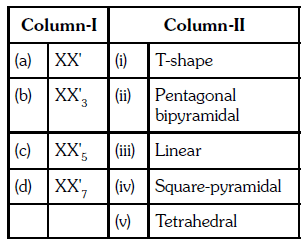
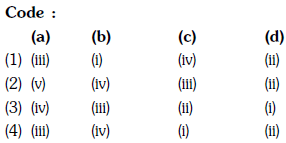
Q2: Match the interhalogen compounds of column-I with the geometry in column II and assign the correct code. (NEET 2017)
(a) (1) (b) (2) (c) (3) (d) (4)
Solution:
Ans: (a)
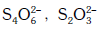
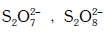
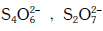
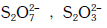
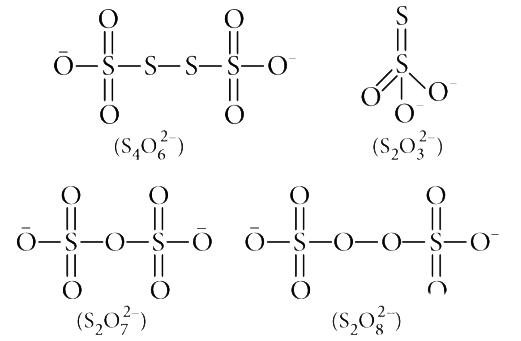
Q3: In which pair of ions both the species contain S-S bond? (NEET 2017) (a) (b) (c) (d)
Solution:
Ans: (a)
S4O62- and S2O32- have S-S bond.
2016
Q1: When copper is heated with conc. HNO3 it produces : (NEET 2016 Phase 1) (a) Cu(NO3)2 and N2O (b) Cu(NO3)2 and NO2 (c) Cu(NO3)2 and NO (d) Cu(NO3)2 , NO and NO2
Solution:
Ans: (b) Cu +4HNO3 (conc.) Cu(NO3)2 + 2NO2 + 2H2O
Q2: Which one of the following orders is correct for the bond dissociation enthalpy of halogen molecules? (NEET 2016 Phase 1) (a) F2 > Cl2 > Br2 > I2 (b) I2 > Br2 > CI2 > F2 (c) CI2 > Br2 > F2 > I2 (d) Br2 > I2 > F2 > CI2
Solution:
Ans: (c) Bond dissociation energies of halogen family decrease down the group as the size of the atom increases. The bond dissociation energy of fluorine, is, however, lower than those of chlorine and bromine because of interelectronic repulsions present in the small atom of fluorine. Hence bond energy decreases in the order Cl2 > Br2 > F2 > I2
Solution:
Q3: Among the following, the correct order of acidity is : (NEET 2016 Phase 1) (a) HCIO4 < HCIO2 < HCIO < HCIO3 (b) HCIO3 < HCIO4 < HCIO2 < HCIO (c) HCIO < HCIO2 < HCIO3 < HCIO4 (d) HCIO2 < HCIO < HCIO3 < HCIO4
Solution:
Ans: (c) As oxidation number of central atom increases, acidic nature increases.
HClO < HClO2 < HClO3 < HClO4
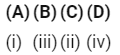
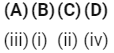
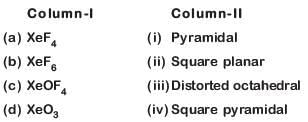
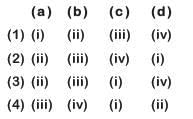
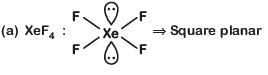
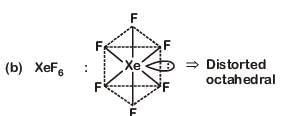
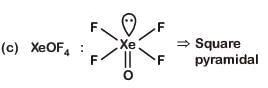
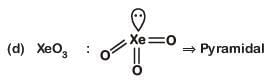
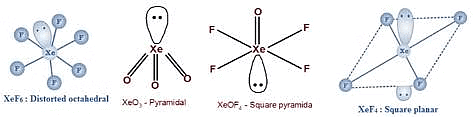
Q4: Match the compound given in column I with the hybridization and shape given in column II and mark the correct option. (NEET 2016 Phase 1) Column-I Column-II (a) XeF6 (i) distorted octahedral (b) XeO3 (ii) square planar (c) XeOF4 (iii) pyramidal (d) XeF4 (iv) square pyramidal Code : (a) (b) (c) (d) (a) (iv) (i) (ii) (iii) (b) (i) (iii) (iv) (ii) (c) (i) (ii) (iv) (iii) (d) (iv) (iii) (i) (ii)
Solution:
Ans: (b) (i) (iii) (iv) (ii)
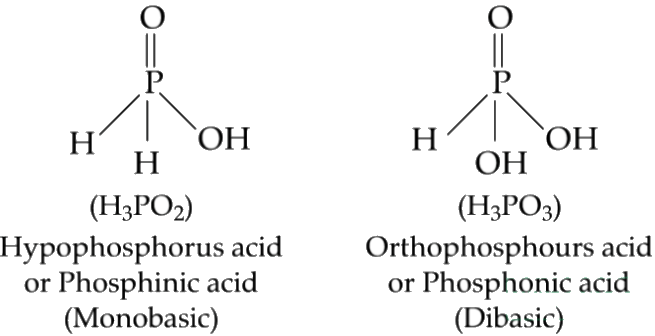
Q5: Which is the correct statement for the given acids? (NEET 2016 Phase 1) (a) Phosphinic acid is a diprotic acid while phosphonic acid is a monoprotic acid. (b) Phosphinic acid is a monoprotic acid while phosphonic acid is a diprotic acid. (c) Both are diprotic acids. (d) Both are triprotic acids.
Solution:
Ans: (b)
Q6: Boric acid is an acid because its molecule (NEET 2016 Phase 2) (a) contains replaceable H+ ion (b) gives up a proton (c) accepts OH- from water releasing proton (d) combines with proton from water molecule.
Solution:
Ans: (c) Boric acid behaves as a Lewis acid, by accepting a pair of electrons from OH- ion of water thereby releasing a proton. H-OH+B(OH)3 [B(OH)4]- + H+
Solution:
Q7: AlF3 is soluble in HF only in presence of KF. It is due to the formation of (NEET 2016 Phase 2) (a) K3[AlF3H3] (b) K3[AlF6] (c) AlH3 (d) K[AlF3H]
Solution:
Ans: (b) AlF3 is insoluble in anhydrous HF because the F- ions are not available in hydrogen bonded HF but, it becomes soluble in presence of little amount of KF due to formation of complex, K3[AIF6].
AIF3 + 3KF K3[AIF6].
2015
Q1: Which of the statements given below is incorrect? (NEET / AIPMT 2015) (a) O3 molecule is bent. (b) ONF is isoelectronic with O2N (c) OF2 is an oxides of fluorine. (d) Cl2O7 is an anhydride of perchloric acid.
Solution:
Ans: (c) OF2 (oxygen difluoride) is a fluoride of oxygen because fluorine is more electronegative than oxygen.
Q2: Strong reducing behavior of H3PO2 is due to (NEET / AIPMT 2015) (a) high electron gain enthalpy of phosphorus (b) high oxidation state of phosphorus (c) presence of two -OH groups and one P-H bond (d) presence of one -OH group and two P-H bonds.
Solution:
Ans: (d) All oxyacids of phosphorus which have P-H bonds act as strong reducing agents. H3PO2 has two P-H bonds hence, it acts as a strong reducing agent.
Q3: The variation of the boiling points of the hydrogen halides is in the order HF > HI > HBr > HCl. (NEET / AIPMT 2015) What explains the higher boiling point of hydrogen fluoride? (a) There is strong hydrogen bonding between HF molecules. (b) The bond energy of HF molecules is greater than in other hydrogen halides. (c) The effect of nuclear shielding is much reduced in fluorine which polarises the HF molecule. (d) The electronegativity of fluorine is much higher than for other elements in the group.
Solution:
Ans: (a) HF forms strong intermolecular H-bonding due to high electronegativity of F. Hence, the boiling point of HF is exceptionally high. Boiling points of other hydrogen halides gradually increases from HCl to HI due to increase in the size of halogen atoms form Cl to I, which further increases the magnitude of van der Waal's forces.
Q4: The stability of +1 oxidation state among Al, Ga, In and Tl increases in the sequence (NEET / AIPMT 2015) (a) Al < Ga < In < Tl (b) Tl < In < Ga < Al (c) In < Tl < Ga < Al (d) Ga < In < Al < Tl
Solution:
Ans: (a) The given elements belong to 13th group. The elements mainly exhibit +3 and +1 oxidation states. As we know, the stability of lower oxidation state i.e., +1 state, increases on moving down the group due to inert pair effect. The, stability follows the order : Al < Ga < In < Tl
Q5: Nitrogen dioxide and sulphur dioxide have some properties in common. Which property is shown by one of these compounds, but not by the other ? (NEET / AIPMT 2015 Cancelled Paper ) (a) is used as a food-preservative (b) forms 'acid-rain' (c) is a reducing agent (d) is soluble in water
Solution:
Ans: (a) SO2 is widely used in food and drinks industries for its property as a preservative and antioxidant while NO2 is not used as food preservative.
2014
Q1: Acidity of diprotic acids in aqueous solutions increases in the order : (NEET 2014) (a) H2Te < H2S < H2Se (b) H2Se < H2Te < H2S (c) H2S < H2Se < H2Te (d) H2Se < H2S < H2Te
Solution:
Ans: (c) Acidic strength of hydrides increases as the size of central atom increases which weakens the M- H bond. Since, the size increases from S to Te thus acidic strength follows the order. H2S<H2Se<H2Te Acidic nature ∝ S to Te size increases, bond dissociation enthalpy decreases and acidic nature increases.
The document NEET Previous Year Questions (2014-2025): The p-Block Elements (Group 15, 16, 17 & 18) is a part of the NEET Course Chemistry Class 12.
FAQs on NEET Previous Year Questions (2014-2025): The p-Block Elements (Group 15, 16, 17 & 18)
1. Which elements in Group 15 show the most variable oxidation states, and why does nitrogen behave differently?
Ans. Nitrogen exhibits oxidation states from -3 to +5, while phosphorus, arsenic, antimony, and bismuth primarily show +3 and +5 states. Nitrogen's small size and absence of d-orbitals restrict its bonding capacity, preventing it from expanding its octet like heavier p-block elements, making it less versatile in forming compounds with higher coordination numbers.
2. How do oxygen and sulphur differ in their bonding behaviour and reactivity patterns?
Ans. Oxygen forms strong double bonds due to its small size and high electronegativity, while sulphur readily forms multiple bonds and expanded octets using d-orbitals. Sulphur exhibits greater versatility in oxidation states (+2, +4, +6) and compounds like SF₆ and SO₄²⁻, whereas oxygen primarily remains in -2 oxidation state, making sulphur significantly more reactive in non-metallic compounds.
3. What are the key differences between chlorine and fluorine in terms of reactivity and electronegativity?
Ans. Fluorine is the most electronegative element but paradoxically less reactive than chlorine in certain reactions due to strong F-F bond energy and electron repulsion. Chlorine's intermediate electronegativity, lower bond dissociation energy, and ability to form stable oxidation states (+1, +3, +5, +7) make it more versatile in halogens group chemistry and NEET examination patterns.
4. Why are noble gases unreactive, and what makes them so stable in Group 18?
Ans. Noble gases possess completely filled p-orbitals with eight valence electrons (except helium with two), achieving maximum stability through filled electron configurations. This octet completion eliminates the driving force for chemical bonding, making them extraordinarily inert and resistant to losing, gaining, or sharing electrons under normal conditions.
5. Which nitrogen oxides are most commonly featured in NEET questions, and what makes NO₂ particularly important?
Ans. NO₂ appears frequently in NEET previous year questions due to its unique dimerisation to N₂O₄, paramagnetic nature, and role in atmospheric pollution chemistry. Students must understand nitrogen's variable oxidation states (+2 in NO, +4 in NO₂, +5 in HNO₃) and how these oxides demonstrate p-block element versatility in different oxidation-reduction reactions.
NEET Previous Year Questions (2014-2025): The p-Block Elements (Group 15, Previous Year Questions with Solutions, 16, Exam, Viva Questions, ppt, 17 & 18), Summary, Objective type Questions, 16, NEET Previous Year Questions (2014-2025): The p-Block Elements (Group 15, past year papers, NEET Previous Year Questions (2014-2025): The p-Block Elements (Group 15, practice quizzes, Extra Questions, Sample Paper, Free, 16, study material, 17 & 18), mock tests for examination, Semester Notes, 17 & 18), video lectures, MCQs, shortcuts and tricks, Important questions, pdf ;






 in the above reaction the product "X" is :