Q1: The total number of possible isomers (both structural as well as stereoisomers) of cyclic ethers of molecular formula C4H8O is: (NEET 2025) (a) 10 (b) 11 (c) 6 (d) 8
Solution:
Ans:(a)
Possible structures include:
Four-membered rings (oxetanes) with different substitution patterns.
Three-membered rings (epoxides) with different substitution patterns.
Considering stereoisomerism: Epoxides can have cis and trans stereoisomers due to the planar nature of the three-membered ring. Oxetanes with different substitutions can also exhibit stereoisomerism. Upon counting all possible structural and stereoisomers:
Three-membered ring (epoxides): 6 isomers (including stereoisomers).
Four-membered ring (oxetanes): 4 isomers (including stereoisomers).
Total number of isomers = 6 (epoxides) + 4 (oxetanes) = 10.
Therefore, the total number of possible isomers (both structural and stereoisomers) of cyclic ethers with the molecular formula C₄H₈O is 10.
2024
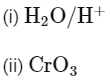
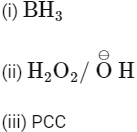
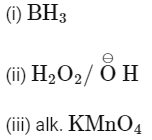
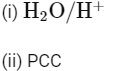
Q1: Identify the correct reagents that would bring about the following transformation. (NEET 2024)
(a) (b) (c) (d)
Solution:
Ans: (b)
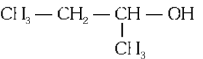
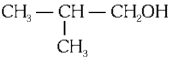
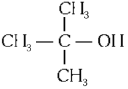
Q2: Which one of the following alcohols reacts instantaneously with Lucas reagent? (NEET 2024) (a) (b) (c) (d)
Solution:
Ans: (d) Tertiary alcohols react instantaneously with Lucas reagent and gives immediate turbidity. In case of tertiary alcohols, they form halides easily with Lucas reagent (conc. HCl and ZnCl2)
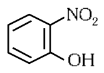
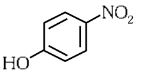
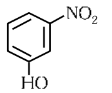
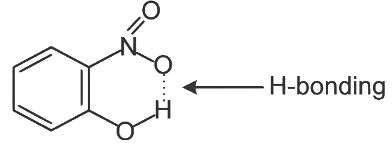
Q3: Intramolecular hydrogen bonding is present in (NEET 2024) (a) (b) (c) (d) HF
Solution:
Ans: (a) In o-nitrophenol intramolecular H-bonding is present.
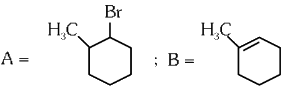
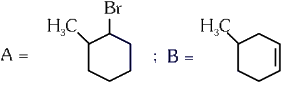
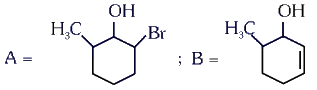
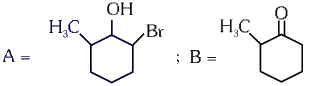
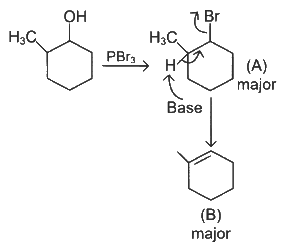
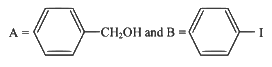
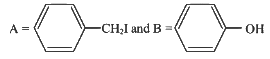
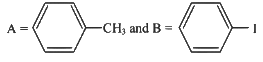
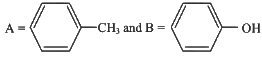
Q4: Major products A and B formed in the following reaction sequence, are (NEET 2024) (a) (b) (c) (d)
Solution:
Ans: (a)
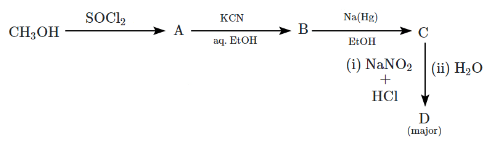
Q5: The major product D formed in the following reaction sequence is: (NEET 2024) (a) (b)
(c) CH3CH2OH
(d) CH3CH2Cl
Solution:
Ans: (c) Step 1: Methanol (CH₃OH) reacts with SOCl₂
SOCl₂ (thionyl chloride) is a reagent that is used to convert alcohols to alkyl chlorides.
CH₃OH + SOCl₂ → CH₃Cl (methyl chloride) + SO₂ + HCl This reaction replaces the hydroxyl group (-OH) with a chlorine atom (-Cl), forming CH₃Cl (methyl chloride).
Step 2: Reaction of CH₃Cl with KCN in ethanol
KCN (potassium cyanide) reacts with CH₃Cl (methyl chloride) to replace the chlorine atom with a cyano group (-CN), forming CH₃CN (acetonitrile).
CH₃Cl + KCN → CH₃CN + KCl This reaction results in the formation of acetonitrile (CH₃CN).
Step 3: Reduction of acetonitrile (CH₃CN) with Na/H₂
Na/H₂ (sodium in hydrogen) is a strong reducing agent that reduces nitriles to primary amines.
CH₃CN + Na/H₂ → CH₃CH₂NH₂ (ethylamine). This step reduces acetonitrile to ethylamine (CH₃CH₂NH₂).
Step 4: Reaction of ethylamine with NaNO₂ and HCl
NaNO₂ (sodium nitrite) reacts with ethylamine (CH₃CH₂NH₂) in the presence of HCl (hydrochloric acid) to form a diazonium salt.
The reaction proceeds as follows: CH₃CH₂NH₂ + NaNO₂ + HCl → CH₃CH₂N₂⁺Cl⁻ (ethyl diazonium chloride)
However, ethyl diazonium chloride is unstable and undergoes hydrolysis when treated with water.
Step 5: Hydrolysis of the diazonium salt
The diazonium salt formed in the previous step undergoes hydrolysis to form ethanol (CH₃CH₂OH).
The major product of the reaction is ethanol (CH₃CH₂OH).
Thus, the correct answer is (c) CH₃CH₂OH (ethanol).
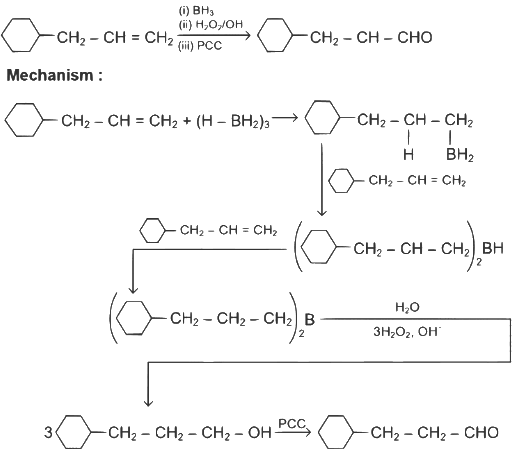
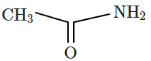
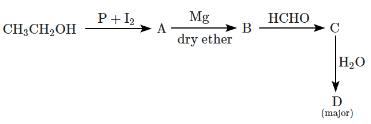
Q6: Identify D in the following sequence of reactions: (NEET 2024) (a) n-Propyl alcohol (b) Isopropyl alcohol (c) Propanal (d) Propionic acid
Solution:
Ans: (a)
2023
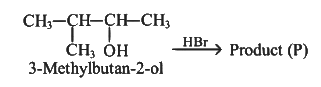
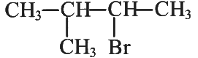
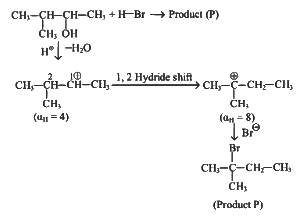
Q1: Consider the following reaction and identify the product (P).
(a) (b) (c) (d)
Solution:
Ans: (d)
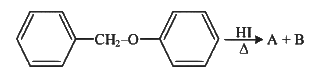
Q2: Consider the following reaction (NEET 2023)
Identify products A and B :-
(a)
(b)
(c)
(d)
Solution:
Ans: (b)
Q3: Which amongst the following will be most readily dehydrated under acidic conditions? (NEET 2023) (a)
(b)
(c)
(d)
Solution:
Ans: (a) Due to presence of conjugation in product.
Q4: Reagents that can be used to convert alcohols to carboxylic acids are: (NEET 2023) (a) CrO₃ - H₂SO₄ (b) K₂Cr₂O₇ + H₂SO₄ (c) KMnO₄ + KOH/H₃O⁺ (d) Cu, 573 K (e) CrO₃ + (CH₃CO)₂O Choose the most appropriate answer from the options given below: (a) (b), (c) and (d) only (b) (b), (d) and (e) only (c) (a), (b) and (c) only (d) (a), (b) and (e) only
Solution:
Ans: (c)
(A) CrO₃ - H₂SO₄: This is a strong oxidizing agent, known as Jones reagent, which can oxidize alcohols (primary alcohols specifically) to carboxylic acids.
(B) K₂Cr₂O₇ + H₂SO₄: This is another powerful oxidizing agent (chromic acid), which can also oxidize alcohols to carboxylic acids.
(C) KMnO₄ + KOH/H₃O⁺: Potassium permanganate (KMnO₄) is a strong oxidizing agent that can oxidize alcohols to carboxylic acids.
(D) Cu, 573 K: This reagent is used for the dehydrogenation of alcohols, typically producing aldehydes or ketones, not carboxylic acids.
(E) CrO₃ + (CH₃CO)₂O: This is an esterification reaction (formation of esters), not related to the conversion of alcohols to carboxylic acids.
Hence, (A), (B), and (C) are the correct reagents for converting alcohols to carboxylic acids.
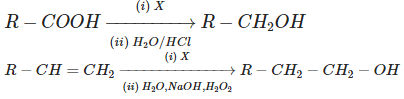
Q5: Consider the following reactions: (NEET 2023) Identify 'X' in above reactions: (a) B2H6 (b) LiAlH4 (c) NaBH4 (d) H2/Pd
Solution:
Ans: (a) First Reaction: Carboxylic acids are reduced to primary alcohols by strong reducing agents such as:
LiAlH₄
Borane (B₂H₆ / BH₃)
The sequence:
(i) X (ii) H2O2/NaOH
represents Hydroboration-Oxidation of alkenes, which gives anti-Markovnikov alcohols.
⇒ Borane (B₂H₆ / BH₃)
LiAlH₄ does not react with alkenes in this way.
The reagent required for hydroboration is:
So, X must be one of these. Conclusion:
Since B₂H₆:
reduces carboxylic acids to primary alcohols
converts alkenes to alcohols via hydroboration-oxidation
Thus, 'X' is B₂H₆. Answer: (a) B₂H₆
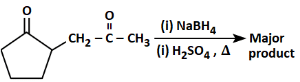
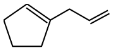
Q6: The major product formed in the following conversion is: (NEET 2023) (a) (b) (c) (d)
Solution:
Ans: (a) Starting compound: The starting compound is a β-keto ester (a compound containing both a carbonyl group and an ester group).
The structure has a ketone (C=O) group attached to the second carbon and an ester (C=O) group attached to the first carbon.
First step (NaBH₄):
Sodium borohydride (NaBH₄) is a mild reducing agent. It selectively reduces ketones but does not affect esters.
NaBH₄ will reduce the ketone group to a secondary alcohol, resulting in the intermediate product where the carbonyl group is replaced by an -OH group.
Second step (H₂SO₄, Δ):
The ester group undergoes decarboxylation under acidic conditions (using sulfuric acid, H₂SO₄, and heat).
This reaction removes the CO₂ group, leading to the formation of a cyclohexene structure with a double bond between two adjacent carbons.
Major product: The major product is the cyclic alkene formed after the decarboxylation step, which is the 1-cyclohexene structure. Thus, the correct answer is Option 1, which shows the major product as 1-cyclohexene.
2022
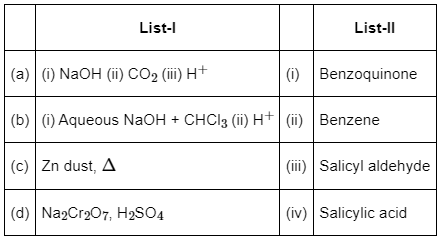
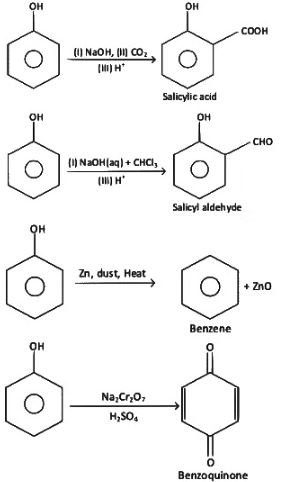
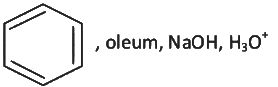
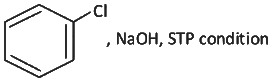
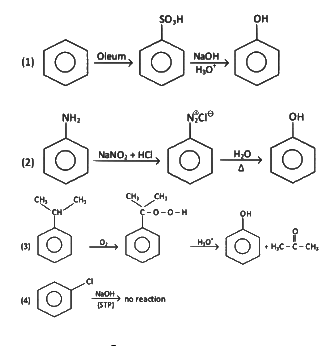
Q1: Match the reagents (List-I) with the product (List-II) obtained from phenol. (NEET 2022 Phase 2)
At STP condition substitution at sp2 carbon atom is not feasible.
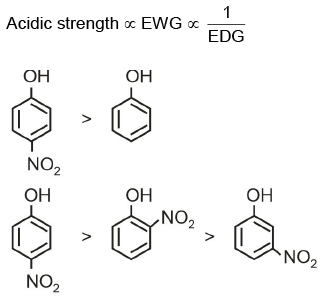
Q2: Given below are two statements: Statement I: The acidic strength of monosubstituted nitrophenol is higher than phenol because of the electron-withdrawing into the group. Statement II: o-nitrophenol, m-nitrophenol, and p-nitrophenol will have same acidic strength as they have one nitro group attached to the phenolic ring. In light of the above statements, choose the most appropriate answer from the options given below: (NEET 2022 Phase 1) (a) Statement I is correct but Statement II is incorrect (b) Statement I is incorrect but Statement II is correct (c) Both Statement I and Statement II are correct (d) Both Statement I and Statement II are incorrect
Solution:
Ans: (a) Statement I is correct, Statement II incorrect.
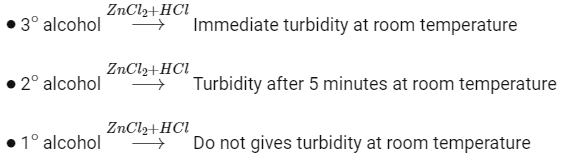
Q4: Given below are two statements: Statement -I: In Lucas test, primary, secondary and tertiary alcohols are distinguished on the basis of their reactivity with conc. HCl + ZnCl2, known as Lucas Reagent. Statement -II: Primary alcohols are most reactive and immediately produce turbidity at room temperature on reaction with Lucas Reagent. In the light of the above statements, choose the most appropriate answer from the options given below: (NEET 2022 Phase 2) (a) Statement I is correct but Statement II is incorrect (b) Statement I is incorrect but Statement II is correct (c) Both statement I and Statement II are correct (d) Both Statement I and Statement II are incorrect
Solution:
Ans: (a) Primary, secondary and tertiary alcohols can be differentiated by their reaction with (HCl + anhy ZnCl2) Lucas reagent
2020
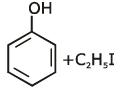
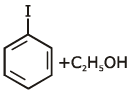
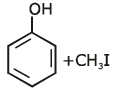
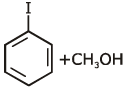
Q1: Anisole on cleavage with HI gives : (NEET 2020) (a) (b) (c) (d)
Solution:
Ans: (c)
2019
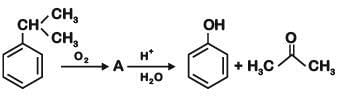
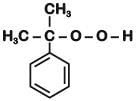
Q1: The structure of intermediate A in the following reaction, is (NEET 2019) (a)
(b)
(c)
(d)
Solution:
Ans: B
2018
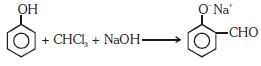
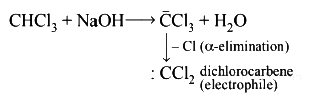
Q1: In the reaction the electrophile involved is (NEET 2018) (a) dichloromethyl cation (b) formyl cation (c) dichloromethyl anion (d) dichlorocarbene
Solution:
Ans: (d)
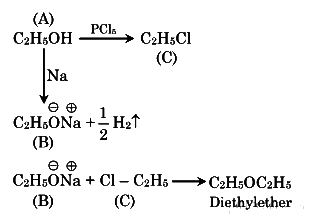
Q2: The compound A on treatment with Na gives B, and with PCl5 gives C. B and C react together to give diethyl ether. A, B and C are in the order (NEET 2018) (a) C2H5OH, C2H6, C2H5Cl (b) C2H5OH, C2H5Cl, C2H5ONa (c) C2H5Cl,C2H6,C2H5OH (d) C2H5OH,C2H5ONa,C2H5Cl
Solution:
Ans: (d)
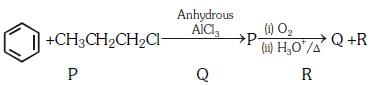
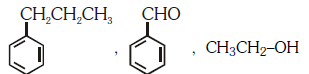
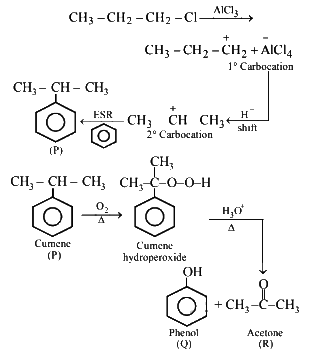
Q3: Identify the major products P, Q and R in the following sequence of reaction: (NEET 2018) (a)
(b)
(c)
(d)
Solution:
Ans: (d)
2017
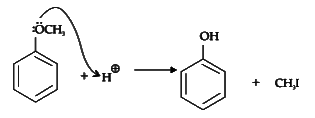
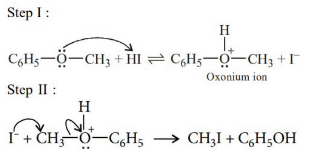
Q1: The heating of phenylmethyl ethers with HI produces (NEET 2017) (a) iodobenzene (b) phenol (c) benzene (d) ethyl chlorides
Solution:
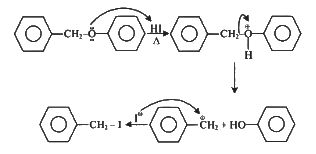
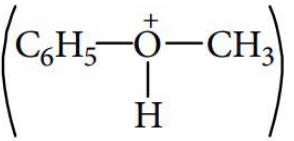
Ans: (b) In case of phenyl methyl ether, methyl phenyl oxonium ion
is formed by protonation of ether. The O-CH3 bond is weaker than O-C6H5 bond as O-C6H5 has partial double bond character. Therefore, the attack by I- ion breaks O-CH3 bond to form CH3I.
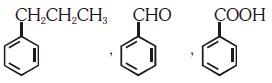
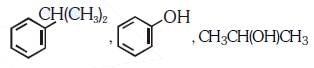
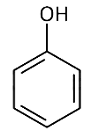
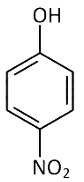
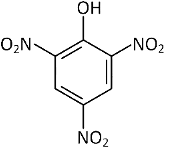
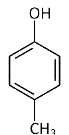
Q2: Which one is the most acidic compound? (NEET 2017) (a)
(b)
(c)
(d)
Solution:
Ans: (c) Electron withdrawing group at o and p-position w.r.t. OH group of phenol, increase the acidic strength. Picric acid (2, 4, 6-trinitrophenol) is extremely more acidic among the given compounds due to the presence of three strong electron withdrawing groups ( NO2 group) at ortho and para-positions.
Ans: B The treatment of sodium alkoxide with a suitable alkyl halide to form an ether is called as Williamson ether synthesis reaction.
2015
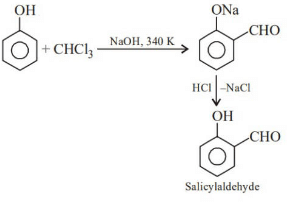
Q1: Reaction of phenol with chloroform in the presence of dilute sodium hydroxide finally introduces which one of the following functional groups? (NEET / AIPMT 2015) (a) -COOH (b) -CHCl2 (c) -CHO (d) -CH2Cl
Solution:
Ans: (c) This is Reimer-Tiemann reaction.
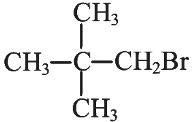
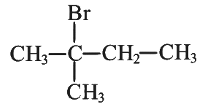
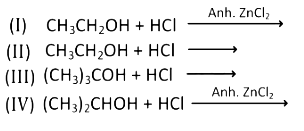
Q2: Which of the following reaction(s) can be used for the preparation of alkyl halides? (NEET / AIPMT 2015)
(a) (I) and (II) only (b) (IV) only (c) (III) and (IV) only (d) (I), (III), and (IV) only
Solution:
Ans: (d) Lucas reagent [HCl + ZnCl2] can be used for 1° / 2° / 3° alcohol but if ZnCl2 is absent then only 3° alcohol can be used because it is most reactive due to 3° carbocation.
Ans: (b) The reaction is called Williamson synthesis
2014
Q1: Which of the following will not be soluble sodium hydrogen carbonate? (NEET 2014) (a) o-Nitrophenol (b) Benzenesulphonic acid (c) 2, 4, 6 - trinitrophenol (d) Benzoic acid
Solution:
Ans: (a) Acid reacts with sodium hydrogen carbonate as follows : Among all the given options ortho-nitrophenol is weaker acid than HCO3 hence, it does not react with NaHCO3.
The document NEET Previous Year Questions (2014-2025): Alcohols, Phenols & Ethers is a part of the NEET Course Chemistry Class 12.
FAQs on NEET Previous Year Questions (2014-2025): Alcohols, Phenols & Ethers
1. What's the difference between alcohols, phenols, and ethers in organic chemistry?
Ans. Alcohols contain a hydroxyl (-OH) group bonded to a carbon atom; phenols have -OH attached to an aromatic ring; ethers have two alkyl or aryl groups bonded to oxygen without hydrogen. These structural differences make phenols more acidic than alcohols. Understanding these distinctions is crucial for NEET, as reaction mechanisms and chemical properties depend entirely on functional group placement.
2. Why are phenols more acidic than alcohols even though both have -OH groups?
Ans. Phenols are stronger acids because the aromatic ring delocalises the negative charge on the conjugate base, stabilising it significantly. In alcohols, the alkyl group cannot stabilise this charge effectively. This acidity difference explains why phenols react with sodium hydroxide while alcohols don't-a concept frequently tested in NEET previous year questions on acid-base chemistry.
3. How do you identify whether a compound is a primary, secondary, or tertiary alcohol in NEET problems?
Ans. Classification depends on the carbon bearing the -OH group: if attached to one carbon, it's primary; two carbons, secondary; three carbons, tertiary. This matters because oxidation patterns differ-primary alcohols oxidise to aldehydes then carboxylic acids, while secondary alcohols form ketones. NEET questions often test this distinction through oxidation reaction sequences.
4. What happens when alcohols and phenols undergo dehydration, and why do they react differently?
Ans. Alcohols undergo dehydration via E1 or E2 mechanisms to form alkenes, with reactivity depending on carbon substitution. Phenols resist dehydration because breaking the C-O bond would destabilise the aromatic system. This reactivity difference is a common NEET exam concept tested in elimination reaction comparisons and mechanism identification.
5. Which chemical tests can distinguish between alcohols, phenols, and ethers in practical questions?
Ans. The ferric chloride test produces colour with phenols but not alcohols; bromine water shows different reactivity patterns; sodium metal distinguishes alcohols and phenols (producing hydrogen) from ethers (no reaction). NEET papers frequently feature identification questions requiring knowledge of these classification tests and their underlying principles.
NEET Previous Year Questions (2014-2025): Alcohols, Viva Questions, video lectures, Phenols & Ethers, Extra Questions, Objective type Questions, Sample Paper, NEET Previous Year Questions (2014-2025): Alcohols, study material, Semester Notes, mock tests for examination, NEET Previous Year Questions (2014-2025): Alcohols, Free, Phenols & Ethers, Phenols & Ethers, pdf , practice quizzes, Previous Year Questions with Solutions, MCQs, past year papers, ppt, Exam, Important questions, Summary, shortcuts and tricks;




 (a)
(a) 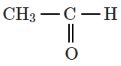
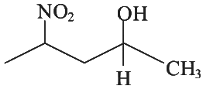
 (a) n-Propyl alcohol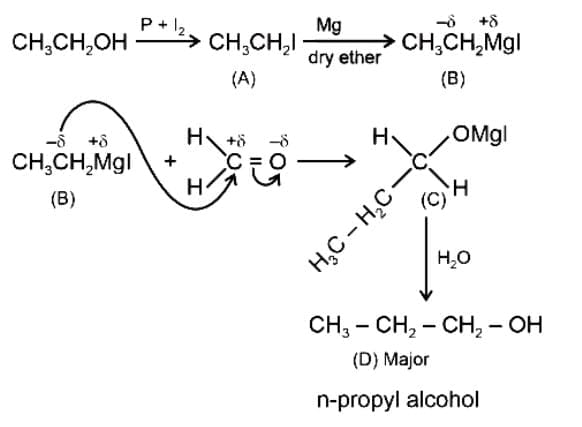


 Identify 'X' in above reactions:
  (a)
(a) 

 the electrophile involved is (NEET 2018)



 (AIPMT 2015 Cancelled Paper)
 The reaction is called Williamson synthesis





