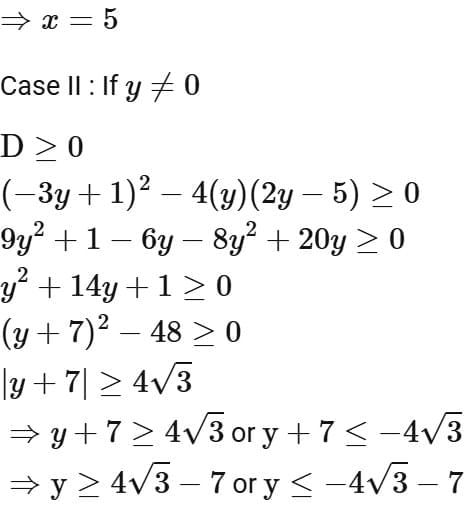
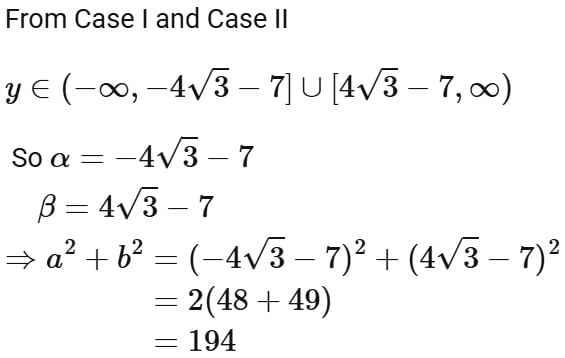
Q1. If the range of the function is then is equal to: (a) 188 (b) 192 (c) 190 (d) 194
Solution:
Ans. d
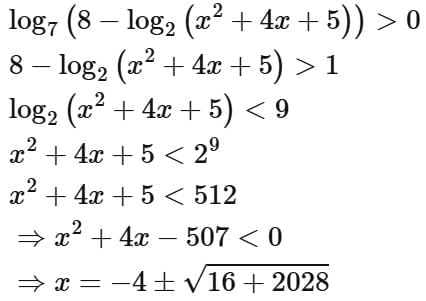
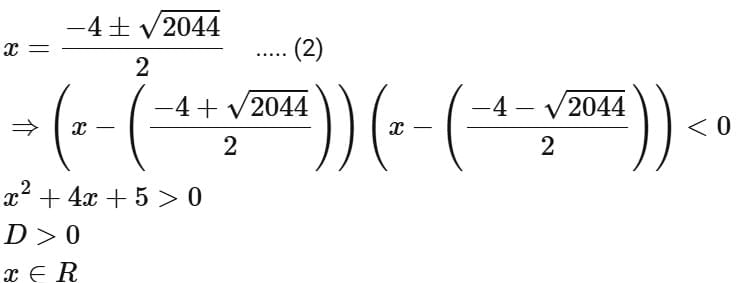
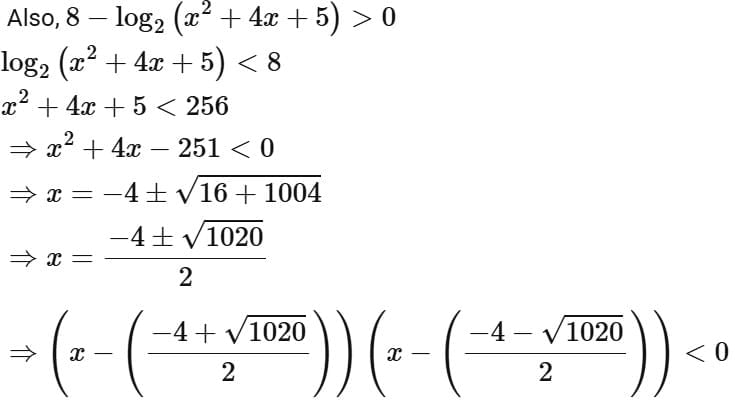
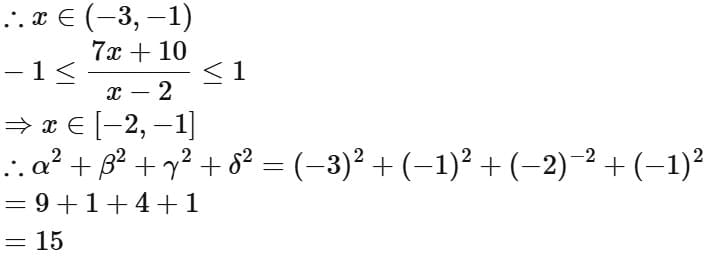
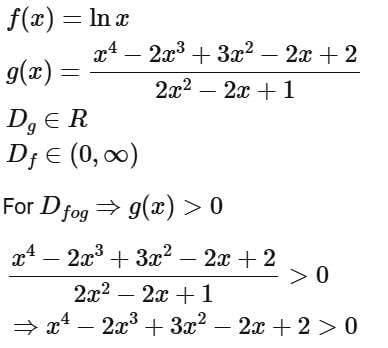
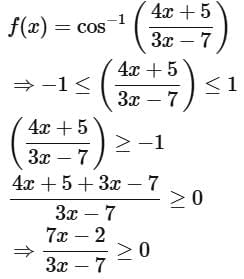
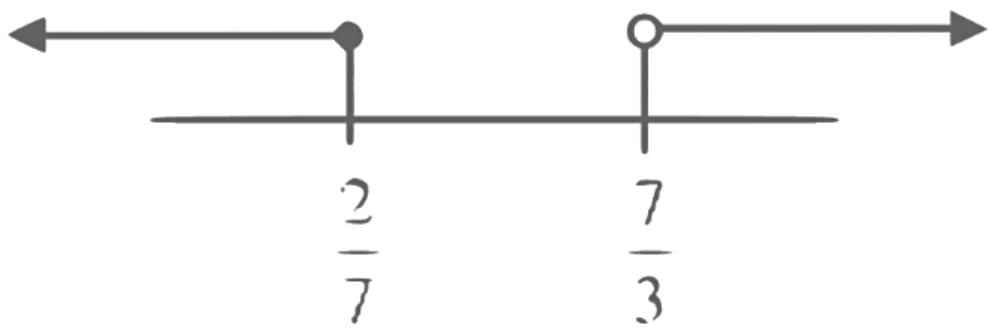
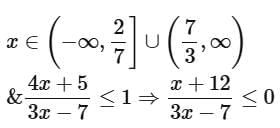
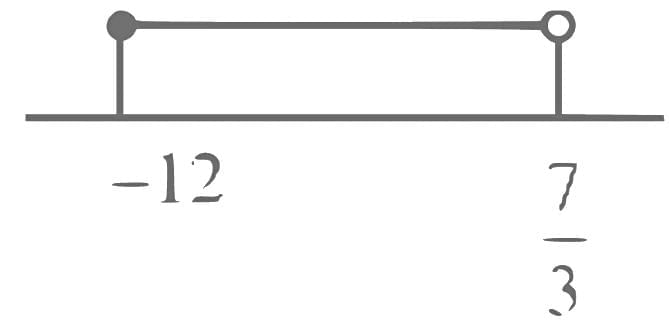
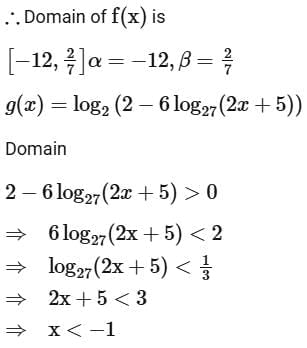
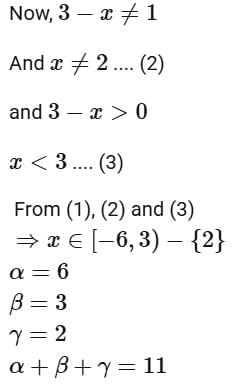
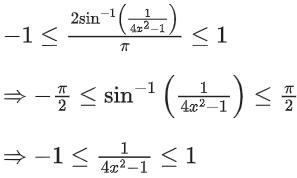
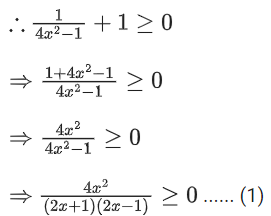
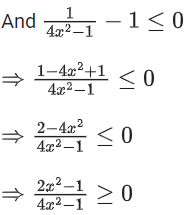
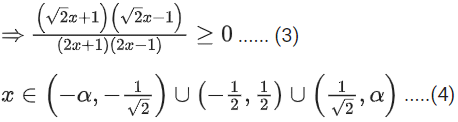
Q2. Let the domains of the functions f(x) = log4 log3 log7 (8 - log2 (x2 + 4x + 5)) and be (α, β) and [γ, δ], respectively. Then α2 + β2 + γ2 + δ2 is equal to: (a) 15 (b) 13 (c) 16 (d) 14
Solution:
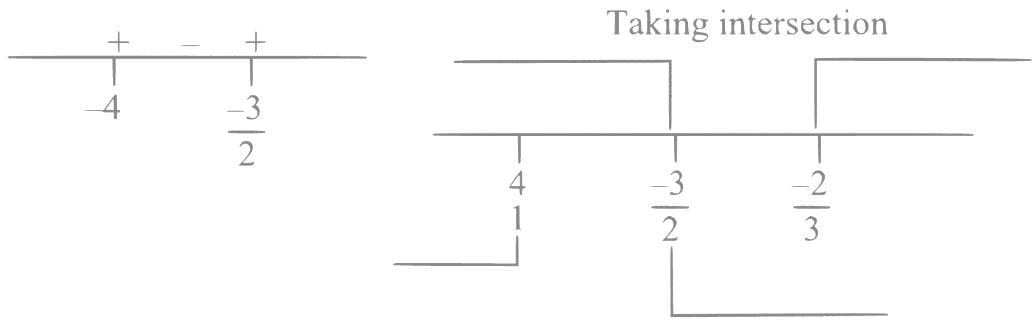
Ans. a ∴ Intersection of (1), (2) and (3)
Q3. Let be defined as If the range of the function fog: is equal to (a) 56 (b) 2 (c) 29 (d) 68
Solution:
Ans. a
Q4. Let f be a function such that Then f (3) + f (8) is equal to (a) 13 (b) 11 (c) 10 (d) 12
Solution:
Ans. b
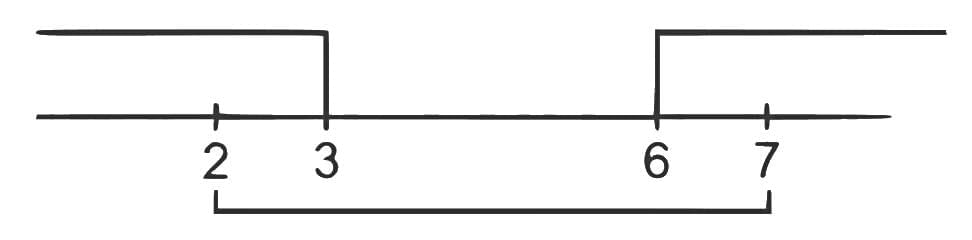
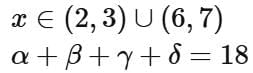
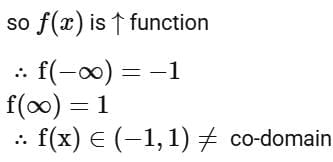
Q5. If the domain of the function is then is equal to (a) 17 (b) 15 (c) 16 (d) 18
Solution:
Ans. d
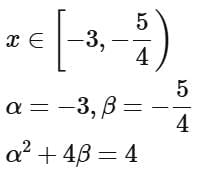
Q6. If the domain of the function is [α, β) then α2 + 4β is equal to (a) 4 (b) 3 (c) 7 (d) 5
Solution:
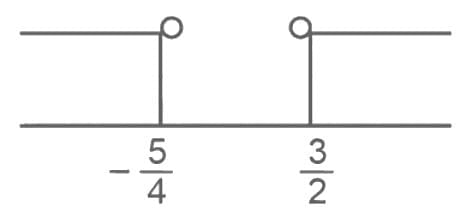
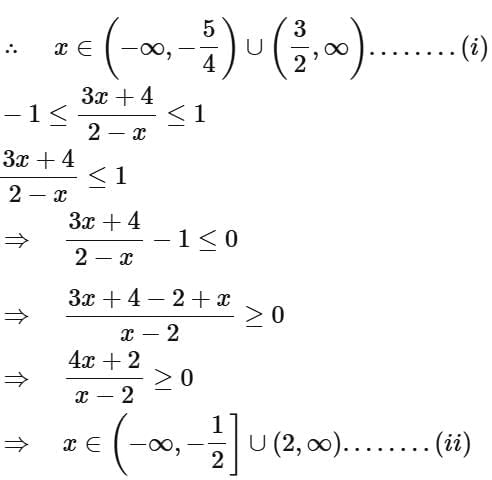
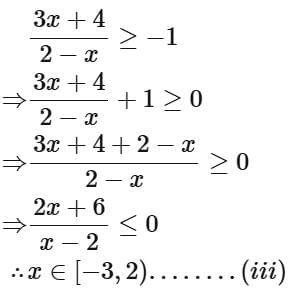
Ans. a Taking intersection of (i), (ii) and (iii)
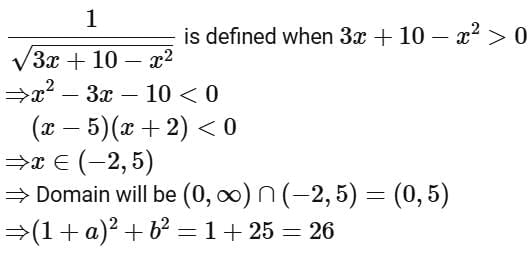
Q7. If the domain of the function is, (a, b), then (1 + a)2 + b2 is equal to: (a) 29 (b) 30 (c) 25 (d) 26
Solution:
Ans. d Similarly,
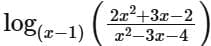
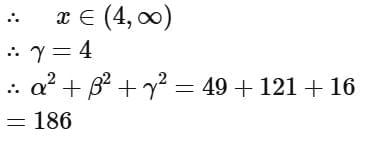
Q8. If the domain of the function log5(18x - x2 - 77) is (α, β) and the domain of the function is (γ, δ), then α2 + β2 + γ2 is equal to: (a) 186 (b) 179 (c) 195 (d) 174
Solution:
Ans. a
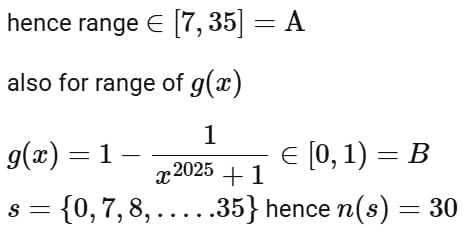
Q9. Let f : [0, 3] → A be defined by f(x) = 2x3 -15x2 +36x + 7 and g : [0,∞) → B be defined by If both the functions are onto and S = {x ∈ Z; x ∈ A or x ∈ B}, then n(S) is equal to: (a) 29 (b) 31 (c) 30 (d) 36
Solution:
Ans. c
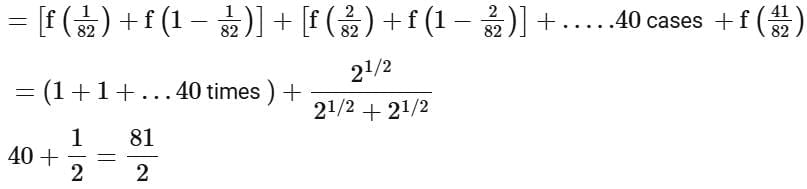
Q10. If is equal to (a) 82 (b) 81√2 (c) 41 (d) 81/2
Solution:
Ans. d
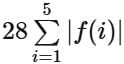
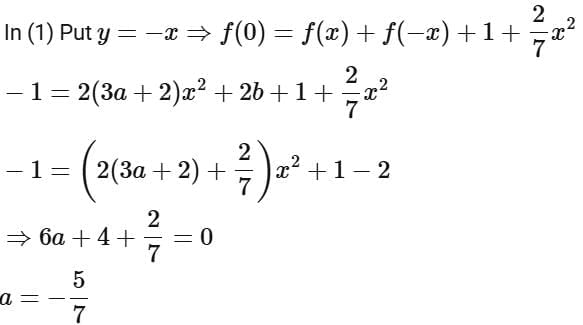
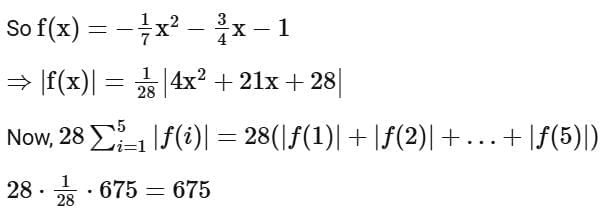
Q11. Let f : R → R be a function defined by If then the value of is (a) 735 (b) 675 (c) 715 (d) 545
Solution:
Ans. b
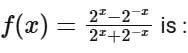
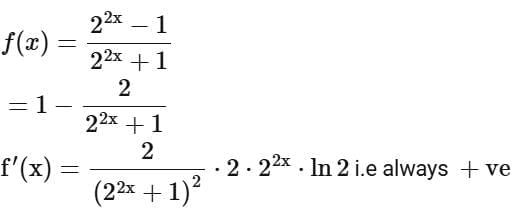
Q12. The function f : (-∞,∞) → (-∞,1) defined by (a) One-one but not onto (b) Onto but not one-one (c) Both one-one and onto (d) Neither one-one nor onto
Solution:
Ans. a so function is one-one but not onto
Q13. Let Then the value of is equal to (a) 108 (b) 92 (c) 118 (d) 102
Solution:
Ans. c
Q14. Let Then the domain of f o g is (a) (0, ∞) (b) [1, ∞] (c) (d) [0, ∞]
Solution:
Ans. c Clearly x < 0 satisfies which are included in option (1) only.
Q15. Let A = {1, 2, 3, 4} and B = {1, 4, 9, 16}. Then the number of many-one functions f : A → B such that 1 ∈ f (A) is equal to: (a) 151 (b) 139 (c) 163 (d) 127
Solution:
Ans. a Step 1: Total Functions with 1 ∈ f (A) Any function f : A → B where A = {1, 2, 3, 4} and B = {1,4, 9, 16} is defined by choosing one of the four elements of B for each element of A. Thus, the total number of functions is 44 = 256. To count those functions where 1 appears at least once in the set f(A), we can use the complementary counting method: subtract the functions that never use 1. If 1 is excluded, each element of A has only 3 choices (namely, {4, 9, 16}), so the number of such functions is 34 = 81. Thus, the number of functions such that 1 ∈ f(A) is 256 - 81 = 175. Step 2: Counting Many-One Functions In this context, "many-one functions" are understood to be non-injective functions. Since an injective (one-to-one) function from A to B must be a permutation (because both sets have 4 elements), the number of one-to-one functions is 4! = 24. It is important to note that every injective function f : A → B has f(A) = B (a full permutation) which automatically means 1 ∈ f(A). Thus, the number of many-one (non-injective) functions f : A → B with 1 ∈ f(A) is found by subtracting the one-to-one functions from the total functions that include 1: 175 - 24 = 151. This detailed explanation shows that the number of many-one functions f : A → B such that 1 ∈ f(A) is indeed 151.
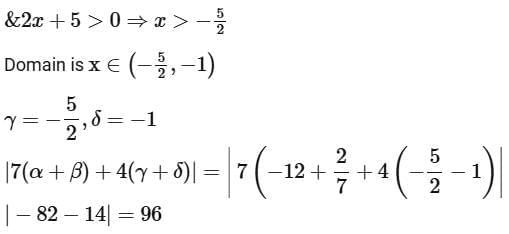
Q16. Let the domain of the function and the domain of Then |7(α + β) + 4(γ + δ)| is equal to ____________________.
Solution:
Ans. 96
2024
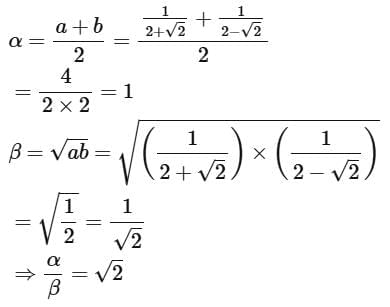
Q1. Let the range of the function If α and β ar respectively the A.M. and the G.M. of a and b, then α/β is equal to (a) π (b) √π (c) √2 (d) 2
Solution:
Ans. c
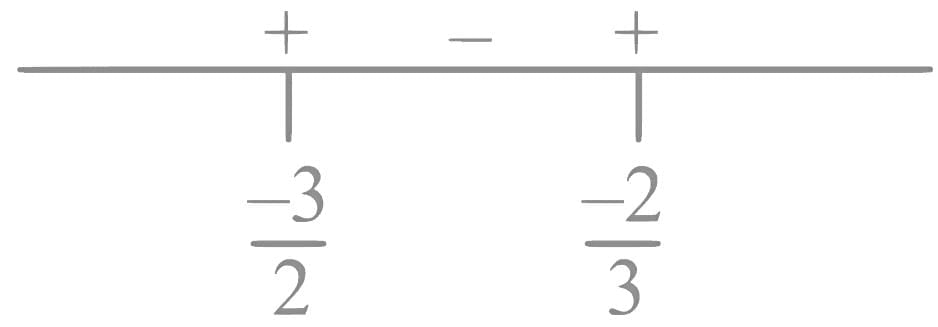
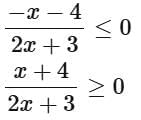
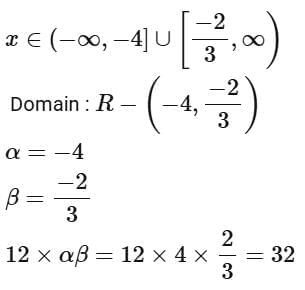
Q2. If the domain of the function is R - (α, β), then 12 αβ is equal to: (a) 40 (b) 36 (c) 24 (d) 32
Solution:
Ans. d
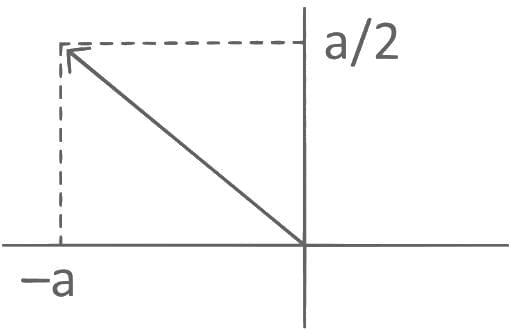
Q3. where a > 0 and g(x) = (f(|x|) - |f(x)|)/2. Then the function is (a) neither one-one nor onto. (b) both one-one and onto. (c) one-one. (d) onto
Solution:
Ans. a Neither one-one nor onto.
Q4. If the function attains the maximum value at x = 1/e then: (a) (b) (c) (d)
Ans. d
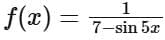
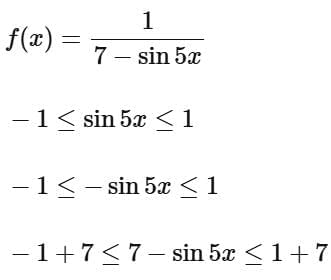
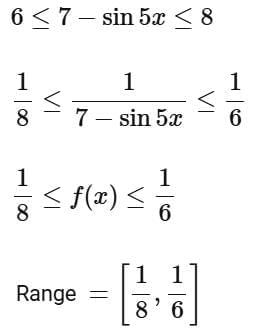
Q5. Let be a function defined on R. Then the range of the function f(x) is equal to: (a) (b) (c) (d)
Solution:
Ans. d
Q6. The function is (a) both one-one and onto. (b) onto but not one-one. (c) neither one-one nor onto. (d) one-one but not onto.
Solution:
Ans. c The function can be simplified to For x = 3 and x = -5, f(x) equals 0. Therefore, f(x) is not one-one as it yields the same output for different input values. The range of f(x) is [-2, 1.6], indicating that f(x) does not cover all possible real values. Consequently, f(x) is not onto. Thus, the function is neither one-one nor onto.
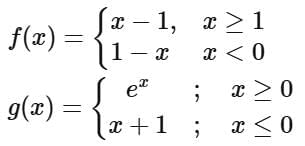
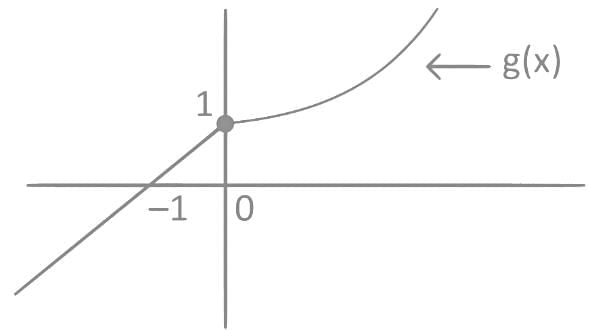
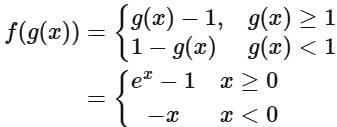
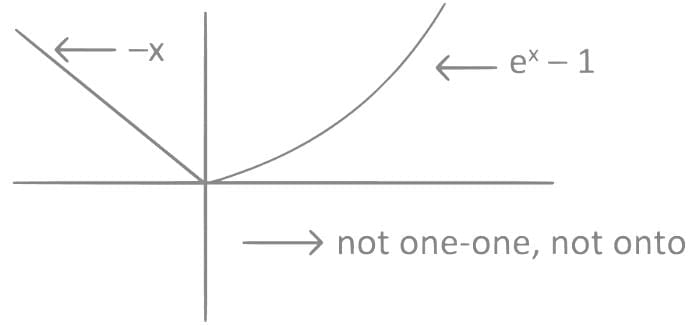
Q7. Let f, g : R → R be defined as:
Then the function f(g(x)) is (a) neither one-one nor onto. (b) one-one but not onto. (c) both one-one and onto. (d) onto but not one-one.
Solution:
Ans. a
Q8. Let A = {1,3, 7, 9, 11} and B = {2,4,5, 7, 8, 10, 12}. Then the total number of one-one maps f : A → B, such that f(1)+ f(3) =14, is: (a) 120 (b) 180 (c) 240 (d) 480
Solution:
Ans. c f(1)+f(3)=14 Case I f(1)=2,f(3)=12 f(1)=12,f(3)=2 Total one-one function =2 × 5 × 4 × 3 =120 Case II f(1)=4,f(3)=10 f(1)=10,f(3)=4 Total one-one function = 2 × 5 × 4 × 3 =120 Total cases = 120 + 120 = 240
Q9. If the domain of the function is then α2 + β2 is equal to: (a) 140 (b) 175 (c) 125 (d) 150
Solution:
Ans. d To find the domain of the function we need to consider the domain conditions for both the square root function and the logarithmic function. The square root function requires that the argument of the square root be non-negative, so x2 - 25 ≥ 0. This inequality is satisfied when x ≤ -5 or x ≥ 5. The denominator of the rational part of f(x), (4 - x2), cannot be zero, otherwise, the function will become undefined due to division by zero. Thus, we must have 4 - x2 ≠ 0. This inequality is violated when x = ±2. Combining these conditions gives us the domain for the rational part of the function: x ∈ (-∞,-5] U (5,∞) and x ≠ 2,-2. Moving on to the logarithmic function, log10(x2 +2x - 15), the argument must be positive: x2 + 2x - 15 > 0. This is a quadratic inequality, which we can factor to find the solution: (x +5)(x - 3) > 0. From this, we see that the inequality is satisfied for x < -5 or x > 3. The overall domain of f(x) is the intersection of the domains for each piece. Taking the intersection of the two sets gives us: x € (-∞,-5) U (5,∞), Since the question states that the domain is of the form (-∞, α) U [β, ∞), we can infer that α =- 5 and β = 5. We calculate α2 + β3 as follows: α2 + β3 = (-5)2 +53 =25 + 125 = 150. So the correct answer, representing the sum of α2 and β3, is: Option D 150.
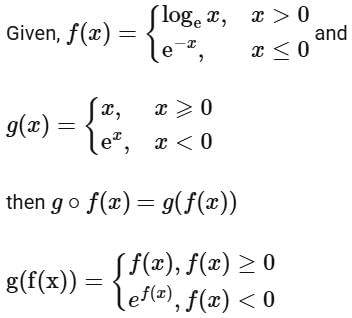
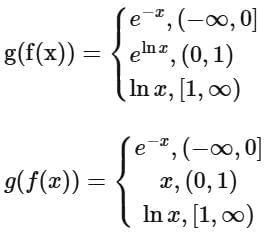
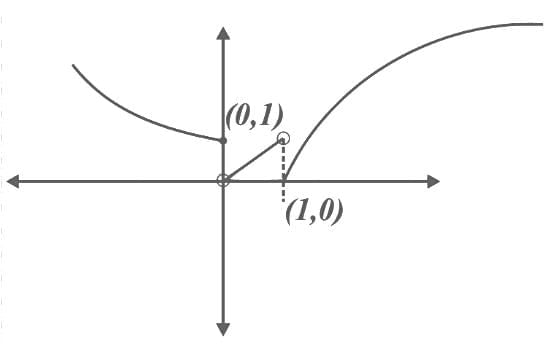
Q10. Let f : R → R and g : R → R be defined as and Then, gof : R → R is: (a) one-one but not onto (b) neither one-one nor onto (c) onto but not one-one (d) both one-one and onto
Solution:
Ans. b From the graph of g (f(x)), we can say g (f(x)) ⇒ Many one into
Q11. If where then is equal to (a) -4 (b) 19/20 (c) -19/20 (d) 4
Solution:
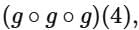
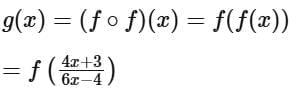
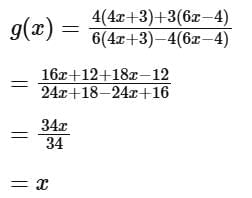
Ans. d To find we first need to understand the composition of f with itself, i.e., We can then repeatedly apply g to get the given expression. First, let's calculate To evaluate this expression, we substitute for x in the function f (x): Now, we simplify the expression: So, g(x) = x for all x in the domain of g, which is R - {2/3}. It's important to note that the domain restriction is preserved through the composition because f{x} has a vertical asymptote at x = 2/3 which doesn't intersect the graph. So, g (x) is the identity function on its domain, which means that applying g any number of times will result in the same input for x in the given domain. Hence, we have:
This corresponds to option D, which is 4 .
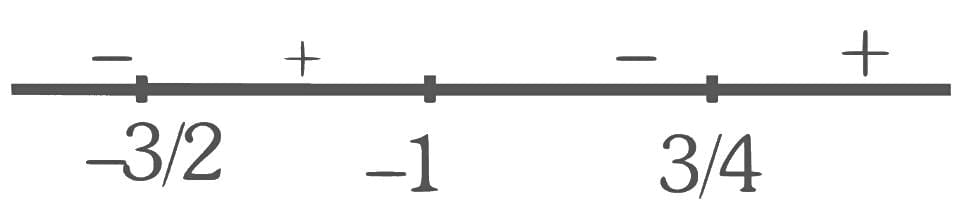
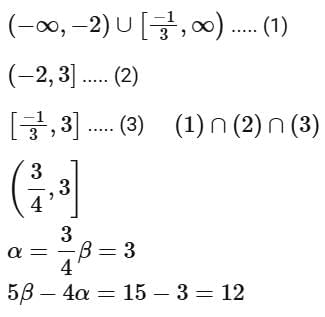
Q12. If the domain of the function is (α, β), then the value of 5 β - 4α is equal to (a) 9 (b) 12 (c) 11 (d) 10
Solution:
Ans. b
Q13. If the domain of the function then α + β + γ is equal to: (a) 11 (b) 12 (c) 9 (d) 8
Solution:
Ans. a
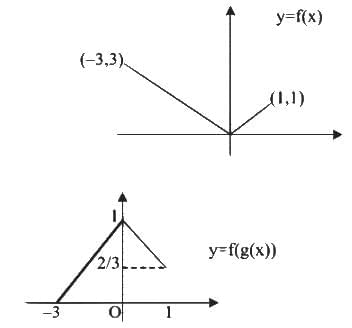
Q14. If then range of is (a) [0, 1) (b) [0, 3) (c) (0, 1] (d) [0, 1]
Solution:
Ans. d
Range of f (g(x)) is [0, 1]
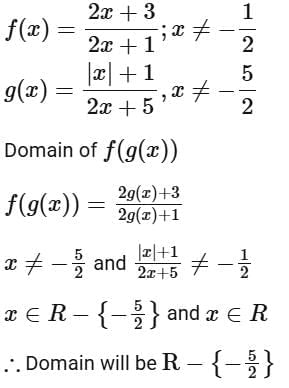
Q15. Let be defined as Then, the domain of the function fog is: (a) R - {-7/4} (b) R (c) (d) R - {-5/2}
Solution:
Ans. d
Q16. The function f : N - {1} → N; defined by f (n) = the highest prime factor of n, is: (a) one-one only (b) neither one-one nor onto (c) onto only (d) both one-one and onto
Solution:
Ans. b f : N - {1} → N f(n) = The highest prime factor of n. f(2) = 2 f(4) = 2 ⇒ many one 4 is not image of any element ⇒ into Hence many one and into Neither one-one nor onto.
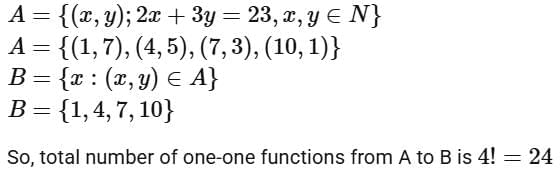
Q17. Let A = {(x, y) : 2x + 3y = 23, x, y ∈ N} and B = {x : (x, y) ∈ A}. Then the number of one-one functions from A to B is equal to __________.
Solution:
Ans. 24
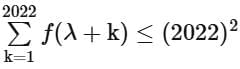
Q18. If a function f satisfies f(m + n) = f(m) + f(n) for all m, n ∈ N and f(1) = 1, then the largest natural number λ such that is equal to _________.
Solution:
Ans. 1010
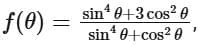
Q19. If the range of then the sum of the infinite G.P., whose first term is 64 and the common ratio is α/β, is equal to __________.
Solution:
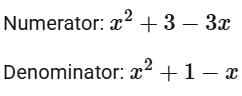
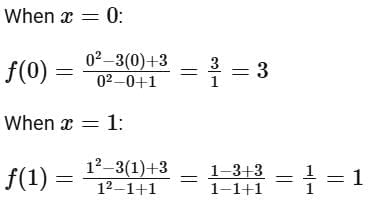
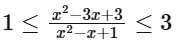
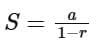
Ans. 96 To determine the range of the function let's start by simplifying the expression. Let sin2θ = x, so cos2θ = 1 - x . The function then transforms into: Simplify the numerator and denominator separately: Thus, the function becomes: Next, we need to find the range of this function. Let's analyze the function by testing specific values of x in the interval [0 , 1] (since sin2θ ranges from 0 to 1): It appears that f (x) achieves values within [1, 3]. To confirm this, we need to solve the quadratic inequality: By solving the inequalities, it can be confirmed that the function indeed ranges from 1 to 3 on the interval [0,1]. Hence, we have: The common ratio of the infinite geometric progression is: Given the first term a = 64, the sum S of the infinite geometric progression can be given as: Substituting the values a = 64 and r = 1/3, we get: Therefore, the sum of the infinite geometric progression is 96.
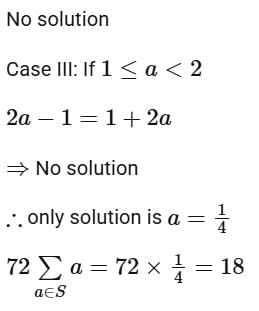
Q20. If S = {a ∈ R : |2a - 1| = 3[a] + 2{a}}, where [t] denotes the greatest integer less than or equal to t and {t} represents the fractional part of t , then is equal to _________.
Solution:
Ans. 18
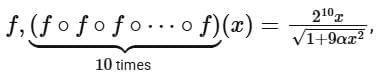
Q21. Consider the function If the composition of then the value of is equal to _______.
Solution:
Ans. 1024
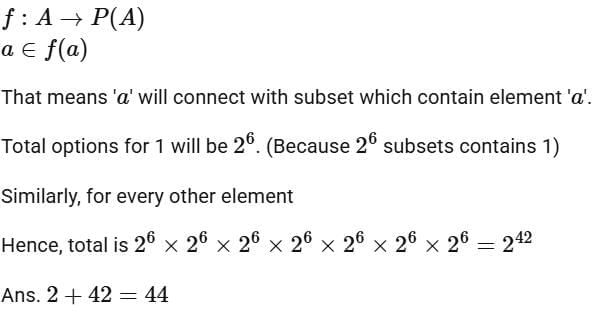
Q22. Let A = {1,2,3, ... , 7} and let P(A) denote the power set of A. If the number of functions f : A → P(A) such that a ∈ f(a), ∀a ∈ A is m", m and n ∈ N and m is least, then m + n is equal to _________.
Solution:
Ans. 44
2023
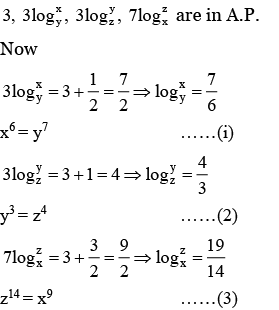
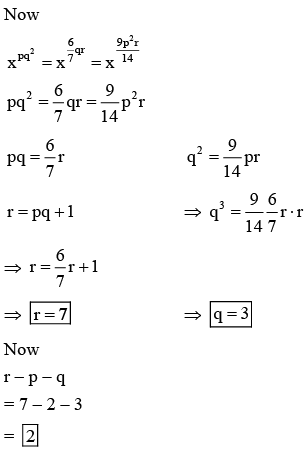
Q1. For three positive integers and r = pq + 1 such that 3,3logy x, 3logz y, 7logx z are in A.P. with common difference 1/2. Then r - p - q is equal to (a) -6 (b) 12 (c) 6 (d) 2
Solution:
Ans. d & r = pq + 1
2022
Q1. Let |M| denote the determinant of a square matrix M. Let g: [0, π/2] → R be the function defined by
Solution:
Solution: where
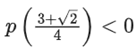
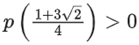
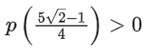
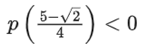
Q2. Let p(x) be a quadratic polynomial whose roots are the maximum and minimum values of the function g(θ), and p(2) = 2 - √2. Then, which of the following is/are TRUE? (a) (b) (c) (d)
Solution:
Correct Answe r is Option (a, c)
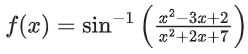
Q3. The domain of the function (a) [1, ∞) (c) [-1, 2] (c) [-1, ∞) (d) (-∞, 2]
Solution:
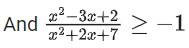
Correct Answer is Option (c) Solution: x2 + 2x + 7 5x ≥ - 5 x ≥ -1 x2 - 3x + 2 ≥ - x2 - 2x - 7 2x2 - x + 9 ≥ 0 x ∈ R (i) ∩ (ii) Domain ∈ [-1, ∞)
Q4. The function f(x) = xex(1-x), x ∈ R, is: (a) increasing in (b) decreasing in (c) increasing in (d) decreasing in
Solution:
Correct Answer is Option (a) Solution: f(x) = xex(1-x), x ∈ R f′(x) = xex(1-x) . (1 - 2x) + ex(1-x) = ex(1-x)[x - 2x2 + 1] = -ex(1-x)[2x2 - x - 1] = -ex(1-x)(2x + 1)(x - 1) ∴ f(x) is increasing inand decreasing in
Q5. Let be such that and Let f(x) = ax2 + bx + c be such that f(1) = 3, f(-2) = λ and f(3) = 4. If f(0) + f(1) + f(-2) + f(3) = 14, then λ is equal to: (a) -4 (b) 13/2 (c) 23/2 (d) 4
Solution:
Correct Answer is Option (d) Solution: f(1) = a + b + c = 3 ..... (i) f(3) = 9a + 3b + c = 4 .... (ii) f(0) + f(1) + f(-2) + f(3) = 14 OR c + 3 + (4a - 2b + c) + 4 = 14 OR 4a - 2b + 2c = 7 ..... (iii) From (i) and (ii) 8a + 2b = 1 ..... (iv) From (iii) -(2) × (i) ⇒ 2a - 4b = 1 ..... (v) From (iv) and (v) a = 1/6, b = -1/6 and c = 3 f(-2) = 4a - 2b + c 4/6 + 2/6 + 3 = 4
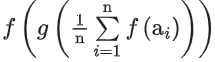
Q6. Let α, β and γ be three positive real numbers. Let f(x) = αx5 + βx3 + γx, x ∈ R and g : R → R be such that g(f(x)) = x for all x ∈ R. If a1, a2, a3,..., an be in arithmetic progression with mean zero, then the value ofis equal to: (a) 0 (b) 3 (c) 9 (d) 27
Solution:
Correct Answer is Option (a) Solution: ∴ First and last term, second and second last and so on are equal in magnitude but opposite in sign. f(x) = αx5 + βx3 + γx = 0α + 0β + 0γ = 0
Q7. Considering only the principal values of the inverse trigonometric functions, the domain of the function (a) (-∞, 1/4] (b) (c) (-1/3, ∞) (d) (-∞, 1/3]
Solution:
Correct Answer is Option (b) Solution: ⇒ -x2 - 3 ≤ x2 - 4x + 2 ≤ x2 + 3 ⇒ 2x2 - 4x + 5 ≥ 0 & -4x ≤ 1 x ∈ R & x ≥ So domain is
Q8. The domain of the functionwhere [t] is the greatest integer function, is: (a) (b) (c) (d)
Q9. Let f, g : N - {1} → N be functions defined by f(a) = α, where α is the maximum of the powers of those primes p such that pα divides a, and g(a) = a + 1, for all a ∈ N - {1}. Then, the function f + g is (a) one-one but not onto (b) onto but not one-one (c) both one-one and onto (d) neither one-one nor onto
Solution:
Correct Answer is Option (d) Solution: f, g : N - {1} → N defined as f(a) = α, where α is the maximum power of those primes p such that pα divides a. g(a) = a + 1, Now, f(2) = 1, g(2) = 3 ⇒ (f + g)(2) = 4 f(3) = 1, g(3) = 4 ⇒ (f + g)(3) = 5 f(4) = 2, g(4) = 5 ⇒ (f + g)(4) =7 f(5) = 1, g(5) = 6 ⇒ (f + g)(5) = 7 ∵ (f + g)(5) = (f + g)(4) ∴ f+g is not one-one Now, ∵ fmin = 1, gmin = 3 So, there does not exist any x ∈ N - {1} such that (f + g)(x) = 1, 2, 3 ∴ f + g is not onto
Q10. If the maximum value of a, for which the function fa(x) = tan-12x - 3ax + 7 is non-decreasing in is equal to (a) (b) (c) (d)
Solution:
Correct Answer is Option (a) Solution: fa(x) = tan-12x - 3ax + 7 ∵ fa(x) is non-decreasing in
Q11. Let f : R → R be a continuous function such that f(3x) - f(x) = x. If f(8) = 7, then f(14) is equal to: (a) 4 (b) 10 (c) 11 (d) 16
Solution:
Correct Answer is Option (b) Solution: f(3x) - f(x) = x ...... (1) x → x/3 f(x) - f(x/3) = x/3 ....... (2) Again x → x/3 f(x/3) - f(x/9) = x/32 ...... (3) Similarly Adding all these and applying n → ∞ f(3x) - f(0) = 3x/2 Putting x = 8/3 f(8) - f(0) = 4 ⇒ f(0) = 3 Putting x = 14/3 f(14) - 3 = 7 ⇒ f(14) = 0
Q12. The number of bijective functions f : {1, 3, 5, 7, ..., 99} → {2, 4, 6, 8, .... 100}, such that f(3) ≥ f(9) ≥ f(15) ≥ f(21) ≥ ..... f(99), is ____________. (a) 50P17 (b) 50P33 (c) 33! × 17! (d) 50!/2
Solution:
Correct Answer is Option (b) Solution: As function is one-one and onto, out of 50 elements of domain set 17 elements are following restriction f(3) > f(9) > f(15) ....... > f(99) So number of ways = 50C17 . 1 . 33! = 50!/2
Q13. If the absolute maximum value of the functionin the interval [-3, 0] is f(α), then: (a) α = 0 (b) α = -3 (c) α ∈ (-1, 0) (d) α ∈ (-3, -1)
Solution:
Correct Answer is Option (b)
Q14. The total number of functions, f : {1, 2, 3, 4} → {1, 2, 3, 4, 5, 6} such that f(1) + f(2) = f(3), is equal to: (a) 60 (b) 90 (c) 108 (d) 126
Solution:
Correct Answer is Option (b) Solution: Given, f(1) + f(2) = f(3) It means f(1), f(2) and f(3) are dependent on each other. But there is no condition on f(4), so f(4) can be f(4) = 1, 2, 3, 4, 5, 6. For f(1), f(2) and we have to find how many functions possible which will satisfy the condition f(1) + f(2) = f(3) Case 1: When f(3) = 2 then possible values of f(1) and f(2) which satisfy f(1) + f(2) = f(3) is f(1) = 1 and f(2) = 1. And f(4) can be = 1, 2, 3, 4, 5, 6 ∴ Total possible functions = 1 × 6 = 6 Case 2: When f(3) = 3 then possible values (1) f(1) = 1 and f(2) = 2 (2) f(1) = 2 and f(2) = 1 And f(4) can be = 1, 2, 3, 4, 5, 6. ∴ Total functions = 2 × 6 = 12 Case 3: When f(3) = 4 then (1) f(1) = 1 and f(2) = 3 (2) f(1) = 2 and f(2) = 2 (3) f(1) = 3 and f(2) = 1 And f(4) can be = 1, 2, 3, 4, 5, 6 ∴ Total functions = 3 × 6 = 18 Case 4: When f(3) = 5 then (1) f(1) = 1 and f(4) = 4 (2) f(1) = 2 and f(4) = 3 (3) f(1) = 3 and f(4) = 2 (4) f(1) = 4 and f(4) = 1 And f(4) can be = 1, 2, 3, 4, 5 and 6 ∴ Total functions = 4 × 6 = 24 Case 5: When f(3)=6 then (1) f(1) = 1 and f(2) = 5 (2) f(1) = 2 and f(2) = 4 (3) f(1) = 3 and f(2) = 3 (4) f(1) = 4 and f(2) = 2 (5) f(1) = 5 and f(2) = 1 And f(4) can be = 1, 2, 3, 4, 5 and 6 ∴ Total possible functions = 5 × 6 = 30 ∴ Total functions from those 5 cases we get = 6 + 12 + 18 + 24 + 30 = 90
Q15. Let and S2 = {x ∈ R : 32x - 3x+1 - 3x+2 + 27 ≤ 0}. Then, S1 ∪ S2 is equal to: (a) (-∞, -2] ∪ (1, 2) (b) (-∞, -2] ∪ [1, 2] (c) (-2, 1] ∪ [2, ∞) (d) (-∞, 2]
Solution:
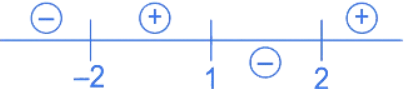
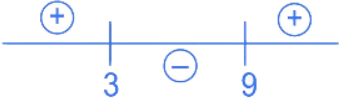
Correct Answer is Option (b) Solution: Given, x2 + 3x + 5 is a quadratic equation a = 1 > 0 and D = (-3)2 - 4 . 1 . 5 = -11 < 0 ∴ x2 + 3x + 5 > 0 (always) So, we can ignore this quadratic term ∴ x ∈ (-α, -2] ∪ (1, 2) ∴ S1 = (-α, -2] ∪ (1, 2) Now, 32x - 3x+1 - 3x+2 + 27 ≤ 0 ⇒ (3x)2 - 3 . 3x - 32 . 3x + 27 ≤ 0 Let 3x = t ⇒ t2 - 3 . t - 32 . t + 27 ≤ 0 ⇒ t(t - 3) - 9(t - 3) ≤ 0 ⇒ (t - 3)(t - 9) ≤ 0 ∴ 3 ≤ t ≤ 9 ⇒ 31 ≤ 3x ≤ 32 ⇒ 1 ≤ x ≤ 2 ∴ x ∈ [1, 2] ∴ S2 = [1, 2] ∴ S1 ∪ S2 = (-α, 2] ∪ (1, 2) ∪ [1, 2]
Q16. The domain of the function (a) (b) (-∞, -1] ∪ [1, ∞) ∪ {0} (c) (d)
Solution:
Correct Answer is Option (d) Solution: From (3) and (4), we get
Q17. Let a function f : N → N be defined by then, f is (a) one-one but not onto (b) onto but not one-one (c) neither one-one nor onto (d) one-one and onto
Solution:
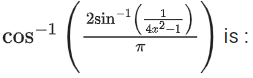
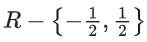
Correct Answer is Option (d) Solution: When n = 1, 5, 9, 13 thenwill give all odd numbers. When n = 3, 7, 11, 15 ..... n - 1 will be even but not divisible by 4 When n = 2, 4, 6, 8 ..... Then 2n will give all multiples of 4 So range will be N. And no two values of n give same y, so function is one-one and onto.
Q18. Let f : R → R be defined as f (x) = x - 1 and g : R - {1, -1} → R be defined as g(x)=Then the function fog is: (a) one-one but not onto (b) onto but not one-one (c) both one-one and onto (d) neither one-one nor onto
Solution:
Correct Answer is Option (d) Solution: f : R → R defined as f(x) = x - 1 and g : R → {1, -1} → R, g(x) = ∴ Domain of fog(x)=R-{-1,1} And range of fog(x) = (-∞, -1] ∪ (0, ∞) ∴ fog(x) is neither one-one nor onto.
Q19. Let f(x) = 2cos-1x + 4cot-1x - 3x2 - 2x + 10, x ∈ [-1, 1]. If [a, b] is the range of the function f, then 4a - b is equal to: (a) 11 (b) 11 - π (c) 11 + π (d) 15 - π
Solution:
Correct Answer is Option (b) Solution: f(x) = 2cos-1x + 4cot-1x - 3x2 - 2x + 10 ∀ x ∈ [-1, 1] So f(x) is decreasing function and range of f(x) is [f(1), f(-1)], which is [π + 5, 5π + 9] Now 4a - b = 4(π + 5) - (5π + 9) = 11 - π
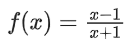
Q20. Let f(x) =, x ∈ R - {0, -1, 1}. If fn+1(x) = f(fn(x)) for all n ∈ N, then f6(6) + f7(7) is equal to: (a) 7/6 (b) (c) 7/12 (d)
Solution:
Correct Answer is Option (b) Solution: Given, Also given, fn+1(x) = f(fn(x)) ..... (1) ∴ For n = 1 f1+1(x) = f(f1(x)) ⇒ f2(x) = f(f(x)) From equation (1), when n = 2 f2+1(x) = f(f2(x)) ⇒ f3(x) = f(f2(x)) Similarly, f4(x) = f(f3(x)) ∴ f5(x) = f(f4(x)) = f(x) f6(x) = f(f5(x)) = -1x (Already calculated earlier) f7(x) = f(f6(x)) ∴ f6(6) = So, f6(6) + f7(7)
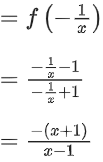
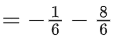
Q21. Let f : R → R and g : R → R be two functions defined by f(x) = loge(x2 + 1) - e-x + 1 and Then, for which of the following range of α, the inequality holds? (a) (2, 3) (b) (-2, -1) (c) (1, 2) (d) (-1, 1)
Q22. Let f(x) be a polynomial function such that f(x) + f′(x) + f″(x) = x5 + 64. Then, the value of is equal to: (a) -15 (b) -60 (c) 60 (d) 15
Solution:
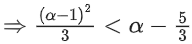
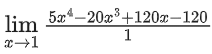
Correct Answer is Option (a) Solution: f(x) + f′(x) + f″(x) = x5 + 64 Let f(x) = x5 + ax4 + bx3 + cx2 + dx + e f′(x) = 5x4 + 4ax3 + 3bx2 + 2cx + d f″(x) = 20x3 + 12ax2 + 6bx + 2c x5(a + 5)x4 + (b + 4a + 20)x3 + (c + 3b + 12a)x2 + (d + 2c + 6b)x + e + d + 2c = x5 + 64 ⇒ a + 5 = 0 b + 4a + 20 = 0 c + 3b + 12a = 0 d + 2c + 6b = 0 e + d + 2c = 64 ∴ a = -5, b = 0, c = 60, d = -120, e = 64 ∴ f(x) = x5 - 5x4 + 60x2 - 120x + 64 By L' Hospital rule = -15
Q23. Let f : R → R be defined as f(x) = x3 + x - 5. If g(x) is a function such that f(g(x)) = x, ∀′x′ ∈ R, then g'(63) is equal to ______________. (a) 1/49 (b) 3/49 (c) 43/49 (d) 91/49
Solution:
Correct Answer is Option (a) Solution: f(x) = 3x2 + 1 f'(x) is bijective function and f(g(x)) = x ⇒ g(x) is inverse of f(x) g(f(x)) = x g′(f(x)) . f′(x) = 1 g′(f(x)) = Put x = 4 we get g′(63) = 1/49
Q24. Let f : N → R be a function such that f(x + y) = 2f(x)f(y) for natural numbers x and y. If f(1) = 2, then the value of α for whichholds, is: (a) 2 (b) 3 (c) 4 (d) 6
Solution:
Correct Answer is Option (c) Solution: Given, f(x + y) = 2f(x)f(y) and f(1) = 2 For x = 1 and y = 1, f(1 + 1) = 2f(1)f(1) ⇒ f(2) = 2(f(1))2 = 2(2)2 = 23 For x = 1, y = 2, f(1 + 2) = 2f(1)y(2) ⇒ f(3) = 2 . 2 . 23 = 25 For x = 1, y = 3, f(1 + 3) = 2f(1)f(3) ⇒ f(4) = 2 . 2 . 25 = 27 For x = 1, y = 4, f(1 + 4) = 2f(1)f(4) ⇒ f(5) = 2 . 2 . 27 = 29 ..... (1) Also given ⇒ f(α + 1) + f(α + 2) + f(α + 3) + ... + f(α + 10) = 512/3(220 - 1) ⇒ f(α + 1) + f(α + 2) + f(α + 3) + .... + f(α + 10) = This represent a G.P with first term = 29 and common ratio = 22 ∴ First term = f(α + 1) = 29 ..... (2) From equation (1), f(5) = 29 ∴ From (1) and (2), we get f(α + 1) = 29 = f(5) ⇒ f(α + 1) = f(5) ⇒ f(α + 1) = f(4 + 1) Comparing both sides we get, α = 4
Q25. The domain of the function (a) (-∞, 1) ∪ (2, ∞) (b) (2, ∞) (c) (d)
Solution:
Correct Answer is Option (d) Solution: The solution to this inequality is for x2 - 3x + 2 > 0 and ≠ 1 Combining the two solution sets (taking intersection)
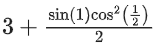
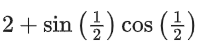
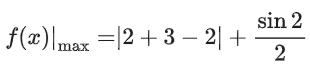
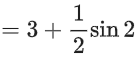
Q26. The sum of absolute maximum and absolute minimum values of the function f(x) = |2x2 + 3x - 2| + sinx cosx in the interval [0, 1] is: (a) (b) (c) (d)
Solution:
Correct Answer is Option b Solution:
f′(x) = -4x - 3 + cos2x < 0 For x ≥ 1/2: f′(x) = 4x + 3 + cos2x > 0 So, minima occurs at x = 1/2 So, maxima is possible at x = 0 or x = 1 Now checking for x = 0 and x = 1, we can see it attains its maximum value at x = 1 Sum of absolute maximum and minimum value
Q27. For the function f(x) = 4loge(x - 1) - 2x2 + 4x + 5, x > 1, which one of the following is NOT correct? (a) f is increasing in (1, 2) and decreasing in (2, ∞) (b) f(x) = -1 has exactly two solutions (c) f′(e) - f″(2) < 0 (d) f(x) = 0 has a root in the interval (e, e + 1)
Solution:
Correct Answer is Option (c) Solution: f(x) = 4loge(x - 1) - 2x2 + 4x + 5, x > 1 For 1 < x < 2 ⇒ f′(x) > 0 For x > 2 ⇒ f′(x) < 0 (option A is correct) f(x) = -1 has two solution (option B is correct) f(e) > 0 f(e + 1) < 0 f(e) ⋅ f(e + 1) < 0 (option D is correct) (option C is incorrect)
Q28. For p, q ∈ R, consider the real valued function f(x) = (x - p)2 - q, x ∈ R and q > 0. Let a1, a2, a3 and a4 be in an arithmetic progression with mean p and positive common difference. If |f(ai)| = 500 for all i = 1, 2, 3, 4, then the absolute difference between the roots of f(x) = 0 is ___________.
Solution:
Solution: ∵ a1, a2, a3, a4 ∴ a2 = p - 3d, a2 = p - d, a3 = p + d and a4 = p + 3d Where d > 0 ∵ |f(ai)| = 500 ⇒ |9d2 - q| = 500 and |d2 - q| = 500 ..... (i) either 9d2 - q = d2 - q ⇒ d = 0 not acceptable ∴ 9d2 - q = q - d2 ∴ 5d2 - q = 0 ..... (ii) Roots of f(x) = 0 are p + √q and p - √q ∴ absolute difference between roots = |2√q| = 50
Q29. The number of functions f, from the set A = {x ∈ N : x2 - 10x + 9 ≤ 0} to the set B = {n2 : n ∈ N} such that f(x) ≤ (x - 3)2 + 1, for every x ∈ A, is ___________.
Solution:
Solution: A = {x ∈ N, x2 - 10x + 9 ≤ 0} = {1, 2, 3, ...., 9} B = {1, 4, 9, 16, .....} f(x) ≤ (x - 3)2 + 1 f(1) ≤ 5, f(2) ≤ 2, .......... f(9) ≤ 37 x = 1 has 2 choices x = 2 has 1 choice x = 3 has 1 choice x = 4 has 1 choice x = 5 has 2 choices x = 6 has 3 choices x = 7 has 4 choices x = 8 has 5 choices x = 9 has 6 choices ∴ Total functions = 2 x 1 x 1 x 1 x 2 x 3 x 4 x 5 x 6 = 1140
Q30. Let f(x) = 2x2 - x - 1 and S = {n ∈ Z : |f(n)| ≤ 800}. Then, the value ofis equal to ___________.
Q31. The sum of the maximum and minimum values of the function f(x) = |5x - 7| + [x2 + 2x] in the interval [5/4, 2], where [t] is the greatest integer ≤ t, is ______________.
Solution:
Solution: f(x) = |5x - 7| + [x2 + 2x] = |5x - 7| + [(x + 1)2] - 1 Critical points of f(x) = 7/5, √5 - 1, √6 - 1, √7 - 1, √8 - 1, 2 ∴ Maximum or minimum value of f(x) occur at critical points or boundary points f(7/5) = 0 + 4 = 4 as both |5x - 7| and x2 + 2x are increasing in nature after x = 7/5 ∴ f(2) = 3 + 8 = 11 ∴ f(7/5)min = 4 and f(2)max = 11 Sum is 4 + 11 = 15
Q32. Let f(x) be a quadratic polynomial with leading coefficient 1 such that f(0) = p, p ≠ 0, and f(1) = 13. If the equations f(x) = 0 and f ∘ f ∘ f ∘ f(x) = 0 have a common real root, then f(-3) is equal to ________________.
Solution:
Solution: Let f(x) = (x - α)(x - β) It is given that f(0) = p ⇒ αβ = p and f(1) = 1/3 ⇒ (1 - α)(1 - β) = 1/3 Now, let us assume that, α is the common root of f(x) = 0 and f ∘ f ∘ f ∘ f(x) = 0 f ∘ f ∘ f ∘ f(x) = 0 ⇒ f ∘ f ∘ f(0) = 0 ⇒ f ∘ f(p) = 0 So, f(p) is either α or β. (p - α)(p - β) = α (αβ - α)(αβ - β) = α ⇒ (β - 1)(α - 1)β = 1 (∵ α ≠ 0) So, β = 3 (1 - α)(1 - 3) = 1/3 α = 7/6
Q33. Let f(x) and g(x) be two real polynomials of degree 2 and 1 respectively. If f(g(x)) = 8x2 - 2x and g(f(x)) = 4x2 + 6x + 1, then the value of f(2) + g(2) is _________.
Solution:
Ans. 18
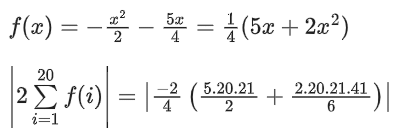
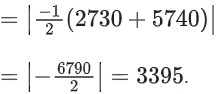
Q34. Let c, k ∈ R. If f(x) = (c + 1)x2 + (1 - c2)x + 2k and f(x + y) = f(x) + f(y) - xy, for all x, y ∈ R, then the value of |2(f(1) + f(2) + f(3) + ...... + f(20))| is equal to ____________.
Solution:
Solution: f(x) is polynomial Put y = 1/x in given functional equation we get ⇒ 2(c + 1) = 2K - 1 ..... (1) and put x = y = 0 we get f(0) = 2 + f(0) - 0 ⇒ f(0) = 0 ⇒ k = 0 ∴ k = 0 and 2c = -3 ⇒ c = -3/2
Q35. Let [t] denote the greatest integer ≤ t and {t} denote the fractional part of t. The integral value of α for which the left hand limit of the functionat x = 0 is equal tois _____________.
Q36. Let S = {1, 2, 3, 4, 5, 6, 7, 8, 9, 10}. Let g : S → S be a function such that Then g(10)g(1) + g(2) + g(3) + g(4) + g(5)) is equal to _____________.
Q39. Let f : R → R be a function defined byIf the function g(x) = f(f(f(x)) + f(f(x)), then the greatest integer less than or equal to g(1) is ____________.
Q40. The number of points where the function f(x)= [t] denotes the greatest integer ≤ t, is discontinuous is _____________.
Solution:
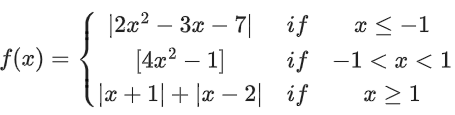
Solution: ∵ f(-1) = 2 and f(1) = 3 For x ∈ (-1, 1), (4x2 - 1) ∈ [-1, 3) hence f(x) will be discontinuous at x = 1 and also whenever 4x2 - 1 = 0, 1 or 2 So there are total 7 points of discontinuity.
Q41. The number of one-one functions f : {a, b, c, d} → {0, 1, 2, ......, 10} such that 2f(a) - f(b) + 3f(c) + f(d) = 0 is ___________.
Solution:
Solution: Given one-one function f : {a, b, c, d} → {0, 1, 2, .... 10} and 2f(a) - f(b) + 3f(c) + f(d) = 0 ⇒ 3f(c) + 2f(a) + f(d) = f(b) Case I: (1) Now let f(c) = 0 and f(a) = 1 then 3 × 0 + 2 × 1 + f(d) = f(b) ⇒ 2 + f(d) = f(b) Now possible value of f(d) = 2, 3, 4, 5, 6, 7, and 8. f(d) can't be 9 and 10 as if f(d) = 9 or 10 then f(b) = 2 + 9 = 11 or f(b) = 2 + 10 = 12, which is not possible as here any function's maximum value can be 10. ∴ Total possible functions when f(c) = 0 and f(a) = 1 are = 7 (2) When f(c) = 0 and f(a) = 2 then 3 × 0 + 2 × 2 + f(d) = f(b) ⇒ 4 + f(d) = f(b) ∴ possible value of f(d) = 1, 3, 4, 5, 6 ∴ Total possible functions in this case = 5 (3) When f(c) = 0 and f(a) = 3 then 3 × 0 + 2 × 3 + f(d) = f(b) ⇒ 6 + f(d) = f(b) ∴ Possible value of f(d) = 1, 2, 4 ∴ Total possible functions in this case = 3 (4) When f(c) = 0 and f(a) = 4 then 3 × 0 + 2 × 4 + f(d) = f(b) ⇒ 8 + f(d) = f(b) ∴ Possible value of f(d) = 1, 2 ∴ Total possible functions in this case = 2 (5) When f(c) = 0 and f(a) = 5 then 3 × 0 + 2 × 5 + f(d) = f(b) ⇒ 10 + f(d) = f(b) Possible value of f(d) can be 0 but f(c) is already zero. So, no value to f(d) can satisfy. ∴ No function is possible in this case. ∴ Total possible functions when f(c) = 0 and f(a) = 1, 2, 3 and 4 are = 7 + 5 + 3 + 2 = 17 Case II: (1) When f(c) = 1 and f(a) = 0 then 3 × 1 + 2 × 0 + f(d) = f(b) ⇒ 3 + f(d) = f(b) ∴ Possible value of f(d) = 2, 3, 4, 5, 6, 7 ∴ Total possible functions in this case = 6 (2) When f(c) = 1 and f(a) = 2 then 3 × 1 + 2 × 2 + f(d) = f(b) ⇒ 7 + f(d) = f(b) ∴ Possible value of f(d) = 0, 3 ∴ Total possible functions in this case = 2 (3) When f(c) = 1 and f(a) = 3 then 3 × 1 + 2 × 3 + f(d) = f(b) ⇒9 + f(d) = f(b) ∴ Possible value of f(d) = 0 ∴ Total possible functions in this case = 1 ∴ Total possible functions when f(c) = 1 and f(a) = 0, 2 and 3 are = 6 + 2 + 1 = 9 Case III: (1) When f(c) = 2 and f(a) = 0 then 3 × 2 + 2 × 0 + f(d) = f(b) ⇒ 6 + f(d) = f(b) ∴ Possible values of f(d) = 1, 3, 4 ∴ Total possible functions in this case = 3 (2) When f(c) = 2 and f(a) = 1 then, 3 × 2 + 2 × 1 + f(d) = f(b) ⇒ 8 + f(d) = f(b) ∴ Possible values of f(d) = 0 ∴ Total possible function in this case = 1 ∴ Total possible functions when f(c) = 2 and f(a) = 0, 1 are = 3 + 1 = 4 Case IV: (1) When f(c) = 3 and f(a) = 0 then 3 × 3 + 2 × 0 + f(d) = f(b) ⇒ 9 + f(d) = f(b) ∴ Possible values of f(d) = 1 ∴ Total one-one functions from four cases = 17 + 9 + 4 + 1 = 31
2021
Q1. The number of 4-digit numbers which are neither multiple of 7 nor multiple of 3 is ____________.
Solution:
Solution: A = 4-digit numbers divisible by 3 A = 1002, 1005, ....., 9999. 9999 = 1002 + (n - 1)3 ⇒ (n - 1)3 = 8997 ⇒ n = 3000 B = 4-digit numbers divisible by 7 B = 1001, 1008, ......., 9996 ⇒ 9996 = 1001 + (n - 1)7 ⇒ n = 1286 A ∩ B = 1008, 1029, ....., 9996 9996 = 1008 + (n - 1)21 ⇒ n = 429 So, no divisible by either 3 or 7 = 3000 + 1286 - 429 = 3857 total 4-digits numbers = 9000 required numbers = 9000 - 3857 = 5143
Q2. If A = {x∈R : |x -2| > 1}, C = {x ∈R : |x - 4|≥ 2} and Z is the set of all integers, then the number of subsets of the set (A ∩B ∩C)c∩Z is ________________.
Solution:
Solution: A = (-∞, 1) ∪ (3, ∞) B = (-∞, -2) ∪ (2, ∞) C = (-∞, 2] ∪ [6, ∞) So, A ∩ B ∩ C = (-∞, -2) ∪ [6, ∞) z ∩ (A ∩ B ∩ C)' = {-2, -1, 0, -1, 2, 3, 4, 5} Hence, no. of its subsets = 28 = 256.
Q3. Let S = {1, 2, 3, 4, 5, 6, 7}. Then the number of possible functions f : S → S such that f(m . n) = f(m) . f(n) for every m, n∈ S and m . n∈ S is equal to _____________.
Solution:
Solution: F(mn) = f(m) . f(n) Put m = 1 f(n) = f(1) . f(n) ⇒ f(1) = 1 Put m = n = 2 Put m = 2, n = 3 f(5), f(7) can take any value Total = (1 × 1 × 7 × 1 × 7 × 1 × 7) + (1 × 1 × 3 × 1 × 7 × 1 × 7) = 490
Q4. Let A = {n ∈N | n2≤n + 10,000}, B = {3k + 1 | k∈N} an dC = {2k | k ∈ N}, then the sum of all the elements of the set A ∩(B - C) is equal to _____________.
Solution:
Solution: B - C ≡ {7, 13, 19, ......, 97, .......} Now, n2 - n ≤ 100 × 100 ⇒ n(n - 1) ≤ 100 × 100 ⇒ A = {1, 2, ......., 100}. So, A∩(B - C) = {7, 13, 19, ......., 97} Hence, sum =
Q5. Let A = {0, 1, 2, 3, 4, 5, 6, 7}. Then the number of bijective functions f : A → A such that f(1) + f(2) = 3- f(3) is equal to
Solution:
Solution: f(1) + f(2) = 3 - f(3) ⇒ f(1) + f(2) = 3 + f(3) = 3 The only possibility is: 0 + 1 + 2 = 3 ⇒ Elements 1, 2, 3 in the domain can be mapped with 0, 1, 2 only. So number of bijective functions.
Q6. If f(x) and g(x) are two polynomials such that the polynomial P(x) = f(x3) + x g(x3) is divisible by x2 + x + 1, then P(1) is equal to ___________.
Solution:
Solution: Given, p(x) = f(x3) + xg(x3) We know, x2 + x + 1 = (x -ω) (x -ω2) Given, p(x) is divisible by x2 + x + 1. So, roots of p(x) is ω and ω2. As root satisfy the equation, So, put x = ω p(ω) = f(ω3) + ωg(ω3) = 0 = f(1) + ωg(1) = 0 [ω3 = 1] Comparing both sides, we get So, f(1) = 0 Now, p(1) = f(1) + 1 . g(1) = 0 + 0 = 0
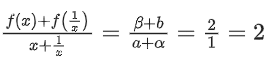
Q7.If a +α = 1, b + β= 2 andthen the value of theexpressionis __________.
Solution:
Solution: Replace x with 1/x (i) + (ii)
Q8. Let A = {n∈N: n is a 3-digit number} B = {9k + 2: k ∈ N} and C = {9k + l: k ∈ N} for somel(0 < l < 9) If the sum of all the elements of the set A ∩(B ∪ C) is 274× 400, thenl is equal to ________.
Solution:
Solution: 3 digit number of the form 9K + 2 are {101, 109, .............992} ⇒ Sum equal to 100/2 (1093) = s1 = 54650 274 × 400 = s1 + s2 274 × 400 = 100/2 [101 + 992] + s2 274 × 400 = 50 × 1093 + s2 s2 = 109600 - 54650 s2 = 54950 s2 = 54950 = 100/2[(99 + l) + (990 + l)] 1099 = 2l + 1089 l = 5
Q9. The range of the function, (a) (0, √5) (b) [-2, 2] (c) (d) [0, 2]
Solution:
Correct Answer is Option (d) Solution: So, Range of f(x) is [0, 2]
Q10. Let f : N → N be a function such that f(m + n) = f(m) + f(n) for every m, n ∈ N. If f(6) = 18, then f(2) . f(3) is equal to: (a) 6 (b) 54 (c) 18 (d) 36
Solution:
Correct Answer is Option (b) Solution: f(m + n) = f(m) + f(n) Put m = 1, n = 1 f(2) = 2f(1) Put m = 2, n = 1 f(3) = f(2) + f(1) = 3f(1) Put m = 3, n = 3 f(6) = 2f(3) ⇒ f(3) = 9 ⇒ f(1) = 3, f(2) = 6 f(2) . f(3) = 6 × 9 = 54
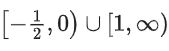
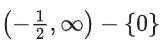
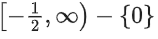
Q11. The domain of the function
(a) (b) (c) (d)
Solution:
Correct Answer is Option (c) Solution: (1) & (2)
Q12. Which of the following is not correct for relation R on the set of real numbers? (a) (x, y) ∈ R ⇔ 0 < |x| - |y| ≤ 1 is neither transitive nor symmetric. (b) (x, y) ∈ R ⇔ 0 < |x - y| ≤ 1 is symmetric and transitive. (c) (x, y) ∈ R ⇔ |x| - |y| ≤ 1 is reflexive but not symmetric. (d) (x, y) ∈ R ⇔ |x - y| ≤ 1 is reflexive and symmetric.
Solution:
Correct Answer is Option (b) Solution: Note that (a, b) and (b, c) satisfy 0 < |x - y| ≤ 1 but (a, c) does not satisfy it so 0 ≤ |x - y| ≤ 1 is symmetric but not transitive. For example, x = 0.2, y = 0.9, z = 1.5 0 ≤ |x - y| = 0.7 ≤ 1 0 ≤ |y - z| = 0.6 ≤ 1 But |x - z| = 1.3 > 1 So, (b) is correct.
Q13. The domain of the functionis: (a) (b) (c) (d)
Solution:
Correct Answer is Option (d) Solution:
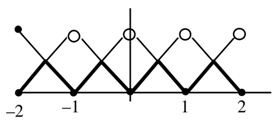
Q14. Let [t] denote the greatest integer less than or equal to t. Let f(x) = x -[x], g(x) = 1 -x + [x], and h(x) = min{f(x), g(x)}, x∈ [-2, 2]. Then h is: (a) A continuous in [-2, 2] but not differentiable at more than four points in (-2, 2) (b) not continuous at exactly three points in [-2, 2] (c) continuous in [-2, 2] but not differentiable at exactly three points in (-2, 2) (d) not continuous at exactly four points in [-2, 2]
Solution:
Correct Answer is Option (a) Solution:
min{x - [x], 1 - x + [x]}
h(x) = min{x - [x], 1 - [x - [x])}
⇒ always continuous in [-2, 2] but not differentiable at 7 points.
Q15. Out of all patients in a hospital 89% are found to be suffering from heart ailment and 98% are suffering from lungs infection. If K% of them are suffering from both ailments, then K can not belong to the set: (a) {80, 83, 86, 89} (b) {84, 86, 88, 90} (c) {79, 81, 83, 85} (d) {84, 87, 90, 93}
Solution:
Correct Answer is Option (c) Solution: n(A ∪ B) ≥ n(A) + n(B) - n(A ∩ B) 100 ≥ 89 + 98 - n(A ∪ B) n(A ∩ B) ≥ 87 87 ≤ n(A ∩ B) ≤ 89
Q16. Let N be the set of natural numbers and a relation R on N be defined byR = {(x, y) ∈ N × N : x3 - 3x2y - xy2 + 3y3 = 0}. Then the relation R is: (a) symmetric but neither reflexive nor transitive (b) reflexive but neither symmetric nor transitive (c) reflexive and symmetric, but not transitive (d) an equivalence relation
Solution:
Correct Answer is Option (b) Solution: x3 - 3x2y - xy2 + 3y3 = 0 ⇒ x(x2 - y2) - 3y(x2 - y2) = 0 ⇒ (x - 3y)(x - y)(x + y) = 0 Now, x = y ∀(x, y) ∈N × N so reflexive but not symmetric & transitive. See, (3, 1) satisfies but (1, 3) does not. Also (3, 1) & (1, -1) satisfies but (3, -1) does not.
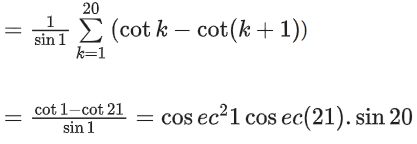
Q17. Let f : R → R be defined asf(x + y) + f(x - y) = 2f(x)f(y), f(1/2) = -1. Then, the value ofis equal to: (a) cosec2(21) cos(20) cos(2) (b) sec2(1) sec(21) cos(20) (c) cosec2(1) cosec(21) sin(20) (d) sec2(21) sin(20) sin(2)
Solution:
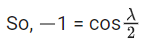
Correct Answer is Option (a) Solution: f(x) = cosλx ⇒ λ = 2π Thus f(x) = cos2πx Now k is natural number Thus f(k) = 1
Q18. Consider function f : A → B and g : B → C (A, B, C ⊆ R) such that (gof)-1 exists, then: (a) f and g both are one-one (b) f and g both are onto (c) f is one-one and g is onto (d) f is onto and g is one-one
Solution:
Correct Answer is Option (c) Solution: ∴ (gof)-1 exist ⇒ gof is bijective ⇒ 'f' must be one-one and 'g' must be ONTO.
Q19. If [x] be the greatest integer less than or equal to x, thenis equal to: (a) 0 (b) 4 (c) -2 (d) 2
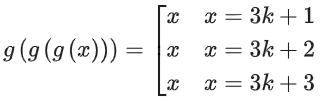
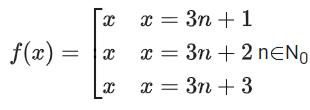
Q20. Let g : N → N be defined as g(3n + 1) = 3n + 2, g(3n + 2) = 3n + 3, g(3n + 3) = 3n + 1, for all n≥0. Then which of the following statements is true? (a) There exists an onto function f : N → N such that fog = f (b) There exists a one-one function f : N → N such that fog = f (c) gogog = g (d) There exists a function : f : N → N such that gof = f
Solution:
Correct Answer is Option (a) Solution: g : N → N g(3n + 1) = 3n + 2, g(3n + 2) = 3n + 3, g(3n + 3) = 3n + 1 If f : N → N, if is a one-one function such that f(g(x)) = f(x) ⇒ g(x) = x, which is not the case If f : N → N f is an onto function such that f(g(x)) = f(x), one possibility is Here f(x) is onto, also f(g(x)) = f(x) ∀ x∈N
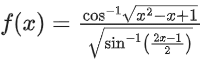
Q21.If the domain of the functionis the interval (α, β], then α + β is equal to: (a) 3/2 (b) 2 (c) 1/2 (d) 1
Solution:
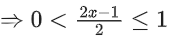
Correct Answer is Option (a) Solution: O ≤ x2 - x + 1 ≤ 1 ⇒ x2 - x ≤ 0 ⇒ x ∈ [0, 1] ⇒ 0 < 2x - 1 ≤ 2 1 < 2x ≤ 3 1/2 < x ≤ 3/2 Taking intersection x ∈ (1/2, 1] ⇒ α = 1/2, β = 1 ⇒ α + β = 3/2
Q22. The number of solutions of sin7x + cos7x = 1, x∈ [0, 4π] is equal to (a) 11 (b) 7 (c) 5 (d) 9
Solution:
Correct Answer is Option (c) Solution: sin7x ≤ sin2x ≤ 1 ...... (1) and cos7x ≤ cos2x ≤ 1 ..... (2) also sin2x + cos2x = 1 ⇒ equality must hold for (1) & (2) ⇒ sin7x = sin2x & cos7x = cos2x ⇒ sin x = 0 & cos x = 1 or cos x = 0 & sin x = 1 ⇒ x = 0, 2π, 4π, π/2, 5π/2 ⇒ 5 solutions
Q23. Let [x] denote the greatest integer less than or equal to x. Then, the values of x∈R satisfying the equationlie in the interval: (a) [0, 1/e) (b) [loge2, loge3) (c) [1, e) (d) [0, loge2)
Solution:
Correct Answer is Option (d) Solution: Let [ex] = t ⇒ t2 + t - 2 = 0 ⇒ t = -2, 1 [ex] = -2 (Not possible) or [ex] = 1 ∴ 1 ≤ ex < 2 ⇒ ln(1) ≤ x < ln(2) ⇒ 0 ≤ x < ln(2) ⇒ x ∈ [0, In 2)
Q24.Let f : R - {α/6} → Rbe defined byThen the value ofαfor which (fof)(x) = x, for allx ∈ R - {α/6}, is: (a) No such α exists (b) 5 (c) 8 (d) 6
Solution:
Correct Answer is Option (b) Solution: 5x + 3 = 6xy - αy x(6y - 5) = αy + 3 fo f(x) = x f(x) = f-1(x) From eqn (i) & (ii) Clearly (α = 5)
Q25. Let [ x ] denote the greatest integer≤x, where x ∈ R. If the domain of the real valued functionf(x)=is (-∞, a)]∪ [b, c)∪[4, ∞), a < b < c, then the value of a + b + c is: (a) 8 (b) 1 (c) -2 (d) -3
Solution:
Correct Answer is Option (c) Solution: For domain, Case I: When |[x]|-2≥ 0 and |[x]|-3 > 0 ∴ x ∈ (-∞, -3) ∪ [4, ∞) ...... (1) Case II: When |[x]|-2≤ 0 and |[x]|-3 < 0 ∴ x ∈ [-2, 3) ..... (2) So, from (1) and (2) we get Domain of function = (-∞, -3) ∪ [-2, 3) ∪ [4, ∞) ∴ (a + b + c) = -3 + (-2) + 3 = -2 (a < b < c) ⇒ Option (c) is correct.
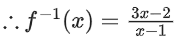
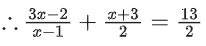
Q26.Let f : R -{3} → R - {1} be defined by Let g : R → R be given as g(x) = 2x-3. Then, the sum of all the values of x for which f-1(x) + g-1(x) = 13/2 is equal to: (a) 3 (b) 5 (c) 2 (d) 7
Solution:
Correct Answer is Option (b) Solution: Finding inverse of f(x) Similarly for g-1(x) ⇒ 6x - 4 + x2 + 2x - 3 = 13x - 13 ⇒ x2 - 5x + 6 = 0 ⇒ (x - 2)(x - 3) = 0 ⇒ x = 2 or 3
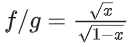
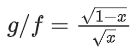
Q27. If the functions are defined asthen what is the common domain of the following functions: (a) 0 ≤ x ≤ 1 (b) 0 ≤ x < 1 (c) 0<x<1 (d) 0 < x ≤ 1
Solution:
Correct Answer is Option (c) Solution: ⇒ x ≥ 0 & 1 - x ≥ 0 ⇒ x ∈ [0, 1] ⇒ x ≥ 0 & 1 - x ≥ 0 ⇒ x ∈[0, 1] ⇒ x ≥ 0 & 1 - x > 0 ⇒ x ∈ [0, 1) ⇒ 1 - x ≥ 0 & x > 0 ⇒ x ∈ (0, 1] ⇒ 1 - x ≥ 0 & x ≥ 0 ⇒ x ∈ [0, 1] ⇒ x ∈ (0, 1)
Q28. The real valued functionwhere [x] denotes the greatest integer less than or equal to x, is defined for all x belonging to: (a) all real except integers (b) all non-integers except the interval [ -1, 1 ] (c) all integers except 0, -1, 1 (d) all real except the interval [ -1, 1 ]
Solution:
Correct Answer is Option (b) Solution: Domain of cosec-1x: x ∈ (-∞, -1] ∪ [1, ∞) and, x - [x] > 0 ⇒ {x} > 0 ⇒ x ≠ I ∴ Required domain = (-∞, -1] ∪ [1, ∞)- I
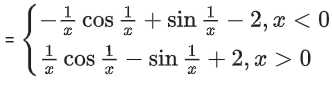
Q29. Consider the function f : R → R defined by Then f is: (a) not monotonic on (-∞, 0) and (0, ∞) (b) monotonic on (0, ∞) only (c) monotonic on (-∞, 0) only (d) monotonic on (-∞, 0) ∪ (0, ∞)
Solution:
Correct Answer is Option (a) Solution: ∴ f'(x) is an oscillating function which is non-monotonic on (-∞, 0) and (0, ∞).
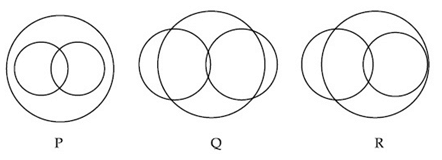
Q30. In a school, there are three types of games to be played. Some of the students play two types of games, but none play all the three games. Which Venn diagrams can justify the above statement? (a) Q and R (b) None of these (c) P and R (d) P and Q
Solution:
Correct Answer is Option (b) Solution: As none play all three games the intersection of all three circles must be zero. Hence none of P, Q, R justify the given statement.
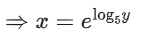
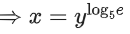
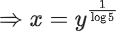
Q31. The inverse ofy = 5logx is: (a) x = 5logy
(b) (c) (d) x = ylogy5
Solution:
Correct Answer is Option (b) Solution: y = 5logx
⇒ logy = logx . log5
Q33. Let A = {2, 3, 4, 5, ....., 30} and '≃' be an equivalence relation on A × A, defined by (a, b) ≃ (c, d), if and only if ad = bc. Then the number of ordered pairs which satisfy this equivalence relation with ordered pair (4, 3) is equal to: (a) 5 (b) 6 (c) 8 (d) 7
Solution:
Correct Answer is Option (d) Solution:
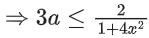
ad = bc (a, b) R (4, 3) ⇒ 3a = 4b b must be multiple of 3 b = {3, 6, 9 ..... 30} (a, b) = {(4, 3), (8, 16), (12, 9), (16, 12), (20, 15), (24, 18), (28, 21)} ⇒ 7 ordered pair
Q34. Let f be a real valued function, defined on R - {-1, 1} and given by Then in which of the following intervals, function f(x) is increasing? (a) (-∞, -1) ∪ ([1/2, ∞) - {1}) (b) (-∞, ∞) - {-1, 1) (c) (-∞, 1/2] - {-1} (d) (-1, 1/2]
Solution:
Correct Answer is Option (a) Solution:
Q35. The range of a ∈ R for which thefunction f(x) = (4a - 3)(x + loge 5) + 2(a- 7) cot(x/2) sin2(x/2), x ≠2nπ, n∈N has critical points, is: (a) [1, ∞) (b) (-3, 1) (c) (d) (-∞, -1]
Solution:
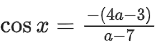
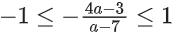
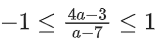
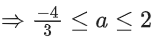
Correct Answer is Option (c) Solution: f(x) = (4a - 3)(x + ln 5) + (a - 7)sin x f′(x) = (4a - 3) + (a - 7)cos x = 0
Q36. Let [ x ] denote greatest integer less than or equal to x. If for n ∈ N, (a) 2n-1 (b) n (c) 2 (d) 1
Q37. The number of elements in the set {x ∈ R : (|x|-3) |x + 4| = 6} is equal to: (a) 4 (b) 2 (c) 3 (d) 1
Solution:
Correct Answer is Option (b) Solution: Case 1: x ≤-4 (-x - 3)(-x - 4) = 6 ⇒ (x + 3)(x + 4) = 6 ⇒ x2 + 7x + 6 = 0 ⇒ x = -1 or -6 but x ≤-4 x = -6 Case 2: x ∈ (-4, 0) (-x - 3)(x + 4) = 6 ⇒-x2- 7x - 12 - 6 = 0 ⇒ x2 + 7x + 18 = 0 D < 0 No solution Case 3: x ≥ 0 (x - 3)(x + 4) = 6 ⇒ x2 + x - 12 - 6 = 0 ⇒ x2 + x - 18 = 0
Q38.LetA = {1, 2, 3, ...., 10} andf : A → A be defined as Then the number of possible functions g : A → Asuch thatgof = f is: (a) 55 (b) 105 (c) 5! (d) 10C5
Solution:
Correct Answer is Option (b) Solution: f(1) = 2 f(2) = 2 f(3) = 4 f(4) = 4 f(5) = 6 f(6) = 6 f(7) = 8 f(8) = 8 f(9) = 10 f(10) = 10 ∴ f(1) = f(2) = 2 f(3) = f(4) = 4 f(5) = f(6) = 6 f(7) = f(8) = 8 f(9) = f(10) = 10 Given, g(f(x)) = f(x) when x = 1, g(f(1)) = f(1) ⇒ g(2) = 2 when, x = 2, g(f(2)) = f(2) ⇒ g(2) = 2 ∴ x = 1, 2, g(2) = 2 Similarly, at x = 3, 4, g(4) = 4 at x = 5, 6, g(6) = 6 at x = 7, 8, g(8) = 8 at x = 9, 10, g(10) = 10 Here, you can see for even terms mapping is fixed. But far odd terms 1, 3, 5, 7, 9 we can map to any one of the 10 elements. ∴ For 1, number of functions = 10 For 3, number of functions = 10 For 9, number of functions = 10 ∴ Total number of functions = 10 × 10 × 10 × 10 × 10 = 105
Q39. Let R = {(P, Q) | P and Q are at the same distance from the origin} be a relation, then the equivalence class of (1, -1) is the set: (a) S = {(x, y)|x2 + y2 = √2} (b) S = {(x, y)|x2 + y2 = 2} (c) S = {(x, y)|x2 + y2 = 1} (d) S = {(x, y)|x2 + y2 = 4}
Solution:
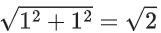
Correct Answer is Option (b) Solution: Given R = {(P, Q) | P and Q are at the same distance from the origin}. Then equivalence class of (1, -1) will contain al such points which lies on circumference of the circle of centre at origin and passing through point (1, -1). i.e., radius of circle = ∴ Required equivalence class of (S) {(x, y)|x2 + y2 = 2}
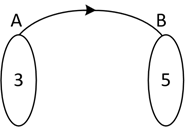
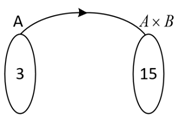
Q40. Let x denote the total number of one-one functions from a set A with 3 elements to a set B with 5 elements and y denote the total number of one-one functions form the set A to the set A × B. Then: (a) 2y = 273x (b) y = 91x (c) 2y = 91x (d) y = 273x
Solution:
Correct Answer is Option (c) Solution: Number of elements in A = 3 Number of elements in B = 5 Number of elements in A × B = 15 Number of one-one function x = 5 × 4 × 3 x = 60 Number of one-one function y = 15 × 14 × 13 y = 15 × 4 ×14/4× 13 y = 60 ×7/2× 13 2y = (13)(7x) 2y = 91x
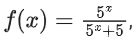
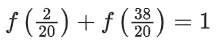
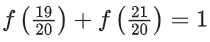
Q41. A function f(x) is given bythen the sum of the seriesis equal to: (a) 39/2 (b) 19/2 (c) 49/2 (d) 29/2
Solution:
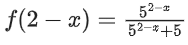
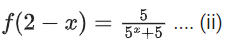
Correct Answer is Option (a) Solution: Adding equation (i) and (ii) f(x) + f(2 - x) = 1
Q42. Let f, g : N → N such that f(n + 1) = f(n) + f(1) ∀ n ∈ N and g be any arbitrary function. Which of the following statements is NOT true? (a) If g is onto, then fog is one-one (b) f is one-one (c) If f is onto, then f(n) = n ∀ n ∈ N (d) If fog is one-one, then g is one-one
Q43. Let f : R → R be defined as f (x) = 2x - 1 and g : R - {1} → R be defined as g(x) =Then the composition function f(g(x)) is: (a) one-one but not onto (b) onto but not one-one (c) both one-one and onto (d) neither one-one nor onto
Solution:
Correct Answer is Option (a) Solution: Given, f(x) = 2x - 1; f : R → R f[g(x)] = 2g(x) - 1 Now, draw the graph of ∵ Any horizontal line does not cut the graph at more than one points, so it is one-one and here, co-domain and range are not equal, so it is into. Hence, the required function is one-one into.
2020
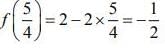
Q1. If g(x) = x2 + x - 1 and (gof) (x) = 4x2 - 10x + 5, then f (5/4) is equal to (a) 3/2 (b) - 1/2 (c) 1/2 (d) - 3/2
Q3. Let f: (1, 3) → R be a function defined by where [x] denotes the greatest integer ≤ x . Then, the range of f is
Solution:
Correct Answer is Option (b) Solution: We have, Since f(x) is a decreasing function, then
Q4. Let f and g be differentiable functions on R such that fog is the identity function. If for some a, b ∈ R g'(a) = 5 and g(a) = b then f'(b) is equal to (a) 1/5 (b) 1 (c) 5 (d) 2/5
Solution:
Correct Answer is Option (a) Solution: f and g are differentiable functions on R and fog is the identity function. So, f(g(x)) = x ⇒ f'(g(x)) . g'(x) = 1 (1) Substituting x = a in EQ (1), we get f'(g(a)). g'(a) = 1 ⇒ f'(b) × 5 = 1 ⇒ f'(b) = 1/5
2019
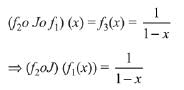
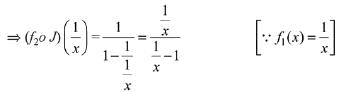
Q1. For x ∈ R - {0, 1}, let f1(x) = 1/x, f2 (x) = 1 - x and f3(x) = 1/1-x be three given functions. If a function, J(x) satisfies (f2oJof1) (x) = f3(x) then J(x) is equal to: (a) f3(x) (b) 1/x f3(x) (c) f2(x) (d) f1(x)
Solution:
Correct Answer is Option (a) Solution: The given relation is
Q2. If the fractional part of the number 2403/15 is k/15, then k is equal to: (a) 6 (b) 8 (c) 4 (d) 14
Solution:
Correct Answer is Option (b) Solution: 2403 = 2400 · 23 = 24 × 100 · 23 = (24)100· 8 = 8(24)100 = 8(16)100 = 8(1 + 15)100 = 8 + 15μ When 2403 is divided by 15, then remainder is 8. Hence, fractional part of the number is 8/15 Therefore, value of k is 8
Q3. Let A = {x ∈ R: x is not a positive integer}. Define a function f: A → R as f(x) = 2x/x - 1, then f is: (a) Not injective (b) Neither injective nor surjective (c) Surjective but not injective (d) Injective but not surjective
Solution:
Correct Answer is Option (d) Solution: As A = {x ∈ R: x is not a positive integer} A function f: A → R given by f(x) = 2x/x-1 f(x1) = f(x2) ⇔ x1 = x2 So, f is one-one. As f(x) ≠ 2 for any x ∈ A ⇒ f is not onto. Hence f is injective but not subjective.
Q4. Let N be the set of natural numbers and two functions f and g be defined as f, g : N → N such that and g(n) = n - (- 1)n. Then fog is: (a) Onto but not one-one. (b) One-one but not onto. (c) Both one-one and onto. (d) Neither one-one nor onto.
Solution:
Correct Answer is Option (a) Solution: ⇒ fog is onto but not one - one
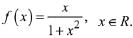
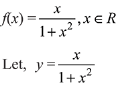
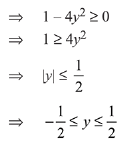
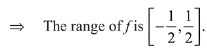
Q5. Let f: R → R be defined by Then the range of f is: (a) [- 1/2, 1/2] (b) R - [-1,1] (c) R - [- 1/2, 1/2] (d) (-1,1) - {0}
Solution:
Correct Answer is Option (a) Solution:
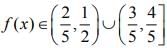
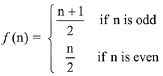
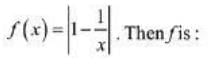
Q6. Let a function f: (0, ∞) → (0, ∞) be defined by
(a) Not injective but it is surjective (b) Injective only (c) Neither injective nor surjective (d) Both injective as well as surjective
Solution:
Correct Answer is Option (a) Solution: f: (0, ∞) → (0, ∞) ∵ f(1) = 0 and 1 ∈ domain but 0 ∉ co-domain Hence, f(x) is not a function.
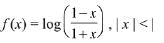
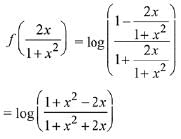
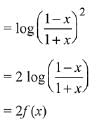
Q7. If f(x) = loge(1 - x)/(1 + x) , |x| < 1, then f(2x/1 + x2) is equal to : (a) 2f(x) (b) 2f(x2) (c) (f(x))2 (d) -2f(x)
Solution:
Correct Answer is Option (a) Solution:
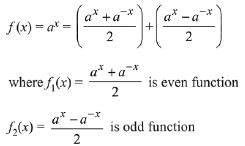
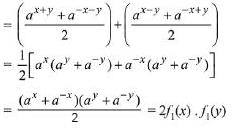
Q8. Let f(x) = ax (a > 0) be written as f(x) = f1(x) + f2(x), where f1(x) is an even function and f2(x) is an odd function. Then f1(x + y) + f1(x - y) equals: (a) 2 f1(x) f1(y) (b) 2 f1(x + y) f1(x - y) (c) 2 f1(x) f2(y) (d) 2 f1(x + y) f2(x - y)
Solution:
Correct Answer is Option (a) Solution: Given function can be written as
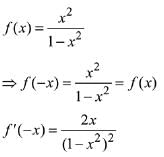
Q9. If the function f: R - {1, -1} → A defined by f(x) = x2/1 - x2, is surjective, then A is equal to: (a) R - {-1} (b) [0, ∞] (c) R- [-1, 0] (d) R - (-1, 0]
Solution:
Correct Answer is Option (c) Solution: ∴ f(x) increases in x ∈ (0, ∞) Also f(0) = 0 and ∴ Set A = R - [-1, 0) And the graph of function f(x) is
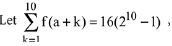
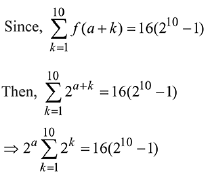
Q10. where the function f satisfies f(x + y) = f(x) f(y) for all natural numbers x, y and f(1) = 2. Then the natural number 'a' is: (a) 2 (b) 16 (c) 4 (d) 3
Solution:
Correct Answer is Option (d) Solution: ∵ f(x + y) = f(x) x f(y) ⇒ Let f(x) = tx ∵ f(1) = 2 ∵ t = 2 ⇒ f(x) = 2x ⇒ a = 3
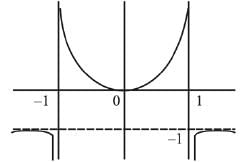
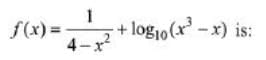
Q11. The domain of the definition of the function (a)(-1, 0) ∪ (1, 2) ∪ (3, ∞) (b)(-2, -1) ∪ (-1, 0) ∪ (2, ∞) (c)(-1, 0) ∪ (1, 2) ∪ (2, ∞) (d)(1, 2) ∪ (2, ∞)
Solution:
Correct Answer is Option (c) Solution: To determine domain, denominator ≠ 0 and x3 - x > 0 i.e., 4 - x2 ≠ 0 x ≠ ±2...(1) and x (x - 1) (x + 1) > 0 x∈(-1, 0) ∪ (1, ∞)...(2) Hence domain is intersection of (1) & (2). i.e.,x ∈ (-1, 0) ∪ (1, 2) ∪ (2, ∞)
Q12. Let f(x) = x2, x ∈ R. For any A ⊆ R, define g(A) = {x∈R: f(x) ∈ A}. If S = [0, 4], then which one of the following statements is not true? (a) g(f(S)) ≠ S (b) f(g(S)) = S (c) g(f(S)) = g(S) (d) f (g (S)) ≠ f (S)
Solution:
Correct Answer is Option (c) Solution: f(x) = x2 ; x ∈ R g(A) = {x ∈ R: f(x) ∈ A} S = [ 0, 4] g(S) = {x ∈ R: f(x) ∈ S} = {x ∈ R: 0 ≤ x2 ≤ 4} = { x ∈ R : -2 ≤ x ≤ 2} ∴ g(S) ≠ S ∴ f(g (S)) ≠ f(S) g(f(S)) = {x ∈ R: f(x) ∈ f(S)} = { x ∈ R : x2 ∈ S2} = { x ∈ R : 0 ≤ x2 ≤ 16} = {x ∈ R : -4 ≤ x ≤ 4} ∴ g(f(S)) ≠ g(S) ∴ g(f(S)) = g (S) is incorrect.
Q13. Let f(x) = loge (sinx), (0 < x < π) and g(x) = sin-1 (e-x), (x > 0). If α is a positive real number such that a = (fog)' (α) and b = (fog) (α), then: (a) aα2 + bα + a = 0 (b) aα2 - bα - a = 1 (c) aα2 - bα - a = 0 (d) aα2 + bα - a = - 2a2
Solution:
Correct Answer is Option (b) Solution: f(x) = ln (sin x), g (x) = sin-1 (e-x) ⇒ f(g(x)) = ln (sin (sin-1 e-x)) = - x ⇒ f(g(α)) = - α But given that (fog) (α) = b ∴ - α = b and f' (g(α)) = a, i.e., a = - 1 ∴ aα2 - bα - a = - α2 + a2 - (- 1) ⇒ aα2 - bα - a = 1
Q14. For x ∈ (0, 3/2), let f(x) = √x, g(x) = tan x and h(x) = (1-x2)/1+x2). If φ(x) = ((hof)og), (x), then φ (π/3) is equal to: (a) tan π/12 (b) tan 11π/12 (c) tan 7π/12 (d) tan 5π/12
Q1. Let f(x) = 210dx + 1 and g(x) = 310x - 1. If (fog)(x) = x, then x is equal to: (a) (210 - 1)/(210 - 3-10) (b) (1 - 2-10)/(310 - 2-10) (c) (310 - 1)/(310 - 2-10) (d) (1 - 3-10)/(210 - 3-10)
Solution:
Correct Answer is Option (b) Solution: f(g(x)) = x f(310x - 1) = 210(310.x - 1) = x = 1/(310 - 2-110) 210(310x - 1) + 1 = x x(610 - 1) = 210 - 1 x = (210 - 1)/(610 - 1) = (1 - 2-10)/(310 - 2-10)
Q2. The function f: N → N defined by f(x) = x - 5[x/5], where N is the set of natural numbers and [x] denotes the greatest integer less than or equal to x, is: (a) One-one but not onto (b) One-one and onto (c) Neither one-one nor onto (d) Onto but not one-one
Solution:
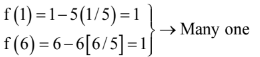
Correct Answer is Option (c) Solution: f(10) = 10 - 5(2) = 0 which is not in codomain So, the function is many one + into
2016
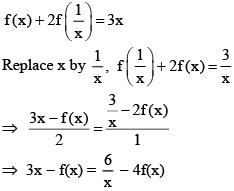
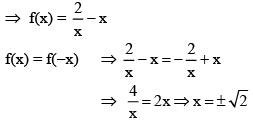
Q1. If f(x) + 2f(1/x) = 3x, x ≠ 0, and S = {x ∈ R: f(x) = f(-x)}; then S: (a) Is an empty set (b) Contains exactly one element (c) Contains exactly two elements. (d) Contains more than two elements.
Solution:
Correct Answer is Option (c) Solution:
The document JEE Main Previous Year Questions (2016- 2025): Functions is a part of the JEE Course Mathematics (Maths) Class 12.
FAQs on JEE Main Previous Year Questions (2016- 2025): Functions
1. How do I identify if a function is one-one and onto in JEE Main questions?
Ans. A function is one-one (injective) if different inputs produce different outputs; it's onto (surjective) if every element in the codomain is mapped to by at least one domain element. To verify, check if f(x₁) = f(x₂) implies x₁ = x₂ for one-one, and ensure the range equals the codomain for onto. Previous year JEE Main problems frequently test this distinction through graphical and algebraic methods simultaneously.
2. What's the difference between domain and range in function problems for JEE exams?
Ans. Domain comprises all possible input values a function accepts, while range includes all actual output values the function produces. For JEE Main functions, domain restrictions arise from denominators (cannot be zero), square roots (non-negative arguments), and logarithms (positive arguments only). Range depends on the function's behaviour across its entire domain and often requires calculus or algebraic manipulation to determine completely.
3. How do I solve composite function problems that appear in JEE Main past papers?
Ans. Composite functions combine two functions: (f∘g)(x) = f(g(x)), meaning apply g first, then f to the result. To solve JEE Main composite function questions, identify each function clearly, determine the domain of the inner function and the domain of the outer function applied to the inner function's range. Previous year questions frequently test whether composite functions are commutative and require careful substitution and algebraic simplification.
4. Why do inverse functions appear so often in JEE Main, and how do I find them?
Ans. Inverse functions reverse the mapping: if f(a) = b, then f⁻¹(b) = a. They're critical in JEE Main because they test understanding of function behaviour and bijections. To find f⁻¹(x), replace f(x) with y, swap x and y, then solve for y. Inverse functions exist only for one-one and onto functions; many JEE questions verify this property before asking you to determine the inverse explicitly.
5. What types of function transformations should I know for JEE Main previous year questions?
Ans. Function transformations shift, stretch, or reflect graphs: f(x) + c shifts vertically, f(x - c) shifts horizontally, cf(x) stretches vertically, and f(cx) compresses horizontally. JEE Main papers test whether students recognise these transformations graphically and algebraically. Understanding transformations helps solve complex function problems faster, as examiners often present modified functions and ask about domain, range, or specific values without requiring full recalculation from scratch.
video lectures, mock tests for examination, Sample Paper, Viva Questions, pdf , JEE Main Previous Year Questions (2016- 2025): Functions, practice quizzes, Extra Questions, Free, shortcuts and tricks, Semester Notes, Important questions, MCQs, ppt, JEE Main Previous Year Questions (2016- 2025): Functions, JEE Main Previous Year Questions (2016- 2025): Functions, study material, Previous Year Questions with Solutions, past year papers, Exam, Objective type Questions, Summary;


 is
is  then
then 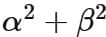 is equal to: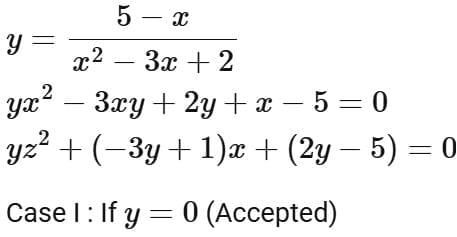
 be (α, β) and [γ, δ], respectively. Then α2 + β2 + γ2 + δ2 is equal to: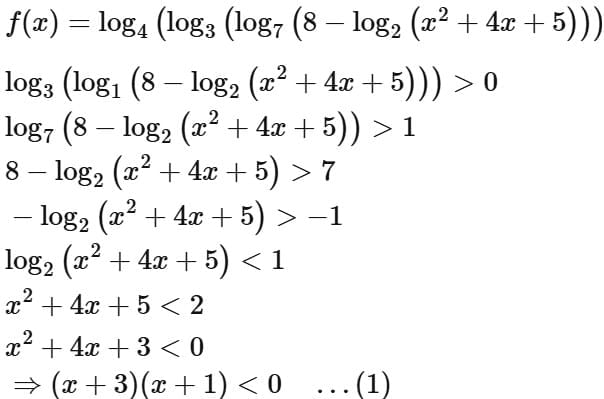

 be defined as
  If the range of the function fog:
  is equal to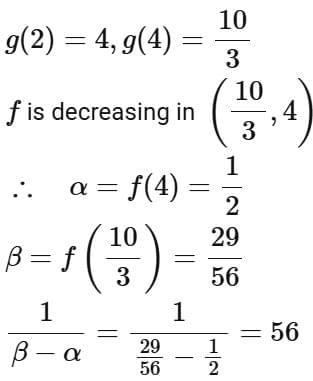
 Then f (3) + f (8) is equal to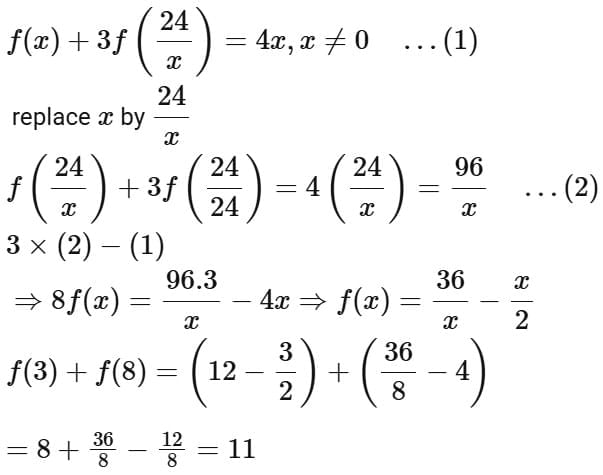
 is
is 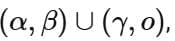 then
then 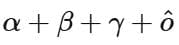 is equal to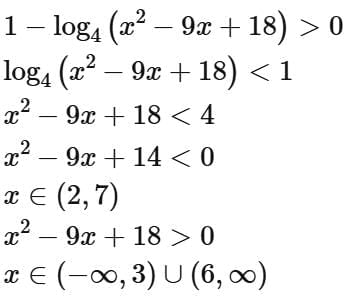
 is [α, β) then α2 + 4β is equal to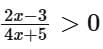
 is, (a, b), then (1 + a)2 + b2 is equal to: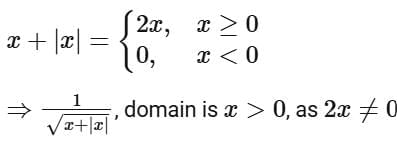
 is (γ, δ), then α2 + β2 + γ2 is equal to: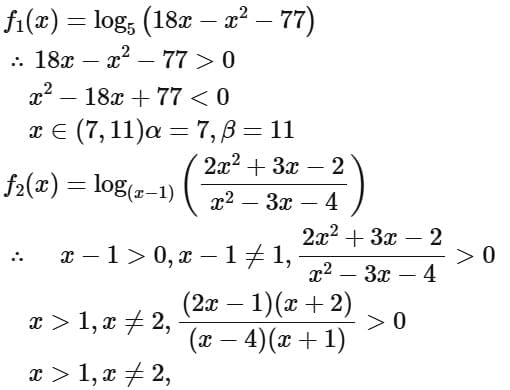

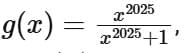 If both the functions are onto and S = {x ∈ Z; x ∈ A or x ∈ B}, then n(S) is equal to: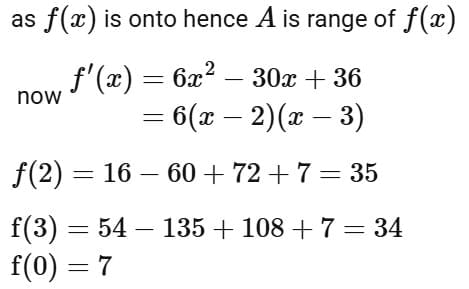
 is equal to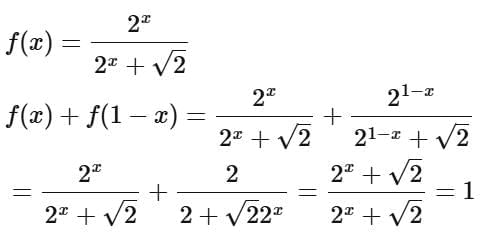

 If
If  then the value of
 is
is 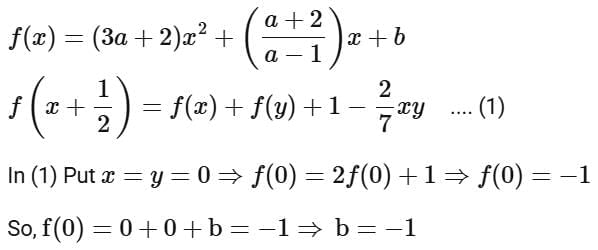
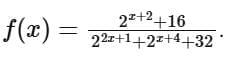 Then the value of
  is equal to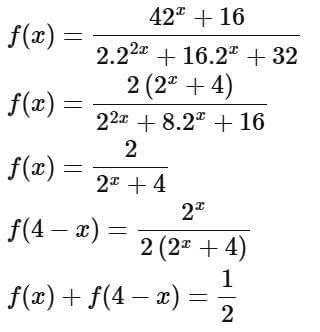
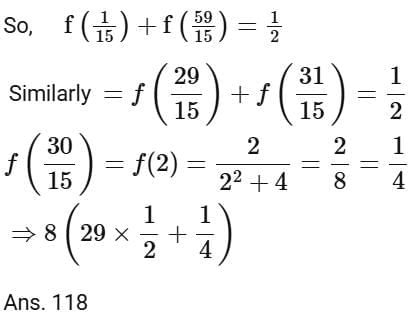
 Then the domain of f o g is
 and the domain of
 If α and β ar respectively the A.M. and the G.M. of a and b, then α/β is equal to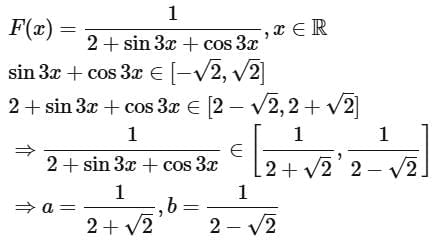
 is R - (α, β), then 12 αβ is equal to: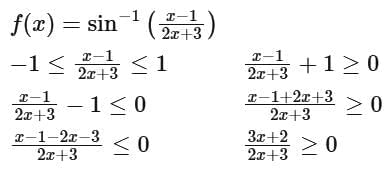
 where a > 0 and g(x) = (f(|x|) - |f(x)|)/2. Then the function
  is
is 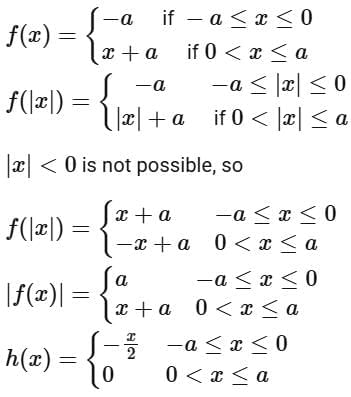
 Neither one-one nor onto.
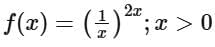 attains the maximum value at x = 1/e then:
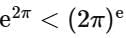
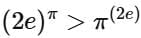

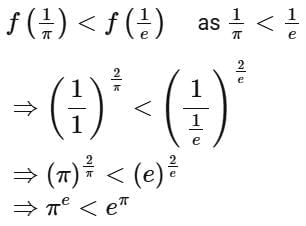
 be a function defined on R. Then the range of the function f(x) is equal to:


 is
is  can be simplified to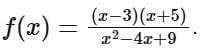

 is
is 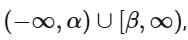 then α2 + β2 is equal to:
  we need to consider the domain conditions for both the square root function and the logarithmic function.
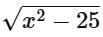 requires that the argument of the square root be non-negative, so x2 - 25 ≥ 0.
 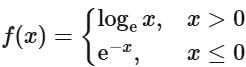 and
and 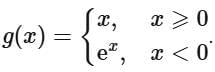
 From the graph of g (f(x)), we can say
 where
where  then
then 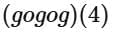 is equal to
  we first need to understand the composition of f with itself, i.e.,
 We can then repeatedly apply g to get the given expression.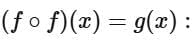
 for x in the function f (x):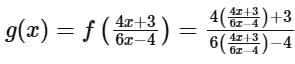

 is (α, β), then the value of 5 β - 4α is equal to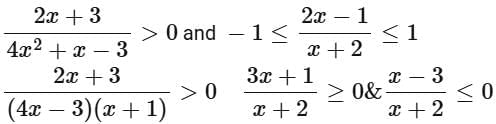
 then α + β + γ is equal to: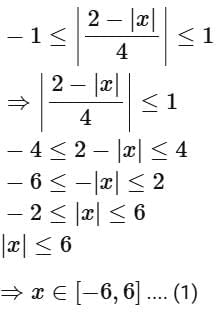
 then range of
  is
is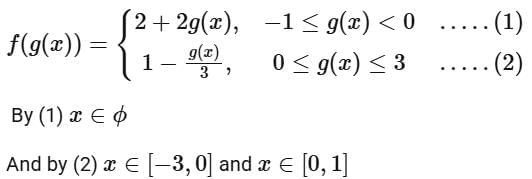
 be defined as
  Then, the domain of the function fog is: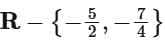
 is equal to _________.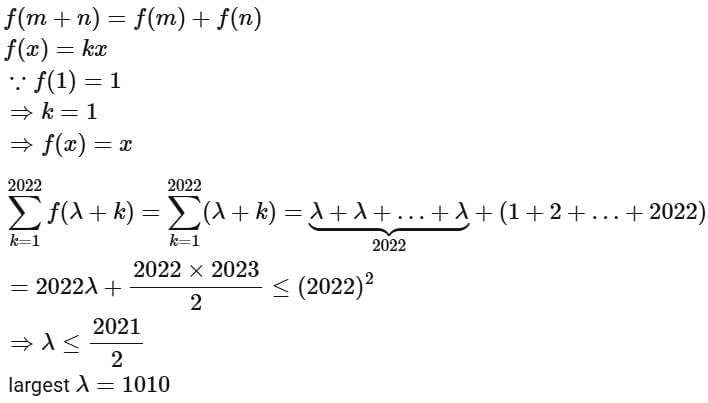
 then the sum of the infinite G.P., whose first term is 64 and the common ratio is α/β, is equal to __________.
  let's start by simplifying the expression.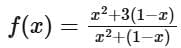




 is equal to _________.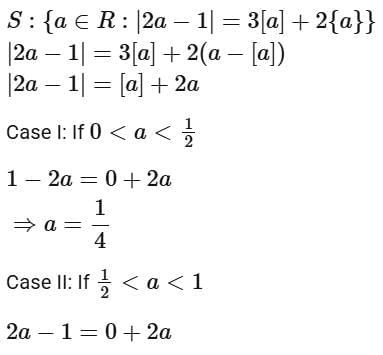
 If the composition of
  then the value of
  is equal to _______.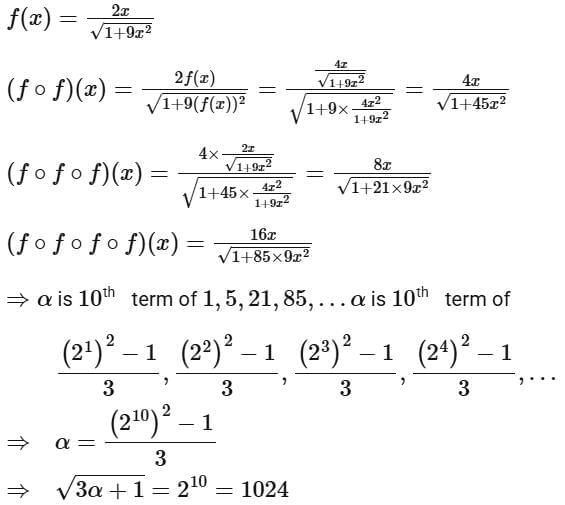
 and r = pq + 1 such that 3,3logy x, 3logz y, 7logx z are in A.P. with common difference 1/2. Then r - p - q is equal to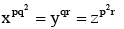






 and decreasing in
 is equal to: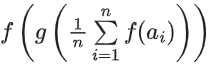

 = 0α + 0β + 0γ





 where [t] is the greatest integer function, is: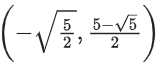
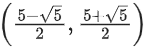
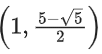
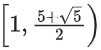
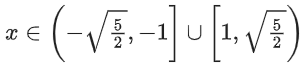

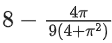
 is equal to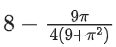





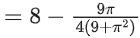


 in the interval [-3, 0] is f(α), then:
  and S2 = {x ∈ R : 32x - 3x+1 - 3x+2 + 27 ≤ 0}. Then, S1 ∪ S2 is equal to: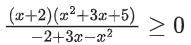
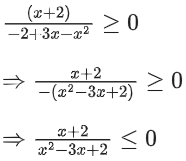
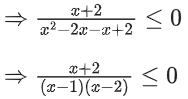




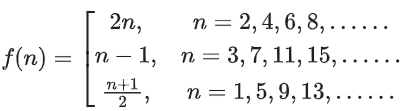
 will give all odd numbers.
 Then the function fog is:

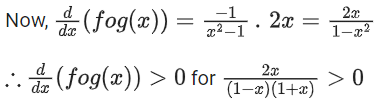
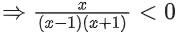


 , x ∈ R - {0, -1, 1}. If fn+1(x) = f(fn(x)) for all n ∈ N, then f6(6) + f7(7) is equal to:

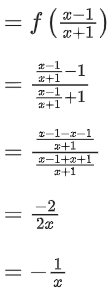
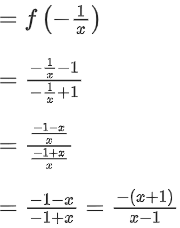
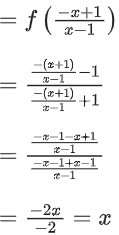

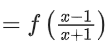



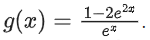 Then, for which of the following range of α, the inequality
  holds?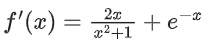


 is equal to:


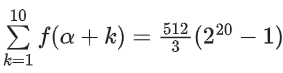 holds, is: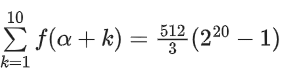
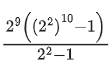
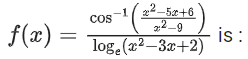
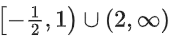



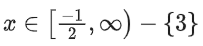









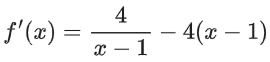

 is equal to ___________.







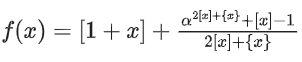 at x = 0 is equal to
 is _____________.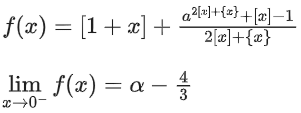
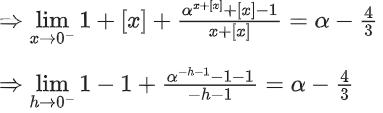
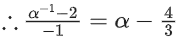




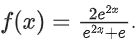 Then
Then  is equal to ______________.
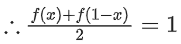


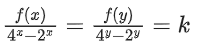
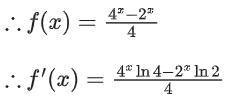
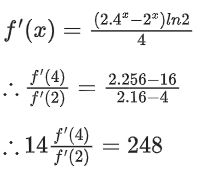
 If the function g(x) = f(f(f(x)) + f(f(x)), then the greatest integer less than or equal to g(1) is ____________.



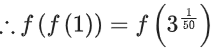
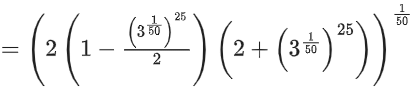
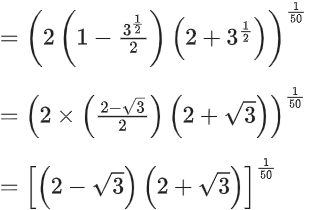
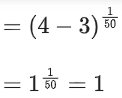


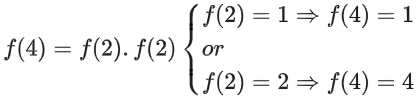
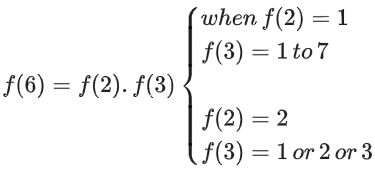
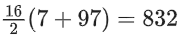


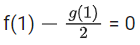

 then the value of the expression
 is __________.







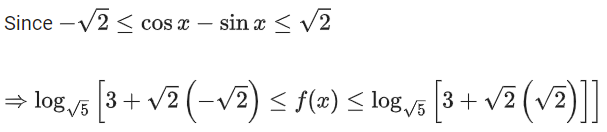



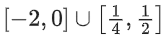
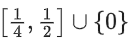





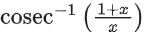 is:
is: 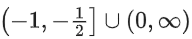




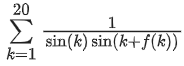 is equal to: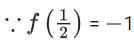

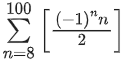 is equal to: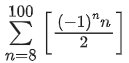
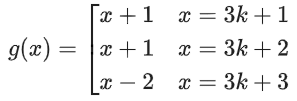
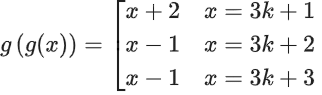
 is the interval (α, β], then α + β is equal to:
 lie in the interval:

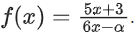 Then the value of α for which (fof)(x) = x, for all x ∈ R - {α/6}, is:
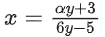

 is (- ∞, a) ]∪ [b, c) ∪ [4, ∞), a < b < c, then the value of a + b + c is: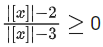
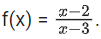


 then what is the common domain of the following functions:



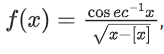 where [x] denotes the greatest integer less than or equal to x, is defined for all x belonging to:
 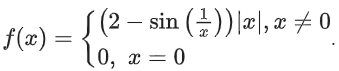 Then f is: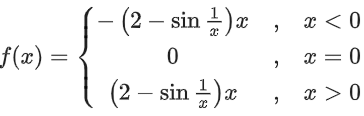

 (a) Q and R



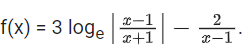
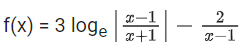

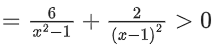

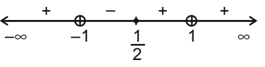




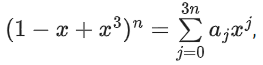
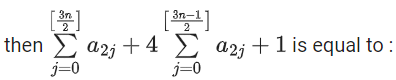
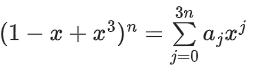
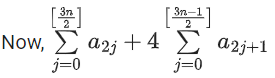
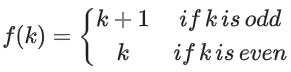
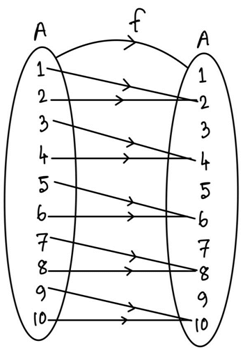
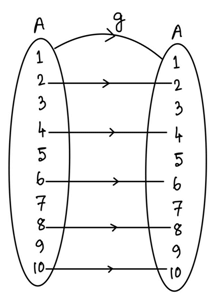
 then the sum of the series
 is equal to: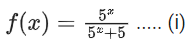



 Then the composition function f(g(x)) is:





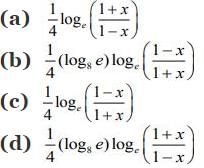
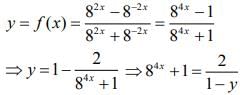
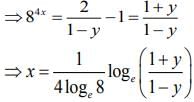
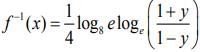
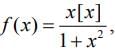
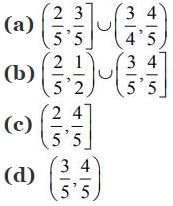
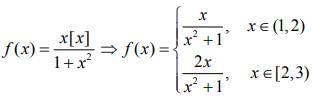



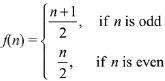
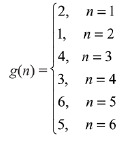
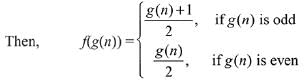
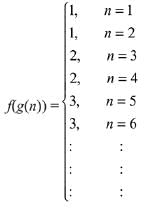

 (a) Not injective but it is surjective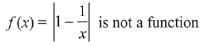



 (a) (-1, 0) ∪ (1, 2) ∪ (3, ∞)