

Q3: Role of the water vascular system in Echinoderms is:
A. Respiration and Locomotion
B. Excretion and Locomotion
C. Capture and transport of food
D. Digestion and Respiration
E. Digestion and Excretion
Choose the correct answer from the options given below:
(a) B and C only
(b) B, D and E only
(c) A and B only
(d) A and C only
NEET Exam > NEET Notes > Biology Class 11 > NEET Previous Year Questions(2016-24): Animal Kingdom
NEET Previous Year Questions(2016-24): Animal Kingdom
2025
Q1: Given below are two statements: one is labelled as Assertion (A) and the other is labelled as Reason (R).
Assertion (A): All vertebrates are chordates but all chordates are not vertebrates.
Reason (R): The members of subphylum vertebrata possess notochord during the embryonic period; the notochord is replaced by a cartilaginous or bony vertebral column in adults.
Choose the correct answer from the options given below:
(a) (A) is True but (R) is False
(b) (A) is False but (R) is True
(c) Both (A) and (R) are True and (R) is the correct explanation of (A)
(d) Both (A) and (R) are True but (R) is not the correct explanation of (A)
Ans: (c)
Solution :
- (i) Assertion: True. All vertebrates belong to phylum Chordata because they show chordate features (for example, a notochord) at some stage. However, several chordates (such as urochordates and cephalochordates) are not vertebrates.
- (ii) Reason: True. In members of subphylum Vertebrata, a notochord is present in the embryo and is largely replaced by a segmented vertebral column made of cartilage or bone in adults.
- (iii) Justification: The reason explains why vertebrates are a subset of chordates - the developmental replacement of the notochord by a vertebral column is a defining feature that distinguishes vertebrates from non-vertebrate chordates. Hence (c) is correct.
Therefore, the correct answer is: (c) . Both (A) and (R) are True and (R) is the correct explanation of (A).
Q2: All living members of the class Cyclostomata are:
(a) Symbiotic
(b) Ectoparasite
(c) Free living
(d) Endoparasite
Ans: (b)
Solution: Members of class Cyclostomata (for example, lampreys and hagfishes) lack jaws and paired fins and usually have a circular, sucker-like mouth. Many lampreys are ectoparasites; they attach to the external surface of other fishes and feed on blood or body fluids using horny teeth. Hagfishes are also commonly considered ectoparasitic or scavengers on dead or dying fishes.
Ans: (d)
Solution: The water vascular system of echinoderms (for example, starfish and sea urchins) is a hydraulic network that primarily functions in:
- Locomotion: Tube feet are extended and retracted by hydraulic pressure generated within the water vascular system, enabling movement.
- Respiration: Gas exchange occurs partly through tube feet and dermal structures associated with the water vascular system.
- Capture and transport of food: Tube feet help grasp, manipulate and transport food particles towards the mouth.
It does not have a primary role in digestion or excretion. Therefore, the correct combination of functions given among the options is A and C only, so option (d) is correct.
Q4: While trying to find out the characteristics of a newly found animal, a researcher did the histology of an adult animal and observed a cavity with the presence of mesodermal tissue towards the body wall, but no mesodermal tissue was observed towards the alimentary canal. What could be the possible coelom of that animal?
(a) Schizocoelomate
(b) Spongocoelomate
(c) Acoelomate
(d) Pseudocoelomate
Solution: In a pseudocoelomate:
- The body cavity (pseudocoel) exists between the body wall and the alimentary canal.
- The mesoderm lines the body wall only, but it does not line the gut (alimentary canal).
This contrasts with:
- Schizocoelomates (true coelomates) - coelom fully lined by mesoderm around both body wall and gut.
- Acoelomates - no body cavity between gut and body wall.
- Spongocoelomate - not a coelom classification; spongocoel refers to the central cavity of sponges and is unrelated to coelom types.
Therefore, the correct answer is: 4. Pseudocoelomate.
2024
Q1: Match List I with List II: (NEET 2024)
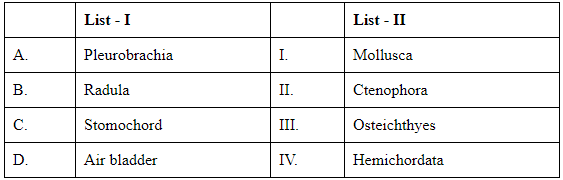
Choose the correct answer from the options given below :
(a) A-IV, B-II, C-III, D-I
(b) A-II, B-I, C-IV, D-III
(c) A-II, B-IV, C-I, D-III
(d) A-IV, B-III, C-II, D-I
Ans: (b)
Solution: Match each item by its defining characteristic:
Pleurobrachia: Pleurobrachia is a genus that belongs to the phylum Ctenophora, which is commonly known as comb jellies, so A → II.
Radula: A radula is a toothed, chitinous organ found within mollusks that is used for scraping or cutting food before the food enters the esophagus, so B → I.
Stomochord: The stomochord is a small, tubular structure found in the collar of hemichordates, a fundamental character previously thought to link hemichordates and chordates, so C → IV.
Air bladder (swim bladder):The air bladder, or swim bladder, is a gas-filled sac present in many bony fish that helps to maintain buoyancy (Osteichthyes, a class of bony fish), so D → III.Thus the correct set is A-II, B-I, C-IV, D-III, i.e. option (b).
Q2: Consider the following statements : (NEET 2024)
A. Annelids are true coelomates
B. Poriferans are pseudocoelomates
C. Aschelminthes are acoelomates
D. Platyhelminthes are pseudocoelomates
Choose the correct answer from the options given below :
(a) B only
(b) A only
(c) C only
(d) D only
Ans: (b)
Solution:
A. Correct. Annelids (segmented worms) are true coelomates - their coelom is completely lined by mesoderm.
B. Incorrect. Poriferans (sponges) lack true tissues and a body cavity; they are neither coelomates nor pseudocoelomates.
C. Incorrect. Aschelminthes (roundworms, often referred to Nematoda) are pseudocoelomates, not acoelomates.
D. Incorrect. Platyhelminthes (flatworms) are acoelomates, lacking any body cavity.
Therefore only statement A is correct; option (b) is right.
Q3: The following are the statements about non-chordates: (NEET 2024)
A. Pharynx is perforated by gill slits.
B. Notochord is absent.
C. Central nervous system is dorsal.
D. Heart is dorsal if present.
E. Post anal tail is absent.
Choose the most appropriate answer from the options given below:
(a) A & C only
(b) A, B & D only
(c) B, D & E only
(d) B, C & D only
Ans: (c)
Solution:B. Correct. Non-chordates do not possess a notochord.
D. Correct. If a heart is present in non-chordates, it is typically located dorsally.
E. Correct. Non-chordates lack a post-anal tail, which is a chordate feature.Statements A and C describe chordate features (pharyngeal gill slits and a dorsal central nervous system), so option (c) (B, D & E only) is correct.
Q4: Match List I with List II : (NEET 2024)
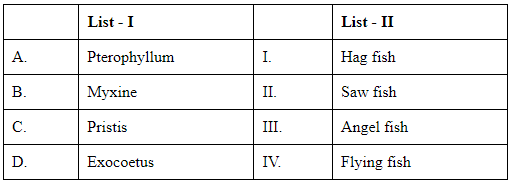
Choose the correct answer from the options given below :
(a) A-II, B-I, C-IIII, D-IV
(b) A-III, B-I, C-II, D-IV
(c) A-IV, B-I, C-II, D-III
(d) A-III, B-II, C-I, D-IV
Ans: (b)
Solution:
Pterophyllum (A) → Angel fish (III): Pterophyllum are freshwater cichlids commonly called angelfish.
Myxine (B) → Hagfish (I): Myxine is a genus of hagfishes.
Pristis (C) → Saw fish (II): Pristis includes sawfishes with a toothed rostrum.
Exocoetus (D) → Flying fish (IV): Exocoetus are flying fishes that glide above water.These matches correspond to option (b).
Q5: Which of the following group of animals have three chambered heart? (NEET 2024)
(a) Bufo, Alligator, Struthio
(b) Chameleon, Hyla, Calotes
(c) Crocodilus, pavo, Clarias
(d) Exocoetus, Hemidactylus, Rana
Ans: (b)
Solution: A three-chambered heart (two atria and one ventricle) is typical of most amphibians and many reptiles. In option (b):
- Chameleon - reptile (usually three-chambered heart)
- Hyla - a genus of tree frogs (amphibian; three-chambered)
- Calotes - lizard (reptile; typically three-chambered)
Therefore option (b) is correct.
Q6: Given below is a list of some sexually reproducing animals. Select the hermaphrodite animals from the list. (NEET 2024)
A. Cockroach
B. Leech
C. Housefly
D. Tapeworm
E. Earthworm
Choose the correct answer from the options given below:
(a) A, B and D only
(b) C and D only
(c) B, D and E only
(d) A, C and E only
Ans: (c)
Solution: Hermaphroditism means an individual possesses both male and female reproductive organs. Among the listed organisms:
- Leech (B) - hermaphrodite
- Tapeworm (D) - hermaphrodite (most cestodes)
- Earthworm (E) - hermaphrodite
Cockroach and Housefly have separate sexes (not hermaphrodite). Hence option (c) is correct.
Q7: Given below are two statements: One is labelled as Assertion (A) and the other is labelled as Reason (R). (NEET 2024)
Assertion (A): In hemichordates, the body cavity is lined by mesoderm.
Reason (R): In aschelminthes, the body cavity is not lined by mesoderm.
In the light of the above statements, choose the correct answer from the options given below:
(a) Both (A) and (R) are True and (R) is the correct explanation of (A).
(b) Both (A) and (R) are True but (R) is not the correct explanation of (A).
(c) (A) is True but (R) is False.
(d) (A) is False but (R) is True.
Ans: (b)
Solution:
- (i) Assertion: True. Hemichordates possess a body cavity that is lined by mesodermal tissue; they are considered coelomate or show coelomic compartments.
- (ii) Reason: True. Aschelminthes (roundworms, i.e. Nematoda) have a pseudocoel - a body cavity not completely lined by mesoderm.
- (iii) Justification: Although both statements are true, the fact about Aschelminthes (pseudocoelom) does not explain why hemichordates have mesodermal lining; the two statements describe different groups and are not causally related. Therefore option (b) is correct.
Q8: Which of the following pairs is an incorrect match? (NEET 2024)
(a) Annelids and arthropods - Bilateral symmetry
(b) Sponges - Acoelomates
(c) Coelenterates and Ctenophores - Radial symmetry
(d) Platyhelminthes - Diploblastic organisation
Ans: (d)
Solution: Platyhelminthes (flatworms) are triploblastic (possess ectoderm, mesoderm and endoderm). Diploblastic organisation (two germ layers) is a feature of groups like Coelenterata (Cnidaria). Thus pairing Platyhelminthes with diploblastic organisation is incorrect; option (d) is the wrong match.
Q9: Match List-I with List-II: (NEET 2024)
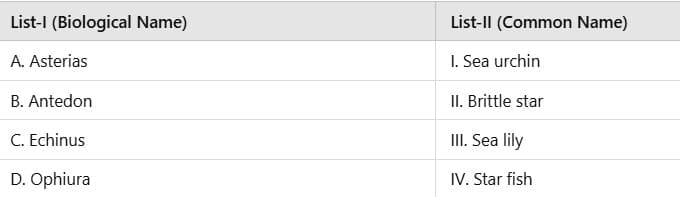 Choose the correct answer from the options given below:
(a) A-III, B-IV, C-II, D-I
(b) A-IV, B-III, C-I, D-II
(c) A-I, B-II, C-I, D-IV
(d) A-I, B-II, C-IV, D-III
Ans: (b)
Solution:
- Asterias (Biological Name): Asterias is a genus of sea stars (class Asteroidea) - common name: star fish. Common name for Asterias = IV. Star fish.
- Antedon (Biological Name): Antedon is a crinoid (class Crinoidea) - common name: sea lily. Common name for Antedon = III. Sea lily.
- Echinus (Biological Name): Echinus refers to sea urchins (class Echinoidea) - common name: sea urchin. Common name for Echinus = I. Sea urchin.
- Ophiura (Biological Name): Ophiura belongs to brittle stars (class Ophiuroidea) - common name: brittle star. Common name for Ophiura = II. Brittle star.
Q10: Match List-I with List-II: (NEET 2024)
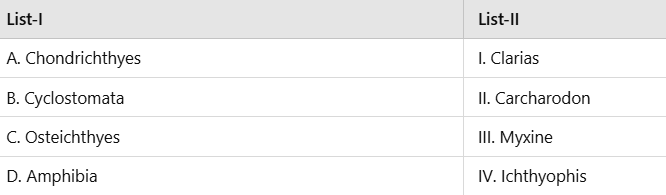
Choose the correct answer from the options given below:
(a) A-II, B-IV, C-I, D-III
(b) A-I, B-III, C-I, D-IV
(c) A-II, B-III, C-I, D-IV
(d) A-I, B-II, C-III, D-IV
Ans: (c)
Solution:
- Chondrichthyes - class of cartilaginous fishes; Carcharodon (great white shark) belongs here (A → II).
- Cyclostomata - jawless fishes; Myxine (hagfish) belongs here (B → III).
- Osteichthyes - bony fishes; Clarias (catfish) belongs here (C → I).
- Amphibia - class including caecilians; Ichthyophis (a caecilian) belongs here (D → IV).
Q 11: Given below are two statements: One is labelled as Assertion A and the other is labelled as Reason R.
Assertion (A): Members of subphylum vertebrate possess notochord during the embryonic period. The notochord is replaced by a cartilaginous or bony vertebral column in the adult.
Reason (R): All chordates are vertebrates but not all vertebrates are chordates.
Choose the correct answer from the options given below:
(a) (A) is True but (R) is False
(b) (A) is False but (R) is True
(c) Both (A) and (R) are True and (R) is the correct explanation of (A).
(d) Both (A) and (R) are True but (R) is not the correct explanation of (A).
Ans: (a)
Solution:
- (i) Assertion (A): True. Vertebrates show a notochord during embryonic development; in adults the notochord is largely replaced by a segmented vertebral column of cartilage or bone.
- (ii) Reason (R): False. The statement reverses the taxonomic relationship. In fact, all vertebrates are chordates, but not all chordates are vertebrates. Therefore (R) is incorrect.
- (iii) Because the reason is false, option (a) - (A) is True but (R) is False - is correct.
2023
Q1: Radial symmetry is NOT found in adults of phylum ______. (NEET 2023)
(a) Ctenophora
(b) Hemichordata
(c) Coelenterata
(d) Echinodermata
Ans: (b)
Solution: Radial symmetry in adults is characteristic of groups such as Ctenophora, Coelenterata (Cnidaria) and Echinodermata (adult echinoderms show radial symmetry). Hemichordata adults are bilaterally symmetrical; therefore radial symmetry is not found in adults of Hemichordata, making option (b) correct.
Q2: The unique mammalian characteristics are: (NEET 2023)
(a) hairs, tympanic membrane and mammary glands
(b) hairs, pinna and mammary glands
(c) hairs, pinna and indirect development
(d) pinna, monocondylic skull and mammary glands
Ans: (b)
Solution: Unique mammalian characteristics include:
- Hair or fur: Mammals are the only animals that have hair. This hair helps to insulate the body to maintain a constant body temperature.
- Mammary glands: These are glands that, in females, produce milk for the nourishment of young ones. This is a characteristic feature of all mammals and is, in fact, the feature that gives this group its name.
- The presence of pinnae (external ears): Most mammals have pinnae that help to collect and direct sound waves into the ear.
Option A is incorrect because while mammals do have a tympanic membrane (ear drum), it is not unique to mammals; other vertebrate groups, such as birds and reptiles, also have a tympanic membrane.
Option C is incorrect because indirect development is not a unique characteristic of mammals; many animals, including certain insects, amphibians, and fishes, undergo indirect development.
Option D is incorrect because a monocondylic skull, in which the skull only articulates with the first vertebra via a single condyle, is a characteristic of some reptiles and amphibians, not mammals. Mammals possess a dicondylic skull, with two occipital condyles.
So, the correct answer is :
Option B: hairs, pinna and mammary glands.
Q3: Select the correct statements with reference to chordates. (NEET 2023)
A. Presence of a mid-dorsal, solid and double nerve cord.
B. Presence of the closed circulatory system.
C. Presence of paired pharyngeal gill slits.
D. Presence of dorsal heart
E. Triploblastic pseudocoelomate animals.
Choose the correct answer from the options given below:
(a) A, C and D only
(b) B and C only
(c) B, D and E only
(d) C, D and E only
Ans: (b)
Solution:B. True. Chordates have a closed circulatory system.
C. True. Paired pharyngeal gill slits are a chordate feature (present at least during development).
A. Incorrect. Chordates have a dorsal, hollow nerve cord, not a mid-dorsal solid double cord.
D. Incorrect. The heart in chordates is typically ventral, not dorsal.
E. Incorrect. Chordates are triploblastic coelomates, not pseudocoelomates.
Thus only B and C are correct; option (b) is the right choice.
Q4: Match List - I with List - II (NEET 2023)
| List-I | List-II |
|---|---|
| (A) Contractile vacuole | (I) Asterias |
| (B) Water vascular system | (II) Amoeba |
| (C) Canal system | (III) Spongilla |
| (D) Flame cells | (IV) Taenia |
Choose the correct answer from the options given below:
(a) (A) - (IV), (B) - (II), (C) - (I), (D) - (III)
(b) (A) - (I), (B) - (III), (C) - (II), (D) - (IV)
(c) (A) - (III), (B) - (II), (C) - (I), (D) - (IV)
(d) (A) - (II), (B) - (I), (C) - (III), (D) - (IV)
Ans: (d)
Solution:
Contractile vacuole is found in freshwater protists such as Amoeba (List-II: II).
Water vascular system is a feature of echinoderms such as Asterias (List-II: I).
Canal system (water canal system) is characteristic of sponges such as Spongilla (List-II: III).
Flame cells are excretory structures found in platyhelminthes like Taenia (List-II: IV).
Q5: Select the correct statements: (NEET 2023)
A: Platyhelminthes are triploblastic, pseudocoelomate and bilaterally symmetrical organisms.
B: Ctenophores reproduce only sexually and fertilization is external.
C: In tapeworms, fertilization is internal but the sexes are not separate.
D: Ctenophores are exclusively marine, diploblastic and bioluminescent organisms.
E: In sponges, fertilization is external and development is direct.
Choose the correct answer from the options given below:
(a) (A), (C) and (D) only
(b) (B), (C) and (D) only
(c) (A) and (E) only
(d) (B) and (D) only
Ans: (b)
Solution:A - Incorrect. Platyhelminthes are triploblastic and bilaterally symmetrical but they are acoelomate, not pseudocoelomate.
B - Correct. Ctenophores can reproduce sexually with typically external fertilisation; some also reproduce asexually.
C - Correct. Tapeworms (Taenia) are hermaphroditic; fertilisation is internal within proglottids.
D - Correct. Ctenophores are predominantly marine, diploblastic and many exhibit bioluminescence.
E - Incorrect. Sponges often show internal fertilisation and typically indirect development (with larval stages).
Therefore statements B, C and D are correct; option (b) is the right choice.
Q6: Match List I with List II. (NEET 2023)
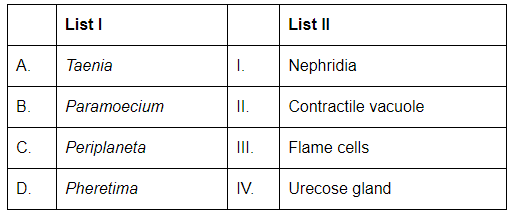
Choose the correct answer from the options given below:
(a) A-II B-I C-IV D-III
(b) A-I B-II C-III D-IV
(c) A-I B-II C-IV D-III
(d) A-III B-II C-IV D-I
Ans: (d)
(a) A-II, B-I, C-IV, D-III
This option incorrectly matches Taenia with contractile vacuole, which is not applicable as Taenia does not possess this structure.
(b) A-I, B-II, C-III, D-IV
This option incorrectly matches Taenia with nephridia, which is not correct as Taenia does not have nephridia.
(c) A-I, B-II, C-IV, D-III
This option incorrectly matches Taenia with nephridia, which is not applicable. Additionally, it mismatches Pheretima with flame cells.
(d) A-III, B-II, C-I, D-IV
This is the correct option as it accurately matches each organism with its corresponding feature.
2022
Q1: Exoskeleton of arthropods is composed of: (NEET 2022 Phase 1)
(a) Cellulose
(b) Chitin
(c) Glucosamine
(d) Cutin
Ans: (b)
Solution: The exoskeleton of arthropods is primarily composed of chitin, a nitrogenous polysaccharide whose monomeric unit is N-acetyl glucosamine. Cellulose and cutin are unrelated structural biopolymers; option (b) is correct.
Q2: Given below are two statements: one is labelled as Assertion and the other is labelled as Reason. (NEET 2022 Phase 1)
Assertion: All vertebrates are chordates, but all chordates are not vertebrates.
Reason: Notochord is replaced by a vertebral column in the adult vertebrates.
In the light of the above statements, choose the most appropriate answer from the options given below:
(a) Both Assertion and Reason are correct but Reason is not the correct explanation of Assertion.
(b) Assertion is correct but Reason is not correct
(c) Assertion is not correct but Reason is correct
(d) Both Assertion and Reason are correct and Reason is the correct explanation of Assertion.
Ans: (a)
Solution: The assertion is correct: vertebrates are a subgroup within chordates. The reason is also correct in itself: vertebrates typically replace the embryonic notochord with a vertebral column. However, replacement of the notochord does not logically explain why all vertebrates are chordates while not all chordates are vertebrates. They are related facts but the reason is not the direct explanation of the assertion. Thus option (a) is appropriate.
Q3: Which of the following animals has three chambered heart? (NEET 2022 Phase 2)
(a) Pteropus
(b) Scoliodon
(c) Hippocampus
(d) Chelone
Ans: (d)
Solution: Chelone (a turtle) is a reptile; most reptiles (except crocodilians) have a three-chambered heart (two atria and one ventricle). Pteropus (a bat) is a mammal with a four-chambered heart; Scoliodon (a shark) and Hippocampus (a seahorse) are fishes with two-chambered hearts.
Q4: Select the incorrect statements with respect to Cyclostomes: (NEET 2022 Phase 2)
(a) They lack scales and paired fins.
(b) They have circular mouth with jaws.
(c) They bear 6-15 pairs of gills.
(d) They migrate to deep sea for spawning.
Choose the most appropriate answer from the options given below:
(a) (a) and (d) only
(b) (a) and (b) only
(c) (b) and (c) only
(d) (b) and (d) only
Ans: (d)
Solution:
- (b) is incorrect because cyclostomes (lampreys and hagfishes) have a circular mouth without true jaws.
- (d) is incorrect because many cyclostomes migrate between marine and freshwater for spawning (for example, certain lampreys migrate from sea to fresh water), they do not typically migrate to deep sea for spawning.
(a) and (c) are correct (they lack scales and paired fins; gill openings may number from 6-15 pairs in different species). Hence option (d) (b and d only are incorrect) is correct.
2021
Q1: Match the following (NEET 2021)
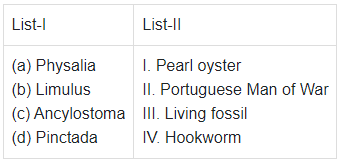
Choose the correct answer from the options given below.
(a) (b) (c) (d)
(a) (ii) (iii) (iv) (i)
(b) (i) (iv) (iii) (ii)
(c) (ii) (iii) (i) (iv)
(d) (iv) (i) (iii) (ii)
Ans: (a)
Solution: Correct matching is as follows:
- Physalia (Portuguese man-of-war) - phylum Coelenterata (Cnidaria).
- Limulus - a horseshoe crab often called a living fossil (Arthropoda).
- Ancylostoma - a roundworm (Nematoda), known as a hookworm.
- Pinctada - a pearl oyster (Mollusca).
Q2: Read the following statements. (NEET 2021)
(a) Metagenesis is observed in Helminths.
(b) Echinoderms are triploblastic and coelomate animals.
(c) Round worms have organ-system level of body organization
(d) Comb plates present in ctenophores help in digestion.
(e) Water vascular system is characteristic of Echinoderms.
Choose the correct answer from the options given below.
(a) (a), (d) and (e) are correct
(b) (b), (c) and (e) are correct
(c) (c), (d) and (e) are correct
(d) (a), (b) and (c) are correct
Ans: (b)
Solution:
- (b) Echinoderms are triploblastic coelomates.
- (c) Roundworms (Aschelminthes/Nematoda) have an organ-system level of organisation.
- (e) Water vascular system is indeed characteristic of echinoderms.
- (a) is incorrect - metagenesis (alternation of generations) is characteristic of some coelenterates (Cnidaria), not helminths generally.
- (d) is incorrect - comb plates (ctenes) in ctenophores function in locomotion, not digestion.
Q3: Match List - I with List - II (NEET 2021)
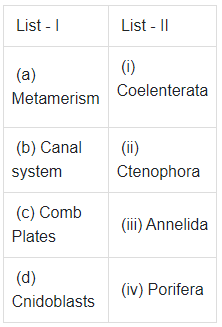
Choose the correct answer from the options given below.
(a) (b) (c) (d)
(a) (iii) (iv) (ii) (i)
(b) (iv) (i) (ii) (iii)
(c) (iv) (iii) (i) (ii)
(d) (iii) (iv) (i) (ii)
Ans: (a)
Solution:
- Metamerism is a feature of Annelida (segmentation of body).
- Water canal system is a characteristic of Porifera (sponges).
- Comb plates (ctenes) help in locomotion in Ctenophora.
- Cnidae/cnidoblasts are diagnostic of Cnidaria (Coelenterata).
Q4: Which one of the following organisms bears hollow and pneumatic long bones? (NEET 2021)
(a) Macropus
(b) Ornithorhynchus
(c) Neophron
(d) Hemidactylus
Ans: (c)
Solution: Hollow and pneumatic (air-filled) long bones are characteristic of many birds, which reduces skeletal weight for flight. Neophron (a vulture) is a bird. Macropus and Ornithorhynchus are mammals; Hemidactylus is a lizard (reptile).
2020
Q1: Bilaterally symmetrical and acoelomate animals are exemplified by : (NEET 2020)
(a) Aschelminthes
(b) Annelida
(c) Ctenophora
(d) Platyhelminthes
Ans: (d)
Solution: Platyhelminthes (flatworms) are bilaterally symmetrical, triploblastic and acoelomate, making option (d) correct.
Q2: Which of the following statements are true for the phylum - Chordata? (NEET 2020)
(i) In Urochordata notochord extends from head to tail and it is present throughout their life.
(ii) In Vertebrata notochord is present during the embryonic period only.
(iii) Central nervous system is dorsal and hollow.
(iv) Chordata is divided into 3 subphyla: Hemichordata, Tunicata and Cephalochordata.
(a) (i) and (ii)
(b) (ii) and (iii)
(c) (iv) and (iii)
(d) (iii) and (i)
Ans: (b)
Solution: In vertebrates the notochord is present during embryonic development and is largely replaced by a vertebral column in adults (statement ii true). Chordates have a dorsal, hollow nerve cord (statement iii true). Statement (i) is incorrect because in Urochordata (tunicates) the notochord is present only in the larval tail and not throughout life. Statement (iv) is incorrect because Hemichordata is a separate phylum, not a subphylum of Chordata.
Q3: Match the following columns and select the correct option - (NEET 2020)
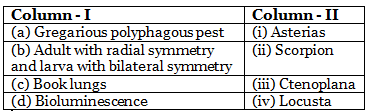
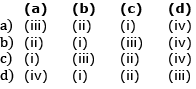
Ans: (d)
Solution: Locusta is a terrestrial insect pest. Echinoderm adults are radially symmetrical while larvae are bilaterally symmetrical. Scorpions possess book lungs for respiration. Bioluminescence is characteristic of ctenophores.
2019
Q1: Consider following features. (NEET 2019)
(A) Organ system level of organisation
(B) Bilateral symmetry
(C) True coelomates with segmentation of body
Select the correct option of animal groups which possess all the above characteristics.
(a) Annelida, Mollusca and Chordata
(b) Annelida, Arthropoda and Chordata
(c) Annelida, Arthropoda and Mollusca
(d) Arthropoda, Mollusca and Chordata
Ans: (b)
Solution: Annelida, Arthropoda and Chordata all exhibit an organ-system level of organisation, bilateral symmetry, and are true coelomates with segmentation (metamerism in Annelida and Chordata; arthropod segmentation is modified). Therefore option (b) is correct.
Q2: Match the following organisms with respective characteristics. (NEET 2019)
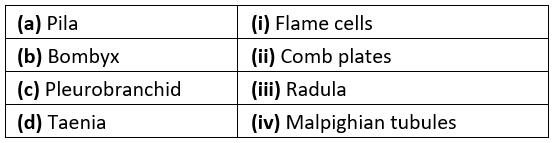
Select the correct option from the following.
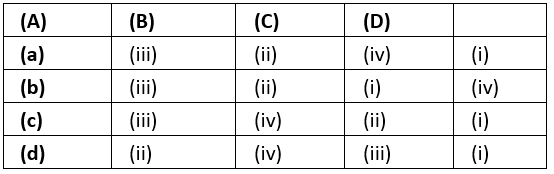
Ans: (c)
Solution:
- Pila (Mollusca) - has a radula for feeding.
- Bombyx (Arthropoda) - insects like Bombyx possess Malpighian tubules for excretion.
- Pleurobrachia (Ctenophora) - has comb plates (ctenes) for locomotion.
- Taenia (Platyhelminthes) - possesses flame cells for excretory function.
2018
Q1: Identify the vertebrate group of animals characterised by crop and gizzard in its digestive system. (NEET 2018)
(a) Amphibia
(b) Reptilia
(c) Aves
(d) Osteichthyes
Ans: (c)
Solution: Birds (Aves) possess specialised digestive chambers: the crop (for temporary storage) and the gizzard (a muscular grinding organ). Hence option (c) is correct.
Q2: Which one of these animals is not a homeotherm? (NEET 2018)
(a) Macropus
(b) Chelone
(c) Camelus
(d) Psittacula
Ans: (b)
Solution: Chelone (a turtle) is a reptile and therefore poikilothermic (body temperature varies with environment). The others are homeotherms (mammals and birds) that maintain a relatively constant internal temperature.
2017
Q1: Which among these is the correct combination of aquatic mammals? (NEET 2017)
(a) Dolphins, Seals, Trygon
(b) Whales, Dolphins, Seals
(c) Trygon, Whales, Seals
(d) Seals, Dolphins, Sharks
Ans: (b)
Solution: Whales, dolphins and seals are all mammals adapted to aquatic life. Trygon (a ray) and sharks are fishes, not mammals. Hence option (b) is correct.
Q2: In case of poriferans, the spongocoel is lined with flagellated cells called (NEET 2017)
(a) Oscula
(b) Choanocytes
(c) Mesenchymal cells
(d) Ostia
Ans: (b)
Solution: The inner surface of the spongocoel in sponges is lined by choanocytes (collar cells); their flagella drive water flow and trap food particles.
Q3: Important characteristic that hemichordates share with chordates is (NEET 2017)
(a) Ventral tubular nerve cord
(b) Pharynx with gill slits
(c) Pharynx without gill slits
(d) Absence of notochord
Ans: (b)
Solution: Hemichordates possess pharyngeal gill slits, which is a feature shared with chordates. Notochord is a chordate feature not present in hemichordates; haemichordates do not have a ventral tubular nerve cord.
2016
Q1: Which of the following characteristic features always holds true for the corresponding group of animals? (NEET 2016)

Ans: (c)
Solution: Phylum Chordata includes jawless vertebrates (Agnatha) and jawed vertebrates (Gnathostomata). Crocodiles (class Reptilia) have a four-chambered heart. Monotremes (platypus Ornithorhynchus and echidna Tachyglossus) are examples of oviparous mammals. Thus option (c) is correct.
Q2: Which of the following features is not present in the Phylum Arthropoda? (NEET 2016)
(a) Parapodia
(b) Jointed appendages
(c) Chitinous exoskeleton
(d) Metameric segmentation
Ans: (a)
Solution: Parapodia are lateral fleshy outgrowths used for locomotion and respiration in some annelids, not in arthropods. Arthropods do possess jointed appendages, a chitinous exoskeleton and show segmentation. Hence option (a) is correct.
Q3: Which one of the following characteristics is not shared by birds and mammals? (NEET 2016)
(a) Viviparity
(b) Warm-blooded nature
(c) Ossified endoskeleton
(d) Breathing using lungs
Ans: (a)
Solution: Most mammals are viviparous (give birth to live young), but birds are oviparous (lay eggs); therefore viviparity is not shared. Birds and mammals are both warm-blooded, have ossified endoskeletons and breathe using lungs. Option (a) is correct.
Q4: Choose the correct statement. (NEET 2016 Phase 2)
(a) All mammals are viviparous.
(b) All cyclostomes do not possess jaws and paired fins.
(c) All reptiles have a three-chambered heart.
(d) All Pisces have gills covered by an operculum.
Ans: (b)
Solution:
- (a) is false - monotremes (egg-laying mammals) are oviparous.
- (b) is correct - cyclostomes (lampreys and hagfishes) lack jaws and paired fins.
- (c) is false - crocodilians have a four-chambered heart, whereas most other reptiles typically have three chambers.
- (d) is false - not all fishes (Pisces) have an operculum; cartilaginous fishes (sharks and rays) lack an operculum while bony fishes have one.
Therefore option (b) is correct.
The document NEET Previous Year Questions(2016-24): Animal Kingdom is a part of the NEET Course Biology Class 11.
All you need of NEET at this link: NEET
FAQs on NEET Previous Year Questions(2016-24): Animal Kingdom
| 1. Which animal phyla are most commonly asked in NEET exams from the Animal Kingdom chapter? |  |
Ans. Phyla like Cnidaria, Arthropoda, Mollusca, Echinodermata, and Chordata dominate NEET previous year questions on Animal Kingdom. These groups appear repeatedly across 2016-2024 papers because they showcase key evolutionary adaptations and structural diversity. Students should focus on characteristic features, body cavity types, and classification patterns of these major phyla to secure maximum marks in this high-weightage topic.
| 2. What's the difference between acoelomate, pseudocoelomate, and coelomate animals that keep appearing in NEET Animal Kingdom questions? | |
Ans. Acoelomate animals lack a body cavity entirely (flatworms), pseudocoelomates have a false cavity not lined by mesoderm (roundworms), and coelomates possess a true cavity fully enclosed by mesoderm (most complex animals). This classification framework appears frequently in NEET exams because it reflects evolutionary advancement. Understanding which phyla fall into each category helps students answer comparative questions and diagram-based questions correctly.
| 3. How do I identify the correct phylum when NEET questions describe an animal's characteristics without naming it? | |
Ans. Match key identifying features: presence of notochord indicates Chordata; jointed legs suggest Arthropoda; radial symmetry points toward Cnidaria or Echinodermata; shell presence often indicates Mollusca. NEET previous year papers frequently test this identification skill through descriptive passages. Students should create mental checklists of unique characteristics-like tentacles (Cnidaria), segmentation (Annelida), or water vascular system (Echinodermata)-to answer such questions confidently.
| 4. What are the most important classification levels and examples I need to memorize for NEET Animal Kingdom from recent exams? | |
Ans. Master Kingdom → Phylum → Class → Order → Family → Genus → Species with concrete examples: humans (Chordata → Mammalia), honeybees (Arthropoda → Insecta), and earthworms (Annelida → Oligochaeta). NEET questions test this taxonomic hierarchy through multiple-choice and assertion-reasoning formats. Referring to flashcards, mind maps, and visual worksheets available on EduRev helps reinforce these classification patterns across different animal groups systematically.
| 5. Why do symmetry types and germ layer formations appear so often in NEET Animal Kingdom previous year papers? | |
Ans. Symmetry (radial versus bilateral) and germ layer count (diploblastic versus triploblastic) are fundamental evolutionary markers that distinguish major animal groups and predict structural complexity. NEET examiners test these concepts because they reflect phylogenetic relationships and developmental biology principles. Questions on these topics help assess whether students understand how body organisation relates to adaptive success across diverse phyla in Animal Kingdom.
About this Document

18.1K Views

4.95/5 Rating

Apr 20, 2026 Last updated
Document Description: NEET Previous Year Questions(2016-24): Animal Kingdom for NEET 2026 is part of Biology Class 11 preparation. The notes and questions for NEET Previous Year Questions(2016-24): Animal Kingdom have been prepared according to the NEET exam syllabus. Information about NEET Previous Year Questions(2016-24): Animal Kingdom covers topics like and NEET Previous Year Questions(2016-24): Animal Kingdom Example, for NEET 2026 Exam. Find important definitions, questions, notes, meanings, examples, exercises and tests below for NEET Previous Year Questions(2016-24): Animal Kingdom.
Introduction of NEET Previous Year Questions(2016-24): Animal Kingdom in English is available as part of our Biology Class 11 for NEET & NEET Previous Year Questions(2016-24): Animal Kingdom in Hindi for Biology Class 11 course. Download more important topics related with notes, lectures and mock test series for NEET Exam by signing up for free. NEET: NEET Previous Year Questions(2016-24): Animal Kingdom
Description
NEET Previous Year Questions(2016 of Biology Class 11 is important for the exam. Get access to all the questions with solutions asked in past years of NEET exam. Download it from EduRev.
Information about NEET Previous Year Questions(2016-24): Animal Kingdom
In this doc you can find the meaning of NEET Previous Year Questions(2016-24): Animal Kingdom defined & explained in the simplest way possible. Besides explaining types of NEET Previous Year Questions(2016-24): Animal Kingdom theory, EduRev gives you an ample number of questions to practice NEET Previous Year Questions(2016-24): Animal Kingdom tests, examples and also practice NEET tests



Related Searches
NEET Previous Year Questions(2016-24): Animal Kingdom, past year papers, practice quizzes, Viva Questions, video lectures, Semester Notes, Summary, MCQs, Exam, shortcuts and tricks, mock tests for examination, pdf , NEET Previous Year Questions(2016-24): Animal Kingdom, Extra Questions, Free, Previous Year Questions with Solutions, Important questions, NEET Previous Year Questions(2016-24): Animal Kingdom, study material, ppt, Objective type Questions, Sample Paper;