NCERT Exemplar: Morphology of Flowering Plants | Biology Class 11 - NEET PDF Download

MULTIPLE CHOICE QUESTIONS
Q.1. Rearrange the following zones choose the correct option as seen in the root in vertical section and choose the correct option.
(A) Root hair zone
(B) Zone of meristems
(C) Root cap zone
(D) Zone of Maturation
(E) Zone of elongation
Option:
(a) C, B, E, A, D
(b) A, B, C, D, E
(c) D, E, A, C, B
(d) E, D, C, B, A
Ans. (a)
Solution.
(C) Root cap zone
(B) Zone of meristems
(E) Zone of elongation
(A) Root hair zone
(D) Zone of maturation
Q.2. In an inflorescence where flowers are borne laterally in an acropetal succession, the position of the youngest floral bud shall be
(a) Proximal
(b) Distal
(d) Intercalary
(d) Anywhere
Ans. (b)
Solution.
In racemose type of inflorescences the main axis continues to grow, the flowers are borne laterally in an acropetal succession, i.e. youngest flower is present at apex and oldest flower is present at the base. In racemose, inflorescence the growth of floral axis is unlimited or indefinite.
In cymose type of inflorescence the main axis terminates in a flower, hence is limited in growth. The flowers are borne in a basipetal. order, i.e. youngest flower is present at the base and oldest flower is present at the apex. In cymose inflorescence oldest flower remains in center and youngest towards the periphery. This type of arrangement is called centrifugal.
Q.3. The mature seeds of plants such as gram and peas, possess no endosperm, because
(a) These plants are not angiosperms
(b) There is no double fertilization in them
(c) Endosperm is not formed in them
(d) Endosperm gets used up by the developing embryo during seed development.
Ans. (d)
Solution.
The mature seeds of plants such as gram and peas, possess no endosperm, because endosperm gets used up by the developing embryo during seed development.
Q.4. Roots developed from parts of the plant other than radicle are called
(a) Tap roots
(b) Fibrous roots
(c) Adventitious roots
(d) Nodular roots
Ans. (c)
Solution.
Roots developed from parts of the plant other than radicle are called adventitious roots.
Q.5. Venation is a term used to describe the pattern of arrangement of
(a) Floral organs
(b) Flowers in inflorescence
(c) Veins and veinlets in a lamina
(d) All of them
Ans. (c)
Solution.
Venation is a term used to describe the pattern of arrangement of veins and veinlets in a lamina.
Q.6. Endosperm, a product of double fertilization in angiosperms is absent in the seeds of
(a) Coconut
(b) Orchids
(c) Maize
(d) Castor
Ans. (b)
Solution.
Endosperm, a product of double fertilization in angiosperms is absent in the seeds of orchids.
Q.7. Many pulses of daily use belong to one of the families below (tick the correct answer).
(a) Solanaceae
(b) Fabaceae
(c) Liliaceae
(d) Poaceae
Ans. (b)
Solution.
Many pulses of daily use belong to one of the family fabaceae.
Solanaceae (potato family)
Liliaceae (lily family)
Poaceae (cereal or grass family).
Q.8. The placenta is attached to the developing seed near the
(a) Testa
(b) Hilum
(c) Micropyle
(d) Chalaza
Ans. (b)
Solution.
The placenta is attached to the developing seed near the hilum.
Q.9. Which of the following plants is used to extract the blue dye?
(a) Trifolium
(b) Indigofera
(c) Lupin
(d) Cassia
Ans. (b)
Solution.
Blue dye is obtained from Indigofera tinctoria which belongs to family fabaceae.
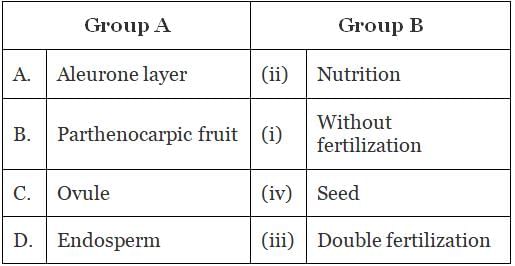
Q.10. Match the followings and choose the correct option.
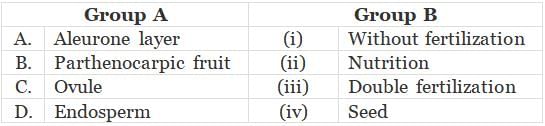
Options:
(a) A-i, B-ii, C-iii, D-iv
(b) A-ii, B-i, C-iv, D-iii
(c) A-iv, B-ii, C-i, D-iii
(d) A-ii, B-iv, C-i, D-iii
Ans. (b)
Solution.
VERY SHORT ANSWER TYPE QUESTIONS
Q.1. Roots obtain oxygen from air in the soil for respiration. In the absence or deficiency of O2, root growth is restricted or completely stopped. How do the plants growing in marshlands or swamps obtain their O2 required for root respiration?
Ans. In some plants such as Rhizophora and Sonneratia (mangrove plant) growing in swampy areas near river mouths (saline marshy soil or halophytes), many roots come out of the ground and grow vertically upwards (negatively geotropic: against gravitational force). Such roots, called pneumatophores or breathing roots or respiratory roots, help to get oxygen for respiration.
Q.2.Write floral formula for a flower which, is bisexual; actinomorphic; pentamerous sepal, petal, stamens free with ovary, syncarpous, superior, trilocular with axile placentation.
Ans. 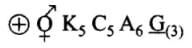
Q.3. In Opuntia the stem is modified into a flattened green structure to perform the function of leaves (i.e., photosynthesis). Cite two other examples of modifications of plant parts for the purpose of photosynthesis.
Ans. Some plants of arid regions modify their stems into flattened (Opuntia), or fleshy cylindrical (Euphorbia) structures. These modified stems of indefinite growth are called phylloclades. They contain chlorophyll and carry out photosynthesis.
Q.4. In swampy areas like the Sunderbans in West Bengal, plants bear special kind of roots called __________ .
Ans. Pneumatophores
Q.5. In aquatic plants like Pistia and Eichhornia, leaves and roots are found near _____________.
Ans. Node
Q.6. Reticulate and parallel venation are characteristic of ________ and ______ respectively.
Ans. Dicotyledons and monocotyledons
Q.7. In epigynous flower, ovary is situated below the _______.
Ans. Calyx, corolla and androecium.
Q.8. Add the missing floral organs of the given floral formula of Fabaceae.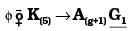
Ans.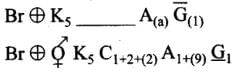
Q.9. Name the body part modified for food storage in the following
(a) Carrot __________________________
(b) Colocasia __________________________
(c) Sweet potato __________________________
(d) Asparagus __________________________
(e) Radish __________________________
(f) Potato __________________________
(g) Dahlia __________________________
(h) Turmeric __________________________
(i) Gladiolus __________________________
(j) Ginger __________________________
(k) Portulaca __________________________
Ans.
(a) Carrot - Tap root
(b) Colocasia - Stem'(corm)
(c) Sweet potalo - Root
(d) Asparagus - Root
(e) Radish - Root
(f) Potato - Stem
(g) Dahlia - Adventitious root
(h) Turmeric - Stem
(i) Gladiolus - Stem
(J) Ginger - Stem
(k) Portulaca - Adventitious root
SHORT ANSWER TYPE QUESTIONS
Q.1. Give two examples of roots that develop from different parts of the angiospermic plant other than the radicle.
Ans. The root that arise from parts of plant other than radicle are called adventitious roots.
Pneumatophores—for respiration Stilt roots—for support Prop roots—for support
Q.2. The essential functions of roots are anchorage and absorption of water and minerals in the terrestrial plant. What functions are associated with the roots of aquatic plants. How are roots of aquatic plants and terrestrial plants different?
Ans. The roots of aquatic plants help in balancing and anchorage. In terrestrial plants, functions of roots are anchorage and absorption of water and minerals.
Q.3. Draw diagrams of a typical monocot and dicot leaves to show their venation pattern.
Ans.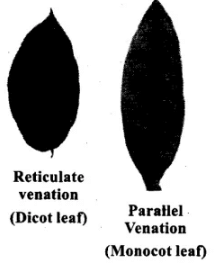
Q.4. A typical angiosperm flower consists of four floral parts. Give the names of the floral parts and their arrangements sequentially.
Ans. A typical flower has four different kinds of whorls arranged successively on the swollen end of the stalk or pedicel, called thalamus or receptacle. These are calyx, corolla, androecium and gynoecium. The calyx is the outermost whorl of the flower and the members are called sepals. Corolla is the second outermost whorl composed of petals. Androecium is the second innermost whorl composed of stamens. Gynoecium is the innermost whorl which is female reproductive part of the flower and is made up of one or more carpels.
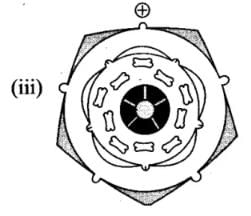
Q.5. Given below are floral formulae of some plants. Draw floral diagrams from these formulae.
Ans.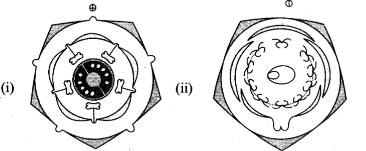
Q.6. Reticulate venation is found in dicot leaves while in monocot leaves venation is of parallel type. Mention one exception to this generalization .
Ans. Smilax and Dioscorea are monocots having reticulate venation. Calophyllum and Eryngium are dicots having parallel venation.
Q.7. You have heard about several insectivorous plants that feed on insects. Nepenthes or the pitcher plant is one such example, which usually grows in shallow water or in marsh lands. What part of the plant is modified into a ‘pitcher’? How does this modification help the plant for food even though it can photosynthesize like any other green plant?
Ans. In Nepenthes, picher is modified lamina. Insectivorous plants capable of growing in nitrogen or nitrate deficient soil. Pitcher help in providing the nitrogen to the plant. Leaves also photosynthesize their food.
Q.8. Mango and coconut are ‘drupe’ type of fruits. In mango fleshy mesocarp is edible. What is the edible part of coconut? What does milk of tender coconut represent?
Ans. Edible part of coconut is endosperm or seed. Milk of tender coconut represent free nuclear liquid endosperm.
Q.9. How can you differentiate between free central and axile placentation?
Ans. When the ovules are borne on central axis and septa are absent, as in Dianthus and Primrose the placentation is called free central.
When the placenta is axial and the ovules are attached to it in a multilocular ovary, the placentation is said to be axile, as in China rose, tomato and lemon.
Q.10. Tendrils are found in the following plants. Identify whether they are stem tendrils or leaf tendrils.
(a) Cucumber
(b) Peas
(c) Pumpkins
(d) Grapevine
(e) Watermelons
Ans.
(a) Cucumber—stem tendrils
(b) Peas - Leaf Tendrils
(c) Pumpkins—stem tendrils
(d) Grapevine – stem tendrils
(e) Watermelons—stem tendrils
Q.11. Why is maize grain usually called as a fruit and not a seed?
Ans. Maize is an example of caryopsis fruit which is a simple, one seeded dry, indehiscent fruit in which pericarp and testa are fused. Pericarp is also called fruit wall which is present in maize grain, hence maize grain is actually a fruit and not a seed.
Q.12. Tendrils of grapevines are homologous to the tendril of pumpkins but are analogous to that of pea. Justify the above statement.
Ans. Tendrils of grapevines are homologous to the tendril of pumpkins because both are the modification of stem (i.e., stem tendrils). Homologous structure have same origin.
Analogous structure have different origin but similar function. Tendrils of grapevines are analogous to that of pea because tendrils of grapevines are modification of stem while tendrils of pea are modification of leaves. Both have different origin but performing same function, i.e., support.
Q.13. Rhizome of ginger is like the roots of other plants that grows underground. Despite this fact ginger is a stem and not a root. Justify.
Ans. Rhizome is a underground stem growing parallel to soil surface. Ginger is a stem which can be differentiated from root as it has nodes and intemodes.
Q.14. Differentiate between.
(a) Bract and Bracteole
(b) Pulvinus and petiole
(c) Pedicel and peduncle
(d) Spike and spadix
(e) Stamen and staminoide
(f) Pollen and pollenium
Ans.
(a) Reduced leaf found at the base of the pedicel is called bract while leaf like structure present between bract and flower is called bracteole.
(b) In some leguminous plants the leaf base may become swollen is called pulvinus. The petiole (mesopodium) connect the leaf base with lamina and help hold the blade to light.
(c) Pedicie is the stalk of flower while peduncle is the stalk of inflorescence.
(d) In spike sessile flowers are attached on elongated peduncle.
Example: Achyranthes.
Spadix is a special type of spike having a fleshy peduncle and a large brightly coloured bract called spathe.
Example: Palm, Colocasia.
(e) Androecium is composed of stamens. Each stamen represents the male reproductive organ. A sterile stamen is called staminode.
(f) Male gametophyte of angiosperms is called pollen or microspore. A group of pollens forms the pollinium (present in Calotropis).
LONG ANSWER TYPE QUESTIONS
Q.1. Distinguish between families Fabaceae, Solanaceae, Liliaceae on the basis of gynoecium characteristics (with figures). Also write economic importance of any one of the above family.
Ans.
(a) Gynoecium
(i) Fabaceae— Monocarpellary, ovary unilocular, marginal placentation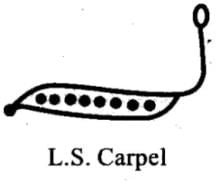 (ii) Solgnaceae—Bicarpellary,* syncarpous, carpels placed obliquely, bilocular, axile placentation
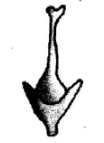 (iii) Liliaceae—Tricarpellary, syncarpous, ovary superior, axile placentation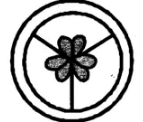
(b) Economic importance of fabacae:
(i) Source of pulses (gram, arhar)
(ii) Edible oil (soyabean, groundnut)
(iii) Dye (Indigofera)
(iv) Fibres (sunhemp)
(v) Fodder (Sesbania, Trifolium)
(vi) Ornamental {Lupin)
(vii) Medicine (mulaithi)
Q.2. Describe various stem modifications associated with food storage, climbing and protection.
Ans. The stem may not always be typically like what they are expected to be. They are modified to perform different functions. Underground stems of potato, ginger, turmeric, zaminkand, Colocasia are modified to store food in them. They also act as organs of perennation to tide over conditions unfavourable for growth. Stem tendrils which develop from axillary buds, are slender and spirally coiled and help plants to climb such as in gourds (cucumber, pumpkins, watermelon) and grapevines. Axillary buds of stems may also get modified into woody, straight and pointed thorns. Thoms are found in many plants such as Citrus, Bougainvillea. They protect plants from browsing animals. Some plants of arid regions modify their stems into flattened {Opuntia), or fleshy cylindrical {Euphorbia) structures. They contain chlorophyll and carry out photosynthesis.
Q.3. Stolon, offset and rhizome are different forms of stem modifications. How can these modified forms of stem be distinguished from each other?
Ans. Underground stems called stolon of some plants spread to new niches and when older parts die new plants are formed.
Of Fest: A lateral branch with short intemodes and each node bearing a rosette of leaves and a tuft of roots is found in aquatic plants like Pistia and Eichhornia.
Rhizome is underground stem growing parallel to soil surface. In ginger, turmeric, Gloriosa and lotus stem is called rhizome which is differentiated from roots in having scale leaves and axillary buds and helps in vegetative propagation.
Q.4. The mode of arrangements of sepals or petals in a floral bud is known as aestivation. Draw the various types of aestivation possible for a typical pentamerous flower.
Ans. The mode of arrangement of sepals or petals in floral bud with respect to the other members of the same whorl is known as aestivation. The main types of aestivation are valvate, twisted, imbricate and vexillary. When sepals or petals in a whorl just touch one another at the margin, without overlapping, as in Calotropis, it is said to be valvate. If one margin of the appendage overlaps that of the next one and so on as in china rose, lady’s finger and cotton, it is called twisted. If the margins of sepals or petals overlap one another but not in any particular direction as in Cassia and gulmohur, the aestivation is called imbricate. In pea, bean and Crotolaria flowers, there are five petals, the largest (standard) overlaps the two lateral petals (wings) which in turn overlap the two smallest anterior petals (keel); this type of aestivation is known as vexillary or papilionaceous (or descending imbricate).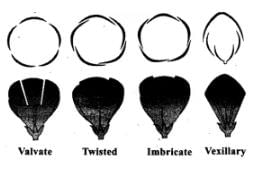
Q.5. The arrangements of ovules within the ovary is known as placentation. What does the term placenta refer to? Name and draw various types of placentations in the flower as seen in T.S. or V.S.
Ans. The ovules are female reproductive structures and borne in the ovary of the flower. The number, structure, their position in the ovary varies in different plants. They also differ in mode of attachment with the ovary wall. At the point of attachment there is a cellular ridge or cushion of cells called placenta. The mode of attachment of ovule to the placenta is known as placentation which is of the following types:
(a) Parietal
(b) Marginal
(c) Axile
(d) Free central
(e) Basal.
Q.6. Sunflower is not a flower. Explain.
Ans. Sunflower is actually an inflorescence (capitulum), it is not a flower.
Capitulum (Head): Here the peduncle is flattened which is called receptacle. Inflorescence is surrounded by whorl of bracts collectively called involucre. On receptacle two kinds of florets are present: .
(i) Ray florets: Zygomorphic, unisexual female, corolla ligulate or strap shaped.
(ii) Disc florets: Actinomorphc, bisexual, corolla tubular, present in centre. Ray florets present towards periphery and disc florets present in the centre,
Example: Compositae (Asteraceae) family—Sunflower (Helianthus), Tagetus (Marigold) and Dahlia.
Q.7. How do you distinguish between hypogeal germination and epigeal germination? What is the role of cotyledon (s) and the endosperm in the germination of seeds?
Ans.
(1) Hypogeal Germination: When the epicotyl grows first, only the plumule is pushed out of the soil. While cotyledons and all other parts remain under the soil, the germination is called hypogeal.
Example: Most of the monocots (Maize’ Rice and Coconut) and some of the dicots (Pea, Gram, Broad bean = Vicia faba, Mango).
(2) Epigeal Germination: When hypocotyl grows first, it pushes the cotyledons and other parts of the seed out of the soil. This germination is called epigeal.
Example: Helianthus (sunflower), mustard, cucurbits, castor, Onion, Tamarindus, French bean, Alisma.
Q.8. Seeds of some plants germinate immediately after shedding from the plants while in other plants they require a period of rest before germination. The later phenomena is called as dormancy. Give the reasons for seed dormancy and some methods to break it.
Ans. There are certain seeds which fall to germinate even when external conditions are favourable. Such seeds are understood to be undergoing a period of dormancy which is controlled not by external environment but are under endogenous control or conditions within the seeds itself.
Reasons for seed dormancy:
(i) Impermeable and hard seed coat; presence of chemical inhibitors such as abscisic acid (ABA), phenolic acid; para-ascrobic acid; and immature embryos are some of the reasons which causes seed dormancy.
Methods of breaking seed dormancy:
(ii) Seed dormancy allows the plants to overcome unfavourable climatic conditions. This dormancy however can be overcome through natural means and various other man-made measures. For example, the seed coat barrier in some seeds cane be broken by mechanical abrasions are caused by microbial action, and passage through digestive tract of animals. Weakening of hard seed coat with sharp edge or knives is called scarification. Prechilling treatment to break seed dormancy is called stratification. Effect of inhibitory substances can be removed by subjecting the seeds to chilling conditions or by application of certain chemical like gibberellic acid and nitrates. Seed domancy is also breaked by auxin and cytokinin. Changing the environment conditions, such as light and temperature and other methods to overcome seed dormancy.
|
150 videos|399 docs|136 tests
|
FAQs on NCERT Exemplar: Morphology of Flowering Plants - Biology Class 11 - NEET
| 1. What is the significance of studying the morphology of flowering plants? |  |
| 2. What are the different types of roots found in flowering plants? | |
| 3. How do stems of flowering plants differ in their structures and functions? | |
| 4. What are the different types of leaves found in flowering plants? | |
| 5. How do flowers contribute to the reproductive process in flowering plants? | |




NCERT Exemplar: Morphology of Flowering Plants | Biology Class 11 - NEET
,MCQs
,Sample Paper
,practice quizzes
,Objective type Questions
,Viva Questions
,past year papers
,Summary
,shortcuts and tricks
,video lectures
,Previous Year Questions with Solutions
,Free
,Extra Questions
,Exam
,mock tests for examination
,Important questions
,NCERT Exemplar: Morphology of Flowering Plants | Biology Class 11 - NEET
,ppt
,study material
,Semester Notes
,NCERT Exemplar: Morphology of Flowering Plants | Biology Class 11 - NEET
;



NCERT Exemplar: Morphology of Flowering Plants Free PDF Download
Importance of NCERT Exemplar: Morphology of Flowering Plants
NCERT Exemplar: Morphology of Flowering Plants Notes
NCERT Exemplar: Morphology of Flowering Plants NEET Questions
Study NCERT Exemplar: Morphology of Flowering Plants on the App
|
© EduRev
|
Education Revolution
|


|




within 7 days!