English Past Year Paper with Solutions - Delhi Set 1 (2020)

General Instructions
Read the following instructions very carefully and strictly following them.
(i) Question paper comprises three section - A, B and C.
(ii) Section A - Reading (20 marks)
Section B - Writing & Grammar(30 marks)
Section C - Literature (30 marks)
(iii) There are 11 questions in the question paper. All questions are compulsory.
(iv) Answer should be brief and to the point.
(v) There is no overall choice in the question paper. However, an internal choice has been provided in Section B and Section C. Make your choices correctly.
(vi) In addition to this, separate instructions are given with each section and question, wherever necessary.
(vii) Do not exceed the prescribed word limit while answering the questions.
Section - A
Read the following passage carefully.
Caged behind thick glass, the most famous dancer in the world can easily be missed in the National Museum, Delhi. The Dancing Girl of Mohenjo-daro is that rare artefact that even school children are familiar with. Our school textbooks also communicate the wealth of our 5000-year heritage of art. You have to be alert to her existence there, amid terracotta animals to rediscover this bronze image.
Most of us have seen her only in photographs or sketches, therefore the impact of actually holding her is magnified a million times over. One discovers that the dancing girl has no feet. She is small, a little over 10 cm tall-the length of a human palm-but she surprises us with the power of the great art-the ability to communicate across centuries.
A series of bangles-of shell or ivory or thin metal-clothe her left upper arm all the way down to her fingers. A necklace with three pendants bunched together and a few bangles above the elbow and wrist on the right hand display an almost modern art.
She speaks of the undaunted, ever hopeful human spirit. She reminds us that it is important to visit museums in our country to experience the impact that a work of art leaves on our senses, to find among all the riches one particular vision of beauty that speaks to us alone.
Q 1.
1.1 On the basis of your reading of the above passage answer the following questions.
(i) The Dancing Girl belongs to:
(a) Mohenjo-daro
(b) Greek culture
(c) Homo sapiens
(d) Tibet
Ans: (a)
Explanation: The passage names the artefact as the Dancing Girl of Mohenjo-daro and links it to that ancient civilisation, so option (a) is correct.
(ii) In the museum she's kept among:
(a) Dancing figures.
(b) Bronze statues.
(c) Terracotta animals.
(d) Books.
Ans: (c)
Explanation: The passage states that one has to look for her amid terracotta animals, so she is kept among terracotta animals in the museum.
(iii) Which information is not given in the passage?
(a) The girl is caged behind glass.
(b) She is a rare artefact.
(c) School books communicate the wealth of our heritage.
(d) She cannot be rediscovered as she's bronze.
Ans: (d)
Explanation: The passage mentions that she is caged behind glass, is a rare artefact and that schoolbooks communicate our heritage. It does not claim she cannot be rediscovered because she is bronze - in fact it says one can rediscover her amid terracotta animals.
(iv) 'Great Art' has power because:
(a) It appeals to us despite a passage of time.
(b) It is small and can be understood.
(c) It's seen in pictures and sketches.
(d) It's magnified a million times.
Ans: (a)
Explanation: The passage explains that great art can communicate across centuries and still appeal to us, which is why it has lasting power; hence option (a) is correct.
(v) The jewellery she wears:
(a) Consists of only bangles of shell or ivory or thin metal.
(b) Is a necklace with two pendants.
(c) Both (a) and (b) are correct.
(d) Neither (a) nor (b) is correct.
Ans: (d)
Explanation: The passage describes bangles of shell or ivory or thin metal and also a necklace with three pendants. Option (a) says only bangles and (b) says a necklace with two pendants; neither is accurate, so (d) is correct.
(vi) She reminds us:
(a) Of the never-say-die attitude of humans.
(b) Why museums in our country are exciting.
(c) Why she will make us come into money.
(d) Of dancing figures.
Ans: (b)
Explanation: While the passage does note the undaunted human spirit, it explicitly says she reminds us that it is important to visit museums in our country to experience the impact of a work of art. This links directly to option (b).
(vii) The synonym of the word "among" in para is 1 _____________
Ans: Amid
(viii) The size of the dancing girl is equal to the length of human palm. (True/ False)
Ans: True
Explanation: The passage states she is a little over 10 cm tall, which is described as the length of a human palm, so the statement is true.
Read the following passage carefully.
As the family finally sets off from home after many arguments there is a moment of lull as the car takes off. "Alright, so where are we going for dinner now?\" asks the one at the driving wheel. What follows is a chaos as multiple voices make as many suggestions.
By the time order is restored and a decision is arrived at, tempers have risen, feelings injured and there is at least one person grumbling.
Twenty years ago, you would step out of home, decision of meal and venue already made with no arguments or opposition and everybody looked forward to the meal with equal enthusiasm. The decision was made by the head of the family and the others fell in line. Today every member of the family has a say in every decision which also promotes a sense of togetherness and bonding.
We empower our kids to take their own decisions from a very early age. We ask them the cuisine they prefer, the movie they want to see, the holiday they wish to go on and the subjects they wish to study.
It's a closely connected world out there where children consult and guide each other. A parent's well-meaning advice can sound like nothing more than unnecessary preaching) How then do we reach our children through all the conflicting views and make the voice of reason be heard? Children today question choices and prefer to go with the flow.
What then is the best path to take? I would say the most important thing one can do is to listen. Listen to your children and their silences. Ensure that you keep some time aside for them, insist that they share their stories with you. Step into their world. It is not as complicated as it sounds; just a daily half an hour of the 'quality time' would do the trick.
Q 2.
2.1 On the basis of your reading of the above passage, answer the following questions in 30-40 words each.
(i) Write one advantage and one disadvantage of allowing every family member to be part of the decision making process.
Ans: An advantage is that involving every family member promotes a sense of togetherness and bonding because everyone feels included. A disadvantage is that it can lead to arguments and delays; by the time a decision is made tempers may rise and some people feel hurt.
(ii) In today's world, what are parents asking their kids?
Ans: Parents today ask their children about many choices - the cuisine they prefer, the movie they want to see, the holiday they wish to go on and the subjects they wish to study - so that children feel empowered to make decisions.
(iii) Which two pieces of advice does the writer give to the parents?
Ans: The writer advises parents to listen carefully to their children, including their silences, and to set aside regular quality time - even half an hour daily - so children will share their thoughts and parents can guide them calmly.
(iv) The passage supports the parents. How far do you agree with the author's views? Support your view with a reason.
Ans: I agree with the author because including children in decisions empowers them and strengthens family bonds. When parents listen and spend regular quality time with children, they can guide them without nagging and help them learn to make responsible choices.
2.2 On the basis of your reading of the above passage, answer the following:
(i) The synonym of 'hurt' as given in paragraph 2 is ________.
Ans: Injured
(ii) The word which means the same as 'a style or method of cooking in paragraph 4 is:
(a) Cuisine
(b) Gourmet
(c) Gastric
(d) Science
Ans. (a)
(iii) The antonym of 'agreeable' as given in paragraph 5 is _______.
Ans. Conflicting
(iv) The antonym of 'simple' as given in paragraph 6 is:
(a) Difficult
(b) Complicated
(c) Easy
(d) Tricky
Ans. (b)
Section - B
Q 3. You are Vaibhavi Sinha, examination incharge, Goodway Public School, Aurobindo Road, Indore. You require 4 reams of white paper, 2 packets of carbon paper, one dozen registers, blue and red ballpoint pens (50 each). Place an order with Sunrise Stationery Mart, 12 Mall Road, Indore mentioning terms of payment, discount asked by you and delivery date. (100-150 words)
OR
Water scarcity is becoming a serious problem because sources of water are getting depleted day by day. Considering the gravity of the situation, write an article in 100-150 words on the topic, "Need of the Hour: Rainwater Harvesting. "You are Ram/Rama.
Goodway Public School
Aurobindo Road, Indore
March 5, 20XX
Sunrise Stationery Mart
12 Mall Road, IndoreDear Sir,
Subject: Purchase of stationery
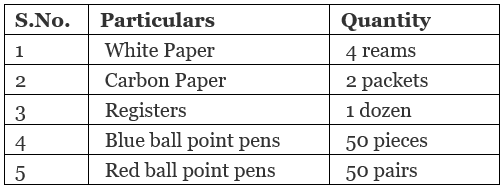
I wish to place a bulk order for stationery for the school for the academic session 2020-2021. The particulars and quantities required are shown in the enclosed list:
Please supply 4 reams of white paper, 2 packets of carbon paper, one dozen registers and 50 blue and 50 red ballpoint pens. As we are placing a regular large order, we request a discount of 5% on the total bill. Payment will be made by digital transfer within 15 days of receipt of the invoice. Kindly confirm the total cost, available discount, and the delivery date; we request delivery on or before March 20, 20XX. Please send the pro forma invoice and bank details for the payment.
Yours truly
Vaibhavi Sinha
(Examination Incharge)OR
Need of the Hour: Rainwater Harvesting
By RamaFresh water is becoming scarce as population, urbanisation and demand for crops grow. Though the earth is mostly water, only a small fraction is usable and easily available. Rainwater harvesting is a simple and effective method to recharge groundwater and store water for later use.
Households and communities can collect rainwater from roofs into tanks or recharge wells. This reduces pressure on rivers and borewells, helps gardens and farms, and lowers water bills. Awareness, small investments and local efforts can make rainwater harvesting a practical solution to the growing water crisis. Adopting it now is essential for a sustainable future.
Q 4. Ahmad went to watch Diwali Mela with his parents. He wanted to enjoy a ride in the merry-go-round. His father________________
OR
Write a story in 150-200 words with the help of the following outline. Give it a suitable title also.
a cricket match __________ boys playing in the street _________ Ram hit the ball ___________ a second floor window pane broken_______.
Riding in the Merry-go-round
Ahmad went to the Diwali mela with his parents and wanted to ride a merry-go-round. His father was hesitant because the swing looked frightening and the crowd seemed agitated, shouting and moving fast. Ahmad begged and his father, though nervous, agreed for his son's sake.
When their turn came, Ahmad's father felt the jitters as the operators fastened the seat belts. The ride began with a sharp jerk, and his father closed his eyes and prayed. Seeing Ahmad's delighted face, his fear eased and he soon began to enjoy the motion and music. By the time the ride stopped, both father and son were laughing, and they decided to go for another round together.
OR
Gully Cricket
On a hot summer evening the neighbourhood boys played gully cricket as usual. Ram, known for his powerful hits, came to bat and struck the ball hard. It flew up and smashed a second-floor windowpane of a nearby house. We all ran away fearing a scolding, but Ram stood still.
A few minutes later a young boy came down with the ball and handed it to Ram. He introduced himself as Shivam. Ram thanked him, and on talking they learned that Shivam had been born deaf and had difficulty in speaking. Ram invited Shivam to play with them and found in him a strong, cheerful teammate. From then on Shivam joined the games and often challenged Ram's long shots.
Q 5. Fill in any four of the following blanks given below choosing the most appropriate options from the ones that follow. Write the answers in your answer sheet against the correct blank numbers. Communication __(a)__ become very effective __(b)__ instant due to smartphones. People are able __(c)__ convey their messages all around the globe to __(d)__ loved ones __(e)__ spending hefty sums of money.
(a)
(i) is
(ii) has
(iii) have
(iv) had
Ans: (ii)
(b)
(i) but
(ii) as
(iii) or
(iv) and
Ans: (iv)
(c)
(i) for
(ii) in
(iii) to
(iv) of
Ans: (iii)
(d)
(i) his
(ii) her
(iii) their
(iv) your
Ans: (iii)
(e)
(i) with
(ii) without
(iii) and
(iv) to
Ans: (ii)
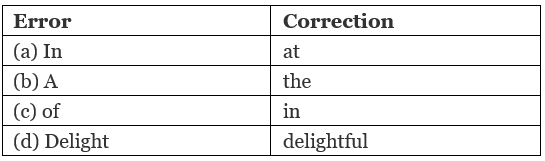
Q 6. The following paragraph has not been edited. There is an error in each line. Write the error along with its correction in the space provided.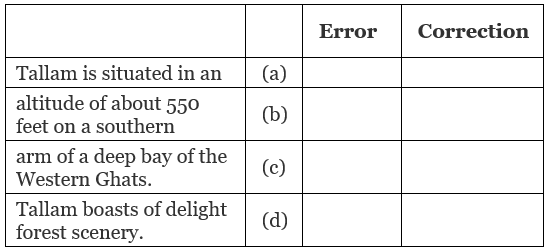
Q 7. Look at the words and phrases given below. Rearrange them to form meaningful sentences.
(i) easy/very/it/to open/it/was
Ans: It was very easy to open it.
(ii) to sleep/night/decided/every/they/ a hotel/in
Ans: They decided to sleep in a hotel every night.
(iii) quickly/very/the clothes/they/and food/packed.
Ans: They packed the food and clothes very quickly.
(iv) the/problems/bags/heavy/in carrying/had/they
Ans: They had problems in carrying the heavy bags.
Section - C
Q 8. And as the light came on, Fowler had his first authentic thrill of the day. For halfway across the room, a small automatic pistol in his hand stood a man.
Ausable blinked a few times.
(i) Who was standing in the room with a pistol in his hand?
(a) Ausable
(b) Fowler
(c) Max
(d) A waiter
Ans: (c)
Explanation: The extract describes a man standing halfway across the room holding a pistol; in the story the man is Max, so option (c) is correct.
(ii) Ausable blinked because he:
(a) Was getting adjusted to the light.
(b) Got afraid of the man with a pistol.
(c) Was thrilled to have reached his room.
(d) Started thinking of how to get rid of the man.
Ans: (d)
Explanation: In the context Ausable blinks and immediately begins to think and act quickly to handle the dangerous situation; he is planning how to get rid of the man with the pistol.
(iii) Fowler was thrilled because what he saw looked like a _______.
Ans: a real thriller scene
Explanation: Fowler's excitement comes from seeing a dramatic, suspenseful situation - a man with a pistol across the room - which resembles a scene from a thriller.
(iv) Which word in the extract means the same as 'genuine/real'?
Ans: Authentic
OR
Read the extract given below and answer the questions that follow:
I stand and look at them long and long.
They do not sweat and whine about their condition.
(i) The poet who has written these lines is _________.
(a) Robert Frost
(b) Carolyn Wells
(c) Walt Whitman
(d) Ogden Nash
Ans: (c)
Explanation: These lines are by Walt Whitman, so option (c) is correct.
(ii) Who are 'they' referred to here?
(a) Animals
(b) Tigers
(c) Ananda's friends
(d) Wanda's dresses
Ans: Animals
Explanation: The poet is referring to animals, admiring their quiet acceptance of their condition without complaint, so 'animals' is the correct reference.
(iii) The poet looks at them long and long because he ________.
Ans: admires their behaviour and wishes to remain with them
Explanation: The poet watches the animals for their calmness and dignity; he admires their behaviour and wants to be near them.
(iv) Which word in the extract means 'complain'?
Ans: Whine
Q 9. Answer any five of the following questions in 30-40 words each.
(i) "The sight of the food maddened him." What does this suggest? (His First Flight)
Ans: The young seagull was extremely hungry and desperate for food. Seeing its mother tearing a fish increased its hunger and eagerness so much that hunger overcame its fear of flying over the sea, forcing it to plunge and then fly.
(ii) Why does the poet not offer the boy money to buy another ball?
Ans: The poet does not offer money because another ball would not teach the boy the lesson he needs. The loss helped the boy learn responsibility and the poet believes replacing the ball would remove that important experience.
(iii) Why is Coorg called the land of rolling hills?
Ans: Coorg is called the land of rolling hills because it is a hill region with many gentle, sloping hills that seem to roll across the landscape, creating a continuous panorama of undulating terrain.
(iv) What made Hari Singh come back to Anil?
Ans: Hari Singh returned because he felt guilty about stealing from Anil. He regretted the loss of trust more than the money and wanted to restore Anil's faith, so he brought back the stolen money and confessed.
(v) Why was Matilda unhappy in her early married life?
Ans: Matilda was unhappy because she belonged to a modest family but had high expectations of luxury and splendour. Her ordinary life and lack of fine things made her feel that she had been born into the wrong social position.
(vi) Describe the curious episode which took place in a clergyman's study.
Ans: Early one morning the clergyman and his wife heard noises from the study and found the desk open and some housekeeping money missing. They searched everywhere but found nobody; the unexplained disappearance of the money made it an "extraordinary affair".
Q 10. Attempt the following question in 100 - 150 words.
What things does Mij do which tell you that he is an intelligent, friendly and fun-loving animal who needs love?
Ans: Mij shows intelligence by inventing games, such as playing with ping-pong balls and even turning on the tap to splash in the water. He forms a close attachment to Maxwell, responding to his name and clinging to his feet when frightened. Although initially aloof, Mij becomes friendly and playful, enjoying toys like marbles and rubber fruit. His behaviour - seeking company, playing inventively and showing affection - makes it clear that he is fun-loving and needs attention and love, which Maxwell readily gives.
OR
What do you think about Anne's talent for writing essays which she wrote convincingly when punished by the teacher?
Ans: Anne showed remarkable talent and wit in writing persuasive and amusing essays when punished. Her essays convinced and amused Mr Keesing, turning his anger into laughter. By using humour and clever argument she won her teacher over, and eventually her punishment was withdrawn. The episode shows Anne's strong writing ability and her skill in persuasion, as well as her imaginative and humorous approach to problems.
Q 11. Attempt the following question in 100 - 150 words.
Give a brief character sketch of Ebright's mother.
Ans: Ebright's mother was gentle, independent and determined. She supported and encouraged Richard's interests from a young age, buying him books such as The Travels of Monarch X and providing equipment like a telescope and microscope. She introduced him to friends and activities that stimulated his curiosity, and she treated him with affection and respect. Her consistent encouragement and practical support played a key role in developing his scientific interests and helped him reach his potential.
OR
How did the people on the earth help the Martian people? How did this effort help the people on both the planets?
Ans: The people on earth taught the Martians how to read, explained everyday differences such as between a sandwich and a book, and helped them set up a model library. This shared learning built mutual understanding and friendship, removed fears of invasion, and allowed both planets to coexist peacefully and benefit from contact, leading to cultural exchange and goodwill.
FAQs on English Past Year Paper with Solutions - Delhi Set 1 (2020)
| 1. What is the importance of solving past year papers for the Class 10 English exam? |  |
| 2. How can I effectively use the solutions provided with the past year papers? | |
| 3. Are the past year papers for the Delhi Set 1 English exam available online? | |
| 4. Can solving past year papers guarantee a high score in the Class 10 English exam? | |
| 5. How can I manage my time effectively during the Class 10 English exam? | |





