Important Concepts: Number System

Introduction
What is a System?
A system is a set of principles or procedures that define how something is done.
What is a Number System?
A number system is a set of principles that explains how numbers are represented and how arithmetic operations such as addition, subtraction, multiplication, and division are carried out. It provides the basic rules for using digits and symbols to work with numbers.
Types of Number Systems
Whenever we change the rules or principles, we create a different number system. That is why there are many types of number systems. Some commonly used number systems include:
- Decimal Number System (Base 10)
- Binary Number System (Base 2)
- Octal Number System (Base 8)
- Hexadecimal Number System (Base 16)
Some examples of number systems are: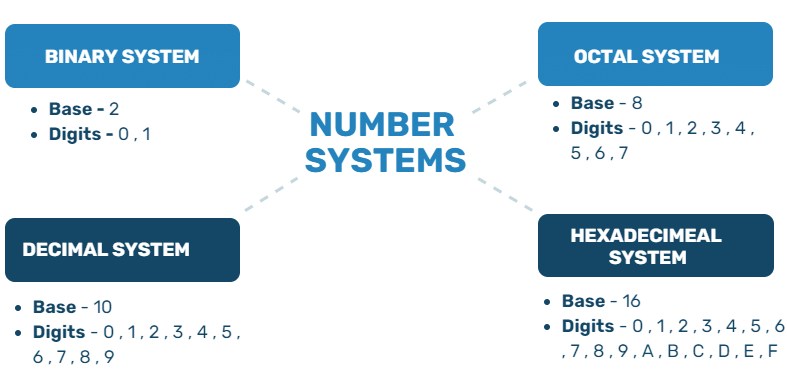
Key Concepts
- Base: The base of a number system is the number of unique digits it uses to represent numbers.
- Digits: Digits are the basic symbols (tools) used to form numbers.
We will be talking about various number systems and their bases in subsequent chapters.
Decimal Number System (Standard System)
The decimal system is the standard number system used across the world.
- It has base 10, because it uses 10 digits (0, 1, 2, 3, 4, 5, 6, 7, 8, 9).
- With these digits, we can represent any number, no matter how large.
Face Value and Place Value
- Face Value: The Value of the digit itself is referred to as the Face Value of a particular digit. In the decimal number system, we use the 10 digits, as mentioned above. Wherever used, the face value remains the same.
Example: The face value of 5 is 5 in 568 and 1285, and even 58738. - Place: The Place Value of a number depends on the place it is at. The various places and the corresponding multipliers of the places in a decimal number system are listed below. We will be starting from the leftmost side and moving to the right place by place.
Example: For a number 786543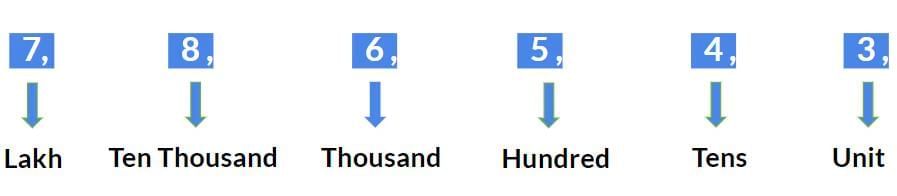
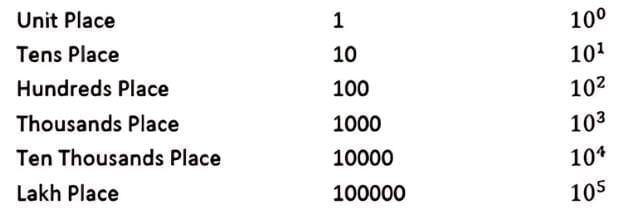
- Place Value of a digit in a particular number system is defined as the face value of the number multiplied by the corresponding place. In the decimal system, the value of the place will be as mentioned in the table above.
Example: The place value of 5 is 500 in 568, and 5 is 50000 in 58738.MULTIPLE CHOICE QUESTIONTry yourself: What is the difference in the two Place Values and Two Face Values of digit 7 in the given number - 78687
In this chapter, we will discuss numbers, their properties, and classifications. All properties will be explained using the decimal number system, as it forms the basis of most exam questions. These concepts are your first step toward mastering the mathematics needed for entrance exams. As you go through, you'll realise that many of these ideas are ones you've already learned in school.
Types of Numbers
1. Natural Number
The primary application of mathematics is counting. That is where the very first category of numbers comes in, i.e. natural numbers or commonly known as Counting Numbers.
Features of Natural Numbers
- These are the complete numbers; i.e. fractions/decimals are not included.
- Zero is not included.
- Negatives are not included.
- They are represented by "N."
- N = {1, 2, 3, 4, 5.........infinity}
Try yourself: Choose the set of Numbers which contains only Natural Numbers
2. Whole Numbers
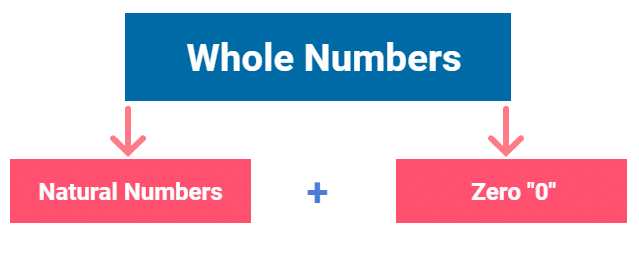
Natural numbers, along with 0, form a set of numbers known as Whole numbers. Since '0' is a representation of the absence of anything and is not used for counting, they are not called the Counting Numbers.
Features of Whole Numbers
- These are the complete numbers, i.e. fractions/decimals, are not included.
- Zero is included.
- Negatives are not included.
- They are represented by "W".
- W = {0, 1, 2, 3, 4, 5.........infinity}.
Try yourself: Choose the set of Numbers which contains only Whole Numbers
3. Integers
Numbers less than 'zero' are represented with a negative sign along with them and are referred to as Negative Numbers.
Whole numbers, along with negative of natural numbers form a set of numbers known as Integers.
Features of Integers
- These are the complete numbers, i.e. fractions/decimals, are not included.
- Zero is included.
- Negatives are included.
- They are represented by "I".
- I = {- infinity.......-3, -2, -1, 0, 1, 2, 3 ......... infinity}.
Try yourself: Choose the set of Numbers which contains only Integers
4. Fractions
The word 'fraction' has been derived from the Latin word 'fractus' which means "broken". Fraction represent part of a whole. When we divide a whole into pieces, each part is a fraction of the whole.
Example: 1/2, 3/5, 2/7, 10/21
A fraction has two parts. The number on the top of the line is called the Numerator. The number below the line is called the Denominator.
Types of Fractions
Fractions are generally of two types based on representation:
(i) Simple Fraction
Example: 30/7
(ii) Mixed Fraction
Example: 
Try yourself: Convert the mixed fraction  into a simple fraction.
Try yourself: Convert the simple fraction 112/19 into a mixed fraction. None of these


5. Decimal Numbers
These are nothing but a form of representation of fractions. We make the value of the denominator as unity, i.e. "1". They can be both negative and positive.
Example: 2.5, 1.25, 1.3333 ......., 2.666....., 2.8284.....
Types of Decimal Numbers
Decimal numbers are majorly divided into two categories:
- Terminating Decimal Numbers: The decimal numbers with a definite end. Example: 2.5, 1.25
- Non-Terminating Decimal Numbers: The decimal numbers without a definite end. Example: 1.3333 ......., 2.666....., 2.8284.....
Non-Terminating Decimal Numbers are further divided into two categories:
(i) Recurring non-terminating decimal numbers: The non-terminating decimal numbers with digits after the decimal repeating again and again.
(ii) Non-recurring non-terminating decimal numbers: The non-terminating decimal numbers with digits after the decimal do not repeat but have a completely random pattern. These are the irrational numbers, which we will discuss ahead in the same chapter.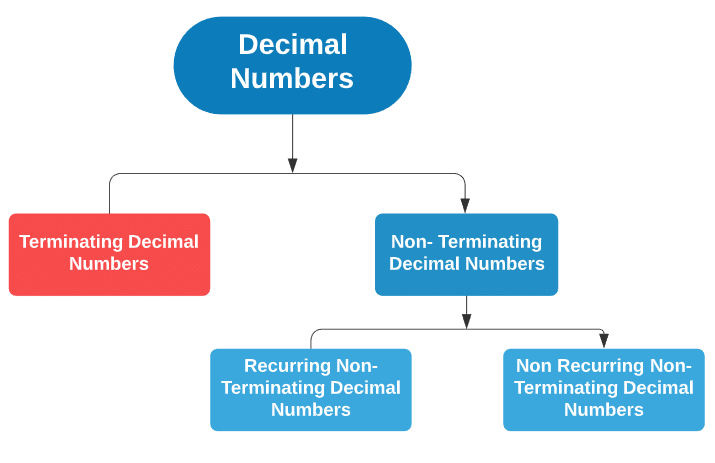 Classification of Decimal Numbers
6. Rational Numbers
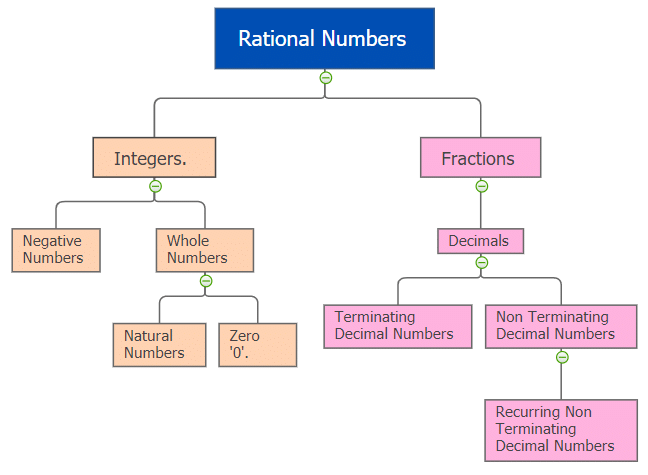
All those numbers that can be represented in the form of p/q where p and q are integers with q ≠ 0 are known as Rational Numbers. All the integers, fractions, terminating decimal numbers and non-terminating recurring decimal numbers fall under the category of Rational Numbers.
7. Irrational Numbers
All those numbers that are not rational are known as Irrational Numbers. Non-reciprocating, non-terminating decimal numbers are irrational numbers. The Square Roots, Cube Roots, etc., of natural numbers turn out to be irrational numbers.
Example: √3 = 1.7320.... , √8 = 2.8284 ......, 3√4 = 1.5874 .......
Converting a Terminating Decimal Number in p/q form:
Example: Convert 80.125 in p/q form
- Count how many digits are thereafter decimal, 3 in this case.
- Remove the decimal and divide the number so received by as many 10's as the counting in step 1.
⇒ 80.125 = 80125/1000 = 641/8
Try yourself: Convert 128.8888 in p/q form
Converting a non-terminating recurring decimal number in p/q form:
 =
=  [Just dividing the numerator and denominator by same factor ]
Example: Convert 80. in p/q form.
- Let the number be equal to x
⇒ x = 80.- Count how many digits are thereafter decimal, 3 in this case.
- Multiply by as many tens on both sides, i.e. 1000, in this case.
⇒ 1000x = 80125.
- Subtract
from
⇒ 999x = 80045
⇒ x = 80045 / 999


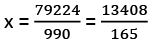
Example: Convert 80. 1 in p/q form.
- Let 80.1
= x
- Multiply both sides by 100
⇒- Subtract
from
⇒ 99x = 7922.4



Try yourself: Convert 16.  in p/q form
 = x
= x 


 from
from 
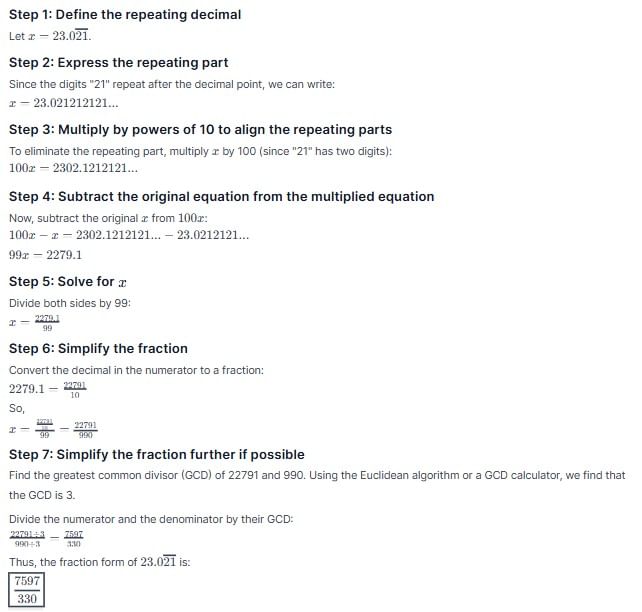
Try yourself: Convert 23.0  in p/q form
The process we have applied in the examples above is too time-consuming. We need a method that can do the same process in much less time. For that, we have a formula with which you can have the answer in a single step.
Every terminating recurring decimal number has 3 parts:
(Taking the example of:
(i) Digits before the decimal (80).
(ii) No. of digits with the bar on them after the decimal (2).
(iii) No. of digits without a bar on them after the decimal (1).
Rational form: All the digits without decimal written once - All the digits without bar written once / as many 9's as no. of digits with bar on them after decimal followed by as many 0's no. of digits without bar on them after decimal.
Example: Convert 80. in p/q form
- All the digits are written once = 80125
- All the digits without bar written once = 80
- No. of digits with bar after decimal = 3
- No. of digits without bar after decimal = 0
- Rational form = (80125 - 80) / 999 = 80045 / 999
Example: Convert 80.1 in p/q form
- All the digits are written once = 80125
- All the digits without Bar written once = 801
- No. of digits with bar after decimal = 2
- No. of digits without bar after decimal = 1
- Rational form = (80125 - 801) / 990 = 79324 / 990
Try yourself: Convert 16.  in p/q from
8. Real Numbers
- Rational numbers, as well as Irrational Numbers, together form the Real Numbers. As per the definition, all the numbers that can be represented on a number line are known as Real Numbers.
- All the categories that we have discussed till now fall in the set of Real numbers, including the irrational numbers. They can also be represented on a number line.
Try yourself: Choose the set of Numbers which doesn't contains only Real Numbers
9. Imaginary Numbers
- All those numbers that actually do not exist in a number system but assume their presence for the sake of calculations are known as Imaginary Numbers.
- They cannot be represented on number lines. They are also called Complex Numbers.
Example: √-3, √-16, 4√-8
Note: The study of complex numbers is not important from Aptitude Testing point of view. So, we will not take this topic any further.
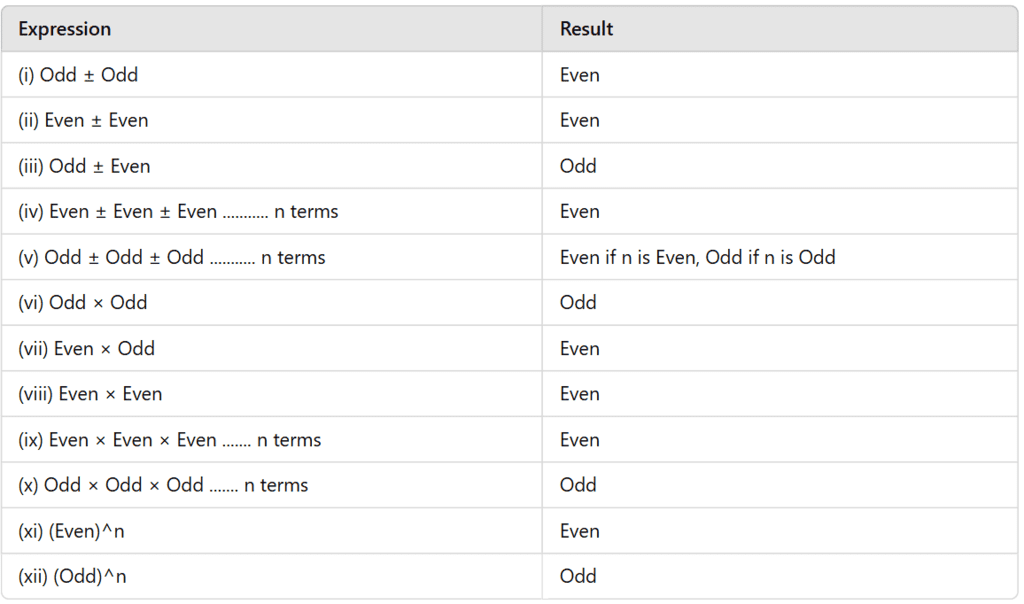
10. Odd and Even Numbers
- Even Numbers are those that are divisible by 2. They are the numbers with their unit digit as either 2, 4, 6, 8 or 0. The general expression of even numbers is 2n, where n is a whole number.
- Odd Numbers are those that are not divisible by 2. They are the numbers with their unit digit as either 1, 3, 5, 7 or 9. The general expression of odd numbers is 2n+1 , where n is a whole number.
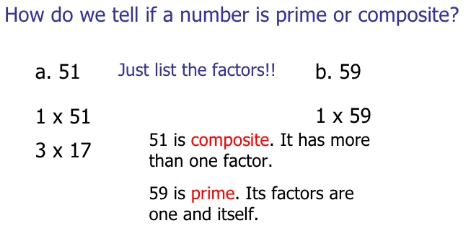
11. Prime and Composite Numbers
(a) Prime Numbers: Being Prime is a property of Natural Numbers. All those numbers which are divisible by exactly 2 numbers, i.e. itself and unity "1".
Example: 2, 3, 5, 7, 11 etc.
(b) Composites are the numbers which are divisible by more than 2 numbers, i.e. itself, unity "1" and at least one other.
Example: 4, 6, 8, 9, 10, etc.
1 is neither Prime nor Composite.
➢ Property of Prime Numbers
- All Prime numbers greater than 3 are of the form 6n ± 1, but not all numbers of the form 6n ± 1 are Prime. This property means that when prime numbers greater than 3 are divided by 6 they leave a remainder of 1 or 5.
12. Co - Prime Numbers
- This is a property of a pair or more than two natural numbers.
- Two numbers are said to be co-prime if the only number that can completely divide both the numbers is 1. No number other than 1 can divide both the given numbers of the pair.
- These numbers in themselves can be prime or composite. 1 is co-prime with all the natural numbers other than 1.
Example: (3, 7); (4, 15); (3, 10) etc. - A set of numbers is said to be co-prime if their HCF is 1. We will be learning about HCF in the following chapters.
Example: (3, 7, 11); (4, 15, 10); (3, 10, 8) etc.
Operations on Whole Numbers:
FAQs on Important Concepts: Number System
| 1. What are natural numbers, whole numbers, and integers-and how do I tell them apart? |  |
| 2. Why do some numbers get classified as rational and others as irrational? | |
| 3. How do I quickly identify if a number is prime or composite in competitive exams? | |
| 4. What's the quickest way to find HCF and LCM without long division methods? | |
| 5. Can a number be both even and odd, and what's the trick for solving even-odd problems? | |