CAT Previous Year Questions - Coordinate Geometry


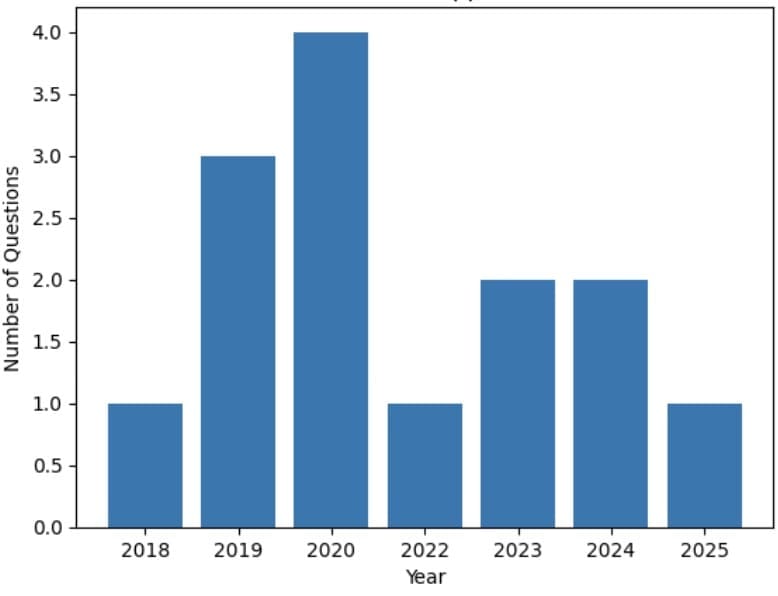
From 2018 to 2025, 14 Coordinate Geometry-based questions appeared in CAT Quant, usually 1-3 questions per year. Topics included area of regions, locus of points, equations of circles and lines, parallelograms, triangles, and combinatorial path counting on coordinate grids. Most questions were moderate in difficulty, requiring strong visualization, graph interpretation, and algebraic manipulation of geometric equations.
2025
Q1: The (x, y) coordinates of vertices P, Q and R of a parallelogram PQRS are (-3, -2), (1, -5) and (9, 1), respectively. If the diagonal SQ intersects the x-axis at (a, 0) , then the value of a is
(a) 27/7
(b) 10/3
(c) 13/4
(d) 29/9
Ans: d
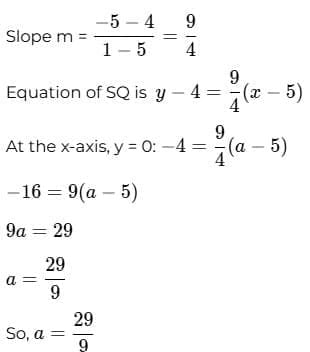
Sol: Given (P(-3,-2)), (Q(1,-5)), and (R(9,1)).
For parallelogram (PQRS), S = P + R - Q = (-3,-2) + (9,1) - (1,-5) = (5,4)
Diagonal SQ passes through S(5,4) and Q(1,-5).
2024
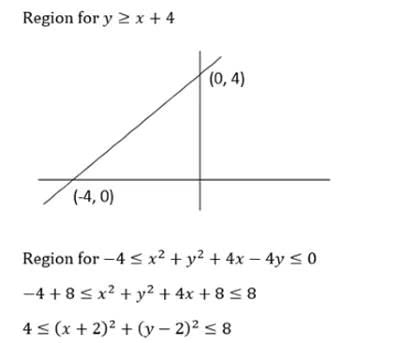
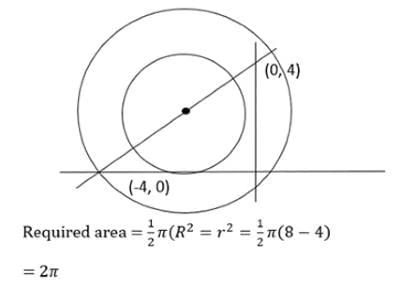
Q1: In the XY-plane, the area, in sq. units, of the region defined by the inequalities y ≥ x + 4 and -4 ≤ x2 + y2 + 4(x - y) ≤ 0 is
(a) 2π
(b) π
(c) 4π
(d) 3π
Ans: a
Sol:
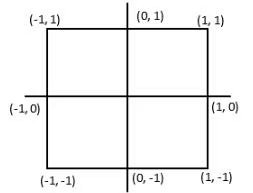
Q2: The number of distinct integer solutions (x, y) of the equation |x + y| + |x - y| = 2, is
Ans: 8
Sol: We have,
|x + y| + |x - y| = 2
Let's analyze the situation better with graphs
Now, we can see that these are the only 8 integral points where the above equation holds.
Hence, the required answer is 8.
2023
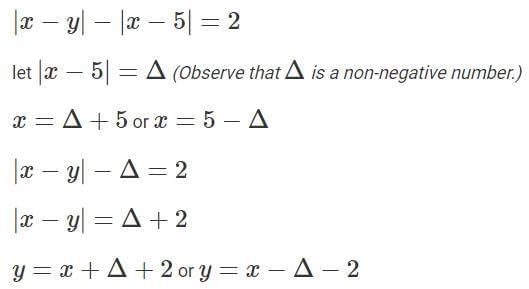
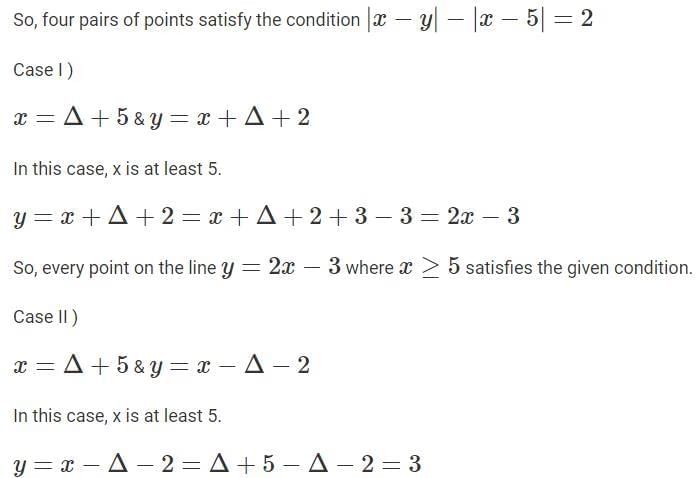
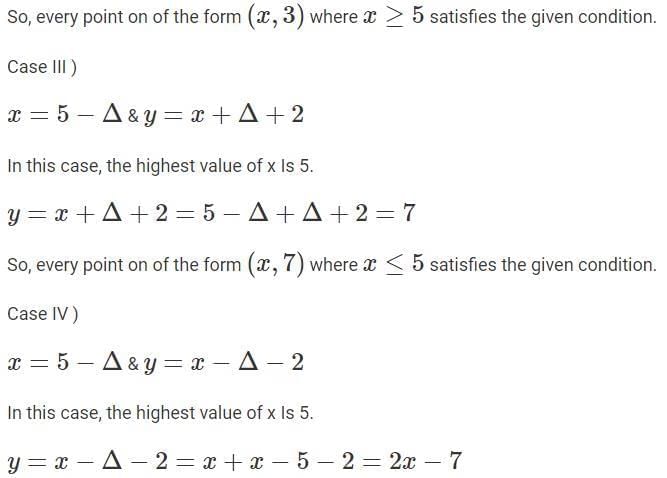
Q1: The area of the quadrilateral bounded by the Y-axis, the line x = 5, and the lines |x - y| - |x - 5| = 2, is [2023]
Ans: 45
Sol:
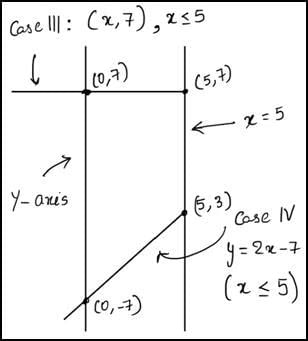
So, every point on the line y = 2x - 7 where x ≤ 5 satisfies the given condition.
We are to find the area enclosed by the y-axis, x = 5 and the lines of |x-y|-|x-5|=2 .
Because the area we are interested is bounded by x = 0 (y-axis) and x = 5, 0 ≤ x ≤ 5.
So, we'll only be concerned about Case III and Case IV.
A rough sketch of the bounded region looks like...
The line y = 2x - 7 touches x = 0 and x = 5 at (0, -7) and (5, 3) respectively.

Q2: Let C be the circle x2 + y2 + 4x - 6y - 3 = 0 and L be the locus of the point of intersection of a 2 pair of tangents to C with the angle between the two tangents equal to 60°. Then, the point at which I touches the line x = 6 is
(a) (6,4)
(b) (6,8)
(c) (6,3)
(d) (6,6)
Ans: c
Sol:
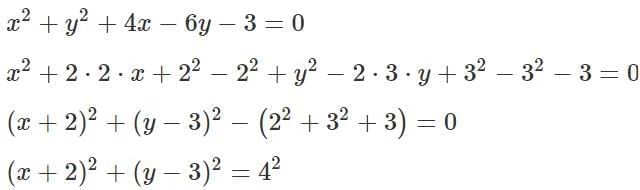
This is the equation of a circle with radius 4 units and centered at (-2, 3)
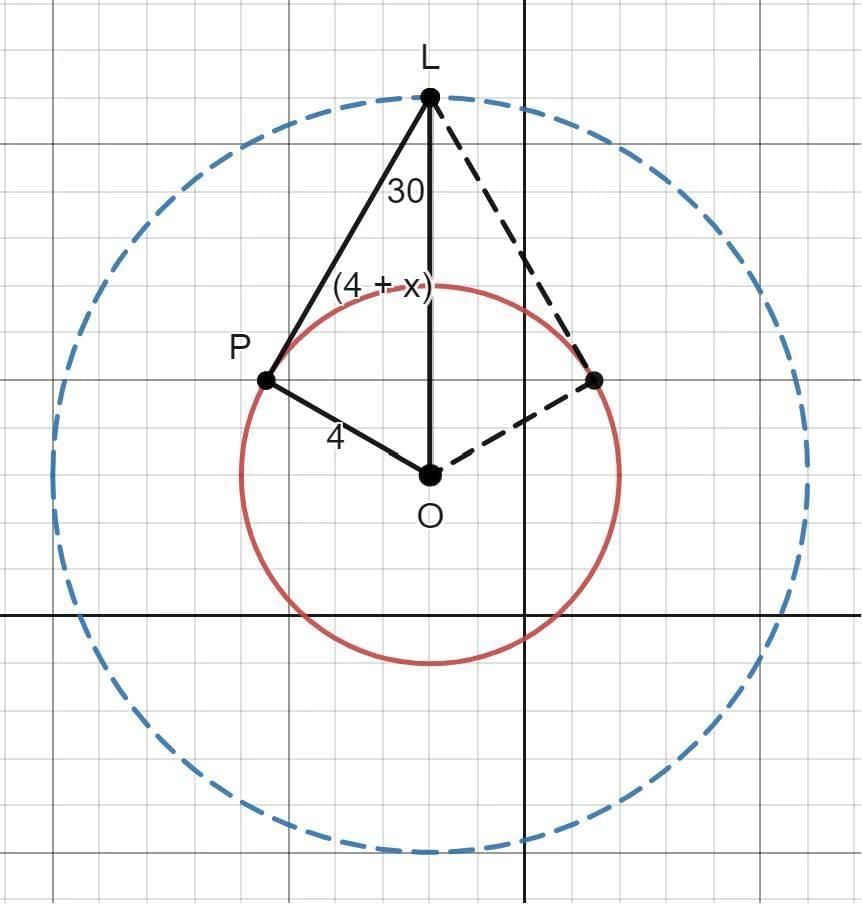
From a point L we drop two tangents on the circle such that the angle between the tangents is 60o.∠LPO = 90∘
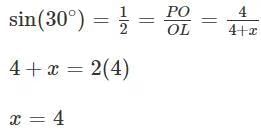
∠PLO=30∘Therefore the locus of the point L, is a circle centered at (-2, 3) and has a radius of (4 + x = 8) units.
The equation of this locus is thus, (x + 2)2 +(y - 3)2 = 82
When x = 6, we have, (8)2 +(y - 3)2 = 82 , that is y = 3
The circle , (x + 2)2 +(y - 3)2 = 82, touches the line x = 6 at (6, 3).
2022
Q1: Let ABCD be a parallelogram such that the coordinates of its three vertices A, B, C are (1, 1), (3, 4) and (-2, 8), respectively. Then, the coordinates of the vertex D are
(a) (-3, 4)
(b) (0, 11)
(c) (4, 5)
(d) (-4, 5)
Ans: d
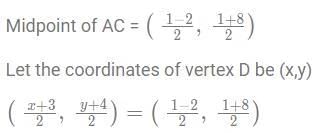
Sol: In a parallelogram, two diagonals of parallelogram bisects each other, which concludes that mid-point of both diagonals are the same.
x = -4 and y = 5
The answer is option D.
2020
Q1: The area of the region satisfying the inequalities |x| - y ≤ 1, y ≥ 0 and y ≤ 1 is
Ans: 3
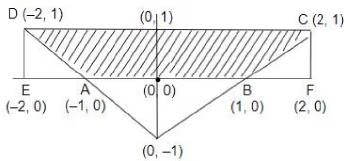
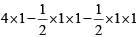
Sol:The graph of | x | - y ≤ 1, y ≥ 0 and y ≤ 1 is as follows:Area of ABCD = Area of EFCD - Area of EAD - Area of BFC
=
=
= 4 - 1 = 3 Square units.

Q2: The area, in sq. units, enclosed by the lines x = 2, y = |x - 2| + 4, the X-axis and the Y-axis is equal to [2020]
A: 8
B: 12
C: 10
D: 6
Ans: C
Sol:
The line y = |x - 2| + 4 intersects the y-axis at (0,6) and intersects x = 2 at (2, 4)
The other vertices are (0,0) and (2,0)
The figure formed is a trapezium of parallel sides 6 and 4 and the distance between the parallel sides is 2.
Required answer = (1/2) x 2 x (6 + 4) = 10
Q3: The vertices of a triangle are (0,0), (4,0) and (3,9). The area of the circle passing through these three points is [2020]
A: 14π/3
B: 12π/5
C: 123π/7
D: 205π/9
Ans: D
Sol:
Area of the triangle = 1/2 x 4 x 9 = 18
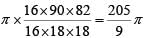
The circumradius of the triangle
Area of the circle
=
=



Q4: The points (2,1) and (-3,-4) are opposite vertices of a parallelogram. If the other two vertices lie on the line x + 9y + c = 0, then c is [2020]
A: 12
B: 14
C: 13
D: 15
Ans: B
Sol:
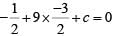
The given line also passes through the point of intersection of the diagonals of the parallelogram, which is the mid-point of (2,1) and (-3,-4). The mid-point of the given two points is (-1/2, -3/2).
Substituting the point in the given equation:
⇒ c = 14
2019
Q1: With rectangular axes of coordinates, the number of paths from (1,1) to (8,10) via (4,6), where each step from any point (x,y) is either to (x,y+1) or to (x+1,y) is [TITA 2019]
Ans: 3920
Sol:
Let us first consider travelling from (1,1) to (4, 6)
This means, Travelling from 1 to 4 units in the x axis → 3 horizontal movements (h h h)
And travelling from 1 to 6 units in the y axis -> 5 vertical movements (v v v v v)
No matter how we proceed, reaching from (1,1) to (4,6) requires 5 vertical movements and 3 horizontal movements.
So, Number of paths to travel from (1,1) to (4,6) = Number of ways of arranging (h h h v v v v v)
Number of ways of arranging (h h h v v v v v) =
Similarly, travelling from (4, 6) to (8, 10) requires 4 horizontal movements and 4 vertical movements
Number of ways of arranging (h h h h v v v v) =
Total number of paths =x
=
x
= 3920


Q2: Let T be the triangle formed by the straight line 3x + 5y - 45 = 0 and the coordinate axes. Let the circumcircle of T have radius of length L, measured in the same unit as the coordinate axes. Then, the integer closest to L is [TITA 2019]
Ans: 9
Sol:
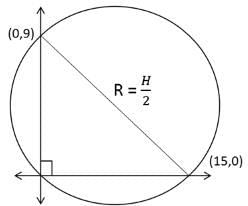
We know that the equation of the straight line is 3x + 5y = 45
The intercepts are (15,0) and (0,9) respectively
Since it's a right-angled triangle, we know that Circumradius (R) =
Circumradius ==
We know that √34 is approximately equal to 6
So, from trial and error to find the closest number, we find that the value of Circumradius is very close to 9
So, the integer closest to L = 9


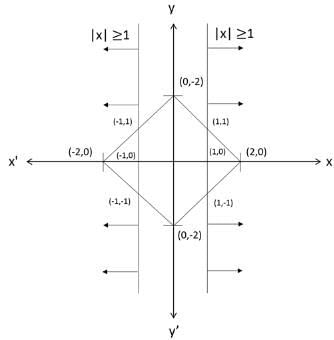
Q3: Let S be the set of all points (x,y) in the x-y plane such that |x| + |y| ≤ 2 and |x| ≥ 1. Then, the area, in square units, of the region represented by S equals [TITA 2019]
Ans: 2
Sol:
Construct the given data on a rough graph.
Required area = Sum of area of two smaller triangles [ (-2,0) (-1,1) (-1,-1) and (2,0) (1,-1) (1,1) ]
Required area = 2 x (1/2) x base x height
Required area = 1 x 2 = 2 Sq units
2018
Q1: A triangle ABC has area 32 sq units and its side BC, of length 8 units, lies on the line x = 4. Then the shortest possible distance between A and the point (0,0) is [2018]
A: 4√2 units
B: 2√2 units
C: 4 units
D: 8 units
Ans: C
Sol:
Given Area (△ABC) = 32 sq units and one of the length BC = 8 units on the line x = 4
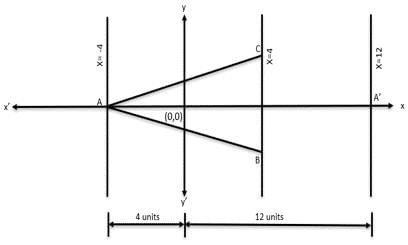
Let us draw a graph and plot the given values.
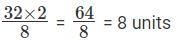
We know that area of the Triangle = 1/2 × base × height considering BC as the base, area of the Triangle = 1/2 × 8 × height = 32
Height =
Since the base lies on x = 4 and has a vertical height is of length = 8 units, A can either lie on the line x = 12 or on x = - 4
However, since we need to find the shortest possible distance between A and the origin, A should lie on the line x = - 4
So, shortest possible distance to A from the point (0,0) = 4 units
FAQs on CAT Previous Year Questions - Coordinate Geometry
| 1. What are the basic concepts of coordinate geometry? |  |
| 2. How can we find the distance between two points using coordinate geometry? | |
| 3. What is the equation of a straight line in coordinate geometry? | |
| 4. How do we determine if two lines are parallel using coordinate geometry? | |
| 5. Can coordinate geometry be used to find the midpoint of a line segment? | |