Laxmikanth Summary: Chief Minister

The governor is the head of the state while the Chief Minister is the head of the government.
In the parliamentary system of government outlined in the Constitution, the Chief Minister holds the de facto executive authority at the state level, akin to the Prime Minister at the national level. The Governor, the de jure executive, appoints the Chief Minister, usually the leader of the majority party in the state legislative assembly.
Appointment of Chief Minister
- The Constitution does not contain any specific procedure for the selection and appointment of the Chief Minister. Article 164 only says that the Chief Minister shall be appointed by the governor, the governor has to appoint the leader of the majority party in the state legislative assembly as the Chief Minister.
- But, when no party has a clear majority in the assembly, then the governor may exercise his personal discretion in the selection and appointment of the Chief Minister.
1. Sarkaria Commission
- The Sarkaria Commission on Centre-State Relations (1983-88) provided key recommendations for the selection and appointment of a Chief Minister.
(a) Consider the party or coalition with the broadest support.
(b) If no clear majority, follow a preference order for party or coalition selection.
2. Appointment Criteria
- If a single party has an absolute majority, its leader automatically becomes Chief Minister.
- In the absence of a majority:
- Prefer alliance formed before elections.
- Largest single party with support.
- Post-electoral coalition with all partners in government.
- Post-electoral alliance with some forming the government and others supporting externally.
3. Vote of Confidence
- Chief Minister, unless leading a majority party, seeks a vote of confidence within 30 days.
4. Resolution of Rival Claims
- Governor doesn't independently decide rival claims; they are tested on the Legislative Assembly floor.
Oath, Term, and Salary
- The Chief Minister takes an oath pledging allegiance to the Constitution and upholds sovereignty.
- Term is at the pleasure of the Governor, contingent on legislative support.
- Salary and allowances are determined by the state legislature.
Powers and Functions of Chief Minister
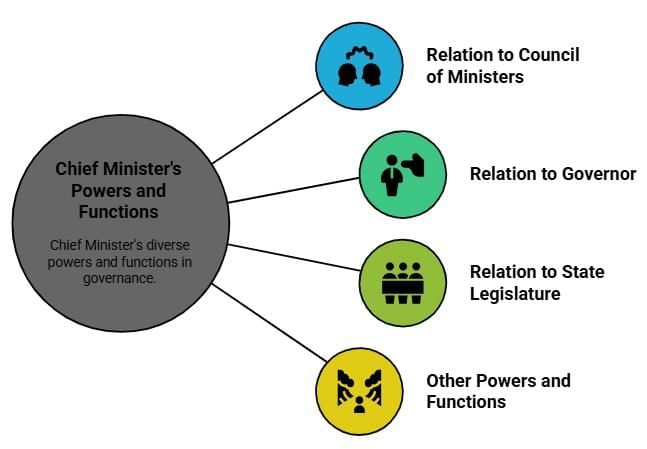
1. In Relation to the Council of Ministers
- Recommends ministers to the Governor.
- Allocates and reshuffles portfolios.
- Can ask a minister to resign.
- Presides over council meetings and guides decisions.
- Can cause the collapse of the council by resigning.
2. In Relation to the Governor
- Acts as the principal link between the Governor and the council.
- Advises on important official appointments.
3. In Relation to the State Legislature
- Advises on summoning and dissolution of legislative sessions.
- Announces government policies in the legislature.
4. Other Powers and Functions
- Chairman of State Planning Board.
- Vice-chairman of relevant zonal council.
- Member of Inter-State Council and NITI Aayog.
- Chief spokesman, crisis manager during emergencies.
- MULTIPLE CHOICE QUESTIONTry yourself: What is the role of the Chief Minister in relation to the state legislature?
Relationship with Governor (Constitutional Provisions)
Chief Minister heads the council of ministers. and the council of ministers is collectively responsible to the legislative assembly.
Articles 163, 164, and 167 define the collaborative relationship between the governor and the Chief Minister.
(a) Article 163: Council of Ministers' Role in Advising the Governor
- There shall be a council of ministers with the Chief Minister as the head to aid and advise the governor.
- The Chief Minister is the chairperson of this council.
- The council aids the governor in the exercise of their functions, except those exercised at their discretion.
(b) Article 164: Appointment and Tenure of Chief Minister and Ministers
- Appointment of Chief Minister:
- The governor appoints the Chief Minister, and other ministers are appointed on the Chief Minister's advice and the council of ministers is collectively responsible to the legislative assembly of the state.
- Tenure and Pleasure:
- Ministers hold office during the pleasure of the governor.
- The council of ministers is collectively responsible to the legislative assembly of the state.
(c) Article 167: Duties of the Chief Minister
- The Chief Minister must communicate to the governor all decisions of the Council of Ministers related to state administration and legislative proposals.
- The Chief Minister is obligated to provide information on state affairs and legislative proposals when requested by the governor.
- If required by the governor, the Chief Minister must present any matter decided by a minister but not yet considered by the council for its deliberation.
FAQs on Laxmikanth Summary: Chief Minister
| 1. What is the appointment process for a Chief Minister? |  |
| 2. What is the oath taken by the Chief Minister? | |
| 3. What is the term of a Chief Minister? | |
| 4. What is the salary of a Chief Minister? | |
| 5. What are the powers and functions of a Chief Minister? | |





