Laxmikanth Summary: State Legislature


State Legislature
Man is the only animal that laughs and has a state legislature. - Samuel Butler
Indian state legislatures represent decentralised governance in the country's federal structure. Elected representatives in these legislatures make laws and policies for matters in the State List and Concurrent List (as applicable), ensuring democratic representation and region-specific decision-making. Articles 168 to 212 of the Constitution (Part VI) deal with the organisation, composition, duration, officers, procedures, privileges and powers of the state legislature. Many provisions mirror those for Parliament, but there are important differences specific to states.
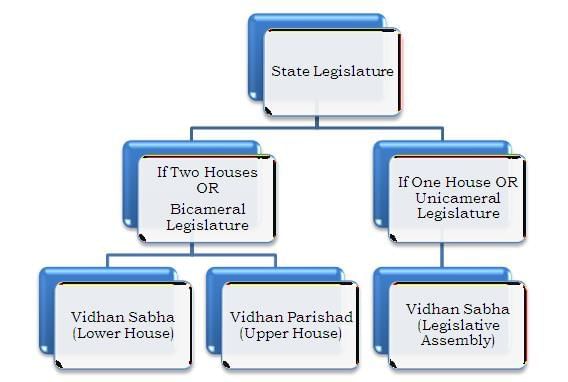 State Legislature
Organization of State Legislature
- State legislatures are either unicameral or bicameral.
- At present, six states have bicameral legislatures: Andhra Pradesh, Telangana, Uttar Pradesh, Bihar, Maharashtra, and Karnataka.
- A unicameral legislature comprises the Governor and the Legislative Assembly (Vidhan Sabha). A bicameral legislature comprises the Governor, the Legislative Council (Vidhan Parishad) and the Legislative Assembly.
- The Legislative Council functions as the upper house and the Legislative Assembly as the lower house in states with two houses.
- Under Article 169, Parliament may create or abolish a Legislative Council in a state if the concerned State Assembly passes a resolution to that effect by a special majority.
- During the Constituent Assembly debates, the idea of a second chamber at state level faced criticism on grounds of cost, possible delay in legislation and representation. Several states have abolished their councils in the past; for example, the Legislative Councils of Tamil Nadu (abolished in 1986), Punjab and West Bengal (abolished in 1969).
- States may pass resolutions to create or abolish a Legislative Council; such resolutions are then acted upon by Parliament through appropriate legislation.
Composition of Two Houses
Composition of the Assembly (Vidhan Sabha)
- Strength: Members of the Assembly (MLAs) are directly elected by the people of the state from territorial constituencies. The maximum permitted strength is 500 and the minimum is 60; the actual number in a state varies according to population and law.
- Nominated Member: Prior to 25 January 2020, a Governor could nominate one member from the Anglo-Indian community to the State Legislative Assembly where the community was not adequately represented. This provision ceased to operate with the 104th Amendment Act, 2019, effective 25 January 2020.
- Territorial Representation: Each MLA represents a single territorial constituency, demarcated on the basis of population and administrative convenience.
- Readjustment after Census: Seat distribution and constituency boundaries are readjusted by Parliament through Delimitation Acts (notable years: 1952, 1962, 1972, 2002). The 42nd Amendment froze readjustment until 2000, and the 84th Amendment extended the freeze to 2026; constituency boundaries were permitted to be redrawn on the basis of the 2001 census by the 87th Amendment (2003) without changing total seats.
- Reservation: Seats are reserved for Scheduled Castes (SCs) and Scheduled Tribes (STs) in proportion to their population in the state.
- Duration: The normal term of the Assembly is five years from the date of its first sitting, unless dissolved earlier.
- Speaker and Deputy Speaker: The Assembly elects a Speaker and a Deputy Speaker from among its members. The Speaker presides over proceedings, maintains order and interprets rules; the Deputy Speaker discharges these duties in the Speaker's absence.
- Powers and Functions: The Assembly enacts laws on state subjects, approves the budget and exercises oversight of the state executive through questions, motions, debates and committees.
Composition of the Council (Vidhan Parishad)
- Strength: The Legislative Council is an indirectly elected body. Its maximum strength is fixed at one-third of the total membership of the Assembly of that state, and the minimum strength at 40.
- Membership Types: The Council consists of elected and nominated members drawn from different electorates and fields of expertise.
- Special Representation: The Council provides representation for certain groups and bodies such as local authorities, graduates and teachers, and also includes nominated persons with special knowledge or practical experience in literature, science, art, cooperative movement or social service.
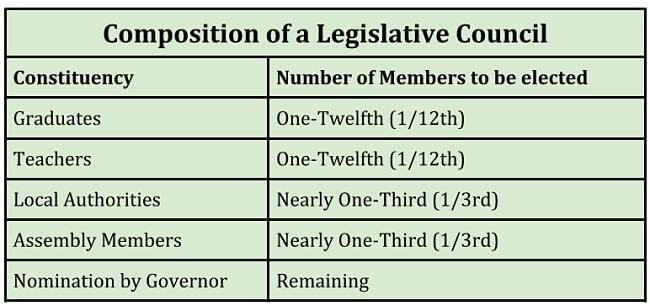
- Manner of Election / Nomination: Of the total Council membership:
- One-third are elected by members of local authorities (municipalities, district boards, etc.).
- One-twelfth are elected by graduates of three years' standing residing in the state.
- One-twelfth are elected by teachers of three years' standing in the state (not lower than secondary school).
- One-third are elected by members of the State Legislative Assembly from amongst persons who are not its members.
- The remainder are nominated by the Governor from persons with special knowledge or practical experience in designated fields.
- Term: Council members serve for six years, with one-third of the members retiring every second year, providing continuity.
- Leadership: The Council elects a Chairperson and a Deputy Chairperson from among its members; the Chairperson presides over sessions and ensures orderly conduct.
- Functions: The Council acts as a revising chamber: it discusses and suggests amendments to legislation, reviews policy matters and provides specialised inputs, though its powers are more limited than the Assembly's, especially on money matters.
- Continuity and Renewal: The Council's staggered retirement system ensures continuous functioning while allowing periodic infusion of new members.
Duration of Two Houses
Duration of Legislative Assembly (Vidhan Sabha)
- Term: The Assembly's normal term is five years from its first sitting, unless dissolved earlier.
- Premature Dissolution: The Governor may dissolve the Assembly (normally on the advice of the Council of Ministers); on dissolution fresh elections are held to constitute a new Assembly.
- Extension: In certain exceptional situations such as during President's Rule under Article 356, Parliament may extend the term of the Assembly by periods not exceeding one year at a time; such extensions require parliamentary approval and are subject to constitutional limits.
Duration of Legislative Council (Vidhan Parishad)
- Permanent Body: The Legislative Council is a continuing or permanent chamber and is not subject to dissolution.
- Rotational Retirement: Members hold office for six years and one-third of the membership retires every two years.
- Renewal: Vacancies caused by retirement are filled by election or nomination as per the prescribed procedure, maintaining continuity in the Council.
The Assembly is a time-bound house with a five-year (or shorter) life and is subject to dissolution; the Council is a permanent body with a rotational retirement system ensuring continuity.
Membership of State Legislature
1. Qualifications for Membership
- MLA (Assembly): Must be an Indian citizen, at least 25 years of age, and an elector in any assembly constituency of the state.
- MLC (Council): Must be an Indian citizen, at least 30 years of age, and fulfil the special electoral requirements if elected from graduates' or teachers' constituencies or be an elector in the state.
2. Disqualifications
- Grounds: A person may be disqualified for holding membership on grounds such as holding an office of profit under the government (subject to exceptions), unsoundness of mind, being an undischarged insolvent, or voluntarily acquiring the citizenship of another country.
- Dual Membership: One cannot simultaneously be a member of both the Legislative Assembly and the Legislative Council of a state.
3. Oath or Affirmation
Every member, before taking their seat, must make and subscribe to an oath or affirmation in the form set out in the Third Schedule of the Constitution. The oath is administered by the Governor or a person authorised by the Governor.
- A member is not entitled to vote, take part in the proceedings of the House, or enjoy privileges of membership until the prescribed oath or affirmation is taken.
- A penalty of ₹500 per day may be imposed if a person sits or votes as a member: (a) before taking the oath, (b) while knowing that they are unqualified or disqualified, or (c) when prohibited by law from sitting or voting.
- Members receive salaries and allowances as determined by the state legislature from time to time; these are charged on the Consolidated Fund of the State as provided by law.
4. Vacation of Seats
- Disqualification: A seat becomes vacant if the member becomes disqualified under the Constitution or applicable law.
- Resignation: A member may resign by writing to the Speaker (for the Assembly) or the Chairman (for the Council); the resignation takes effect from the date it is accepted.
- Absence: Prolonged absence from the House without permission or failure to attend for prescribed periods may lead to vacation of seat under the rules of the House.
Presiding Officers of State Legislature
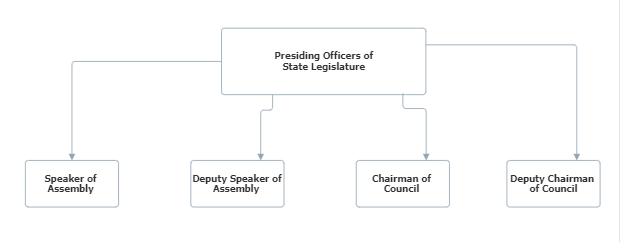 Presiding officers of State Legislature
Each House has its own presiding officer and deputy. The Assembly elects a Speaker and a Deputy Speaker; the Council elects a Chairman and a Deputy Chairman. Panels of chairmen/vice-chairmen may be appointed to preside when both the presiding officer and deputy are absent.
Speaker of the Assembly
- Elected by members of the Assembly to preside over its sittings impartially and protect its dignity.
- Decides points of order, regulates debates, and ensures observance of rules of procedure.
- Grants or refuses permission to members to speak, and decides on admissibility of motions and questions.
- Normally does not participate in debates and does not vote, except to break a tie.
Deputy Speaker of the Assembly
- Assists the Speaker and presides over the Assembly in the Speaker's absence.
- Ensures continuity of proceedings and the smooth functioning of the House.
Chairman of the Council
- Presides over sessions of the Legislative Council and discharges functions analogous to the Speaker in the Assembly.
- Maintains order and interprets the Council's rules of procedure.
Deputy Chairman of the Council
- Assists the Chairman and presides in the Chairman's absence.
- Acts as the second-in-command in the Council's presiding hierarchy.
Try yourself: What is the difference between a unicameral and a bicameral state legislature?
Sessions of State Legislature
- Summoning: The Governor summons each House from time to time. The maximum gap between two successive sittings of the state legislature cannot exceed six months; in practice, the legislature meets at least twice a year.
- Adjournment: An adjournment suspends the work of a sitting for a specified period (hours, days or weeks). Adjournment sine die means terminating a sitting indefinitely; the presiding officer controls adjournments.
- Prorogation: When the business of a session is completed and the House stands adjourned sine die, the Governor issues a notification proroguing the session. Prorogation ends a session but does not dissolve the House.
- Dissolution: The Legislative Assembly alone is subject to dissolution; the Legislative Council is permanent. Dissolution terminates the life of the Assembly and mandates fresh elections. Consequences for bills on dissolution:
- A bill pending in the Assembly lapses, whether it originated there or was transmitted by the Council.
- A bill passed by the Assembly but pending in the Council lapses.
- A bill pending in the Council but not passed by the Assembly does not lapse.
- A bill passed by the Assembly (in a unicameral state) or by both Houses (in a bicameral state) but pending assent of the Governor or the President does not lapse.
- A bill passed by the Assembly (or by both Houses) but returned by the President for reconsideration does not lapse.
- Quorum: A minimum number of members must be present for the House to conduct its business; matters are generally decided by a majority of members present and voting, excluding the presiding officer.
- Voting: Voting may be by voice, by division (members standing to indicate their vote or via electronic systems where available), or by ballot, as the presiding officer directs depending on the nature of the question.
- Language: The state legislature may use the official language(s) specified for the state for its proceedings; translation facilities may be arranged as necessary.
- Rights of Ministers and the Advocate General: Ministers participate in legislative proceedings, introduce government bills and defend policies. The Advocate General, as the state's chief legal advisor, may be called upon to assist with legal matters in the House.
Legislative Procedure in State Legislature
In state legislatures, bills originate, undergo readings in the Houses, obtain assent from the Governor, and in defined circumstances may require consideration or assent by the President.
Ordinary Bill
- Introduction and First Reading: An ordinary bill may originate in either House (in bicameral states) and is introduced by a Minister or a private member.
- Second Reading: Detailed consideration of the bill occurs; the House may refer it to a committee, discuss clauses and propose amendments.
- Third Reading and Passage: The final form of the bill is put to vote and, if passed, is transmitted to the other House for its consideration and decision.
- Consideration in the Second House: The second House examines the bill, may suggest amendments and may return it to the originating House; both Houses must agree on the text for final passage (subject to special rules applicable to certain bills).
- Governor's Assent: When both Houses agree on a bill it is sent to the Governor who may (a) assent to it, (b) withhold assent, or (c) reserve the bill for the consideration of the President where the Constitution or law requires or permits reservation.
- President's Assent: Bills reserved by the Governor are presented to the President who may give assent, withhold assent, or return the bill to the House for reconsideration.
Money Bills
- Origination and Passage: Money bills (dealing with taxation, public expenditure or borrowing) can be introduced only in the Legislative Assembly. After being passed by the Assembly, a money bill is transmitted to the Legislative Council which can make recommendations but cannot reject or amend the bill finally.
- Time Frame and Assent: The Council must return a money bill with recommendations within the time specified by law; if the Council does not do so within that period, the bill is deemed to have been passed by both Houses in the form passed by the Assembly. After passage, money bills are sent to the Governor for assent.
Bills Reserved for the President's Consideration
Bills Mandated for President's Consideration
- Bills which may derogate from the powers of the High Courts or otherwise affect the constitutional role of High Courts (as covered by provisions governing assent and reservation).
- Bills relating to taxes on water, electricity and other matters where central considerations under the Constitution call for Presidential attention (as set out in constitutional provisions regarding reservation and assent).
- Bills introduced during a period of financial emergency (Article 360) may require special consideration and are open to reservation for the President.
Bills Potentially Reserved for Special Purposes
- Bills that seek to confer protection or immunity that might affect fundamental rights (Articles 14 and 19) or bills concerning acquisition of estates and related protections (Article 31A) may be placed for Presidential consideration.
- Bills required to implement certain Directive Principles or those dealing with repugnancy to Union laws on Concurrent List subjects (Article 254) may also attract reservation for Presidential assent.
- Bills imposing restrictions on trade or commerce may require prior Presidential sanction under the relevant constitutional provisions.
Bills Open to Governor's Discretion: Apart from categories expressly requiring reservation, the Governor has discretionary power under Article 200 to reserve certain bills for the President's consideration if they raise questions of constitutionality or national importance.
Legislative Procedure Compared - Position of the Legislative Council
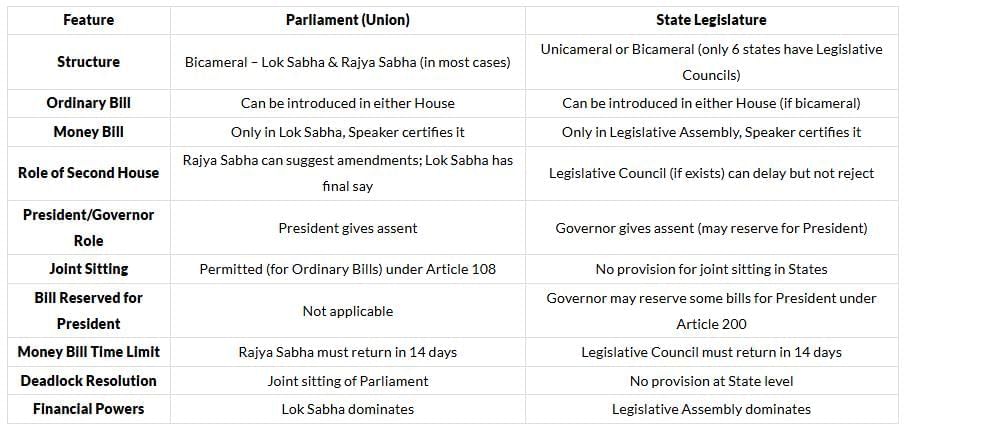
The constitutional position of the Legislative Council vis-à-vis the Legislative Assembly can be viewed from two angles: areas where the Council is effectively equal to the Assembly, and areas where it is subordinate.
Where the Council is Equal with the Assembly
- Bicameral Functioning: In many legislative processes both Houses participate in debate, amendment and scrutiny of bills, enabling a bicameral check on legislation.
- Legislative Powers: Both Houses can introduce and discuss most types of ordinary bills, propose amendments and send bills back for reconsideration.
- Checks and Balances: The Council provides an additional forum for deliberation, promoting fuller scrutiny and diverse perspectives on proposed legislation.
- Representation: The Council brings representation from varied constituencies (local bodies, graduates, teachers) and expert nominees, widening the legislative debate.
Where the Council is Unequal with the Assembly
- Limited Authority on Money Matters: The Council cannot originate or finally reject Money Bills; its recommendations may be returned but the Assembly has primacy.
- Secondary Role in Some Cases: The Assembly's decision may prevail in cases of disagreement on non-money bills after certain procedures; ultimate financial control rests with the Assembly.
- Functional Constraints: The Council's powers are intentionally more restricted to preserve the primacy of directly elected representatives in financial and crucial legislative matters.
- Uneven Representation: Because many Council members are indirectly elected or nominated, their claim to equal legislative authority with directly elected assembly members is sometimes considered limited.
Privileges of the State Legislature
Collective Privileges
- Freedom of Speech: Members enjoy freedom of speech in the House and its committees, subject to the rules of procedure and the Constitution.
- Right to Publish Proceedings: The legislature has the authority to publish its proceedings, reports and papers and to control the publication of debates and documents arising in the House.
- Control over Internal Affairs: Each House has exclusive jurisdiction over its internal affairs, discipline and privileges.
- Exclusive Jurisdiction: The House controls its own proceedings and protects its functioning from interference by external authorities.
Individual Privileges
- Immunity: Members have immunity from legal action for anything said or any vote given in the House or its committees, subject to the rules and limits of privilege.
- Right to Participate: Every member has the right to take part in the business of the House, ask questions, move motions and join committees as permitted by rules.
- Freedom from Arrest: Members are protected from arrest in civil cases during the continuance of a session of the House and for a specified period before and after the session, subject to constitutional and legal provisions.
- Exemption from Jury Duty: Legislators are normally exempt from jury service, allowing them to focus on legislative responsibilities.
- Right to Publish: Individual members may publish speeches and proceedings of the House subject to rules and privileges that prevent misuse or breach of privilege.
FAQs on Laxmikanth Summary: State Legislature
| 1. What is the composition of the two houses in a state legislature? |  |
| 2. What is the duration of the sessions of the two houses in a state legislature? | |
| 3. Who are the presiding officers of the state legislature, and what are their roles? | |
| 4. What are the legislative procedures followed in a state legislature? | |
| 5. What is the position of the Legislative Council in a state legislature? | |





