Laxmikanth Summary: Union Territories


Article 1 of the Constitution describes the territory of India as comprising three categories: the territories of the States, Union Territories, and territories that may be acquired by the Government of India.
- Territories of the States: These are the territories that constitute the individual states of India. There are currently twenty-eight states.
- Union Territories: These are regions administered directly by the Central Government and are therefore often called centrally administered territories. There are currently eight Union Territories.
- Acquired territories: Territories that may be acquired by the Government of India in the future; at present there are no such territories.
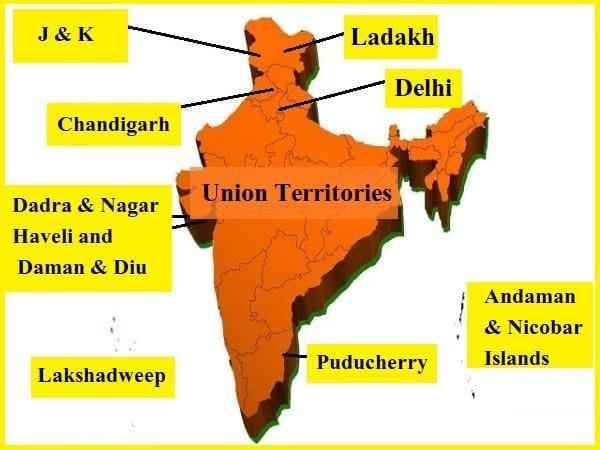 Union Territories of India
Creation of Union Territories
The present category of Union Territories (UTs) evolved through colonial administrative arrangements and post-independence reorganisation. The process can be summarised chronologically and constitutionally.
- Under British rule certain areas were designated as scheduled districts (from 1874) and later administered as chief commissioners' provinces.
- After independence these regions were classified in the Constitution (1950) among Part C states and Part D territories.
- The States Reorganisation Act, 1956 and the Seventh Constitutional Amendment (1956) abolished the Part A-D classification and formalised the category of Union Territories.
- Over time several former Union Territories were granted statehood: Himachal Pradesh, Manipur, Tripura, Mizoram, Arunachal Pradesh, and Goa.
- Territories formerly under Portuguese rule (Goa, Daman and Diu, Dadra and Nagar Haveli) and French rule (Puducherry) were absorbed into the Union as UTs following integration.
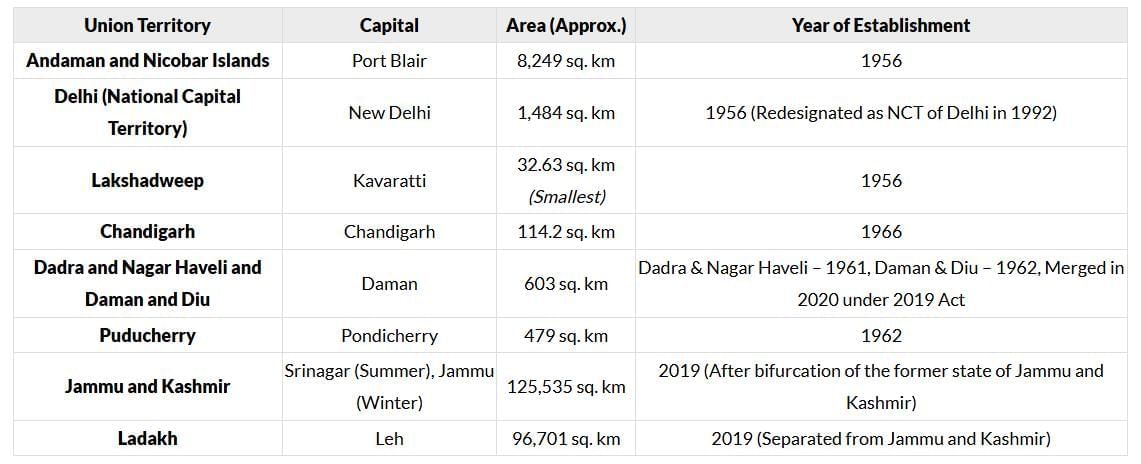
- Current Union Territories include: Andaman and Nicobar Islands (since 1956), Delhi (1956), Lakshadweep (1956), Puducherry (1962), Chandigarh (1966), Jammu and Kashmir (2019), Ladakh (2019), and Dadra and Nagar Haveli and Daman and Diu (2020).
- Historically, until 1973 Lakshadweep was known as the Laccadive, Minicoy and Amindivi Islands. Delhi was redesignated as the National Capital Territory in 1992, and Puducherry was formerly called Pondicherry until 2006.
- At the commencement of the Constitution (1950), states and territories were classified as Part A, Part B, Part C states and Part D territories, a scheme later replaced by the UT classification.
Reasons for creating Union Territories
- Political and administrative considerations: Key administrative needs or political sensitivities led to direct central administration in places such as Delhi and Chandigarh.
- Cultural distinctiveness: Territories with distinct cultural and historical identities-such as Puducherry and Dadra and Nagar Haveli and Daman and Diu-were administered separately to protect local character.
- Strategic importance: Islands and frontier regions like the Andaman and Nicobar Islands and Lakshadweep were kept under central control for national security and strategic reasons.
- Special treatment for backward and tribal areas: Some regions were administered as UTs initially to provide special administrative arrangements for tribal or less developed areas; several such regions later attained statehood.
Administration of Union Territories
Articles 239 to 241 of the Constitution set out the constitutional framework for the governance of Union Territories; although the UT category is uniform in law, its actual administration varies across territories.
- President of India: Every Union Territory is administered in the name of the President, usually through an executive representative appointed by the President.
- Administrator / Lieutenant Governor: The President appoints an Administrator or may designate the office as Lieutenant Governor, Chief Commissioner or Administrator, depending on the UT. The administrator acts as the President's agent rather than as a constitutional head equivalent to a state governor.
- Several UTs are administered by a Lieutenant Governor: currently this includes Delhi, Puducherry, Andaman and Nicobar Islands, Jammu and Kashmir, and Ladakh. Other UTs such as Chandigarh, Dadra and Nagar Haveli and Daman and Diu, and Lakshadweep are administered by an Administrator.
- The President may also appoint a Governor of a neighbouring state to act as the Administrator of an adjoining UT; when so appointed the governor acts in that capacity independently of the state Council of Ministers.
- Legislatures in some UTs: A few UTs have been granted legislative assemblies and Councils of Ministers-namely Puducherry (since 1963), Delhi (since 1992), and Jammu and Kashmir (reorganisation, 2019). The input figures commonly cited are: Puducherry assembly - 30 members; Delhi assembly - 70 members; Jammu and Kashmir (previously) - 83 members.
- Parliamentary supremacy: Parliament has power to make laws for Union Territories on any subject matter, including where a UT has its own legislature; Parliament can also legislate on subjects in the State List for UTs.
- Legislative competence (examples): The Puducherry assembly can make laws on subjects ordinarily in the State List and the Concurrent List. The Delhi assembly can make laws on matters in the State List and Concurrent List except public order, police and land. The Jammu and Kashmir assembly (prior to reorganisation) could legislate on State List and Concurrent List subjects except public order and police.
- Regulations by the President: For certain UTs (for example Andaman and Nicobar Islands, Lakshadweep, Dadra and Nagar Haveli and Daman and Diu, and Ladakh) the President may make regulations for the peace, progress and good government of the territory; such regulations have the force of parliamentary enactments and can amend or repeal an Act of Parliament insofar as it applies to that UT.
- In Puducherry, the President may make regulations when the assembly is suspended or dissolved; regulations thus framed have the same effect as parliamentary acts.
- Judicial arrangements: Parliament may establish a High Court for a UT or place a UT under the jurisdiction of a High Court of an adjacent state. Delhi has its own High Court (since 1966). Other UTs are under the jurisdiction of nearby High Courts: e.g., Dadra and Nagar Haveli and Daman and Diu fall under the Bombay High Court; Andaman and Nicobar Islands, Chandigarh, Lakshadweep, and Puducherry are under the Calcutta, Punjab & Haryana, Kerala and Madras High Courts respectively.
Special provisions and institutional arrangements for Delhi
- Sixty-ninth Constitutional Amendment Act (1991) conferred a special status on Delhi, redesignating it the National Capital Territory (NCT) of Delhi and providing for a legislative assembly.
- Legislative Assembly: The assembly consists of 70 elected members.
- Law-making power: The Delhi assembly may legislate on matters in the State List and the Concurrent List, except for public order, police and land, which remain exclusively with the Union.
- Parliamentary supremacy: Parliamentary enactments continue to prevail over assembly laws where there is a conflict.
- Council of Ministers: The executive is headed by a Chief Minister with a Council of Ministers; the composition and size of the Council are governed by the relevant constitutional and statutory provisions.
- Role of the Lieutenant Governor: The Lieutenant Governor acts on the advice of the Council of Ministers except in matters where he has discretion; in cases of disagreement the matter may be referred to the President.
- Presidential rule: The President can impose rule in the NCT of Delhi if constitutional machinery fails, comparable to Article 356 for states.
- Ordinance power: The Lieutenant Governor may issue ordinances during the assembly recess; such ordinances must be approved by the assembly within the period prescribed by law (commonly within six weeks after reassembly).
- Limitations on ordinances: Ordinances are subject to the same checks and controls as other executive actions and require Presidential or constitutional sanction where applicable.
Try yourself: Which union territory has its own high court?
Advisory committees and administration in Union Territories without legislatures
- Under the Government of India (Allocation of Business) Rules, 1961, the Ministry of Home Affairs is principally responsible for UT matters including legislation, finance, services and appointment of Administrators/Lieutenant Governors.
- The five Union Territories without legislatures-Andaman and Nicobar Islands, Chandigarh, Dadra and Nagar Haveli and Daman and Diu, Lakshadweep, and Ladakh-have consultative/advisory forums to assist administration.
- The principal advisory forums are the Home Minister's Advisory Committee (HMAC)-chaired by the Union Home Minister-and the Administrator's Advisory Committee (AAC), chaired by the Administrator of the respective UT.
- Members typically include Members of Parliament and elected representatives from local bodies (such as District Panchayats and Municipal Councils), together with other nominated members, to discuss social and economic development issues.
Reorganisation of 2019: Jammu and Kashmir and Ladakh
- The state of Jammu and Kashmir was reorganised into two Union Territories: Jammu and Kashmir (with a legislative assembly) and Ladakh (without a legislature). The UT of Ladakh includes the districts of Kargil and Leh.
- The first Lieutenant Governors appointed were Girish Chandra Murmu for Jammu and Kashmir and R. K. Mathur for Ladakh.
- The Jammu and Kashmir Reorganisation Act, 2019 accompanied the abrogation of Article 370 and the revocation of Article 35A.
- The new Union Territories came into effect on 31 October 2019 (the 144th birth anniversary of Sardar Vallabhbhai Patel).
- This was the first instance in independent India of a state being bifurcated and converted into Union Territories.
- The separate flag and earlier special constitutional provisions and penal code of the former state ceased to operate; the Indian Penal Code (IPC) applies to both UTs.
- Parliamentary law-making power extends to all subjects for these UTs, across the lists.
- The Lieutenant Governor in Jammu and Kashmir has specified discretionary powers in relation to appointments under the All India Services and the Anti-Corruption Bureau (ACB).
- The term of the UT legislature in Jammu and Kashmir has been specified as five years (reduced from the previous six years for the erstwhile state).
- By area Ladakh is now the largest Union Territory in India.
- The Legislative Council of Jammu and Kashmir was abolished in the reorganisation; initial plans provide for 107 directly elected seats in the Legislative Assembly with an increase to 114 seats following delimitation.
Merger of Union Territories in 2020
- In 2020, the two Union Territories of Dadra and Nagar Haveli and Daman and Diu were merged to form a single Union Territory: Dadra and Nagar Haveli and Daman and Diu.
- Historical dates: Dadra and Nagar Haveli had been created as a distinct administrative unit in 1961, and Daman and Diu in 1962.
Reasons for the merger
- Administrative similarities: Both territories shared similar administrative structures and overlapping development priorities (for example in tourism and education).
- Infrastructure efficiency: Separate departments and parallel establishments caused duplication of infrastructure and manpower; merging aimed to reduce delays and duplication arising from officials working alternately in both territories.
- Reduce duplication and cost: Separate constitutional and administrative setups resulted in duplication of effort and avoidable fiscal burden; merger aimed at administrative economy.
- Improve governance: The merger was presented as consistent with the government's goal of "minimum government, maximum governance", enabling more efficient use of limited resources in small territories.
Concerns associated with the functioning of Union Territories
Several recurring issues and critiques are raised in academic and policy discussions regarding Union Territories:
- Democratic deficit: Residents of UTs without elected legislatures have limited mechanisms to hold the executive accountable, creating a democratic gap in comparison to states.
- Population versus status: The choice of whether a region is a UT or a state has not always followed population or area criteria strictly. Former UTs granted statehood (for example Mizoram, Arunachal Pradesh, Sikkim) sometimes have smaller populations than current UTs such as Puducherry.
- Structural weakness: The constitutional structure of UTs makes them more exposed to central interference, which can undermine administrative stability and local autonomy.
- Legislative composition and nomination: UT legislatures may comprise elected and nominated members. The nomination process has on occasions been politically controversial (for example in Puducherry), and courts have examined the need for consultation with the Union Government in certain appointments.
- Limited autonomy: UTs generally enjoy less self-government than states; broad powers in the hands of Administrators or Lieutenant Governors can constrain the effectiveness of locally accountable institutions.
It is therefore important that the Central Government respects the intent behind granting legislatures and Councils of Ministers to certain UTs-to meet the democratic aspirations of their people-and that appropriate institutional safeguards are maintained. The Supreme Court has also observed that while Union Territories are administered by the Centre, they remain distinct constitutional entities and must be treated with due regard for their autonomous features where provided by law.
FAQs on Laxmikanth Summary: Union Territories
| 1. What are Union Territories in India and how do they differ from states? |  |
| 2. How many Union Territories does India have and what are their names? | |
| 3. What is the difference between Union Territories with and without legislative assemblies? | |
| 4. Why was Jammu and Kashmir reorganised as a Union Territory in 2019? | |
| 5. What powers does the lieutenant governor of a Union Territory have in the Indian constitutional system? | |





