Laxmikanth Summary: Rights And Liabilities of the Government

Introduction
Articles 294 to 300 in Part XII of the Constitution deal with the property, contracts, rights, liabilities, obligations and suits of the Union and of the States. For these purposes the Constitution treats the Union and the State governments as juristic (legal) persons capable of holding property, entering into contracts and suing or being sued.
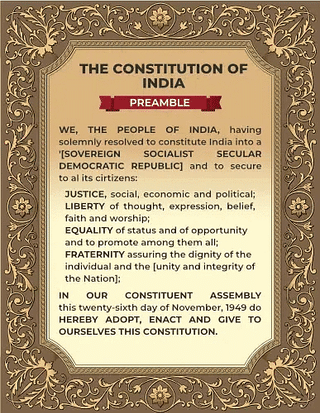 Preface to the Indian Constitution
Property of the Union and the States
Succession
All property, assets, rights and liabilities which immediately before the commencement of the Constitution were vested in the Dominion of India, any province or any Indian princely state, became vested in the Union or in the corresponding State, as the case may be. This principle of succession is provided by the Constitution so that public property and obligations continue seamlessly after the commencement of the Constitution.
Escheat, Lapse and Bona Vacantia
Bona vacantia denotes property found without any owner or without a rightful claimant. Such ownerless property vests in the government where the property is situated; where it is not situate within any State, it vests in the Union. The related concepts of escheat and lapse result in such ownerless property accruing to the Government because there is no rightful owner to claim it.
Sea-Wealth and Submerged Natural Resources
All lands, minerals and other things of value under the waters of the ocean within the territorial waters of India, the continental shelf and the exclusive economic zone (EEZ) vest in the Union. Consequently, a State adjacent to the sea cannot claim proprietary rights over resources lying within the territorial waters, continental shelf or EEZ; these vest in the Union for national management, regulation and exploitation.
Compulsory Acquisition by Law
Both Parliament and the State Legislatures are empowered to make laws for the compulsory acquisition and requisitioning of private property by the Government. The Constitution, as amended, changed the contours of the obligation to provide compensation. The 44th Amendment Act (1978) modified provisions related to the right to property and the constitutional guarantees concerning compensation. As a result, the constitutional obligation to pay compensation was significantly altered and, in the context described here, the Constitution recognises two specific situations in which protection remains:
- when the Government acquires the property of a minority educational institution, and
- when the Government acquires land held by a person under his personal cultivation and that land is within the statutory ceiling limits.
Acquisition under Executive Power
The executive power of the Union or of a State enables it to acquire, hold and dispose of property in the ordinary course of governance. The executive power extends to carrying on trade or business within the State and, subject to constitutional limitations, even in other States. Acquisition by executive action must, however, conform to law and to constitutional safeguards where provided.
Try yourself: What happens to property found without any owner?
Suits by or against the Government
Article 300 - General Position
Article 300 of the Constitution governs suits by or against the Government of India and the State Governments. It provides that the Government of India may sue or be sued by the name of the Union of India and a State Government by the name of the State. The Article recognises the Union and each State as distinct legal entities for the purpose of litigation.
Naming and Entities
When a Government sues or is sued, the cause of action must be correctly framed against the Union or the relevant State in the official name prescribed by law. Liability of the Government to be sued is subject to any law enacted by Parliament or by the State Legislature that alters or regulates such liability.
Liability for Contracts
The executive power of the Union and of the States authorises them to enter into contracts for acquisition or disposition of property, for trade, services or other purposes. The Constitution requires that such contracts be entered into properly; failure to comply with the prescribed formalities may render the contract unenforceable. The following conditions are material for validity and enforceability of contracts made by the Government:
- the contract must be made by a person authorised in law to contract on behalf of the President (for Union) or the Governor (for a State);
- the contract must be executed on behalf of the President or the Governor;
- the person executing the contract must act according to any directions or authorisations issued by the President or the Governor regarding the person or the mode of execution.
Failure to satisfy these conditions may render the contract null and unenforceable in a court of law. While the officer who executes the contract on behalf of the Government is not personally liable for such official contracts, the Government itself remains liable and can be sued for breaches of contract. In practice, the liability of the Union and State Governments in contractual matters corresponds to that of any ordinary person or legal entity under contract law.
Liability for Torts
Historically, under the principle derived from English common law that the 'King can do no wrong', sovereign functions were treated as immune from suit. During the colonial period the East India Company was accountable in relation to its trade but enjoyed immunity for sovereign acts. Britain limited its sovereign immunity for torts through the Crown Proceedings Act, 1947. In India, the position evolved more gradually through judicial decisions.
Initially, the rule in India was that the Government could be sued for civil wrongs committed in respect of non-sovereign functions but not for acts done in the exercise of sovereign powers such as the administration of justice or war-time acts. This distinction is traceable to cases such as the P & O Steam Navigation Company (1861) and was affirmed in later rulings (for example, the Kasturilal case). However, the judiciary has narrowed this immunity over time.
In the Nagendra Rao case (1994) the Supreme Court strongly criticised broad assertions of sovereign immunity and held that the State could not evade compensation for harm caused by its negligent servants simply by labelling the activity as sovereign. Observations in that judgment included:
- Modern legal systems should not permit the State to act without accountability nor deprive citizens of remedies for unlawful actions of the State.
- Public interest cannot justify blanket protection for the State where citizens suffer due to negligence; the trend is to treat the State like any other legal person except for a limited class of functions.
- It is necessary to balance the State's duties and obligations with citizens' rights in a welfare State; a rigid sovereign/non-sovereign dichotomy is inconsistent with contemporary legal thought.
Subsequent judgments, including the Common Cause case (1999) and the Prisoner's Murder case (2000), moved further to reject absolute sovereign immunity and to hold the State liable in tort for wrongful acts causing loss or injury, irrespective of whether the acts were labelled sovereign or non-sovereign. These decisions significantly reduced the doctrinal scope of the old immunity principle.
Suits against Public Officials
President and Governor
The Constitution confers special protections on the President of India and the Governor of a State in relation to legal proceedings. These immunities relate to both their official acts and certain personal acts during their tenure.
- Official acts: The President and Governors are not answerable to any court for the exercise of the powers and duties of their office. Official acts done in good faith and within constitutional authority enjoy protection from suit.
- Personal acts during tenure: Criminal proceedings cannot be instituted against the President or a Governor during their term of office and they cannot be arrested or imprisoned while in office. Civil proceedings for personal acts can be instituted during tenure only after giving a two-month prior notice to the President or Governor, as the case may be. Such protections cease once the person leaves office, subject to applicable law and procedure.
Ministers
Ministers do not enjoy the same degree of immunity as the President or Governors in respect of personal liability. A Minister is not required to endorse the official acts of the President or a Governor and thereby escape liability. Ministers can be held accountable in ordinary courts for criminal or civil wrongs committed by them in their personal capacity. In respect of acts done in the course of advising the President or Governor, constitutional practice recognises collective responsibility and convention, but such acts may, in appropriate cases, be amenable to judicial review.
Judicial Officers
Judicial officers enjoy immunity for acts done in the course of their judicial functions. The long-standing principle is that judges, magistrates and other persons acting judicially cannot be sued in respect of decisions and acts performed in the exercise of their judicial duties. The protection ensures independence and finality in judicial decision-making, while remedies for judicial error are available through appellate and supervisory jurisdictions rather than suits for tort or breach.
Civil Servants
Civil servants acting in their official capacity are generally not personally liable for contracts entered into on behalf of the Government; liability rests with the Government itself. This rule prevents personal exposure of officials for acts done in discharge of official duties. Where a civil servant acts ultra vires or outside the scope of authority, personal liability may arise in appropriate circumstances.
FAQs on Laxmikanth Summary: Rights And Liabilities of the Government
| 1. What are the rights and liabilities of the government? |  |
| 2. What are some examples of the government's rights? | |
| 3. What are the responsibilities of the government towards its citizens? | |
| 4. How does the government ensure transparency and accountability? | |
| 5. What are the environmental responsibilities of the government? | |





