Nitin Singhania Summary: Unesco’s List Of Tangible World Heritage Sites In India

Criteria for Selection
UNESCO World Heritage Sites are places of outstanding universal value selected for protection and recognition by the United Nations Educational, Scientific and Cultural Organization (UNESCO). To be inscribed on the World Heritage List a property must satisfy at least one of the ten criteria adopted by the World Heritage Committee. These ten criteria are grouped into two broad categories - cultural and natural - and together they describe the range of attributes that make a site significant at a global level.
Criteria for Cultural Sites
- Represents a masterpiece of human creative genius.
- Exhibits an important interchange of human values over a span of time, or within a cultural area of the world, on developments in architecture or technology, monumental arts, town-planning or landscape design.
- Bears a unique or exceptional testimony to a cultural tradition or to a civilisation which is living or which has disappeared.
- Is an outstanding example of a type of building, architectural or technological ensemble, or landscape which illustrates a significant stage in human history.
- Is an outstanding example of a traditional human settlement, land-use or sea-use which is representative of a culture or human interaction with the environment, especially where it has become vulnerable under the impact of irreversible change.
- Is directly or tangibly associated with events or living traditions, ideas, beliefs, artistic and literary works of outstanding universal significance.
Criteria for Natural Sites
- Contains superlative natural phenomena or areas of exceptional natural beauty and aesthetic importance.
- Is an outstanding example representing major stages of the Earth's history, including the record of life, significant ongoing geological processes in the development of landforms, or significant geomorphic or physiographic features.
- Is an outstanding example representing significant ongoing ecological and biological processes in the evolution and development of terrestrial, freshwater, coastal and marine ecosystems, and communities of plants and animals.
- Contains the most important and significant natural habitats for in-situ conservation of biological diversity, including those containing threatened species of outstanding universal value from the point of view of science or conservation.
Legal Status of Designated Sites
Inscription as a World Heritage Site is principally a recognition of significance and a commitment by the State Party to protect the property. The designation carries legal, administrative and diplomatic implications that strengthen site conservation:
- World Heritage status brings international recognition and raises awareness about the need for preservation and conservation at national and local levels.
- Listing helps to mobilise technical and financial assistance from UNESCO and other international partners for conservation, restoration and capacity building.
- UNESCO inscription strengthens the legal and policy framework within the State Party by encouraging adoption or enforcement of national laws and regulations to protect the property.
- Inscribed properties receive an added layer of protection under international instruments concerned with cultural property in armed conflict. In particular, the Hague Convention for the Protection of Cultural Property in the Event of Armed Conflict (1954) addresses safeguarding of cultural heritage; references to the Geneva Conventions and their protocols also appear in discussions of humanitarian protections, especially where cultural property protection is an element of international humanitarian law.
- In cases of serious threats to a site's values, the World Heritage Committee can place a site on the List of World Heritage in Danger, which can trigger targeted assistance and monitoring.
UNESCO World Heritage Sites in India
Cultural Sites
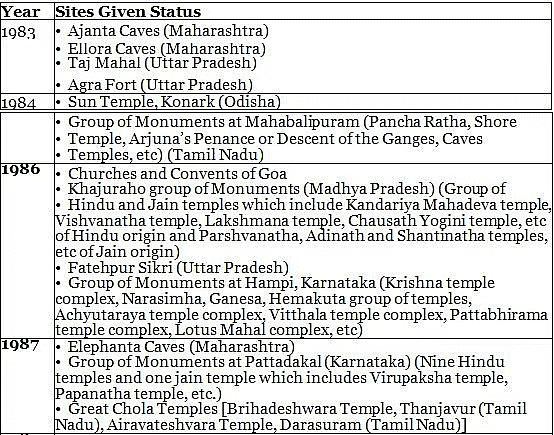
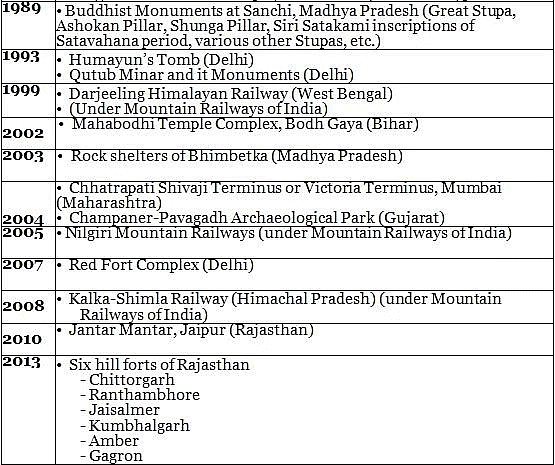
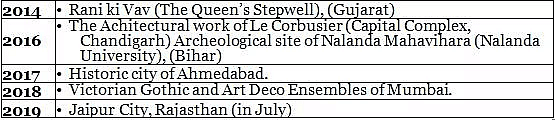
India's World Heritage Sites reflect the subcontinent's long and diverse cultural history - from ancient rock-cut architecture and Buddhist complexes to medieval temples, forts, Mughal monuments and colonial-era ensembles. Representative examples include:
- Taj Mahal (Agra) - widely recognised as a masterpiece of Mughal architecture and an outstanding example of monumental funerary design.
- Ajanta and Ellora Caves (Maharashtra) - complex of rock-cut caves, sculptures and murals illustrating Buddhist, Hindu and Jain traditions and important artistic achievements.
- Sun Temple, Konark (Odisha) - an outstanding example of temple architecture and stone sculpture.
- Hampi (Karnataka) - ruins of the Vijayanagara Empire that demonstrate a distinctive urban and architectural ensemble.
- Red Fort (Delhi), Fatehpur Sikri (Uttar Pradesh), Khajuraho Group of Monuments (Madhya Pradesh) and Humayun's Tomb (Delhi) - each illustrating important phases of architecture, town-planning and cultural interchange.

Natural and Mixed Sites
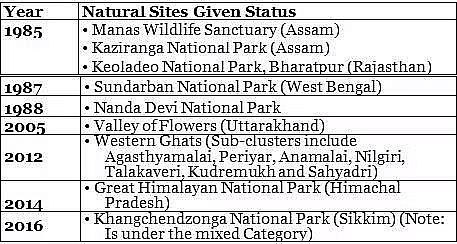
India's natural World Heritage properties cover biodiversity hotspots, unique ecosystems and outstanding geological features. The country also has a mixed site that combines natural and cultural values. Representative examples include:
- Kaziranga National Park (Assam) - important habitat for the Indian one-horned rhinoceros and other species; illustrates in-situ conservation values.
- Sundarbans National Park (West Bengal) - largest mangrove forest and a significant coastal ecosystem with high biodiversity.
- Western Ghats - extensive mountain chain recognised for outstanding biodiversity and endemic species; represents major ecological processes.
- Khangchendzonga National Park (Sikkim) - inscribed as a mixed site, recognised both for its natural biodiversity and its cultural associations with local communities and belief systems.
Practical Examples and Importance for Conservation
Each inscribed site demonstrates how tangible heritage (monuments, ensembles, natural habitats) embodies values that are important beyond national boundaries:
- Cultural sites often illustrate technological advances, changes in town-planning and exchanges of ideas across regions and periods.
- Natural sites showcase geological history, ongoing ecological processes and habitats essential for in-situ conservation of threatened species.
- Mixed sites highlight the interconnectedness of cultural practices with natural landscapes and ecosystems.
Benefits of World Heritage Site Status
- Raises international awareness about the need for site protection, supporting both national and local conservation initiatives.
- Attracts sustainable tourism, which can generate revenue for local communities and for conservation activities when managed properly.
- Enables access to UNESCO technical assistance, advisory services and, when available, emergency funds for restoration and preservation.
- Provides prestige and strengthens partnerships with the United Nations system, bilateral donors, conservation NGOs and academic institutions.
- Facilitates access to global project management resources, training and capacity building for site managers and guardians.
- Enhances legal and administrative support for the site, and can invoke special protection measures under international humanitarian law in situations of armed conflict.
Concluding Notes
World Heritage inscription is a tool for recognition and a catalyst for improved conservation. For a property to retain its status over time, the State Party must maintain the values for which the site was inscribed through effective legal protection, management plans, monitoring and community engagement. For current and complete listings of sites and their official descriptions, the UNESCO World Heritage List and the official State Party nominations provide the authoritative records.
FAQs on Nitin Singhania Summary: Unesco’s List Of Tangible World Heritage Sites In India
| 1. What are UNESCO World Heritage Sites in India? |  |
| 2. How many UNESCO World Heritage Sites are there in India? | |
| 3. How are UNESCO World Heritage Sites in India selected? | |
| 4. What is the importance of preserving UNESCO World Heritage Sites in India? | |
| 5. Can anyone visit UNESCO World Heritage Sites in India? | |





