Old NCERT Summary (RS Sharma): The Age of Satavahanas


Political History
The Satavahanas emerged as the principal successors of the Mauryas in the Deccan and central India. They are generally identified with the Andhras mentioned in the Puranas, although the name Andhra does not occur in contemporary Satavahana inscriptions. The Puranas attribute approximately three hundred years of rule to the Andhras, a period commonly associated with the Satavahana dynasty.
- The earliest epigraphic evidence for Satavahana power appears from the 1st century BCE, particularly in the upper Godavari valley and parts of present-day Maharashtra.
- The Satavahanas competed with western and north-western powers such as the Sakas (also called Western Kshatrapas). Their fortunes fluctuated until the reign of Gautamiputra Satakarni (reigned c. AD 106-130), who is credited with restoring Satavahana supremacy in the Deccan.
- Gautamiputra Satakarni is celebrated in inscriptions for defeating several Saka rulers, including Nahapana, and for extending control across a wide region-from parts of Malwa in the north to Karnataka in the south-while likely exercising influence over Andhra.
- Satavahana power involved alliances and assimilations: some groups of Saka origin were absorbed into local society, often acquiring status as kshatriyas through marriage and political accommodation with the Satavahana house.
- Satavahana kings used inscriptions and titulature to assert their legitimacy and to place themselves in the succession of Indian royal ideals that followed the Mauryan administrative and political legacy.
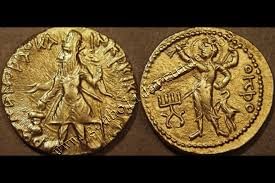 Coins used in The Satvahan Empire
Aspects of Material Culture
The material culture of the Deccan during the Satavahana period was a synthesis of long-standing local traditions and north Indian influences. Archaeological evidence shows continuity from the earlier megalithic societies and a gradual technological and cultural transition during the Satavahana phase.
- Megalithic background: Communities in the Deccan that built megaliths were already acquainted with iron tools and settled agriculture before the Satavahana period.
- Iron tools and agriculture: Iron hoes and other implements are present before c. 200 BCE, with a marked increase in iron agricultural tools in the early centuries of the Common Era.
- Tool forms: Transition to fully socketed iron implements occurred in the Satavahana phase; common items include hoes, sickles, spades, ploughshares, axes, adzes, razors, and tanged or socketed arrowheads and daggers.
- Pottery and crafts: Local pottery traditions continued alongside new forms; craft specialisations-such as textile weaving, metalwork and stone carving-expanded, supporting both local needs and long-distance trade.
- Trade and economy: The Satavahana polity participated in inland and coastal trade. Ports on the western coast connected Deccan producers with maritime trade networks, including exchanges with the Roman world, as indicated by archaeological finds of Roman coins and luxury imports in coastal and urban sites.
Social Organization
The social structure under the Satavahanas reflected both tribal origins and increasing Brahmanical influence. Over time the ruling house underwent processes of Brahmanization-adopting Vedic rituals, patronising Brahmanas, and promoting caste norms that fitted their political needs.
- Tribal origins and Brahmanization: The Satavahanas originated as a Deccan tribal polity; successive rulers adopted and patronised Brahmanical institutions to legitimise rule.
- Restoration of varna norms: Gautamiputra Satakarni is represented in inscriptions as a restorer of the fourfold varna order, an assertion intended to re-establish social order disrupted by earlier migrations and political turmoil.
- Intermixture and assimilation: The ruling policy emphasised ending socially disruptive intermixtures of status and lineage; simultaneously, it assimilated certain western groups (for example, Sakas) into the social hierarchy through marriage and recognition.
- Social groups and occupations: Urban and rural occupational groupings-artisans, traders, peasants, and pastoralists-continued to form the backbone of society. Monastic communities, both Buddhist and Brahmanical priestly groups, played significant social and economic roles.
Pattern of Administration
Satavahana administration retained many features inherited from Mauryan practices while adapting them to regional conditions. The king was represented as the ideal ruler in accordance with Dharmashastra prescriptions: protector and preserver of social and religious order.
- Royal ideology: Kings presented themselves as upholders of dharma and often used epithets that linked them to revered epic heroes (for example, references to Rama, Bhima, Kesava, Arjuna) to assert divine sanction and martial virtues.
- Durbar and officials: The Satavahana state used administrative terms attested in Mauryan contexts. Territorial and fiscal units were organised under district officials and other functionaries.
- Administrative nomenclature: Districts were sometimes called aharas. Officials with titles such as amatyati (ministers or high officials) and mahamatra (senior officers) are mentioned; these terms reflect continuity with older administrative vocabulary.
- Land grants and revenue: The kings granted land to Brahmanas and to Buddhist monasteries and monks, which served both religious patronage and administrative ends by creating landed dependents and local centres of influence.
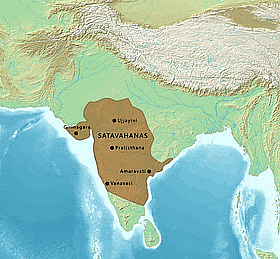 Satvahanana Dynasty
 Religion
Religion in the Satavahana realm was plural and dynamic. While the ruling house emphasised Brahmanical rites, the state also patronised Buddhism, and popular cults of local deities continued to flourish.
- Brahmanical rites and royal sacrality: Satavahana rulers claimed Brahman status in several records and actively participated in major Vedic sacrifices such as the asvamedha and vajapeya, using ritual to legitimise political power and social leadership.
- Vaishnava elements: The rulers and elites also worshipped Vaishnava deities, naming gods such as Krishna and Vasudeva, and making donations to Brahmanas to support Vedic ritual life.
- Buddhism and monastic support: The Satavahanas extended patronage to Buddhist institutions by granting land and resources to monks and monasteries. Mahayana Buddhism, in particular, gained strong followings among certain urban and artisan groups in the region.
- Religious pluralism: The coexistence of Vedic ritualism and Buddhism, combined with local religious practices, made the Satavahana period one of notable religious plurality and patronage across faith lines.
Architecture
The Satavahana period saw intensive development of rock-cut architecture in the north-western Deccan and Maharashtra. Craftsmen carved temples and monastic complexes directly out of the rock, producing two prominent types of structures: the chaitya (prayer hall or temple) and the vihara (monastic residence).
- Rock-cut tradition: The practice of excavating temples and viharas from living rock began around 200 BCE and continued into and beyond the Satavahana age; the work required skilled planning, patient execution and specialised stoneworking techniques.
- Chaitya (temple): Chaityas were large halls with rows of columns leading to an apsidal end that often housed a stupa or sacred image. The chaitya at Karle is a famous example, measuring about 40 metres in length, 15 metres in width, and 15 metres in height, notable for its scale and ornate wood-like stone detailing.
- Vihara (monastery): Viharas were simpler, cell-based residences for monks, usually arranged around a central hall. Sites such as Nasik feature multiple viharas with inscriptions that record donations by rulers like Nahapana and Gautamiputra Satakarni, dating to the first-second centuries AD.
- Regional sites: Important rock-cut centres include Karle, Nasik, Kanheri and early phases of Ajanta; these complexes served both religious and social functions and were focal points for patronage by rulers, merchants and local elites.
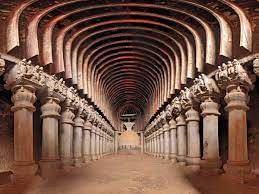 Karla Caves at Karli near Lonavala, Maharashtra.
 Language and Literature
The official and epigraphic language of the Satavahana polity was Prakrit, written in the Brahmi script in inscriptions-continuing an Asokan tradition of administrative language.
- Inscriptions: Satavahana inscriptions are predominantly in Prakrit and employ the Brahmi script. These records include royal proclamations, donation inscriptions, and cave inscriptions that document grants and political achievements.
- Literary works: Some Satavahana kings are associated with Prakrit literary compositions. Notably, the poet-king Hala is traditionally credited with the Gathasaptasati (also called Gaha Sattasai), a collection of some 700 short lyrical verses in Prakrit, reflecting courtly life and love themes. The text underwent later revisions and interpolations, but its association with a Satavahana milieu is widely accepted.
- Administrative usage: Prakrit served as the language of administration and record, making the Satavahana inscriptions important sources for reconstructing political history, religious patronage and social relations in the Deccan.
Concluding Summary
The Satavahana period represents a formative phase in Deccan history when a regional dynasty consolidated power after the Mauryan decline, blended tribal and Brahmanical elements, fostered religious pluralism, and promoted both rock-cut architectural achievements and vibrant material culture. Their inscriptions, literary attributions and archaeology-especially rock-cut caves and evidence of trade-provide the core sources for reconstructing their political, social and cultural history.
FAQs on Old NCERT Summary (RS Sharma): The Age of Satavahanas
| 1. Who were the Satavahanas and why are they important for UPSC history preparation? |  |
| 2. What was the Satavahana administrative system and how did it function in the Deccan? | |
| 3. How did Satavahana trade networks connect India to the Roman Empire and what goods were exchanged? | |
| 4. What was the Satavahana approach to religious patronage and how did Buddhism flourish under their rule? | |
| 5. Which Satavahana rulers were most significant and what were their major achievements? | |





