UPSC Exam > UPSC Notes > History CSE > Mind Map: Indian Society in 18th Century
Mind Map: Indian Society in 18th Century

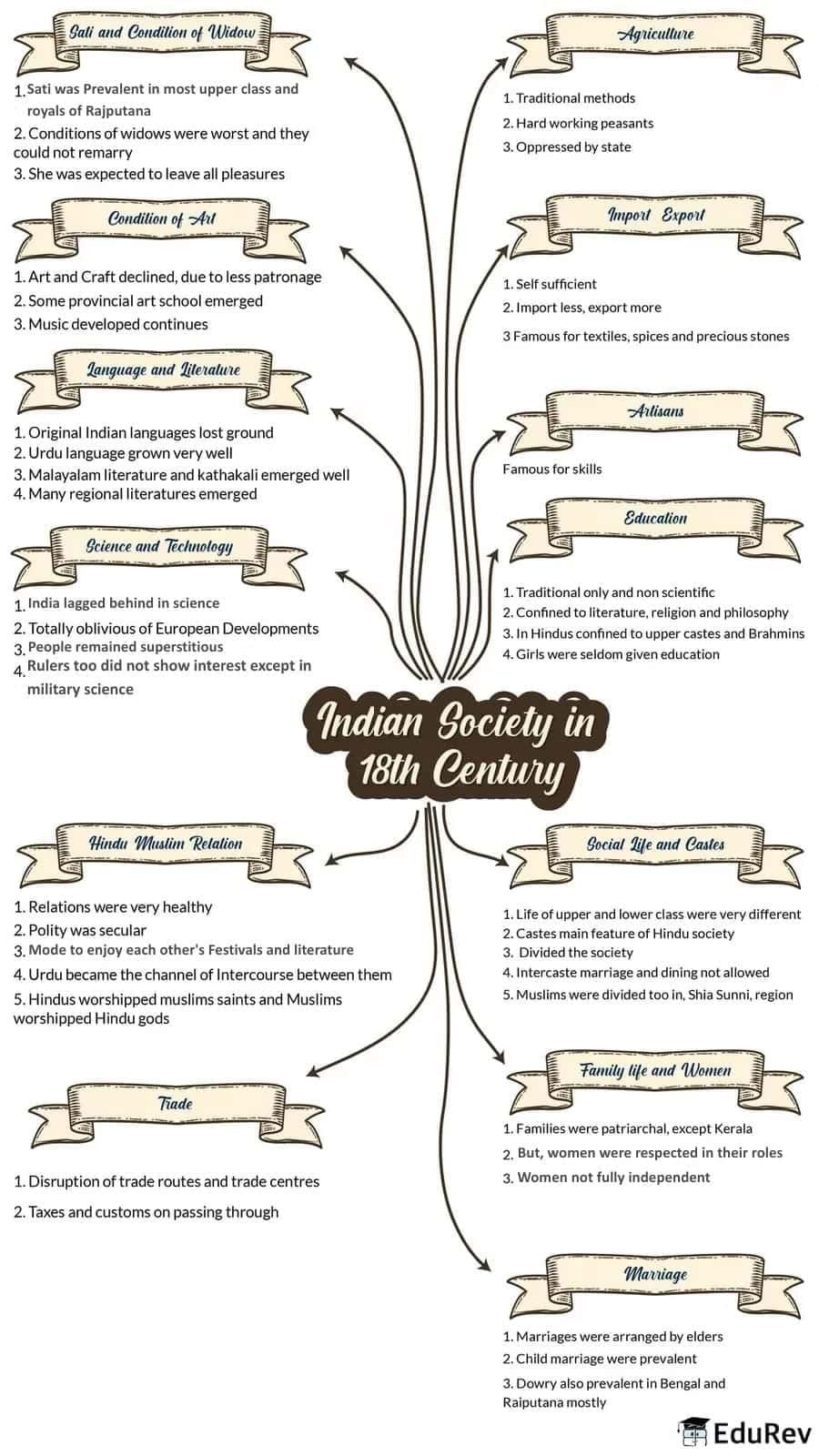
The document Mind Map: Indian Society in 18th Century is a part of the UPSC Course History for UPSC CSE.
All you need of UPSC at this link: UPSC
FAQs on Mind Map: Indian Society in 18th Century
| 1. What were the main social hierarchies and caste divisions in 18th century Indian society? |  |
Ans. Eighteenth-century Indian society was rigidly structured around caste systems, Brahmanical hierarchy, and hereditary occupational divisions that determined social status and livelihood. Brahmins held religious and intellectual authority, while Shudras and untouchables faced severe discrimination. Regional variations existed, but varna-based stratification remained the foundational social framework across most Hindu communities during this period.
| 2. How did the zamindari system and landlord structures affect common people in 18th century India? | |
Ans. The zamindari system created exploitative relationships where zamindars (feudal landlords) collected heavy taxes from peasants and artisans, leaving agricultural communities impoverished. Revenue extraction intensified under colonial transition, destabilising rural economies. Tenant farmers lost land ownership rights, and debt-bonding became widespread, fundamentally altering agrarian social structures and economic interdependence across villages.
| 3. What roles did women hold in 18th century Indian households and society? | |
Ans. Women in 18th-century India were predominantly confined to domestic roles with limited inheritance, education, and legal rights. Practices like sati (widow immolation), child marriage, and purdah (seclusion) were widespread, particularly among upper-caste and elite households. Women's agency was restricted to household management, though lower-caste and tribal women engaged in agricultural labour and craft production with slightly more mobility and economic participation.
| 4. How did religious practices and beliefs shape daily life and social customs in 18th century Indian communities? | |
Ans. Religious beliefs permeated all aspects of 18th-century Indian life through rituals, festivals, pilgrimage traditions, and occupational restrictions tied to faith. Hindu dharma, Islamic practices, and syncretic folk religions influenced marriage customs, dietary rules, and community governance. Temple and mosque economies sustained artisans, musicians, and priests, embedding spirituality deeply within social hierarchies, economic structures, and regional identity formation.
| 5. What was the condition of artisans, merchants, and craftspeople during the 18th century in India? | |
Ans. Eighteenth-century Indian artisans and craftspeople formed crucial middle-class segments, though their prosperity varied regionally. Merchant guilds controlled trade and maintained quality standards, while textile weavers, metalworkers, and jewellers held respected positions. However, competition, monopolies, and declining patronage-particularly under emerging colonial trade patterns-increasingly destabilised craft economies, pushing skilled workers toward debt and economic marginalisation by century's end.
About this Document

14.9K Views

4.91/5 Rating

Apr 18, 2026 Last updated
Related Exams
Document Description: Mind Map: Indian Society in 18th Century for UPSC 2026 is part of History for UPSC CSE preparation. The notes and questions for Mind Map: Indian Society in 18th Century have been prepared according to the UPSC exam syllabus. Information about Mind Map: Indian Society in 18th Century covers topics like and Mind Map: Indian Society in 18th Century Example, for UPSC 2026 Exam. Find important definitions, questions, notes, meanings, examples, exercises and tests below for Mind Map: Indian Society in 18th Century.
Introduction of Mind Map: Indian Society in 18th Century in English is available as part of our History for UPSC CSE for UPSC & Mind Map: Indian Society in 18th Century in Hindi for History for UPSC CSE course. Download more important topics related with notes, lectures and mock test series for UPSC Exam by signing up for free. UPSC: Mind Map: Indian Society in 18th Century
Description
Mind Map: Indian Society in 18th Century of History provides you one-page visual summary of the chapter covering all the important topics. Download the PDF from EduRev.
Information about Mind Map: Indian Society in 18th Century
In this doc you can find the meaning of Mind Map: Indian Society in 18th Century defined & explained in the simplest way possible. Besides explaining types of Mind Map: Indian Society in 18th Century theory, EduRev gives you an ample number of questions to practice Mind Map: Indian Society in 18th Century tests, examples and also practice UPSC tests



Related Searches
shortcuts and tricks, ppt, Free, Extra Questions, Summary, Objective type Questions, Mind Map: Indian Society in 18th Century, MCQs, practice quizzes, mock tests for examination, past year papers, video lectures, Exam, Important questions, study material, pdf , Sample Paper, Mind Map: Indian Society in 18th Century, Mind Map: Indian Society in 18th Century, Viva Questions, Semester Notes, Previous Year Questions with Solutions;