CBSE Class 10 > Class 10 Notes > Mind Maps > Mind Map: Our Environment
Mind Map: Our Environment

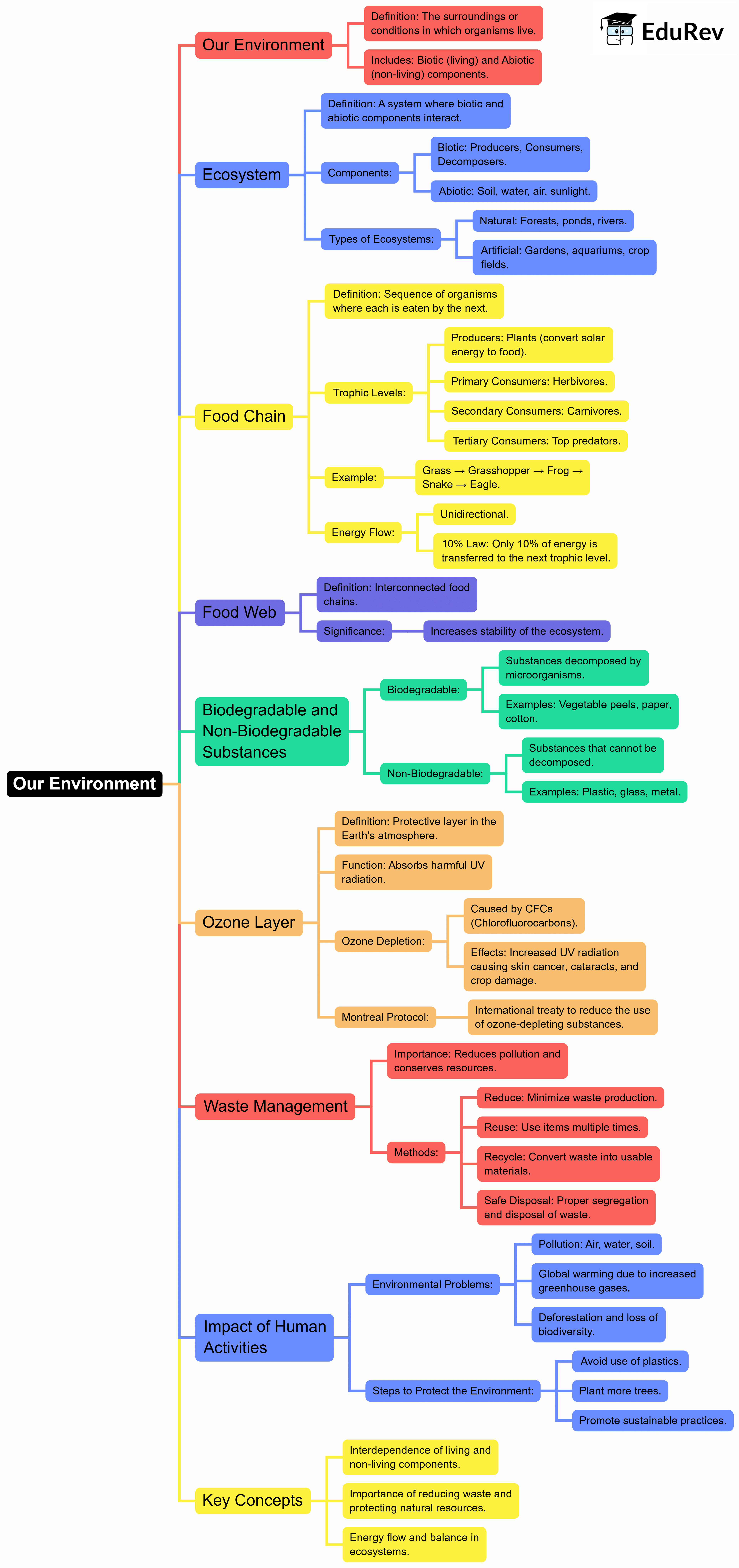
The document Mind Map: Our Environment is a part of the Class 10 Course Mind Maps for Class 10.
All you need of Class 10 at this link: Class 10
FAQs on Mind Map: Our Environment
| 1. What are the main components of our environment that I need to know for Class 10 exams? |  |
Ans. Our environment consists of four interdependent components: the atmosphere (air), hydrosphere (water bodies), lithosphere (land and soil), and biosphere (living organisms). These layers interact constantly to support life on Earth. Understanding how each component functions and connects with others is essential for CBSE Class 10 environmental studies. Mind maps help visualise these relationships clearly and improve retention for board exams.
| 2. How do biotic and abiotic factors interact in an ecosystem? | |
Ans. Biotic factors (living organisms like plants, animals, microorganisms) and abiotic factors (non-living elements like temperature, light, water, soil) work together to create functioning ecosystems. Biotic components depend on abiotic conditions for survival, while organisms modify their physical environment. This interdependence is crucial for ecosystem balance. Visual representations like flowcharts and mind maps effectively show these interactions and relationships for exam preparation.
| 3. What is the difference between renewable and non-renewable resources in environmental studies? | |
Ans. Renewable resources regenerate naturally within a human lifetime-examples include solar energy, wind, forests, and water. Non-renewable resources exist in limited quantities and deplete with use, such as fossil fuels and minerals. Understanding this distinction is vital for sustainable development concepts in Class 10 curriculum. Flashcards and comparative mind maps help students quickly differentiate between these resource types during revision.
| 4. Why is biodiversity important and how does it relate to environmental stability? | |
Ans. Biodiversity ensures ecosystem resilience, genetic diversity, and natural pest control while supporting food chains and nutrient cycles. Greater species variety strengthens ecosystems against environmental disturbances and disease. Loss of biodiversity weakens ecological balance and threatens human survival. This concept connects directly to conservation strategies taught in CBSE environmental science, making it critical for understanding sustainable practices and exam success.
| 5. What causes pollution and how does it affect different environmental components? | |
Ans. Air, water, and soil pollution stem from industrial activities, vehicle emissions, agricultural chemicals, and waste disposal. Pollutants damage atmospheric quality, contaminate water sources, degrade soil fertility, and harm living organisms across ecosystems. Pollution disrupts nutrient cycles and food chains, threatening biodiversity. Using structured mind maps and infographics helps students understand pollution pathways and environmental impact comprehensively for their Class 10 assessments.
About this Document

1.1K Views

4.67/5 Rating

Apr 19, 2026 Last updated
Document Description: Mind Map: Our Environment for Class 10 2026 is part of Mind Maps for Class 10 preparation. The notes and questions for Mind Map: Our Environment have been prepared according to the Class 10 exam syllabus. Information about Mind Map: Our Environment covers topics like and Mind Map: Our Environment Example, for Class 10 2026 Exam. Find important definitions, questions, notes, meanings, examples, exercises and tests below for Mind Map: Our Environment.
Introduction of Mind Map: Our Environment in English is available as part of our Mind Maps for Class 10 for Class 10 & Mind Map: Our Environment in Hindi for Mind Maps for Class 10 course. Download more important topics related with notes, lectures and mock test series for Class 10 Exam by signing up for free. Class 10: Mind Map: Our Environment
Description
Mind Map: Our Environment of Mind Maps provides you one-page visual summary of the chapter covering all the important topics. Download the PDF from EduRev.
Information about Mind Map: Our Environment
In this doc you can find the meaning of Mind Map: Our Environment defined & explained in the simplest way possible. Besides explaining types of Mind Map: Our Environment theory, EduRev gives you an ample number of questions to practice Mind Map: Our Environment tests, examples and also practice Class 10 tests



Related Searches
practice quizzes, Exam, Sample Paper, video lectures, Mind Map: Our Environment, Previous Year Questions with Solutions, past year papers, Mind Map: Our Environment, study material, Extra Questions, Semester Notes, Important questions, Viva Questions, Mind Map: Our Environment, mock tests for examination, Free, pdf , MCQs, Objective type Questions, Summary, shortcuts and tricks, ppt;