NEET Exam > NEET Notes > Chemistry Class 12 > Mind Map: Solutions
Mind Map: Solutions

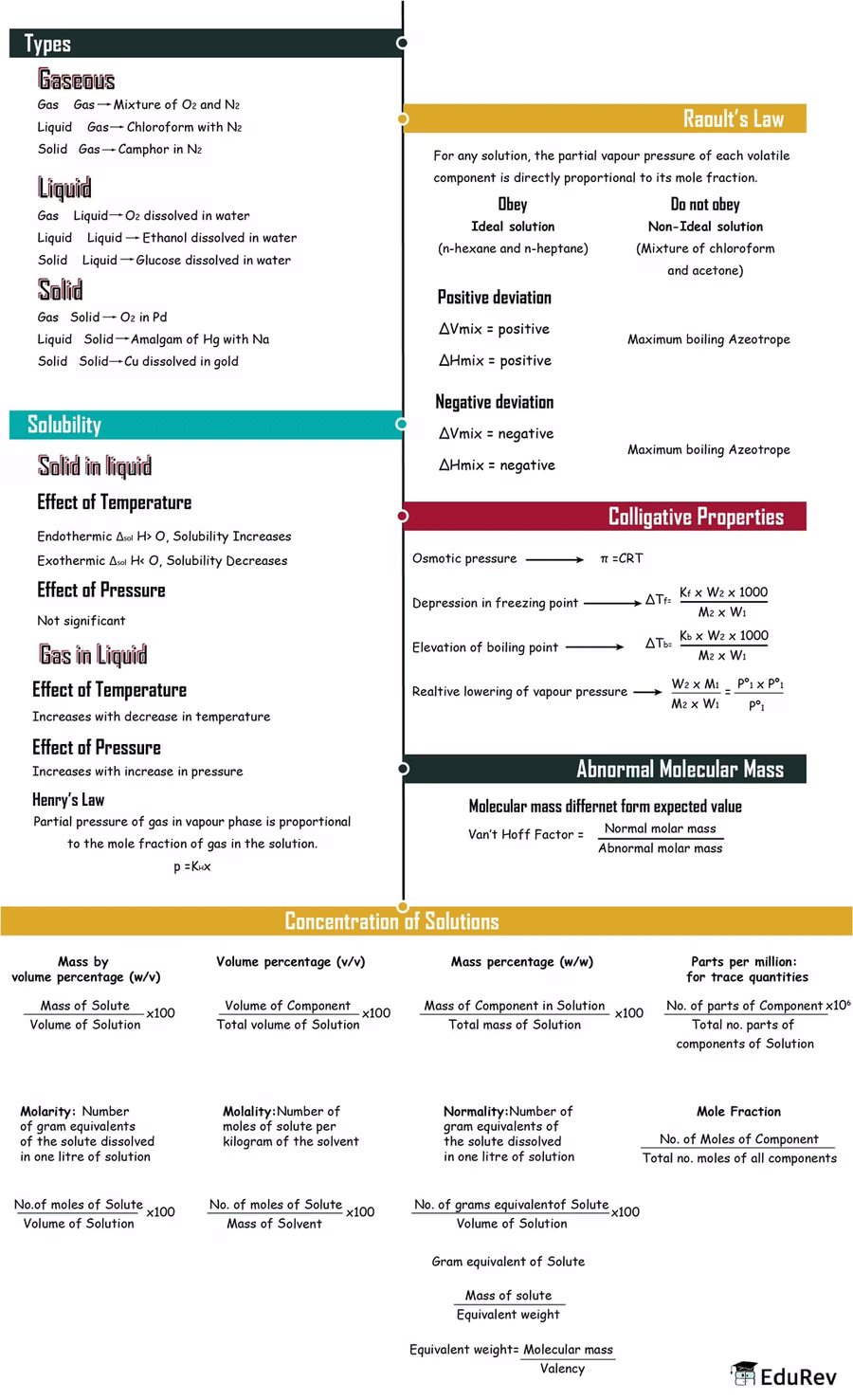
The document Mind Map: Solutions is a part of the NEET Course Chemistry Class 12.
All you need of NEET at this link: NEET
FAQs on Mind Map: Solutions
| 1. What exactly is a solution in chemistry and how is it different from a mixture? |  |
Ans. A solution is a homogeneous mixture where a solute dissolves completely in a solvent at the molecular level, forming a single phase with uniform composition throughout. Unlike suspensions or colloids, solutions cannot be separated by filtration and appear transparent. The solute particles are so small they don't scatter light, making solutions optically clear and chemically stable under standard conditions.
| 2. How do I calculate molarity, molality, and normality without getting confused between them? | |
Ans. Molarity measures moles of solute per litre of solution; molality measures moles per kilogram of solvent; normality measures equivalents per litre of solution. Molarity changes with temperature since volume varies, while molality remains constant. Normality depends on the number of reactive groups-use it for acids, bases, and redox reactions. Refer to mind maps and flashcards to distinguish these concentration units visually.
| 3. Why does some salt dissolve in water but other salts don't, and what's saturation got to do with it? | |
Ans. Solubility depends on the nature of solute-solvent interactions and temperature. A saturated solution contains the maximum amount of dissolved solute at a given temperature; adding more solute won't dissolve further. Supersaturated solutions are unstable and can crystallise suddenly. Solubility curves show how solubility changes with temperature, helping predict precipitation and crystallisation behaviour in chemical processes.
| 4. What's the difference between ideal solutions and real solutions, and does it matter for NEET? | |
Ans. Ideal solutions follow Raoult's law perfectly, with no volume change or heat exchange during mixing. Real solutions deviate from Raoult's law, showing positive or negative deviations based on intermolecular forces. For NEET Chemistry Class 12, understanding deviations helps explain colligative properties like boiling point elevation and freezing point depression. Most practical solutions are non-ideal but treated as ideal for calculations.
| 5. How do colligative properties like boiling point elevation and osmotic pressure actually work in solutions? | |
Ans. Colligative properties depend solely on the number of solute particles, not their identity. When solute dissolves, it lowers vapour pressure, raising the boiling point and lowering the freezing point. Osmotic pressure arises when solvent molecules move across a semipermeable membrane toward higher solute concentration. These four properties-vapour pressure lowering, boiling point elevation, freezing point depression, and osmotic pressure-are interconnected and essential for exam success.
About this Document

2.2K Views

4.62/5 Rating

Apr 18, 2026 Last updated
Document Description: Mind Map: Solutions for NEET 2026 is part of Chemistry Class 12 preparation. The notes and questions for Mind Map: Solutions have been prepared according to the NEET exam syllabus. Information about Mind Map: Solutions covers topics like and Mind Map: Solutions Example, for NEET 2026 Exam. Find important definitions, questions, notes, meanings, examples, exercises and tests below for Mind Map: Solutions.
Introduction of Mind Map: Solutions in English is available as part of our Chemistry Class 12 for NEET & Mind Map: Solutions in Hindi for Chemistry Class 12 course. Download more important topics related with notes, lectures and mock test series for NEET Exam by signing up for free. NEET: Mind Map: Solutions
Description
Mind Map: Solutions of Chemistry Class 12 provides you one-page visual summary of the chapter covering all the important topics. Download the PDF from EduRev.
Information about Mind Map: Solutions
In this doc you can find the meaning of Mind Map: Solutions defined & explained in the simplest way possible. Besides explaining types of Mind Map: Solutions theory, EduRev gives you an ample number of questions to practice Mind Map: Solutions tests, examples and also practice NEET tests



Related Searches
mock tests for examination, Extra Questions, Sample Paper, Mind Map: Solutions, Important questions, practice quizzes, Exam, Previous Year Questions with Solutions, Mind Map: Solutions, past year papers, video lectures, pdf , shortcuts and tricks, Objective type Questions, Free, ppt, Semester Notes, Summary, MCQs, study material, Mind Map: Solutions, Viva Questions;