CBSE Class 10 > Class 10 Notes > Social Studies (SST) > Mind Map: Nationalism in India
Mind Map: Nationalism in India

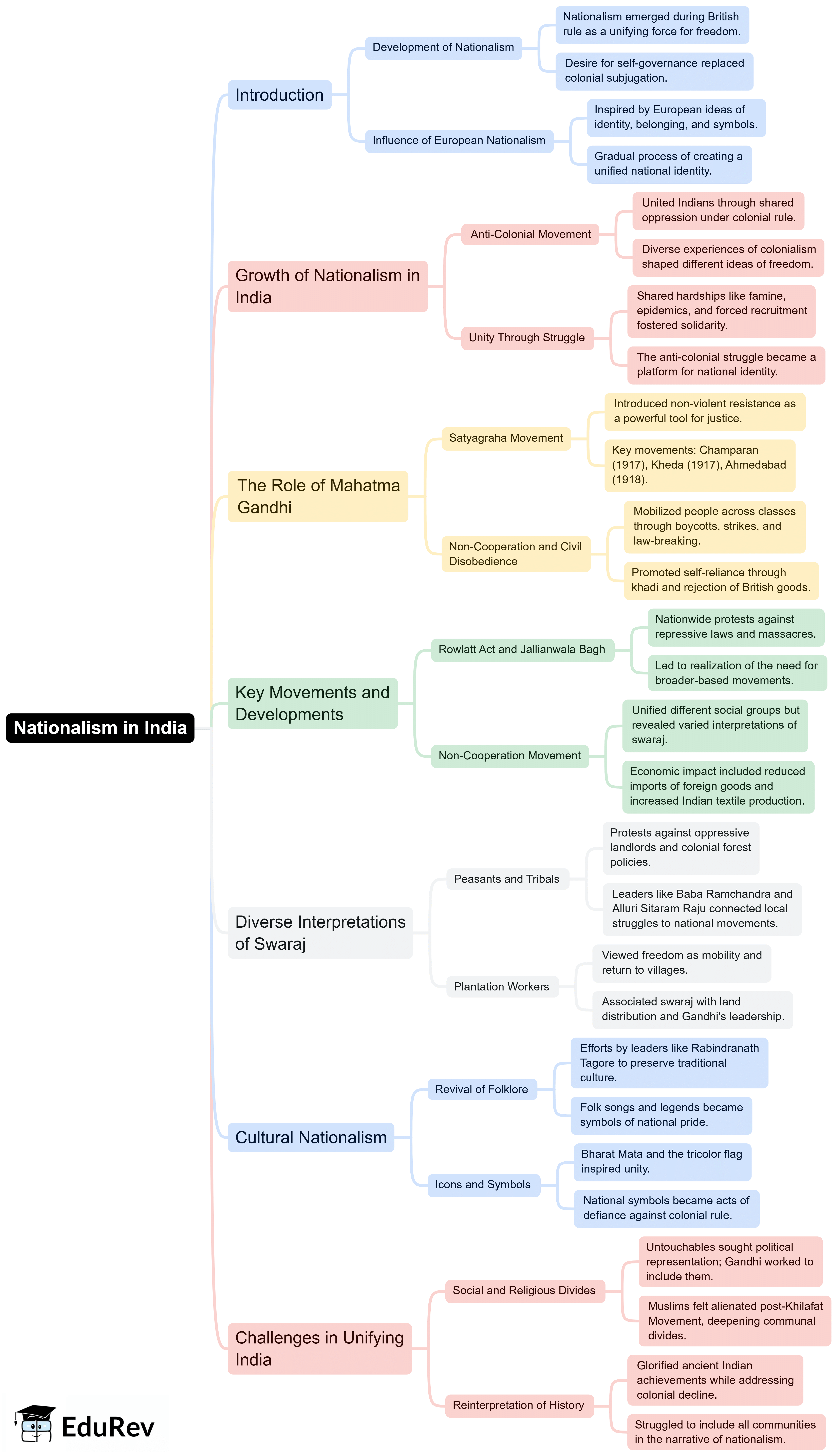
The document Mind Map: Nationalism in India is a part of the Class 10 Course Social Studies (SST) Class 10.
All you need of Class 10 at this link: Class 10
FAQs on Mind Map: Nationalism in India
| 1. What are the main causes of nationalism in India during the independence movement? |  |
Ans. Indian nationalism emerged from colonial exploitation, economic drain, and cultural awakening in the 19th century. Key factors included resentment against British rule, the rise of educated middle class, revival of Indian culture and heritage, and influences from Western political ideas like democracy and equality. These combined to create a powerful freedom struggle.
| 2. How did the Indian National Congress contribute to India's independence struggle? | |
Ans. The Indian National Congress, founded in 1885, became the primary platform for nationalist leaders and independence activists. It organized mass movements, articulated Indian grievances against colonial rule, and united people across regions and religions. Through constitutional methods initially, then civil disobedience under Gandhi, Congress transformed nationalism into organized political action.
| 3. What's the difference between moderate and radical nationalists in the independence movement? | |
Ans. Moderate nationalists like Dadabhai Naoroji and Gopal Krishna Gokhale pursued constitutional reforms and petitions to achieve self-governance. Radical nationalists like Bal Gangadhar Tilak and Lala Lajpat Rai believed in aggressive resistance and armed struggle. While moderates sought gradual change through existing systems, radicals demanded immediate independence using revolutionary methods and mass agitation.
| 4. Why is Mahatma Gandhi considered the father of Indian nationalism? | |
Ans. Gandhi transformed Indian nationalism through non-violent civil disobedience and mass mobilisation. His philosophy of Satyagraha united millions across social divisions, making independence a people's movement rather than elite-led struggle. Gandhi's methods proved effective against British rule, inspiring global freedom movements and establishing India's nationalist identity based on truth and non-violence.
| 5. How did regional movements strengthen the overall nationalist struggle in India? | |
Ans. Regional nationalist movements in Bengal, Maharashtra, Tamil Nadu, and Punjab each contributed unique perspectives and leaders to India's freedom struggle. Bengal's revolutionary movement, Maharashtra's social reform activism, and Punjab's Sikh nationalism created multiple pressure points against colonial rule. These interconnected regional efforts transformed isolated protests into a cohesive, all-India nationalist movement for independence.
About this Document

4.3K Views

4.78/5 Rating

Apr 19, 2026 Last updated
Document Description: Mind Map: Nationalism in India for Class 10 2026 is part of Social Studies (SST) Class 10 preparation. The notes and questions for Mind Map: Nationalism in India have been prepared according to the Class 10 exam syllabus. Information about Mind Map: Nationalism in India covers topics like and Mind Map: Nationalism in India Example, for Class 10 2026 Exam. Find important definitions, questions, notes, meanings, examples, exercises and tests below for Mind Map: Nationalism in India.
Introduction of Mind Map: Nationalism in India in English is available as part of our Social Studies (SST) Class 10 for Class 10 & Mind Map: Nationalism in India in Hindi for Social Studies (SST) Class 10 course. Download more important topics related with notes, lectures and mock test series for Class 10 Exam by signing up for free. Class 10: Mind Map: Nationalism in India
Description
Mind Map: Nationalism in India of SST provides you one-page visual summary of the chapter covering all the important topics. Download the PDF from EduRev.
Information about Mind Map: Nationalism in India
In this doc you can find the meaning of Mind Map: Nationalism in India defined & explained in the simplest way possible. Besides explaining types of Mind Map: Nationalism in India theory, EduRev gives you an ample number of questions to practice Mind Map: Nationalism in India tests, examples and also practice Class 10 tests



Related Searches
Summary, past year papers, video lectures, MCQs, mock tests for examination, Exam, shortcuts and tricks, ppt, Sample Paper, Objective type Questions, Free, Semester Notes, Mind Map: Nationalism in India, pdf , practice quizzes, study material, Extra Questions, Mind Map: Nationalism in India, Previous Year Questions with Solutions, Viva Questions, Mind Map: Nationalism in India, Important questions;