UPSC Exam > UPSC Notes > Class 6 to 12 NCERT Mindmaps Preparation > Mind Map: Print Culture & the Modern World
Mind Map: Print Culture & the Modern World

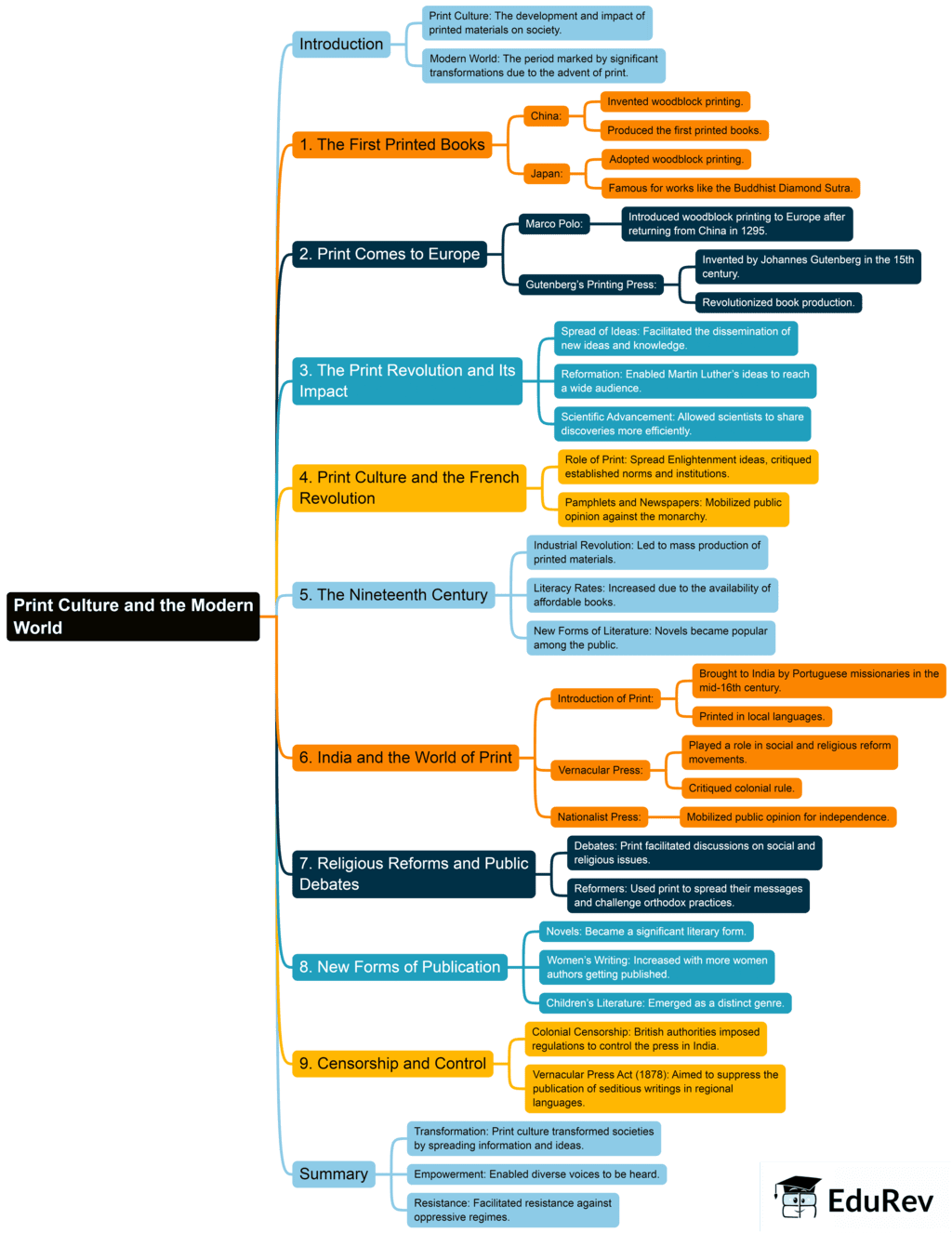
The document Mind Map: Print Culture & the Modern World is a part of the UPSC Course Class 6 to 12 NCERT Mindmaps for UPSC Preparation.
All you need of UPSC at this link: UPSC
FAQs on Mind Map: Print Culture & the Modern World
| 1. How did the printing press change the way books were made and shared in the modern world? |  |
Ans. The printing press, invented by Gutenberg in the 15th century, mechanically reproduced texts, making books cheaper and faster to produce than hand-copying. This revolutionary technology democratised access to knowledge, allowing multiple copies to reach wider audiences beyond the wealthy elite. Print culture transformed literacy rates and enabled the spread of new ideas across Europe and eventually globally.
| 2. What's the difference between oral culture and print culture that students need to know for UPSC? | |
Ans. Oral culture relies on spoken word and memory transmission, while print culture depends on written, published texts for information storage and dissemination. Print culture introduced standardised knowledge, permanent records, and wider accessibility compared to oral traditions. Understanding this shift is crucial for CBSE history, as it marks a fundamental change in how societies preserved and shared information across generations.
| 3. Why did religious groups and governments try to control printing in early modern Europe? | |
Ans. Religious authorities and rulers feared that printed materials would spread ideas challenging their power and beliefs. Mass-produced books could reach common people, potentially undermining Church doctrine and state authority. Censorship and licensing systems emerged to regulate what got printed, revealing how print culture threatened established hierarchies and forced institutions to adapt control mechanisms.
| 4. How did the development of print culture impact the scientific revolution and Enlightenment? | |
Ans. Printed scientific treatises allowed scholars worldwide to access and critique research simultaneously, accelerating discovery and standardising knowledge. The printing press enabled philosophers to circulate Enlightenment ideas rapidly, challenging medieval thinking. Mass distribution of books fostered intellectual exchange, debate, and the emergence of modern scientific method-fundamentally reshaping how knowledge was validated and shared globally.
| 5. What role did printing play in creating national identities and standardising languages? | |
Ans. Printing standardised spelling, grammar, and vocabulary within regional languages, establishing consistent written forms. Published books in vernacular languages strengthened local linguistic identity against Latin dominance. Print culture enabled nation-states to create unified communication systems and shared cultural narratives, making language a tool for consolidating national consciousness and administrative control during the early modern period.
About this Document

1.4K Views

4.81/5 Rating

Apr 19, 2026 Last updated
Document Description: Mind Map: Print Culture & the Modern World for UPSC 2026 is part of Class 6 to 12 NCERT Mindmaps for UPSC Preparation preparation. The notes and questions for Mind Map: Print Culture & the Modern World have been prepared according to the UPSC exam syllabus. Information about Mind Map: Print Culture & the Modern World covers topics like and Mind Map: Print Culture & the Modern World Example, for UPSC 2026 Exam. Find important definitions, questions, notes, meanings, examples, exercises and tests below for Mind Map: Print Culture & the Modern World.
Introduction of Mind Map: Print Culture & the Modern World in English is available as part of our Class 6 to 12 NCERT Mindmaps for UPSC Preparation for UPSC & Mind Map: Print Culture & the Modern World in Hindi for Class 6 to 12 NCERT Mindmaps for UPSC Preparation course. Download more important topics related with notes, lectures and mock test series for UPSC Exam by signing up for free. UPSC: Mind Map: Print Culture & the Modern World
Description
Mind Map: Print Culture & the Modern World of Class 6 to 12 NCERT Mindmaps provides you one-page visual summary of the chapter covering all the important topics. Download the PDF from EduRev.
Information about Mind Map: Print Culture & the Modern World
In this doc you can find the meaning of Mind Map: Print Culture & the Modern World defined & explained in the simplest way possible. Besides explaining types of Mind Map: Print Culture & the Modern World theory, EduRev gives you an ample number of questions to practice Mind Map: Print Culture & the Modern World tests, examples and also practice UPSC tests



Related Searches
pdf , shortcuts and tricks, Mind Map: Print Culture & the Modern World, Previous Year Questions with Solutions, Summary, study material, Semester Notes, past year papers, mock tests for examination, video lectures, Important questions, Free, Exam, MCQs, Sample Paper, Objective type Questions, ppt, practice quizzes, Mind Map: Print Culture & the Modern World, Mind Map: Print Culture & the Modern World, Viva Questions, Extra Questions;