GATE Past Year Questions: Fluid Statics

Q1: A pressure measurement device fitted on the surface of a submarine, located at a depth H below the surface of an ocean, reads an absolute pressure of 4.2 MPa. The density of sea water is 1050 kg/m3 , the atmospheric pressure is 101 kPa, and the acceleration due to gravity is 9.8 m/s2 . The depth H is _______ m (round off to the nearest integer). (2021 Set - 1)
(a) 128
(b) 398
(c) 478
(d) 256
Ans: (b)
Sol: 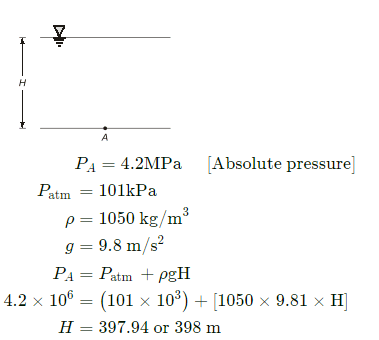
Q2: In the space above the mercury column in a barometer tube, the gauge pressure of the vapour is (2020 Set - 2)
(a) positive, but more than one atmosphere
(b) negative
(c) zero
(d) positive, but less than one atmosphere
Ans: (b)
Sol: 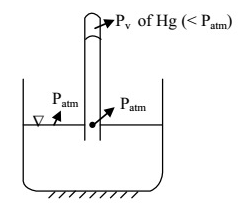 In space above mercury column in barometer, ideally perfect vaccum is expected. But due to evaporation of mercury , the pressure in that space is equal to vapour pressure of mercury [nearly 0.2 Pa (abs)] . As absolute pressure in that space is less than atmospheric pressure, gauge pressure is negative.
Q3: Which of the following conditions is used lo determine the stable equilibrium of all partially submerged floating bodies? (2020 Set - 2)
(a) Centre of buoyancy must be above the centre of gravity
(b) Centre of buoyancy must be below the centre of gravity
(c) Metacentre must be at a higher level than the centre of gravity
(d) Metacentre must be at a lower level than the centre of gravity
Ans: (c)
Sol: Metacentre must be higher level than the centre of gravity
Try yourself: For the stability of a floating body the [2017 : Set-2]
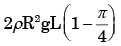
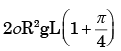
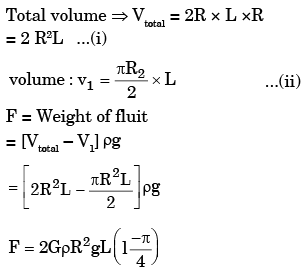
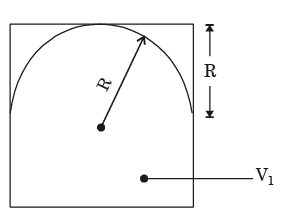
Try yourself: Consider a frictionless, massless and leak-proof plug blocking a rectangular hole of dimensions 2R × L at the bottom of an open tank as shown in the figure. The head of the plug has the shape of a semi-cylinder of radius R. The tank is filled with a liquid of density ρ up to the tip of the plug. [2016 : Set-1] The force F required to hold the plug in its position is ρR2δgL π/2ρR2gL
The gravitational acceleration is g. Neglect the effect of the atmospheric pressure.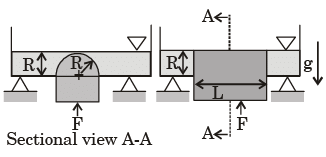
Try yourself: For a floating body, buoyant force acts at the [2016 : Set-1]
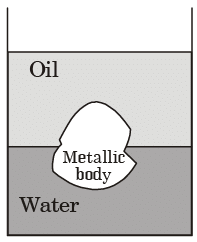
Try yourself: The large vessel shown in the figure contains oil and water. A body is submerged at the interface of oil and water such that 45 percent of its volume is in oil while the rest is in water. [2016 : Set-2]
The density of the body is _______ kg/m3.
The specific gravity of oil is 0.7 and density of water is 1000 kg/m3.
Acceleration due to gravity: g = 10 m/s2.
Try yourself: For a completely submerged body with centre of gravity G and centre of buoyancy B, the condition of stability will be [2014 : Set-1]
Try yourself: A hinged gate of length 5 m, inclined at 30° with the horizontal and with water mass on its left, is shown in figure below. Density of water is 1000 kg/m3. The minimum mass of the gate in kg per unit width (perpendicular to the plane of paper), required to keep it closed [2013]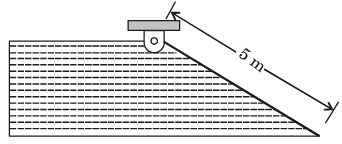
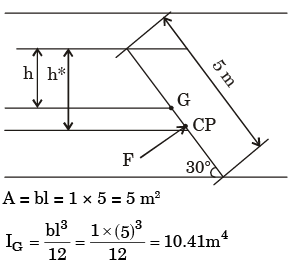
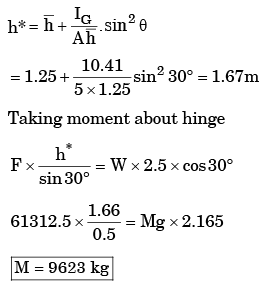
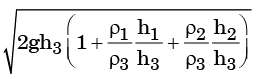
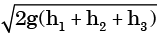
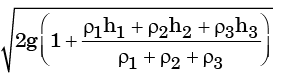
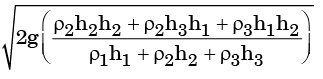
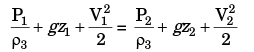
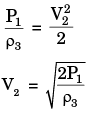
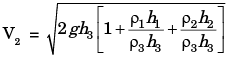
Try yourself: A large tank with a nozzle attached contains three immiscible, inviscid fluids as shown. Assuming that the changes in h1, h2 and h3 are negligible, the instantaneous discharge velocity is [2012]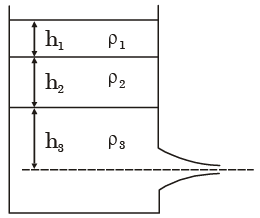
Try yourself: For the stability of a floating body, under the influence of gravity alone, which of the following is TRUE? [2010]
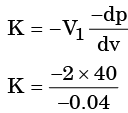
Try yourself: Oil in a hydraulic cylinder is compressed from an initial volume 2m3 to 1.96 m3. If the pressure of oil in the cylinder changes from 40 MPa to 80 MPa during compression, the bulk modulus of elasticity of oil is [2007]

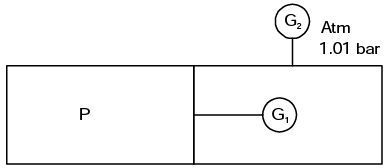
Try yourself: The pressure gauges G1 and G2 installed on the system show pressure of ρG1 = 5.00 bar and ρG2 = 1.00 bar. The value of unknown pressure P is [Atmospheric pressure = 1.01 bar] [2004]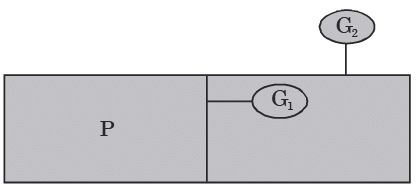

Try yourself: A closed cylinder having a radius R and height H is filled with oil of density ρ. If the cylinder is rotated about its axis at an angular velocity of ω, the thrust at the bottom of the cylinder is [2004] πR2rgH πR2(rw2R2 + ρgH)
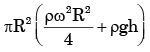
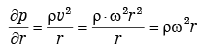 [∵ v = ω × r]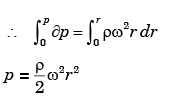

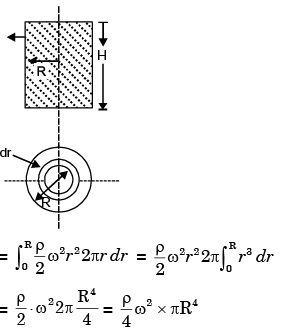
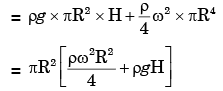
Try yourself: A cylindrical body of cross-sectional area A, height H and density ρs, is immersed to a depth h in a liquid of density ρ, and tied to the bottom with a string. The tension in the string is ____. [2003]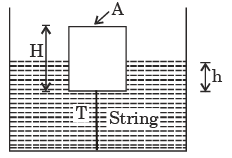
Try yourself: A static fluid can have [2001]
Try yourself: The horizontal and vertical hydrostatic forces Fx and Fy on the semicircular gate, having a width w into the plane of figure, are [2001]

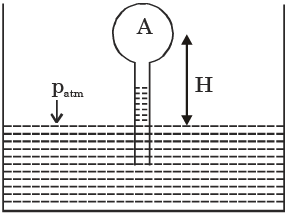
Try yourself: In given figure, if the pressure of gas in bulb A is 50 cm Hg vacuum and patm = 76 cm Hg, then height of column H is equal to [2000]
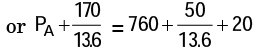
Try yourself: Refer to figure, the absolute pressure of gas A in the bulb is [1997]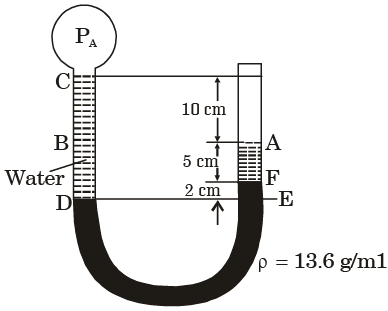
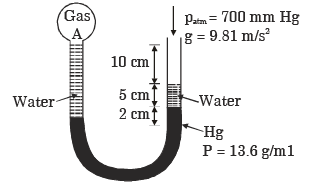
Try yourself: A mercury manometer is used to measure the static pressure at a point in a water pipe as shown in figure. The level difference of mercury in the two limbs is 10 mm. The gauge pressure at that point is [1996]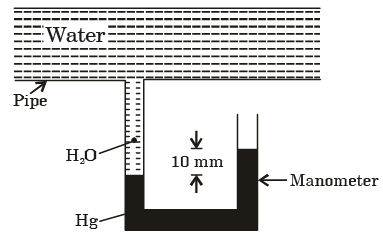
Try yourself: The force F needed to support the liquid of density ρ and the vessel on top (fig.) is [1995]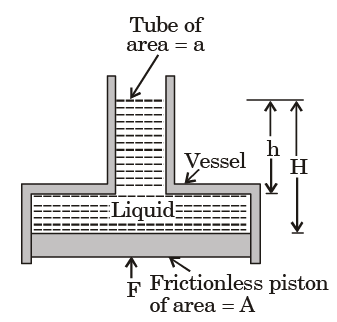
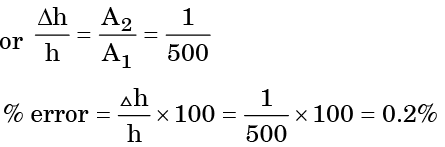
Try yourself: The cross-sectional area of one limb of a U-tube manometer (figure shown below) is made 500 times larger than the other, so that the pressure difference between the two limbs can be determined by measuring h on one limb of the manometer. The percentage error involved is [1990]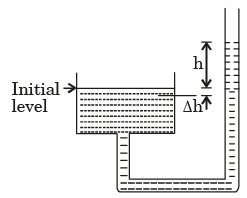
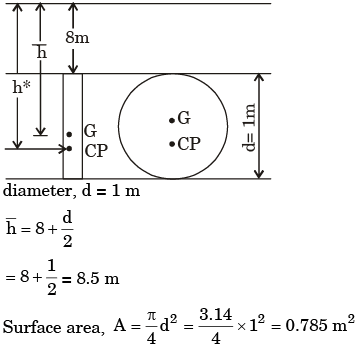
Try yourself: A circular plate 1 m in diameter is submerged vertically in water such its upper edge is 8 m below the free surface of water. The total hydrostatic pressure force on one side of plate is [1988]
FAQs on GATE Past Year Questions: Fluid Statics
| 1. What is fluid statics in civil engineering? |  |
| 2. How is pressure distributed in a fluid at rest? | |
| 3. What is the significance of fluid statics in civil engineering projects? | |
| 4. How can the concept of fluid statics be applied in designing a dam? | |
| 5. What are some practical applications of fluid statics in civil engineering? | |