GATE Past Year Questions: Psychrometric Process

Q1: A rigid tank of volume 50m3 contains a pure substance as a saturated liquid vapour mixture at 400 kPa. Of the total mass of the mixture, 20% mass is liquid and 80% mass is vapour. Properties at 400 kPa are : Tsat = 143.61ºC, vf = 0.001084 m3/kg, vg = 0.46242m3/kg. The total mass of liquid vapour mixture in the tank is _______kg (round off to the nearest integer). [GATE ME 2021 SET-2]
Ans: 134 to 136
Vtotal = vl + vv
= vf × ml + vg × mv
50 = 0.001084 x 0.2m + 0.46242 x 0.8 m
m = 135.08 kg = 135 kg
Q2: An air-conditioning system provides a continuous flow of air to a room using an intake duct and an exit duct, as shown in the figure. To maintain the quality of the indoor air, the intake duct supplies a mixture of fresh air with a cold air stream. The two streams are mixed in an insulated mixing chamber located upstream of the intake duct. Cold air enters the mixing chamber at 5ºC, 105 kPa with a volume flow rate of 1.25 m3/s during steady state operation. Fresh air enters the mixing chamber at 34ºC and 105 kPa. The mass flow rate of the fresh air is 1.6 times of the cold air stream. Air leaves the room through the exit duct at 24ºC.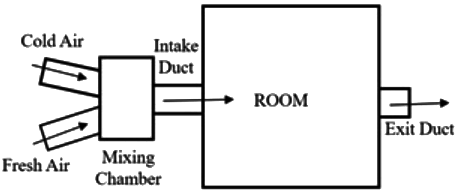 Assuming the air behaves as an ideal gas with cp = 1.005 kJ/kg.K and R = 0.287 kJ/kg.K, the rate of heat gain by the air from the room is ________kW(round off to two decimal places). [GATE ME 2021 SET-1]
Ans: 4.9 to 5.1
1: Cold air
2: Hot air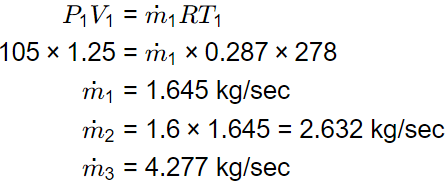
After mixing: 0
1.645 × 5 + 2.632 × 34 = 4.277 t3
t3 = 22.85ºC
Heat gain : = h4 - h3
= 4.277 x 1.005 (24 - 22.85)
= 4.963 kW
Try yourself: Wet bulb depression, under saturated ambient air conditions: [1989]
Try yourself: During the Chemical dehumidification process of air [1999]
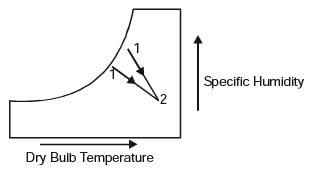
Try yourself: Water at 42°C is sprayed into a stream of air at atmospheric pressure, dry bulb temperature of 40ºC and a wet bulb temperature of 20°C. The air leaving the spray humidifier is not saturated. Which of the following statements is true? [2005]
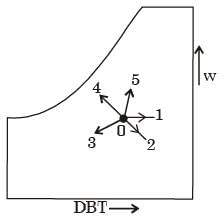
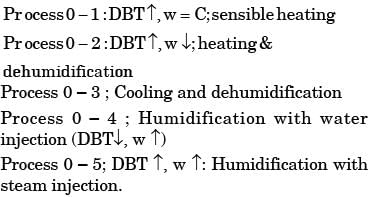
Try yourself: Various psychrometric processes are shown in the figure below. Name of the process [2005]
Process in Figure
P. 0-1
Q. 0-2
R. 0-3
S. 0-4
T. 0-5
(i) Chemical dehumidification
(ii) Sensible heating
(iii) Cooling and dehumidification
(iv) Humidification with steam injection
(v) Humidification with water injection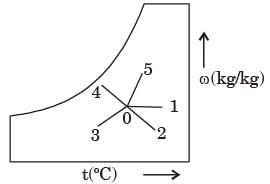
The matching pair are
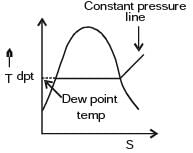
Try yourself: Dew point temperature is the temperature at which condensation begins when the air is cooled at constant [2006]
Try yourself: The statements concern psychrometric chart. [2006]
1. Constant relative humidity lines are uphill straight lines to the right.
2. Constant wet bulb temperature lines are downhill straight lines to the right.
3. Constant specific volume lines are downhill straight lines to the right.
4. Constant enthalpy lines are coincident with constant wet bulb temperature lines.
Which of the statements are correct?
Try yourself: Atmospheric air at a flow rate of 3 kg/s (on dry basis) enters a cooling and dehumidifying coil with an enthalpy of 85 kJ/kg of dry air and a humidity ratio of 19 grams/kg of dry air. The air leaves the coil with an enthalpy of 43 kJ/kg of dry air and a humidity ratio of 8 grams/kg of dry air. If the condensate water leaves the coil with an enthalpy of 67 kJ/kg, the required cooling capacity of the coil in kW is [2007]

Try yourself: Air (at atmospheric pressure) at a dry bulb temperature of 40°C and wet bulb temperature of 20°C is humidified in an air washer operating with continuous water recirculation. The wet bulb depression, the difference between the dry and wet bulb temperatures) at the exit is 25% of that at the inlet. The dry bulb temperature at the exit of the air washer is closest to [2008]
Try yourself: Moist air at 35°C and 100% relative humidity is entering a psychrometric device and leaving at 25°C and 100% relative humidity. The name of the device is [2014]
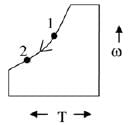
Try yourself: If a mass of moist air contained in a closed metallic vessel is heated, then its [2017]

FAQs on GATE Past Year Questions: Psychrometric Process
| 1. What is a psychrometric process and why is it important in engineering? |  |
| 2. How do you read a psychrometric chart? | |
| 3. What are the key processes in psychrometrics? | |
| 4. How does the psychrometric process apply to HVAC systems? | |
| 5. What are the common equations used in psychrometrics? | |