NEET Exam  >  NEET Notes  >  Chemistry Class 11  >  Hydrogen Bonding

Hydrogen Bonding | Chemistry Class 11 - NEET PDF Download

Hydrogen Bonding

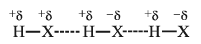
  • Definition: A hydrogen bond is a specific attractive interaction that occurs when a hydrogen atom covalently bonded to a highly electronegative atom (commonly F, O or N) is simultaneously attracted by another nearby electronegative atom. This results in a weak bond often drawn as a dotted line (→···) between the hydrogen and the acceptor atom.
  • Hydrogen Bonding
  • In a hydrogen bond the hydrogen atom is effectively linked to two electronegative centres at the same time: one by a covalent bond and the other by the hydrogen bond; for this reason it is often described as forming a hydrogen bridge.
  • A hydrogen bond is primarily an electrostatic attractive force with some partial covalent character; it is weaker than ordinary covalent or ionic bonds. Typical bond energies lie roughly in the range 2-10 kcal mol-1 (approx. 8-40 kJ mol-1), depending on the atoms and geometry involved.

Conditions for Hydrogen Bonding

  • The molecule must have a hydrogen atom covalently bonded to a highly electronegative atom such as F, O or N. Greater electronegativity increases polarisation of the X-H bond and strengthens the H-bond.
  • The electronegative atom acting as the hydrogen-bond acceptor should be relatively small so that the H...A distance is sufficiently short; smaller acceptors give stronger electrostatic attraction.
  • The acceptor atom must have at least one lone pair of electrons available to interact with the hydrogen atom.
  • Hydrogen bonds are directional: nearly linear X-H...A arrangements (angle close to 180°) are stronger than bent ones.

Types of Hydrogen Bonding

Types of Hydrogen Bonding

Intermolecular Hydrogen Bonding

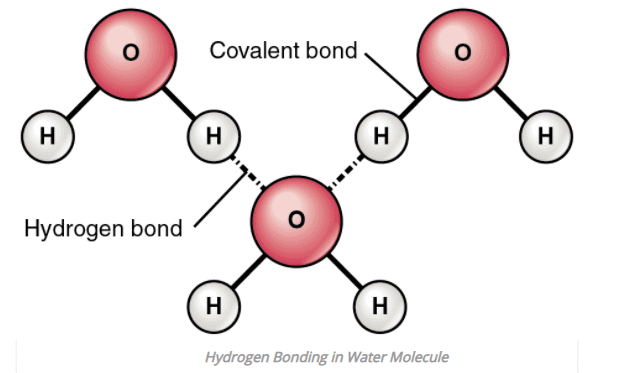
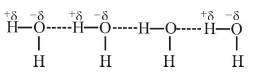
  • When hydrogen bonding occurs between hydrogen-bond donors and acceptors belonging to different molecules, it is called intermolecular hydrogen bonding.
  • Examples: HF, H2O, and alcohols (ROH) form intermolecular H-bonds. Intermolecular hydrogen bonding between different compounds is common (for example, water with ammonia, or water with alcohols).
  • Intermolecular hydrogen bonding raises boiling points, increases viscosity, raises surface tension and affects solubility in polar solvents. It also leads to association (for example, dimerisation of carboxylic acids in non-polar solvents/vapour).
  • Intermolecular Hydrogen Bonding

Intramolecular Hydrogen Bonding

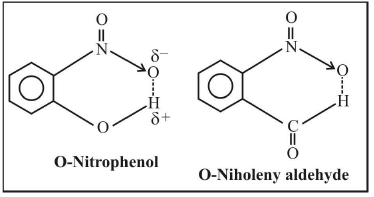
  • If the hydrogen bond is formed within a single molecule-between a hydrogen bonded to an electronegative atom and another electronegative atom elsewhere in the same molecule-the bond is called intramolecular hydrogen bonding.
  • Intramolecular H-bonding typically occurs when the molecular geometry brings donor and acceptor groups into proximity (examples include o-substituted phenols and o-nitrophenol).
  • Intramolecular H-bonds reduce the ability of a molecule to form intermolecular H-bonds and therefore often lower boiling point and reduce solubility in polar solvents relative to positional isomers that form intermolecular H-bonds.
  • Examples: o-Nitrophenol (intramolecular O-H...O bond). Another example in carbonyl chemistry is the formation of an O-H...O bond in some ortho-substituted hydroxy aldehydes/ketones.

Characteristics and Strength

  • Strength: Hydrogen bonds are stronger than ordinary van der Waals forces but much weaker than covalent and ionic bonds; typical energies are 2-10 kcal mol-1.
  • Directionality: H-bonds favour a near-linear arrangement X-H...A; greater linearity generally leads to stronger interaction.
  • Distance: H-bonds are characterised by donor-acceptor distances shorter than the sum of van der Waals radii of the atoms involved.
  • Specificity: Besides F, O and N, other electronegative atoms with lone pairs can act as acceptors, but H-bonding with F, O or N is most common and strongest.
  • Co-operative effects: Multiple hydrogen bonds can act cooperatively (e.g., in water clusters, in DNA base pairs, and in protein secondary structure), leading to enhanced stability compared with isolated H-bonds.

Consequences and Examples (Physical Properties & Chemical Behaviour)

  • Boiling and melting points: Substances capable of hydrogen bonding have higher boiling and melting points than expected from molecular weight alone. Example: H2O has much higher b.p. than H2S; HF and alcohols also show elevated b.p.
  • Viscosity and surface tension: Liquids with extensive hydrogen bonding (water, glycerol, some alcohols) exhibit higher viscosity and surface tension.
  • Solubility: Hydrogen bonding with solvent molecules increases solubility of polar compounds in polar solvents (e.g., alcohols and water).
  • Association and dimerisation: Carboxylic acids form cyclic dimers in the vapour phase and in non-polar solvents through two intermolecular O-H...O hydrogen bonds, increasing apparent molecular size and b.p.
  • Intramolecular H-bonding effects: Ortho-substituted phenols that form intramolecular bonds show lower tendency to form intermolecular H-bonds and so may have lower b.p. and different solubility than para or meta isomers.
  • Biological importance: Hydrogen bonds stabilise secondary and tertiary structures of proteins (α-helix, β-sheet) and are essential for specific base pairing in nucleic acids (A-T and G-C pairs in DNA).

Representative Examples and Comparative Evidence

  • Water (H2O): Each molecule can form up to four hydrogen bonds (two as donor, two as acceptor) in the liquid state; extensive H-bonding explains water's high boiling point, high heat of vaporisation and unique properties.
  • Hydrogen fluoride (HF): Forms strong H-bonded chains in liquid and hydrogen-bonded networks; HF shows association in vapour and liquid phases.
  • Ammonia (NH3): Forms H-bonds but weaker than water because each NH3 has three N-H bonds but only one lone pair as acceptor; this results in a moderate increase in b.p. compared to non-polar analogues.
  • Carboxylic acids: In vapour and in non-polar solvents, exist largely as cyclic dimers due to two O-H...O hydrogen bonds, which strongly affect their b.p. and vapour pressure.

Note:
Strong bonds: Covalent ≈ Ionic > Metallic
Weak interactions: Hydrogen bond > van der Waals forces

Intermolecular Forces Other Than H-bondingVan der Waal's Forces 

These are the weaker attractive forces present between non-polar molecules and also contribute to interactions between polar molecules when hydrogen bonding is absent or weak. They were first described by Dutch scientist J.D. Van der Waal.

  • These forces increase with molecular size and molecular weight and therefore often correlate with boiling points for non-polar substances.
  • Van der Waal force ∝ molecular weight ∝ boiling point (general trend; other factors such as polarity and hydrogen bonding may modify this).
Intermolecular Forces Other Than H-bondingVan der Waal`s Forces 

Types of Van der Waal's Forces

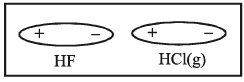
  • Dipole-dipole attraction:Between two polar molecules (for example HF and HCl).
    Types of Van der Waal`s Forces
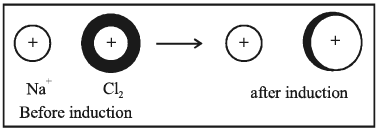
  • Ion-induced dipole attraction:An ion induces a dipole in a neighbouring neutral molecule and attracts it.
    Types of Van der Waal`s Forces
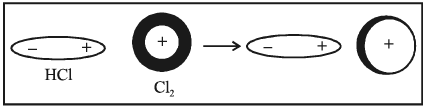
  • Dipole-induced dipole attraction:A permanent dipole induces a dipole in a non-polar molecule.
    Types of Van der Waal`s Forces
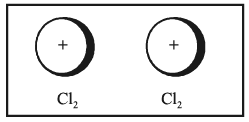
  • Induced dipole-induced dipole attraction (London dispersion forces): Temporary fluctuations in electron distribution in one non-polar molecule induce a dipole in a neighbouring non-polar molecule (examples: Cl2, noble gases such as He).
    Types of Van der Waal`s Forces

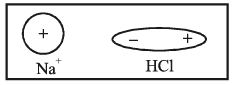
Ion-dipole attraction

  • Ion–dipole interaction is an intermolecular attractive force between a charged ion and the oppositely charged end of a polar molecule (dipole).
  • The attraction occurs because the ion attracts the partial charge (δ⁺ or δ⁻) on the polar molecule. It is primarily electrostatic in nature.
  • Ion–dipole forces are generally stronger than van der Waals forces and hydrogen bonds, but weaker than ionic and covalent bonds. The strength increases with higher ionic charge, smaller ionic radius, great polarity of the dipole.

Ion-dipole attraction


Metallic Bond

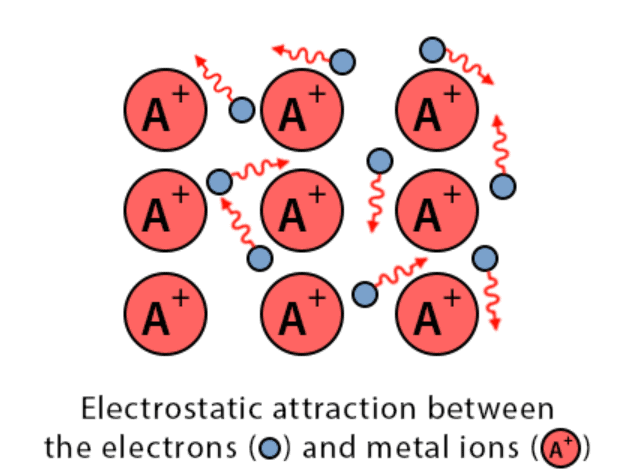
  • In metallic solids the metal atoms are held together by a network of positive kernels (nuclei plus inner electrons) immersed in a 'sea' of delocalised valence electrons. The attractive interaction between the positive kernels and the mobile valence electrons is called the metallic bond.
  • In the electron-sea model, valence electrons are not localised to any particular atom but are free to move through the lattice; kernels occupy the lattice sites while the itinerant electrons fill the interstices and bind the kernels together.
  • Because valence electrons are delocalised, metals show characteristic properties such as electrical conductivity, thermal conductivity, malleability and ductility.
  • Metallic BondMetallic Bond
The document Hydrogen Bonding | Chemistry Class 11 - NEET is a part of the NEET Course Chemistry Class 11.
All you need of NEET at this link: NEET
114 videos|268 docs|79 tests

FAQs on Hydrogen Bonding - Chemistry Class 11 - NEET

1. What is hydrogen bonding?
Ans. Hydrogen bonding is a type of intermolecular force that occurs when a hydrogen atom is bonded to a highly electronegative atom like oxygen, nitrogen, or fluorine. It is a strong dipole-dipole attraction between the hydrogen atom and the electronegative atom of another molecule.
2. How does hydrogen bonding affect the physical properties of substances?
Ans. Hydrogen bonding significantly influences the physical properties of substances. It leads to higher boiling and melting points, increased viscosity, and higher surface tension. These properties can be observed in water, where hydrogen bonding is responsible for its high boiling point, surface tension, and ability to dissolve many substances.
3. What is Vander Waal's force?
Ans. Vander Waal's forces, also known as London dispersion forces, are weak intermolecular attractions that occur between all atoms and molecules, regardless of polarity. These forces arise due to temporary fluctuations in electron distribution, resulting in the formation of temporary dipoles. Vander Waal's forces are responsible for the attraction between nonpolar molecules and the condensation of gases into liquids.
4. How do Vander Waal's forces compare to hydrogen bonding in terms of strength?
Ans. Vander Waal's forces are generally weaker than hydrogen bonding. Hydrogen bonds are relatively strong intermolecular forces due to the large electronegativity difference between the hydrogen atom and the highly electronegative atom it is bonded to. Vander Waal's forces, on the other hand, are weaker because they arise from temporary fluctuations in electron distribution and do not involve a specific bond between atoms.
5. What is metallic bonding?
Ans. Metallic bonding is a type of chemical bonding that occurs between metal atoms. In this bonding, valence electrons are delocalized and free to move throughout the metal lattice, creating a "sea of electrons." This delocalization of electrons gives metals their unique properties, such as high electrical and thermal conductivity, malleability, and ductility. Metallic bonding is responsible for the formation of metallic solids.
Related Searches
Hydrogen Bonding | Chemistry Class 11 - NEET, Free, pdf , ppt, Extra Questions, practice quizzes, study material, mock tests for examination, Summary, MCQs, Hydrogen Bonding | Chemistry Class 11 - NEET, Previous Year Questions with Solutions, Sample Paper, video lectures, Semester Notes, Important questions, past year papers, Exam, Viva Questions, shortcuts and tricks, Objective type Questions, Hydrogen Bonding | Chemistry Class 11 - NEET;