JEE Exam > JEE Notes > Additional Study Material > Electric Potential of Uniformly Charged Ring, Rod, and Disc
Electric Potential of Uniformly Charged Ring, Rod, and Disc

Electric Potential Due to a Charged Ring
Let electric potential at point P due to small element of length dℓ be dV.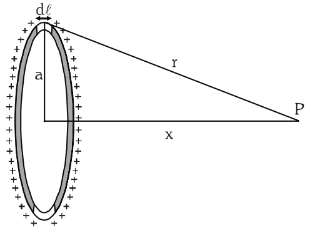
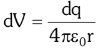
(distance between small element and point P is equal to r)
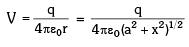
Electric potential due to whole ring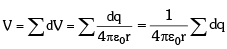
Potential Due to a Uniformly Charged Rod
Electric Potential due to a uniformly charged rod of length L and linear charge density lambda, at a point P on its axial line which is d units away from it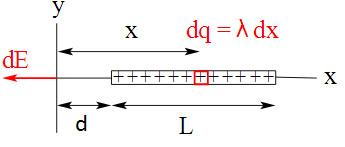
Charge per unit length λ = Q/L
Charge of slice dq = λ.dx
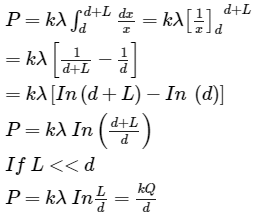
Electric potential: 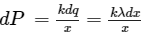
Potential Due to a Uniformly Charged Disc
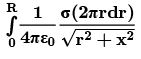
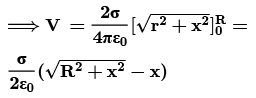
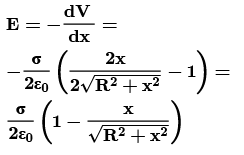
Find the electric potential at the axis of a uniformly charged disc and use potential to find the electric field at same point.
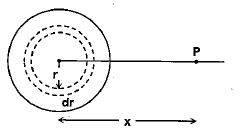
Potential due to ring element of radius r and thickness dr is dv:
The document Electric Potential of Uniformly Charged Ring, Rod, and Disc is a part of the JEE Course Additional Study Material for JEE.
All you need of JEE at this link: JEE
FAQs on Electric Potential of Uniformly Charged Ring, Rod, and Disc
| 1. How do I find the electric potential at the center of a uniformly charged ring? |  |
Ans. The electric potential at the center of a uniformly charged ring equals kQ/R, where k is Coulomb's constant, Q is total charge, and R is the ring's radius. Since all charge elements are equidistant from the center, distances don't vary-only the arithmetic sum matters, not vector addition like with electric field. This makes ring problems simpler than disc or rod calculations.
| 2. What's the difference between electric potential of a charged ring versus a charged disc? | |
Ans. A uniformly charged ring produces uniform potential along its axis because charge elements maintain equal distances from any axial point. A uniformly charged disc's potential varies non-uniformly along the axis since charge distribution changes with position. Ring potential follows simpler algebraic relationships; disc potential requires integration over radial elements and yields more complex expressions involving square roots.
| 3. Why is the electric potential formula different for a rod compared to a ring? | |
Ans. A rod's charge distributes linearly along one dimension, requiring integration using linear charge density (λ). Ring charge distributes around a circle maintaining constant radius, allowing direct summation. Rod potential depends on distance measurements from the rod's endpoints; ring potential depends only on axial distance. These geometric differences produce fundamentally different mathematical expressions and solution methods.
| 4. Can I use the same approach to calculate electric potential for both finite and infinite uniformly charged rods? | |
Ans. No-finite rod calculations use integration with logarithmic expressions involving endpoint distances, while infinite rod potential approaches infinity (requiring reference point adjustments). Finite rods allow direct potential comparisons; infinite rods require differential potential calculations. For JEE problems, finite rods are standard; infinite cases appear in theoretical discussions only.
| 5. How does the position on the axis affect electric potential of a uniformly charged disc? | |
Ans. Electric potential of a uniformly charged disc along its axis depends on axial distance and follows the expression σ(√(R²+z²)-z)/(2ε₀), where z is distance from the disc's center and R is its radius. As z increases, potential decreases. At the disc's surface (z=0), potential is maximum; at infinity, it approaches zero, following characteristic decay patterns.
About this Document

4.66/5 Rating

Apr 29, 2026 Last updated
Related Exams
Document Description: Electric Potential of Uniformly Charged Ring, Rod, and Disc for JEE 2026 is part of Additional Study Material for JEE preparation. The notes and questions for Electric Potential of Uniformly Charged Ring, Rod, and Disc have been prepared according to the JEE exam syllabus. Information about Electric Potential of Uniformly Charged Ring, Rod, and Disc covers topics like and Electric Potential of Uniformly Charged Ring, Rod, and Disc Example, for JEE 2026 Exam. Find important definitions, questions, notes, meanings, examples, exercises and tests below for Electric Potential of Uniformly Charged Ring, Rod, and Disc.
Introduction of Electric Potential of Uniformly Charged Ring, Rod, and Disc in English is available as part of our Additional Study Material for JEE for JEE & Electric Potential of Uniformly Charged Ring, Rod, and Disc in Hindi for Additional Study Material for JEE course. Download more important topics related with notes, lectures and mock test series for JEE Exam by signing up for free. JEE: Electric Potential of Uniformly Charged Ring, Rod, and Disc
Description
Electric Potential of Uniformly Charged Ring, Rod, & Disc of Additional Study Material covers all the important topics, helping you prepare for the JEE exam on EduRev.
Information about Electric Potential of Uniformly Charged Ring, Rod, and Disc
In this doc you can find the meaning of Electric Potential of Uniformly Charged Ring, Rod, and Disc defined & explained in the simplest way possible. Besides explaining types of Electric Potential of Uniformly Charged Ring, Rod, and Disc theory, EduRev gives you an ample number of questions to practice Electric Potential of Uniformly Charged Ring, Rod, and Disc tests, examples and also practice JEE tests



Related Searches
and Disc, Rod, and Disc, Electric Potential of Uniformly Charged Ring, Summary, Electric Potential of Uniformly Charged Ring, Extra Questions, Electric Potential of Uniformly Charged Ring, Free, Semester Notes, Important questions, shortcuts and tricks, Previous Year Questions with Solutions, Objective type Questions, video lectures, ppt, pdf , study material, MCQs, Viva Questions, and Disc, Rod, Sample Paper, past year papers, Exam, practice quizzes, mock tests for examination, Rod;