The Gupta Empire


The Gupta Empire emerged in Magadha in the fourth century AD and gradually extended across much of northern India. Though smaller in extent than the earlier Mauryan Empire, it exercised strong political and cultural influence over the region. Lasting for more than two centuries, the Gupta period is often called the Golden Age of India because of its significant advances in art, literature, science and administration. Our understanding of this era comes from a range of sources, including literary texts, inscriptions, coins and the accounts of foreign travellers.
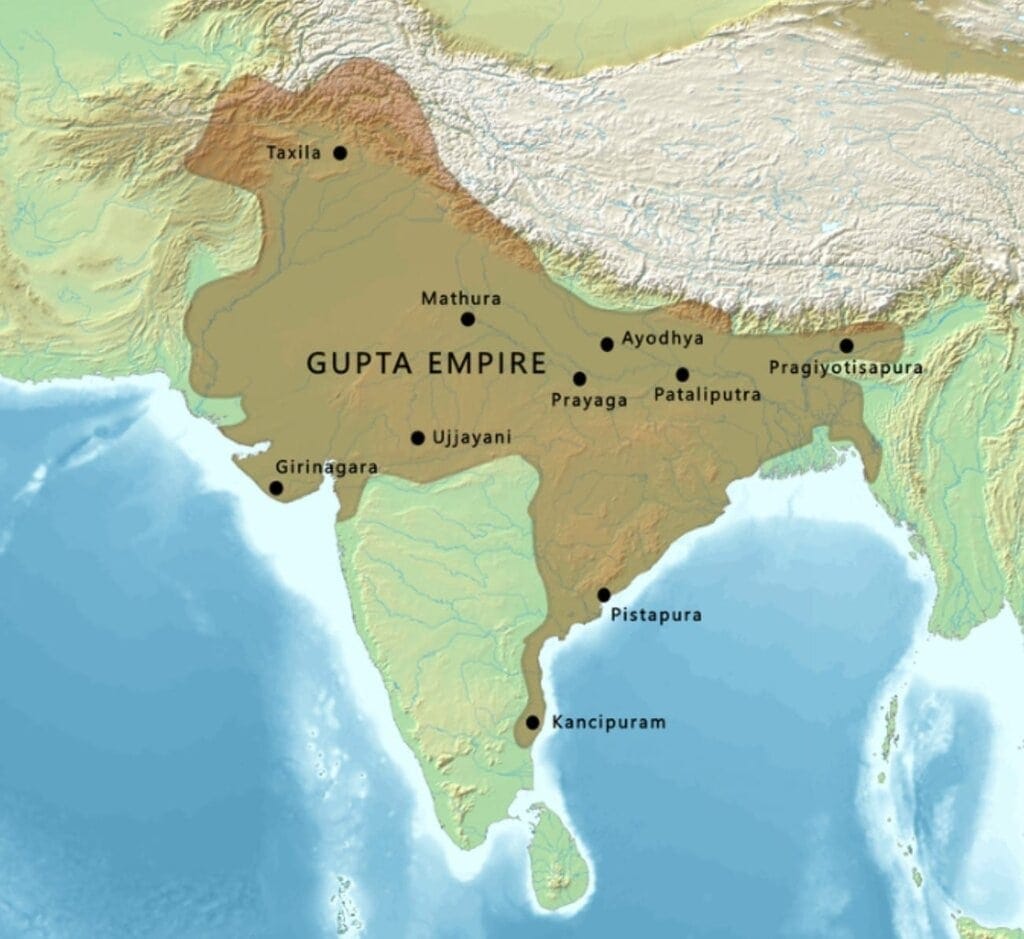
Origin of the Gupta Empire
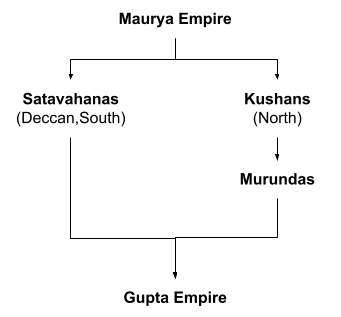
- Post-Maurya Decline:
- After the decline of the Maurya Empire, two significant powers emerged.
- Satavahanas (Andhras): Established dominance in the Deccan and the South.
- Kushans: Controlled the Northern regions.
- Shift of Power:
- Around A.D. 230, the Kushan rule in North India concluded.
- Murundas: Possibly Kushan kinsmen, assumed control over central India.
- Murundas' rule endured for approximately 25 years.
- Gupta Empire Ascendancy:
- Around A.D. 275, Gupta Empire emerged on the remnants of the Kushan Empire.
- Former Dominions: Gupta Empire extended its rule over the territories once held by both Kushans and Satavahanas.
- Political Unity: For over a century, North India experienced political cohesion under Gupta rule.
Material Advantages of the Gupta Empire
- Madhyadesha as the core: The fertile plains of the Gangetic valley (modern Bihar and eastern Uttar Pradesh) formed the agrarian and administrative core of Gupta power.
- Resources and craft production: Proximity to iron ore deposits in central India and south Bihar supported iron-working and military equipment production.
- Trade links: Guptas benefited from overland and coastal trade routes. Texts and coins indicate trade in textiles, silk and luxury goods with western markets, including contacts with the Eastern Roman world.
- Key centres: Early Gupta power was concentrated in the plain around Prayaga and Magadha; later the dynasty patronised other important urban centres such as Pataliputra and Ujjain.
The Sources for the Study of the Gupta Period
Three principal categories of sources provide evidence for reconstructing political, social and cultural aspects of the Gupta age.
Literary sources
- Classical Sanskrit works such as Mudrarakshasa and the play sometimes attributed to Vishakhadatta provide courtly and political detail; Devichandraguptam (an account associated with later traditions) contains material on certain royal episodes.
- Accounts of foreign travellers, especially the Chinese pilgrim Fa-hien (Fa Xian), offer first-hand observations on society, administration and religion during the later Gupta period.
Epigraphical sources
- Major inscriptions include the Allahabad Pillar inscription (composed by Harisena), which contains a long eulogy of Samudragupta and records his conquests and titles.
- Other important inscriptions such as the Mehrauli Iron Pillar inscription and regional pillar or stone inscriptions record royal achievements, land grants and official appointments.
Numismatic sources
- Gold and copper coins of the Guptas carry portraits, royal titles and legends that provide information on chronology, royal titulature, religious affiliations and ceremonial acts such as the performance of the Ashvamedha (horse sacrifice).
The Gupta Dynasty and principal rulers
Sri Gupta founded the Gupta empire. He was then succeeded by Ghatotkacha. Not much information is available about the rule of these two Maharajas. After that, significant rulers from the Gupta dynasty ruled during this period.
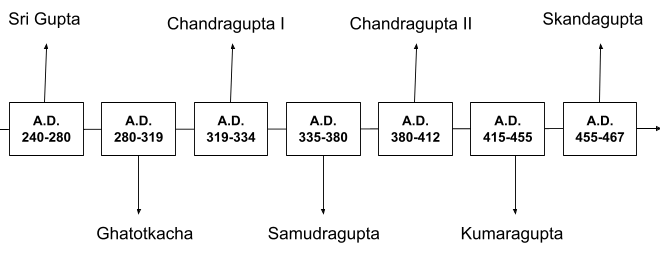
Sri Gupta (c. 240-280 AD)
- Considered the founder of the Gupta family that later established imperial power in north India.
- Later inscriptions refer to him with the title Maharaja, indicating local royal status before expansion under later generations.
Ghatotkacha (c. 280-319 AD)
- Son and successor of Sri Gupta; referred to in inscriptions as Maharaja.
- Little is recorded about his reign; he maintained and consolidated the family's regional position, preparing the way for a more expansive phase.
Chandragupta I (r. c. 319-335 AD)
- Marked the beginning of the Gupta imperial phase; often regarded as the first major king of the dynasty.
- His accession is conventionally taken as the start of the Gupta era (circa AD 320).
- He adopted the title Maharajadhiraja (king of kings), signalling a higher imperial status.
- Strengthened the dynasty by a strategic marriage to the Lichchhavi princess Kumaradevi, a union that brought prestige and territorial advantage.
- Under his rule the Guptas extended authority over parts of Magadha, Saketa and the region around Prayaga; Pataliputra remained an important centre.
Samudragupta (r. c. 330-380 AD)
- Often described as one of the greatest Gupta rulers; frequently praised for his military and cultural achievements and called an Indian Napoleon in some modern comparisons for the scale of his campaigns.
- The Allahabad Pillar inscription provides a detailed account of his military expeditions: campaigns in north India, southern expeditions (the Dakshinapatha campaign) and subjugation of many local rulers.
- He performed the Ashvamedha sacrifice after his victorious campaigns; his coins celebrate this ritual and his title as a restorer of the sacrifice.
- Samudragupta was also a patron of literature and the arts; he is described as Kaviraja (a poet-king), and some coins depict him playing the veena, indicating royal patronage of music.
- He supported scholars and poets such as Harisena, who composed his eulogy; religious tolerance is visible in his patronage of both Vaishnava and Buddhist figures.
Chandragupta II (Vikramaditya) (r. c. 380-412 AD)
- Under his rule the Gupta realm reached its greatest territorial and cultural height.
- Traditional literary material (for example the narrative in Devichandraguptam) relates a succession episode in which an elder brother, Ramagupta, is displaced by Chandragupta II; these accounts are part of the court tradition and literary record.
- He consolidated power through matrimonial alliances with regional dynasties (for example, alliances with the Vakatakas) which extended Gupta influence into central India.
- To the west he successfully challenged and subdued the Shaka Kshatrapas in regions such as western Malwa and Gujarat; to commemorate victories he adopted the illustrious title Vikramaditya and performed the Ashvamedha.
- Made Ujjain an important second capital, improving control over western territories and trade routes.
- The Mehrauli Iron Pillar and other inscriptions from this period claim Gupta authority in north-west regions.
- His court is traditionally described as including nine eminent scholars and poets known as the Navaratnas (nine gems); among the names commonly associated with this group are Kalidasa, Amarasimha, Varahamihira and Dhanvantari.
Kumaragupta I (r. c. 415-455 AD)
- Successor to Chandragupta II; retained much of the Gupta territories and continued royal patronage of learning and religion.
- Took titles such as Mahendraditya and on some coins is associated with the performance of the Ashvamedha.
- Traditional accounts associate him with the early foundation and patronage of Nalanda University, which later became an internationally renowned centre of learning.
Skandagupta (r. c. 455-467 AD)
- Remembered as the last of the great Gupta rulers who defended the empire against major foreign incursions.
- Notably resisted invasions by the Hephthalites/White Huns coming from Central Asia; his military efforts are recorded in inscriptions such as the Bhitari Pillar inscription.
- Though victorious in defence, continuous warfare and heavy expenditure weakened the imperial coffers and administrative cohesion.
- He is also referred to with honourifics such as Vikramaditya in some records.
Gupta administration
The Gupta state combined a centralised royal authority with layered provincial and local administration. Surviving inscriptions and travellers' accounts (notably Fa-hien) indicate an administrative system that aimed at efficiency with relatively light interference in everyday life.
- Royal titles: Inscriptions list a series of royal titles used by the Guptas including Maharajadhiraja, Samrat, Chakravartin and others reflecting imperial status.
- Central officers: The king was assisted by a council of ministers; the chief minister or Maha-Mantri headed the civil administration. Other senior officers included the:
- Maha-baladhikrita (commander-in-chief), Sandhivigrahika (foreign minister), Maha-dandanayaka (chief justice), Maha-asvapati (commander of the cavalry), Maha-pilupati (commander of the elephant corps), and the Ranabhandagarika (master of military stores).
- Military hierarchy: Military officers are named in inscriptions as Senapati, Mahasenapati, various grades of Baladhyaksha and specialised commanders such as Bhatasvapati (commander of infantry and cavalry) and Katuka (commander of elephant corps).
- Administrative officials: The king communicated through officers known as Dutakas. Police and law-and-order were administered by offices such as Dandapasadhikarana (chief of police) and lower police functionaries named Dandapasika, Chatas, Bhatas, Dandika and Chauroddharanika.
- Provinces and districts: Provinces were called Bhuktis, governed by Uparikas (often princes or appointed governors). Bhuktis were subdivided into Vishayas (districts) administered by Vishyapatis.
- Urban and village administration: Nagara Sreshtis looked after city administration while villages were administered by Gramikas.
- Provincial liaison: The central government kept contact with local administration through officials such as Kumaramatyas and Ayuktas.
- Nature of rule: Fa-hien praised the administration as generally mild and benevolent; he described relative personal freedom, safety on roads and low levels of crime, emphasising the prosperity of ordinary people under Gupta rule.
The Maukharis
- The Maukharis appear in early records such as the works of Patanjali and inscriptions; they rose to prominence toward the end of the fifth century AD and established a political centre in the Ganga-Yamuna doab and Kanauj region.
- Early Maukhari rulers named in inscriptions include Yagnavarman, Sardulavarman and Anantavarman; they initially appear as regional chiefs or samantas and in some periods acted under Gupta overlordship.
- Later Maukhari rulers from Kanauj recorded in seals and inscriptions include names such as Harivarman, Adityavarman, Isvaravarman, Isanavarman and Sarvavarman. Some of these bore the title Maharajadhiraja.
- At times relations between the Maukharis and the later Guptas were hostile; military contests and shifting alliances were common. The Maukhari polity eventually declined after dynastic and military reverses in the late sixth century.
- The Maukhari realm covered parts of modern Uttar Pradesh and Magadha, but its boundaries changed frequently because of continuous wars and rivalries in the Gangetic plain.
Causes of the fall of the Gupta Empire
- External invasions: Repeated incursions by Central Asian groups, particularly the White Huns (Hephthalites), severely undermined Gupta authority in the fifth century. These invasions targeted border provinces and disrupted trade and agriculture.
- Military and financial strain: Continuous defence against invasions-despite temporary successes such as those of Skandagupta-placed heavy demands on the imperial treasury and military resources.
- Succession and internal weakness: After Skandagupta, a sequence of weaker rulers and contested successions reduced central control and encouraged provincial autonomy.
- Rise of regional powers: Autonomous kingdoms and local chiefs (for example in Malwa, Gujarat and other regions) acquired strength as central authority waned, fragmenting political unity.
- Economic dislocation: War, tribute demands and disruption of trade routes led to economic difficulties, reducing the state's capacity to maintain administration and military defence.
- Alliances and temporary resistance: Later Gupta rulers tried to resist invaders by forming alliances with regional powers; such coalitions slowed decline but could not restore earlier imperial strength.
In sum, the decline of the Guptas was not the result of a single cause but of multiple, interacting factors: external invasions (notably by the Huns), internal succession problems, economic strain from prolonged warfare and the consequent rise of regional polities that fragmented the once-unified Gupta state.
FAQs on The Gupta Empire
| 1. What were the material advantages of the Gupta Empire? |  |
| 2. What was the origin of the Gupta Empire? | |
| 3. How was the Gupta Empire administrated? | |
| 4. What were the causes of the fall of the Gupta Empire? | |
| 5. What are some frequently asked questions about the Gupta Empire? | |