RS Aggarwal Solutions: Number System (Exercise 1A)

Q.1. Write the numeral for each of the following numbers :
(i) Nine thousand eighteen.
(ii) Fifty four thousand seventy-three.
(iii) Three lakh two thousand five hundred six.
(iv) Twenty lakh ten thousand eight.
(v) Six crore five lakh fifty-seven.
(vi) Two crore two lakh two thousand two hundred two.
(vii) Twelve crore twelve lakh twelve thousand twelve.
(viii) Fifteen crore fifty lakh twenty thousand sixty-eight.
Ans. (i) Nine thousand eighteen = 9,018.
(ii) Fifty four thousand seventy three = 54,073
(iii) Three lakh two thousand five hundred six = 3,02,506.
(iv) Twenty lakh ten thousand eight = 20,10,008.
(v) Six crore five lakh fifty-seven = 6,05,00,057.
(vi) Two crore two lakh two thousand two hundred two = 2,02,02,202.
(vii) Twelve crore twelve lakh twelve thousand twelve = 12,12,12,012.
(viii) Fifteen crore fifty lakh twenty thousand sixty-eight = 15,50,20,068.
Q.2. Write each of the following numbers in words :
(i) 63,005
(ii) 7,07,075
(iii) 34,20,019
(iv) 3,05,09,012
(v) 5,10,03,604
(vi) 6,18,05,008
(vii) 19,09,09,900
(viii) 6,15,30,807
(ix) 6,60,60,060
Ans. (i) 63,005 = Sixty three thousand five.
(ii) 7,07,075 = Seven lakh, seven thousand seventy five.
(iii) 34,20,019 = Thirty-four lakh twenty thousand nineteen.
(iv) 3,05,09,012 = Three crore, five lakh, nine thousand twelve.
(v) 5,10,03,604 = Five crore ten lakh three thousand six hundred four.
(vi) 6,18,05,008 = Six crore eighteen lakh five thousand eight.
(vii) 19,09,09,900 = Nineteen crore nine lakh, nine thousand nine hundred.
(viii) 6,15,30,807 = Six crore fifteen lakh, thirty thousand eight hundred seven.
(ix) 6,60,60,060 = Six crore sixty lakh sixty thousand sixty.
Q.3. Write each of the following numbers in the expanded form :
(i) 15,768
(ii) 3,08,927
(iii) 24,05,609
(iv) 5,36,18,493
(v) 6,06,06,006
(vi) 9,10,10,510
Ans.
(i) 15,768 = (1 × 10000) + (5 × 1000) + (7 × 100) + (6 × 10) + (8 × 1)
(ii) 3,08,927 = (3 × 100000) + (8 × 1000) + (9 × 100) + (2 × 10) + (7 × 1)
(iii) 24,05,609 = (2 × 1000000) + (4 × 100000) + (5 × 1000) + (6 × 100) + (9 × 1)
(iv) 5,36,18,493 = (5 × 10000000) + (3 × 1000000) + (6 × 100000) + (1 × 10000) + (8 × 1000) + (4 × 100) + (9 × 10) + (3 × 1)
(v) 6,06,06,006 = (6 × 10000000) + (6 × 100000) + (6 × 1000) + (6 × 1)
(vi) 9,10,10,510 = (9 × 10000000) + (1 × 1000000) + (1 × 10000) + (5 × 100) + (1 × 10)
Q. 4. Write the corresponding numeral for each of the following :
(i) 6 × 10000 + 2 × 1000 + 5 × 100 + 8 × 10 + 4 × 1
(ii) 5 × 100000 + 8 × 10000 + 1 × 1000 + 6 × 100 + 2 × 10 + 3 × 1
(iii) 2 × 10000000 + 5 × 100000 + 7 × 1000 + 9 × 100 + 5 × 1
(iv) 3 × 1000000 + 4 × 100000 + 6 × 1000 + 5 × 100 + 7 × 1.
Ans. (i) 6 × 10000 + 2 × 1000 + 5 × 100 + 8 × 10 + 4 × 1 = 60000 + 2000 + 500 + 80 + 4
= 62,584.
(ii) 5 × 100000 + 8 × 10000 + 1 × 1000 + 6 × 100 + 2 × 10 + 3 × 1 = 500000 + 80000 + 1000 + 600 + 20 + 3 = 5,81,623
(iii) 2 × 10000000 + 5 × 100000 + 7 × 1000 + 9 × 100 + 5 × 1 = 20000000 + 500000 + 7000 + 900 + 5 = 2,05,07,905
(iv) 3 × 1000000 + 4 × 100000 + 6 × 1000 + 5 × 100 + 7 × 1 = 3000000 + 400000 + 6000 + 500 + 7 = 34,06,507
Q. 5. Find the difference between the place values of the two nines in 79520986.
Ans. In 79520986
Value of first 9 = 9000000 and value of second 9 = 900
∴ Difference = 9000000 - 900 = 89,99,100
Q.6. Find the difference between the place value and the face value of 7 in 27650934.
Ans.
In 27650934 place value of 7 = 7000000 and face value of 7 = 7
∴ Difference = 7000000 - 7 = 6999993
Q. 7. How many 6-digit numbers are there in all ?
Ans. There are 900000 6-digits numbers in all
i.e. 999999 - 99999 = 900000
Q. 8. How many 7-digit numbers are there in all ?
Ans. There are 9999999 - 999999
= 9000000 7-digits numbers in all.
Q.9. How many thousands make a lakh ?
Ans. In 1,00,000, there are 100 thousands.
Q.10. How many thousands make a crore ?
Ans. In 10000,000, there are 10000 thousands.
Q.11. Find the difference between the number 738 and that obtained on reversing its digits.
Ans. Given Number = 738
Reversing its digits = 837
Difference between 738 and 837 = 837 - 738 = 99
Q.12. What comes just after 9547999 ?
Ans. Numbers after 9547999 = 9547999 + 1 = 9548000
Q.13. What comes just before 9900000 ?
Ans. Number first before 9900000 = 9900000 - 1 = 9899999
Q.14. What comes just before 10000000 ?
Ans. Number first before 10000000 = 10000000 - 1 = 9999999
Q.15. Write all 3-digits numbers using 2, 3, 4, taking each digit only once.
Ans. 3-digits numbers using 2, 3, 4 taking each digit only once will be
234, 243, 324, 342, 423, 432
Q.16. Write the smallest number of different digits formed by using the digits 3, 1, 0, 5 and 7.
Ans. The smallest number by using different digits 3, 1, 0, 5 and 7 will be = 10357
Q. 17. Write the largest number of different digits formed by using the digits 2, 4, 0, 3, 6 and 9.
Sol. The largest number formed by using different digits 2, 4, 0, 3,6 and 9 will be
= 964320.
Q.18. Rewrite each of the following numerals with proper commas, using the international place value chart. Also, write the number name of each in the international system :
(i) 735821
(ii) 6057894
(iii) 56943821
(iv) 37502093
(v) 89350064
(vi) 90703006
Ans.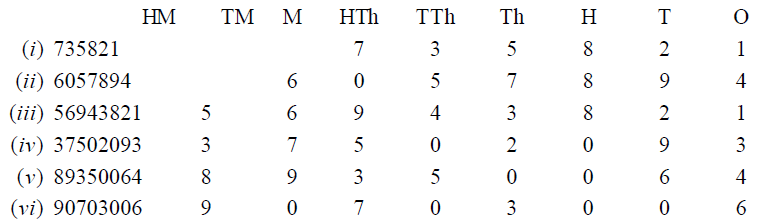
(i) Seven hundred thirty five thousand eight hundred twenty-one.
(ii) Six million fifty seven thousand eight hundred ninety-four.
(iii) Fifty-six million nine hundred forty-three thousand eight hundred twenty-one.
(iv) Thirty-seven million five hundred two thousand ninety-three.
(v) Eighty-nine million three hundred fifty thousand sixty-four.
(vi) Ninety million seven hundred three thousand and six.
Q.19. Write each of the following in figures in the international place-value chart :
(i) Thirty million one hundred five thousand sixty-three.
(ii) Fifty-two million two hundred five thousand six.
(iii) Five million five thousand five.
Ans.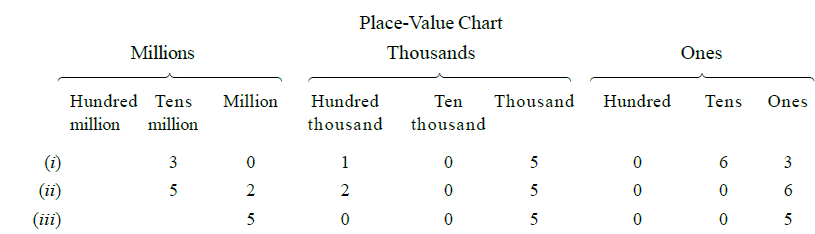
Objective Questions
Tick (√ ) the correct answer in each of the following :
Q.20. The place value of 6 in the numeral 98612453 is
(a) 6
(b) 612453
(c) 600000
(d) 986
Ans.
(c) Because 6 is at lakh place.
Q.21. The face value of 4 in the numeral 97243650 is
(a) 4
(b) 43650
(c) 40000
(d) none of these
Ans.
(a) Because face value is always same.
Q.22. The difference between the place value and the face value of 5 in the numeral 87653421 is
(a) 53416
(b) 49995
(c) 4995
(d) none of these
(b) Because place value and face value of 5 in 87653421 are 50000 and 5.
∴ difference = 50000 - 5 = 49995.
Q. 23. The smallest counting number is
(a) 0
(b) 1
(c) 10
(d) none of these
Ans.
(b) Smallest counting number or natural number is 1.
Q. 24. How many 4-digit numbers are there ?
(a) 8999
(b) 9000
(c) 8000
(d) none of these
Ans.
(b) Number of 4-digits numbers = 9999 - 999 (i.e. these are 1000 to 9999) = 9000
Q. 25. How many 7-digit numbers are there ?
(a) 8999999
(b) 9000000
(c) 1000000
(d) none of these
Ans.
(b) Number of 7-digit numbers (from 1000000 to 9999999) = 9999999 - 999999 = 9000000
Q. 26. How many 8-digit numbers are there ?
(a) 99999999
(b) 89999999
(c) 90000000
(d) none of these
Ans.
(c) Numbers of 8-digit numbers (from 10000000 to 99999999)
= 99999999 - 9999999 = 90000000
Q. 27. What comes just before 1000000 ?
(a) 99999
(b) 999999
(c) 9999999
(d) none of these
Ans.
(b) Because 1000000 - 1 = 999999
FAQs on RS Aggarwal Solutions: Number System (Exercise 1A)
| 1. What are natural numbers and whole numbers, and how are they different? |  |
| 2. How do I identify integers on a number line for CBSE Class 6? | |
| 3. What's the difference between prime numbers and composite numbers? | |
| 4. Why do we use the place value system, and how does it work in Class 6 number system? | |
| 5. How can I quickly check if a number is divisible by 2, 3, 5, or 10? | |