UPSC Exam > UPSC Notes > Lucent For GK > Mind Map: Heat
Mind Map: Heat

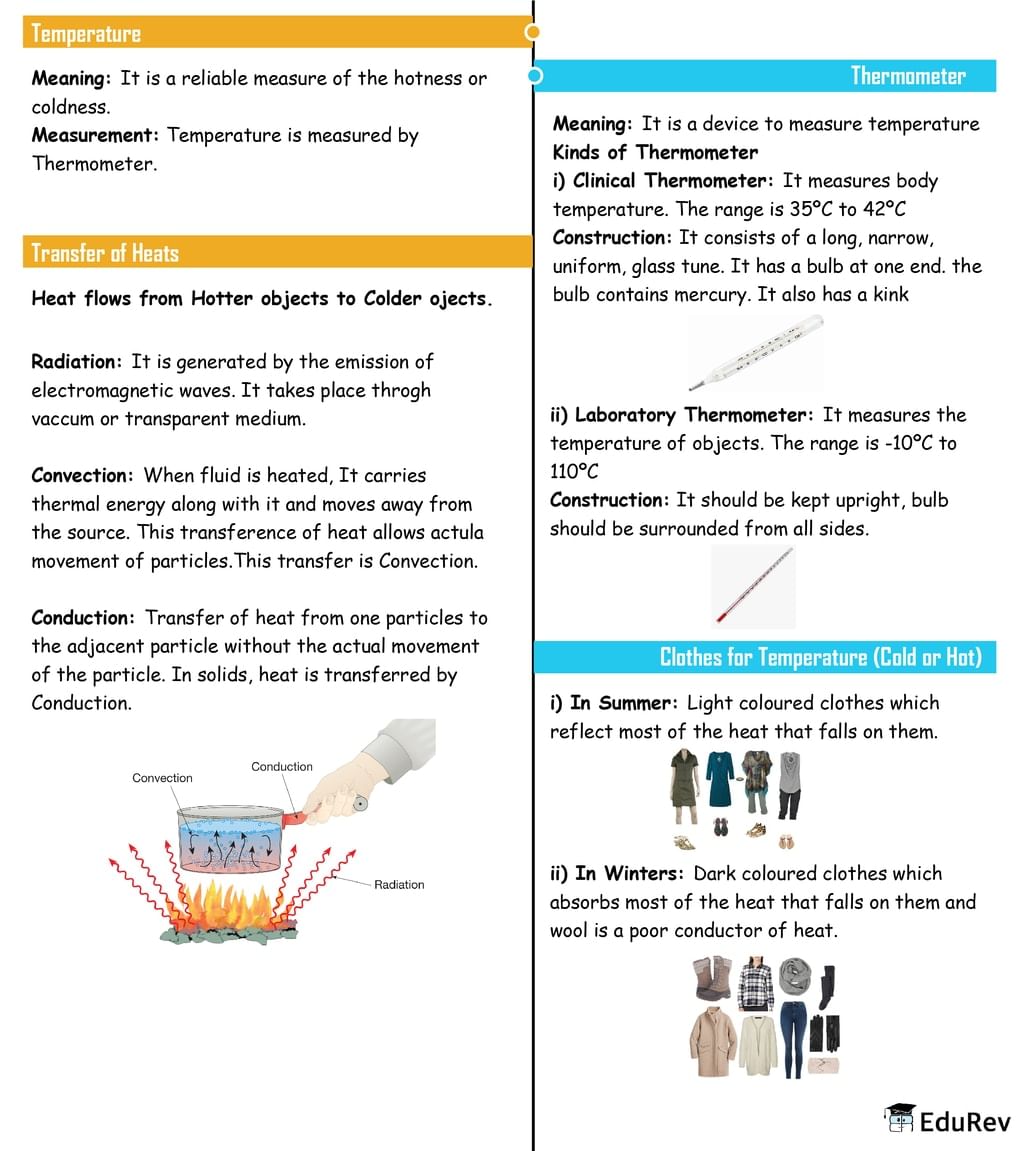
The document Mind Map: Heat is a part of the UPSC Course Lucent For GK.
All you need of UPSC at this link: UPSC
FAQs on Mind Map: Heat
| 1. What are the main types of heat transfer and how do they work differently? |  |
Ans. Heat transfer occurs through three mechanisms: conduction (direct contact between objects), convection (movement of fluids like air or water), and radiation (electromagnetic waves requiring no medium). Conduction happens when heat flows through solid materials; convection involves circulation in liquids and gases; radiation travels through empty space. Understanding these distinctions helps explain everyday phenomena like how a metal spoon heats up in hot tea or why the sun warms Earth across vast distances.
| 2. Why does specific heat capacity matter and how does it affect different materials? | |
Ans. Specific heat capacity measures how much energy a substance requires to raise its temperature by one degree Celsius per unit mass. Materials with high specific heat capacity-like water-absorb substantial heat before temperature changes noticeably, while those with low capacity heat up quickly. This property explains why coastal regions experience mild temperature fluctuations and why metal pans heat faster than ceramic ones, making it crucial for understanding thermal behaviour in CBSE physics.
| 3. How do thermal equilibrium and temperature difference relate to heat flow? | |
Ans. Heat always flows from higher temperature regions to lower temperature regions until thermal equilibrium is reached, where both objects stabilise at the same temperature. The greater the temperature difference between two bodies, the faster heat transfer occurs. This principle, governed by the second law of thermodynamics, determines how quickly hot water cools, why insulation reduces heat loss, and how heat engines operate efficiently.
| 4. What's the difference between heat and temperature, and why do students get confused? | |
Ans. Temperature measures the average kinetic energy of particles in a substance using a scale (Celsius, Kelvin), while heat represents the total thermal energy transferred between objects due to temperature differences. A small cup of boiling water has higher temperature than a swimming pool but contains far less total heat energy. This conceptual distinction is fundamental to solving thermodynamics problems correctly in competitive exams.
| 5. How can a mind map on heat help organise concepts for UPSC preparation? | |
Ans. A mind map visually connects heat's core concepts-transfer mechanisms, thermodynamic principles, and real-world applications-in a single hierarchical structure, enabling quick revision and pattern recognition. It reduces cognitive load by grouping related subtopics, aids memory retention through spatial organisation, and supports faster recall during exams. Students preparing for UPSC can leverage mind maps, flashcards, and visual summaries on EduRev to consolidate thermal physics knowledge efficiently.
About this Document

2.3K Views

4.96/5 Rating

Apr 18, 2026 Last updated
Related Exams
Document Description: Mind Map: Heat for UPSC 2026 is part of Lucent For GK preparation. The notes and questions for Mind Map: Heat have been prepared according to the UPSC exam syllabus. Information about Mind Map: Heat covers topics like and Mind Map: Heat Example, for UPSC 2026 Exam. Find important definitions, questions, notes, meanings, examples, exercises and tests below for Mind Map: Heat.
Introduction of Mind Map: Heat in English is available as part of our Lucent For GK for UPSC & Mind Map: Heat in Hindi for Lucent For GK course. Download more important topics related with notes, lectures and mock test series for UPSC Exam by signing up for free. UPSC: Mind Map: Heat
Description
Mind Map: Heat of Lucent provides you one-page visual summary of the chapter covering all the important topics. Download the PDF from EduRev.
Information about Mind Map: Heat
In this doc you can find the meaning of Mind Map: Heat defined & explained in the simplest way possible. Besides explaining types of Mind Map: Heat theory, EduRev gives you an ample number of questions to practice Mind Map: Heat tests, examples and also practice UPSC tests



Related Searches
past year papers, MCQs, Important questions, Sample Paper, Semester Notes, study material, Free, ppt, mock tests for examination, video lectures, Viva Questions, Summary, Mind Map: Heat, Previous Year Questions with Solutions, shortcuts and tricks, Mind Map: Heat, practice quizzes, pdf , Objective type Questions, Mind Map: Heat, Extra Questions, Exam;