CBSE Class 6 > Class 6 Notes > Subject-Wise Mind Maps > Mind Map: Body Movement
Mind Map: Body Movement

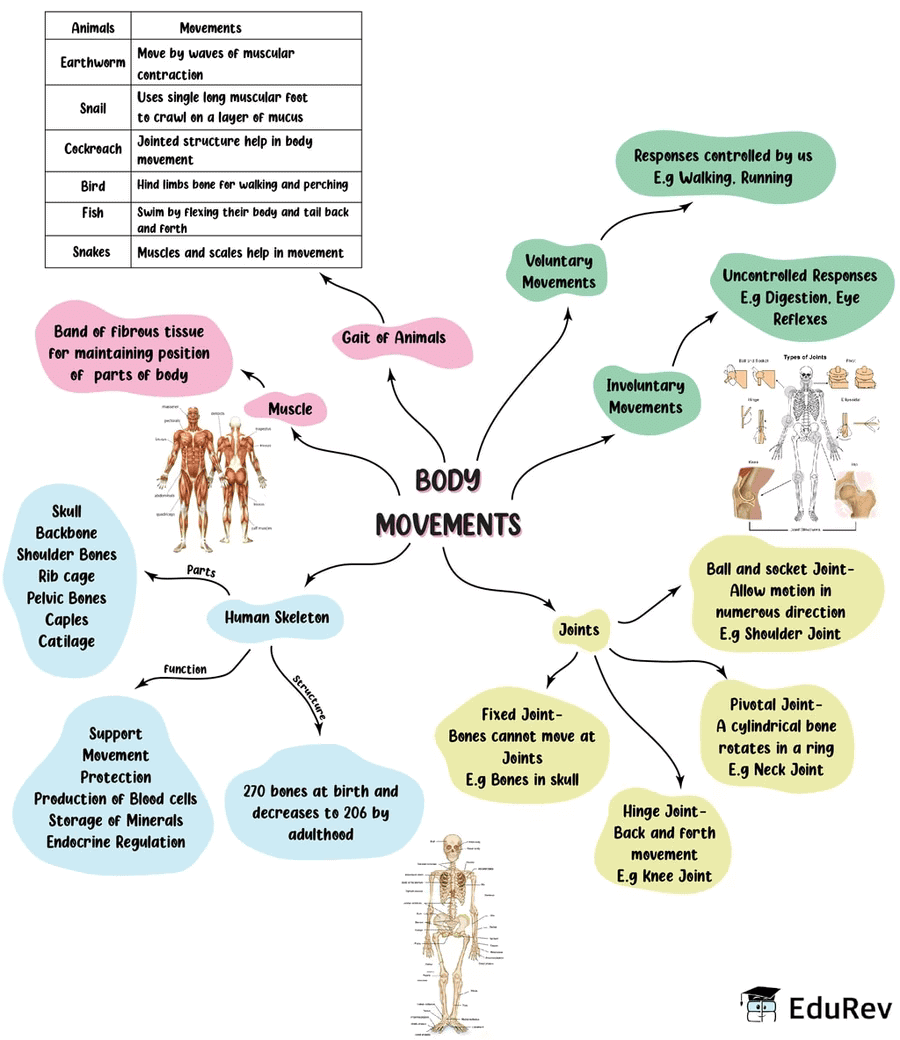
The document Mind Map: Body Movement is a part of the Class 6 Course Subject-Wise Mind Maps for Class 6.
All you need of Class 6 at this link: Class 6
FAQs on Mind Map: Body Movement
| 1. What are the main types of body movements that Class 6 students need to know? |  |
Ans. Body movements are classified into four main types: locomotion (moving from one place to another), non-locomotion (moving in place), manipulation (using objects), and stability movements (maintaining balance). Locomotion includes walking, running, and jumping. Non-locomotion covers bending, stretching, and twisting. Understanding these movement categories helps students recognise how their bodies function during daily activities and sports.
| 2. How do bones and muscles work together to create body movement? | |
Ans. Bones provide the rigid framework, while muscles contract and relax to pull bones, enabling motion. When a muscle contracts, it shortens and pulls the attached bone, creating movement at the joint. Muscles work in pairs-one contracts while its partner relaxes. This coordinated system of skeletal muscles, bones, and joints forms the musculoskeletal system, allowing precise control of locomotion and non-locomotion activities.
| 3. What's the difference between voluntary and involuntary body movements for CBSE Class 6? | |
Ans. Voluntary movements are controlled consciously by the brain and involve skeletal muscles-like walking or writing. Involuntary movements happen automatically without conscious effort, controlled by the nervous system-such as heartbeats or digestion. The nervous system regulates both types through signals. Understanding this distinction clarifies why some body movements require concentration while others operate independently, essential for Class 6 biology concepts.
| 4. What role do joints play in allowing different types of body movement? | |
Ans. Joints are the connection points between bones where movement occurs. Different joint types enable varied ranges of motion: hinge joints (elbows, knees) allow bending and straightening; ball-and-socket joints (shoulders, hips) permit rotational movement; pivot joints enable twisting. The structure of each joint determines the specific movements possible. Cartilage cushions joints, reducing friction during locomotion and stability activities.
| 5. How can I remember all the body movement concepts using mind maps effectively? | |
Ans. Mind maps organise body movement concepts visually with the central topic branching into categories like muscle types, joint structures, and movement classifications. Each branch includes sub-topics and key terms, making connections clear. Refer to mind maps on EduRev that illustrate how bones, muscles, and joints interact, alongside flashcards for terminology. Visual learning through mind maps strengthens retention of locomotion, non-locomotion, and skeletal system relationships.
About this Document

1.7K Views

4.85/5 Rating

Apr 18, 2026 Last updated
Document Description: Mind Map: Body Movement for Class 6 2026 is part of Subject-Wise Mind Maps for Class 6 preparation. The notes and questions for Mind Map: Body Movement have been prepared according to the Class 6 exam syllabus. Information about Mind Map: Body Movement covers topics like and Mind Map: Body Movement Example, for Class 6 2026 Exam. Find important definitions, questions, notes, meanings, examples, exercises and tests below for Mind Map: Body Movement.
Introduction of Mind Map: Body Movement in English is available as part of our Subject-Wise Mind Maps for Class 6 for Class 6 & Mind Map: Body Movement in Hindi for Subject-Wise Mind Maps for Class 6 course. Download more important topics related with notes, lectures and mock test series for Class 6 Exam by signing up for free. Class 6: Mind Map: Body Movement
Description
Mind Map: Body Movement of Subject provides you one-page visual summary of the chapter covering all the important topics. Download the PDF from EduRev.
Information about Mind Map: Body Movement
In this doc you can find the meaning of Mind Map: Body Movement defined & explained in the simplest way possible. Besides explaining types of Mind Map: Body Movement theory, EduRev gives you an ample number of questions to practice Mind Map: Body Movement tests, examples and also practice Class 6 tests



Related Searches
Extra Questions, mock tests for examination, Mind Map: Body Movement, past year papers, practice quizzes, Viva Questions, MCQs, Exam, study material, shortcuts and tricks, ppt, Summary, video lectures, Important questions, Previous Year Questions with Solutions, Mind Map: Body Movement, Sample Paper, Free, Semester Notes, pdf , Mind Map: Body Movement, Objective type Questions;