CBSE Class 7 > Class 7 Notes > Mind Map: Transportation in Animals and Plants
Mind Map: Transportation in Animals and Plants

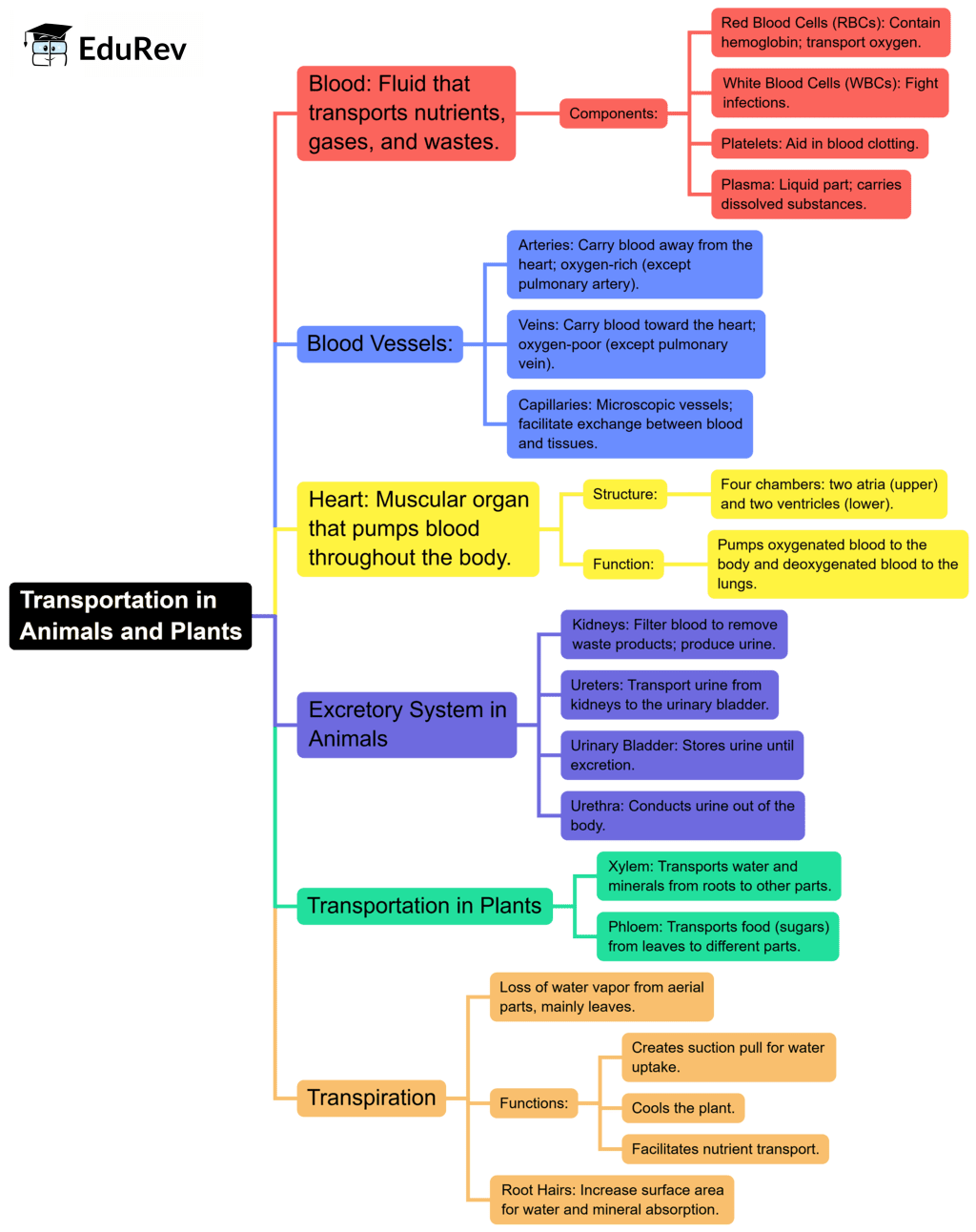
FAQs on Mind Map: Transportation in Animals and Plants
| 1. How do plants transport water and nutrients from roots to leaves? |  |
Ans. Plants transport water and minerals upward through xylem vessels via a process called transpiration pull, where water evaporates from leaves, creating a suction force. This mechanism allows nutrient absorption from soil to reach all plant parts. Simultaneously, phloem tissue transports sugars and organic compounds downward from leaves to roots and storage organs through translocation, ensuring energy distribution throughout the plant body.
| 2. What's the difference between how animals and plants move substances through their bodies? | |
Ans. Animals rely on circulatory systems with hearts pumping blood through vessels to transport oxygen, nutrients, and hormones to cells. Plants, lacking hearts and blood, use passive transport mechanisms-xylem for water and minerals moving upward, phloem for food moving both directions. Animals achieve rapid, active transport; plants depend on diffusion and osmosis across cellular membranes and vascular tissues.
| 3. Why do plants need vascular tissue when animals have blood vessels? | |
Ans. Vascular tissue in plants serves dual functions: xylem transports water against gravity without muscular effort, while phloem distributes photosynthetic products. Animals require blood vessels for active circulation of oxygen-rich blood, maintaining constant pressure and speed. Plants lack circulatory muscles but evolved specialized conducting tissues suited to stationary life, absorbing water from soil and distributing resources efficiently across varied environmental conditions.
| 4. How does transpiration help plants transport water up to tall trees? | |
Ans. Transpiration creates negative pressure in xylem vessels when water evaporates from leaf surfaces, pulling water columns upward from roots-a process called the transpiration-cohesion mechanism. This capillary action overcomes gravity, enabling trees to transport water hundreds of metres high. Water's adhesive properties to vessel walls and cohesive bonds between molecules sustain continuous columns, making transpiration essential for nutrient delivery in tall plants.
| 5. What are the main differences between xylem and phloem transport systems in plants? | |
Ans. Xylem transports water and dissolved minerals unidirectionally upward through dead cells, driven by transpiration pull and root pressure. Phloem transports sugars and organic nutrients bidirectionally-upward or downward-through living cells via active transport and osmotic pressure. Xylem relies on physical forces; phloem requires metabolic energy, making them complementary vascular tissues for complete plant nutrition and growth distribution.
About this Document

1.1K Views

4.7/5 Rating

Apr 20, 2026 Last updated
Document Description: Mind Map: Transportation in Animals and Plants for Class 7 2026 is part of Class 7 preparation. The notes and questions for Mind Map: Transportation in Animals and Plants have been prepared according to the Class 7 exam syllabus. Information about Mind Map: Transportation in Animals and Plants covers topics like and Mind Map: Transportation in Animals and Plants Example, for Class 7 2026 Exam. Find important definitions, questions, notes, meanings, examples, exercises and tests below for Mind Map: Transportation in Animals and Plants.
Introduction of Mind Map: Transportation in Animals and Plants in English is available as part of our Class 7 preparation & Mind Map: Transportation in Animals and Plants in Hindi for Class 7 courses. Download more important topics, notes, lectures and mock test series for Class 7 Exam by signing up for free. Class 7: Mind Map: Transportation in Animals and Plants
Description
Mind Map: Transportation in Animals & Plants of covers all the important topics, helping you prepare for the Class 7 exam on EduRev. Start for free!
Information about Mind Map: Transportation in Animals and Plants
In this doc you can find the meaning of Mind Map: Transportation in Animals and Plants defined & explained in the simplest way possible. Besides explaining types of Mind Map: Transportation in Animals and Plants theory, EduRev gives you an ample number of questions to practice Mind Map: Transportation in Animals and Plants tests, examples and also practice Class 7 tests.
Related Searches
shortcuts and tricks, past year papers, Extra Questions, Sample Paper, pdf , Important questions, Exam, MCQs, Objective type Questions, Viva Questions, Previous Year Questions with Solutions, study material, Mind Map: Transportation in Animals and Plants, video lectures, Summary, Semester Notes, Mind Map: Transportation in Animals and Plants, ppt, mock tests for examination, practice quizzes, Free, Mind Map: Transportation in Animals and Plants;