NEET Exam > NEET Notes > Chemistry Class 11 > Mind Map: Polymers (Old NCERT)
Mind Map: Polymers (Old NCERT)

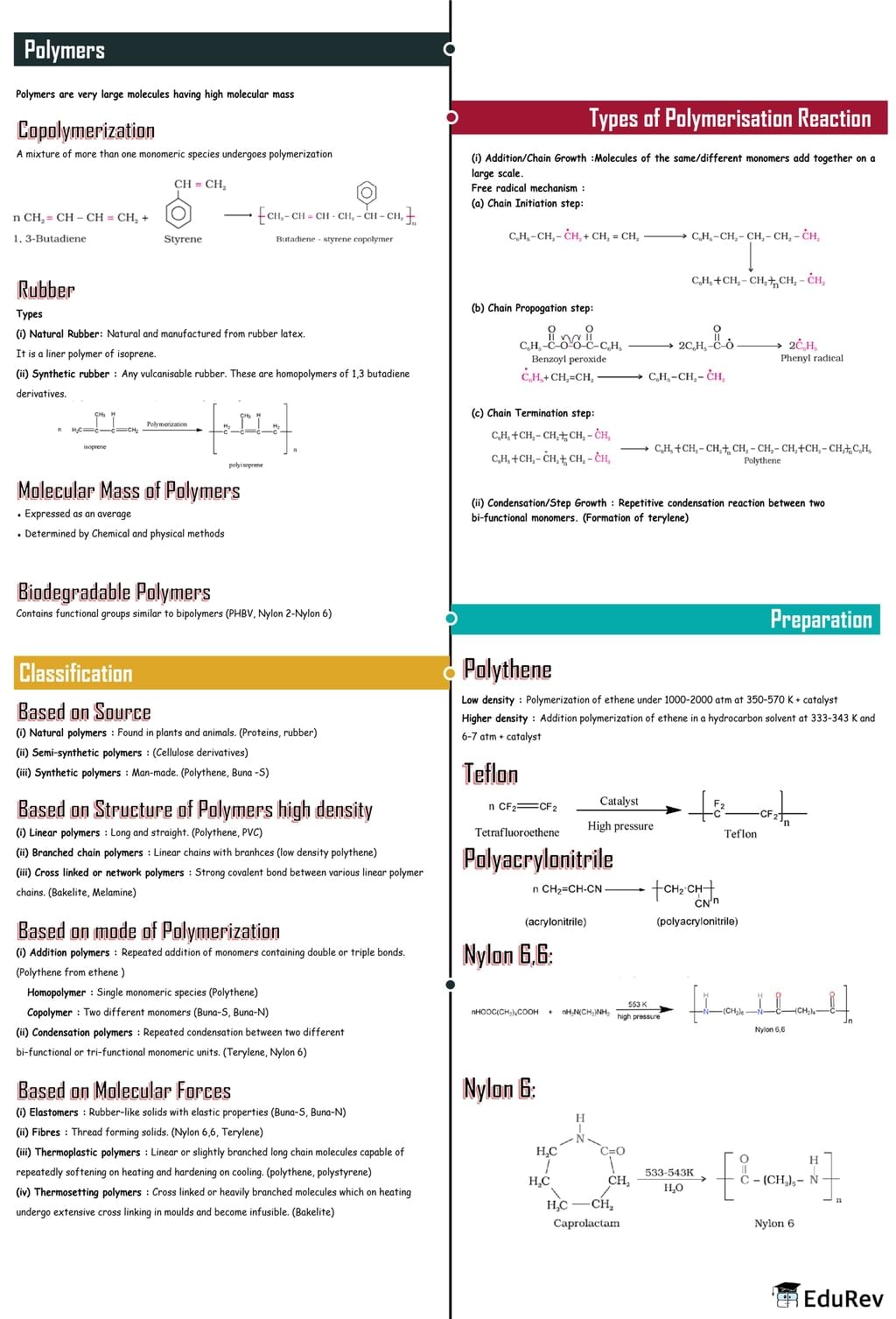
The document Mind Map: Polymers (Old NCERT) is a part of the NEET Course Chemistry Class 11.
All you need of NEET at this link: NEET
FAQs on Mind Map: Polymers (Old NCERT)
| 1. What are polymers? |  |
Ans. Polymers are large molecules made up of repeating subunits called monomers. These monomers are chemically bonded together to form long chains or networks. Polymers can be found in various forms such as plastics, rubber, fibers, and even biopolymers found in living organisms.
| 2. How are polymers formed? | |
Ans. Polymers are formed through a process called polymerization. This process involves the reaction of monomers, which can be either naturally occurring or synthetic, to form long chains or networks. Polymerization can occur through various methods such as addition polymerization, condensation polymerization, or even through biological processes.
| 3. What are the properties of polymers? | |
Ans. Polymers exhibit a wide range of properties depending on their chemical structure and composition. Some common properties of polymers include high flexibility, low density, good electrical insulation, resistance to chemicals, and varying degrees of strength. These properties make polymers suitable for a wide range of applications in industries such as packaging, automotive, construction, and healthcare.
| 4. What are some common applications of polymers? | |
Ans. Polymers find extensive use in various industries and everyday products. Some common applications of polymers include plastic packaging materials, rubber tires, synthetic fibers for clothing, electrical insulation, automotive parts, medical devices, and even in construction materials such as PVC pipes and insulation foams.
| 5. What are the environmental concerns associated with polymers? | |
Ans. Polymers, especially synthetic ones, have raised concerns regarding their impact on the environment. The main concern is the slow degradation of certain polymers, leading to their accumulation in landfills and oceans. This can result in pollution and harm to marine life and ecosystems. Efforts are being made to develop biodegradable polymers and improve recycling processes to minimize the environmental footprint of polymers.
About this Document

4.75/5 Rating

Apr 20, 2026 Last updated
Related Exams
Document Description: Mind Map: Polymers (Old NCERT) for NEET 2026 is part of Chemistry Class 11 preparation. The notes and questions for Mind Map: Polymers (Old NCERT) have been prepared according to the NEET exam syllabus. Information about Mind Map: Polymers (Old NCERT) covers topics like and Mind Map: Polymers (Old NCERT) Example, for NEET 2026 Exam. Find important definitions, questions, notes, meanings, examples, exercises and tests below for Mind Map: Polymers (Old NCERT).
Introduction of Mind Map: Polymers (Old NCERT) in English is available as part of our Chemistry Class 11 for NEET & Mind Map: Polymers (Old NCERT) in Hindi for Chemistry Class 11 course. Download more important topics related with notes, lectures and mock test series for NEET Exam by signing up for free. NEET: Mind Map: Polymers (Old NCERT)
Description
Mind Map: Polymers (Old NCERT) of Chemistry Class 11 provides you one-page visual summary of the chapter covering all the important topics. Download the PDF from EduRev.
Information about Mind Map: Polymers (Old NCERT)
In this doc you can find the meaning of Mind Map: Polymers (Old NCERT) defined & explained in the simplest way possible. Besides explaining types of Mind Map: Polymers (Old NCERT) theory, EduRev gives you an ample number of questions to practice Mind Map: Polymers (Old NCERT) tests, examples and also practice NEET tests



Related Searches
Mind Map: Polymers (Old NCERT), study material, Extra Questions, practice quizzes, Mind Map: Polymers (Old NCERT), Free, Viva Questions, Exam, video lectures, Important questions, Previous Year Questions with Solutions, Sample Paper, ppt, mock tests for examination, Objective type Questions, Summary, shortcuts and tricks, Mind Map: Polymers (Old NCERT), Semester Notes, past year papers, MCQs, pdf ;