NEET Exam > NEET Notes > Chemistry Class 11 > Mind Map: Chemistry in Everyday Life (Old NCERT)
Mind Map: Chemistry in Everyday Life (Old NCERT)

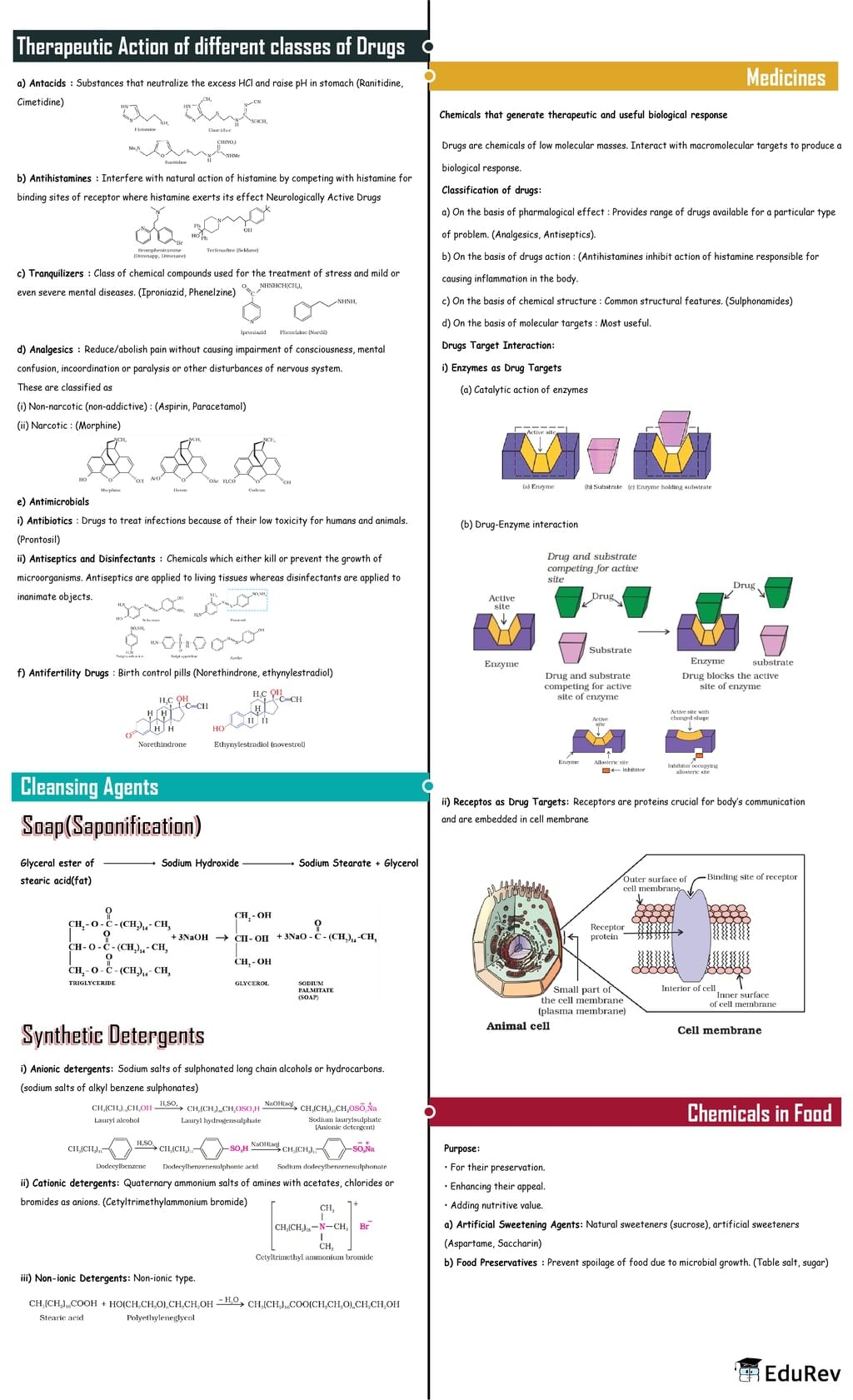
The document Mind Map: Chemistry in Everyday Life (Old NCERT) is a part of the NEET Course Chemistry Class 11.
All you need of NEET at this link: NEET
FAQs on Mind Map: Chemistry in Everyday Life (Old NCERT)
| 1. What is chemistry in everyday life? |  |
Chemistry in everyday life refers to the application of chemical knowledge and principles to understand and improve various aspects of our daily lives. It involves studying the chemicals present in products we use, their interactions, and their impact on our health and environment.
| 2. How does chemistry impact our everyday life? | |
Chemistry impacts our everyday life in numerous ways. It is involved in the production of medicines, food additives, and cosmetics that we use daily. It helps in understanding the effects of pollutants on our environment and enables the development of technologies for clean energy. Chemistry is also essential in understanding the reactions occurring in our body and developing new drugs for various diseases.
| 3. What are some examples of chemistry in everyday life? | |
There are several examples of chemistry in everyday life. Some common examples include the use of detergent to clean clothes, the process of digestion in our body, the fermentation of bread, the production of plastic materials, the preservation of food using preservatives, and the use of batteries in electronic devices.
| 4. How does chemistry play a role in medicine? | |
Chemistry plays a crucial role in medicine. It is involved in the development and production of pharmaceutical drugs. Chemists study the chemical structure of molecules and their interactions with biological systems to design and synthesize new drugs. They also study the metabolism and elimination of drugs from the body to ensure their safety and effectiveness.
| 5. How does chemistry contribute to environmental sustainability? | |
Chemistry contributes to environmental sustainability by developing technologies and processes that reduce pollution and promote clean energy sources. Chemists work on developing catalysts for more efficient and environmentally friendly industrial processes. They also study the behavior of pollutants in the environment and work towards finding solutions to mitigate their harmful effects. Additionally, chemistry plays a role in developing renewable energy sources such as solar cells and fuel cells.
About this Document

4.72/5 Rating

Apr 20, 2026 Last updated
Related Exams
Document Description: Mind Map: Chemistry in Everyday Life (Old NCERT) for NEET 2026 is part of Chemistry Class 11 preparation. The notes and questions for Mind Map: Chemistry in Everyday Life (Old NCERT) have been prepared according to the NEET exam syllabus. Information about Mind Map: Chemistry in Everyday Life (Old NCERT) covers topics like and Mind Map: Chemistry in Everyday Life (Old NCERT) Example, for NEET 2026 Exam. Find important definitions, questions, notes, meanings, examples, exercises and tests below for Mind Map: Chemistry in Everyday Life (Old NCERT).
Introduction of Mind Map: Chemistry in Everyday Life (Old NCERT) in English is available as part of our Chemistry Class 11 for NEET & Mind Map: Chemistry in Everyday Life (Old NCERT) in Hindi for Chemistry Class 11 course. Download more important topics related with notes, lectures and mock test series for NEET Exam by signing up for free. NEET: Mind Map: Chemistry in Everyday Life (Old NCERT)
Description
Mind Map: Chemistry in Everyday Life (Old NCERT) of Chemistry Class 11 provides you one-page visual summary of the chapter covering all the important topics. Download the PDF from EduRev.
Information about Mind Map: Chemistry in Everyday Life (Old NCERT)
In this doc you can find the meaning of Mind Map: Chemistry in Everyday Life (Old NCERT) defined & explained in the simplest way possible. Besides explaining types of Mind Map: Chemistry in Everyday Life (Old NCERT) theory, EduRev gives you an ample number of questions to practice Mind Map: Chemistry in Everyday Life (Old NCERT) tests, examples and also practice NEET tests
Top Courses for NEET
Related Searches
practice quizzes, Extra Questions, Mind Map: Chemistry in Everyday Life (Old NCERT), Important questions, shortcuts and tricks, Viva Questions, ppt, Objective type Questions, Sample Paper, Mind Map: Chemistry in Everyday Life (Old NCERT), Mind Map: Chemistry in Everyday Life (Old NCERT), study material, Semester Notes, Previous Year Questions with Solutions, mock tests for examination, Summary, Free, Exam, MCQs, pdf , video lectures, past year papers;