NEET Exam > NEET Notes > Physics Class 12 > Mind Map: Electrostatic Potential and Capacitance
Mind Map: Electrostatic Potential and Capacitance

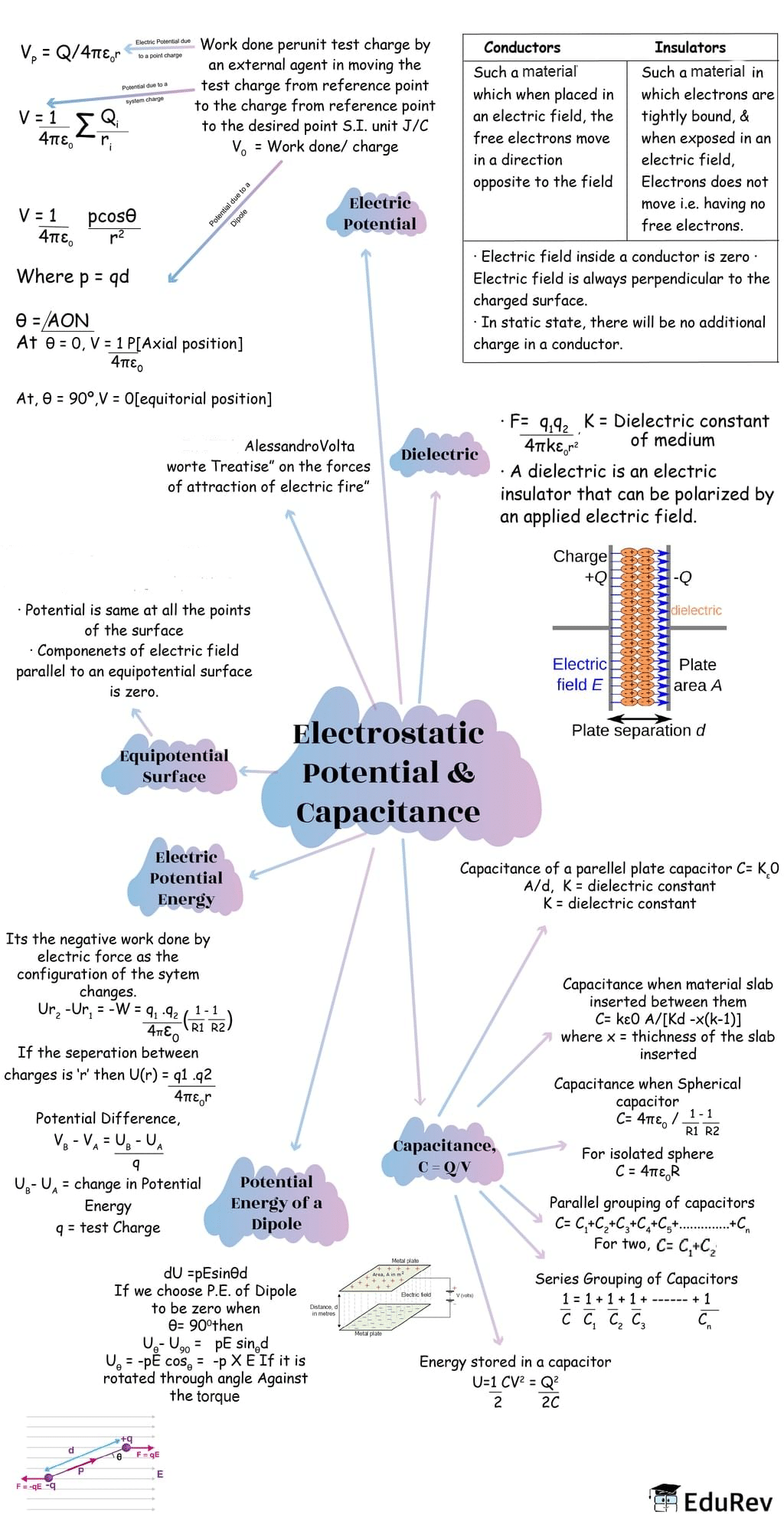
The document Mind Map: Electrostatic Potential and Capacitance is a part of the NEET Course Physics Class 12.
All you need of NEET at this link: NEET
FAQs on Mind Map: Electrostatic Potential and Capacitance
| 1. What's the difference between electrostatic potential and electric field? |  |
Ans. Electrostatic potential measures the work done per unit charge to bring a test charge from infinity to a point, while electric field represents the force exerted per unit charge at that location. Potential is scalar; field is vector. Both describe the same phenomenon differently-potential helps calculate energy changes, whereas field describes force direction and magnitude in electrostatics problems.
| 2. How do I calculate the capacitance of a parallel plate capacitor? | |
Ans. Capacitance of a parallel plate capacitor equals the permittivity of the medium multiplied by the plate area, then divided by the distance between plates (C = εA/d). This relationship shows capacitance increases with larger plate area and closer spacing. Using this formula, you can determine how geometry affects charge storage capacity in capacitor design and exam problems.
| 3. Why does electric potential decrease as you move away from a positive charge? | |
Ans. Electric potential decreases with distance because the work required to bring a unit positive charge from infinity becomes progressively less as separation increases. The mathematical relationship follows an inverse pattern with distance. Understanding this behaviour helps explain why equipotential surfaces form concentric patterns around point charges in electrostatic potential mapping.
| 4. What exactly is an equipotential surface and why does it matter? | |
Ans. An equipotential surface is an imaginary surface where every point holds the same electric potential value. No work is required to move a charge along it since potential energy remains constant. These surfaces remain perpendicular to electric field lines and are crucial in CBSE electrostatics for visualising field behaviour, designing capacitors, and solving complex charge distribution problems.
| 5. How is electrostatic potential energy related to capacitance in storing charge? | |
Ans. Electrostatic potential energy stored in a capacitor depends on both the capacitance value and the applied voltage (U = ½CV²). Higher capacitance means more energy storage at the same voltage. This relationship explains why capacitor design optimises plate area and material selection-greater capacitance directly increases energy density, essential for understanding power applications and exam scenarios.
About this Document

5K Views

4.74/5 Rating

Apr 18, 2026 Last updated
Related Exams
Document Description: Mind Map: Electrostatic Potential and Capacitance for NEET 2026 is part of Physics Class 12 preparation. The notes and questions for Mind Map: Electrostatic Potential and Capacitance have been prepared according to the NEET exam syllabus. Information about Mind Map: Electrostatic Potential and Capacitance covers topics like and Mind Map: Electrostatic Potential and Capacitance Example, for NEET 2026 Exam. Find important definitions, questions, notes, meanings, examples, exercises and tests below for Mind Map: Electrostatic Potential and Capacitance.
Introduction of Mind Map: Electrostatic Potential and Capacitance in English is available as part of our Physics Class 12 for NEET & Mind Map: Electrostatic Potential and Capacitance in Hindi for Physics Class 12 course. Download more important topics related with notes, lectures and mock test series for NEET Exam by signing up for free. NEET: Mind Map: Electrostatic Potential and Capacitance
Description
Mind Map: Electrostatic Potential & Capacitance of Physics Class 12 provides you one-page visual summary of the chapter covering all the important topics. Download the PDF from EduRev.
Information about Mind Map: Electrostatic Potential and Capacitance
In this doc you can find the meaning of Mind Map: Electrostatic Potential and Capacitance defined & explained in the simplest way possible. Besides explaining types of Mind Map: Electrostatic Potential and Capacitance theory, EduRev gives you an ample number of questions to practice Mind Map: Electrostatic Potential and Capacitance tests, examples and also practice NEET tests



Related Searches
pdf , ppt, Mind Map: Electrostatic Potential and Capacitance, shortcuts and tricks, study material, Extra Questions, Semester Notes, Summary, Sample Paper, Viva Questions, Mind Map: Electrostatic Potential and Capacitance, video lectures, practice quizzes, MCQs, Exam, Important questions, mock tests for examination, past year papers, Previous Year Questions with Solutions, Free, Mind Map: Electrostatic Potential and Capacitance, Objective type Questions;