Stability of Slopes

Stability Analysis of Slopes
The quantitative determination of the stability of slopes is required for many geotechnical engineering activities. Typical applications include:
- Design of earth dams and embankments
- Analysis of stability of natural slopes
- Analysis of stability of excavated slopes
- Analysis of deep-seated failure of foundations and retaining walls
Several analytical and graphical techniques are available to evaluate slope stability; choice of method depends on soil type, geometry, groundwater conditions and required accuracy.

Factor of Safety
The factor of safety (Fs) is the ratio of resisting shear strength to the shear stress mobilised by driving forces along a potential failure plane. In general form:
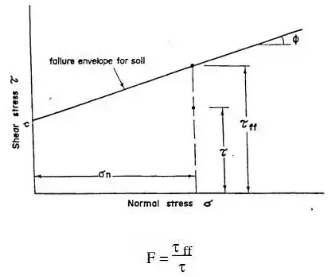
In the expression above, τ_ff is the maximum shear stress the soil can sustain at the given normal stress σn, and τ is the actual shear stress acting on the plane.
The same concept can be written in alternative equivalent forms to reflect mobilisation of cohesion and frictional components separately.
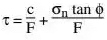
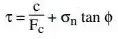
Two other specialised factors of safety sometimes used are the factor of safety with respect to cohesion (Fc) and the factor of safety with respect to friction (Fφ).
Factor of safety with respect to cohesion (Fc) is defined as the ratio of actual cohesion to the cohesion required for stability when the frictional component of strength is fully mobilised:
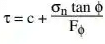
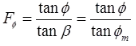
Factor of safety with respect to friction (Fφ) is defined as the ratio of tan of the soil's shearing resistance angle to the tan of the mobilised shearing resistance angle when cohesion is fully mobilised:
A further definition sometimes used is the factor of safety with respect to height (FH), defined as the ratio between the maximum permissible height of a slope (for stability) and the actual height:

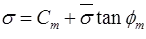
Useful relations (mobilised values):
- Cm = Mobilised cohesion = C / Fs
- ∅m = Mobilised friction angle where tan∅m = tan∅ / Fs
Factor of Safety w.r.t. Cohesion (fc):
Fc = C / Cm
When height-based factors are used:
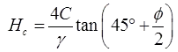
Fc = Hc / H
where Hc is the critical depth and H is the actual depth.
Stability Analysis of Infinite Slopes
An infinite slope is a simplifying idealisation in which the slope extends infinitely in the lateral direction and failure occurs by translation of a thin slice parallel to the slope surface. Infinite-slope analysis is commonly used for shallow failures on slopes where the potential failure surface is approximately planar and parallel to the slope surface.
1. Cohesionless dry soil / dry sand
Consider a thin slice of thickness z, unit length into the page, resting on a slope of angle β. Let y be the unit width (usually taken as 1 m). The weight of the slice is W = γ z cosβ (per unit length if y = 1). The normal and shear stresses on the failure plane are obtained from the weight components.
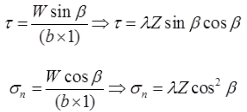
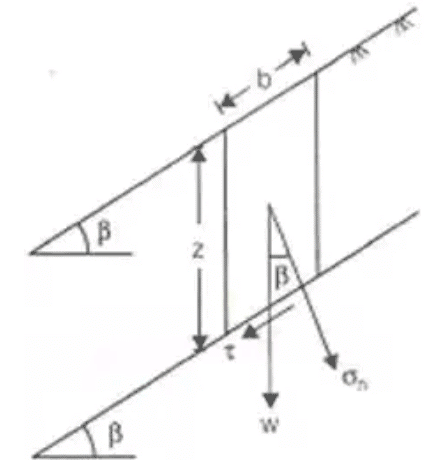
Shear stress mobilised on the plane is denoted τ and the normal stress is σn.

For a cohesionless dry soil the factor of safety against sliding is:
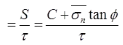
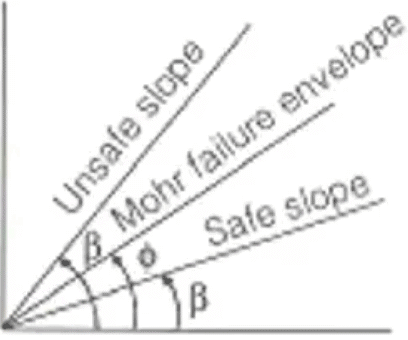
For safety of slopes, the slope angle must satisfy β < ∅ which ensures Fs > 1 under dry, cohesionless conditions.
2. Seepage parallel to slope; water table parallel to slope (cohesionless soil)
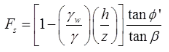
When seepage occurs parallel to the slope and the water table is approximately parallel to the slope surface, pore pressure reduces effective normal stress and hence the shear resistance. Let h be the vertical height of the water table above the slip surface.
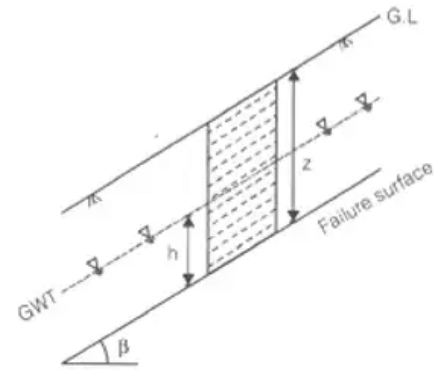
The stability expression includes the reduced effective stress and uses the effective friction angle φ′. γavg denotes the average total unit weight of the soil above the slip surface up to ground level.

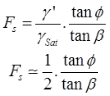
3. If water table is at ground level (h = z)
When the water table intersects the ground surface, the pore-water pressure at the slip surface becomes larger and the effective normal stress reduces further. In this special case take h = z in the stability expressions.
4. Infinite slope of purely cohesive soil
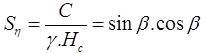
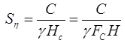
For purely cohesive soil (∅ = 0), the resisting shear stress is provided by cohesion alone. Define the stability number Sη for cohesive slopes which relates cohesion, unit weight and slope geometry.
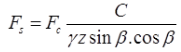
The factor of safety based on a height ratio can be written as:
Fc = Hc / H
Here H = z = depth of the potential sliding slice. At the critical stage Fc = 1 and the slope reaches limiting stable depth.

= Stability Number (used to express nondimensional stability criteria).
5. C-∅ soil on an infinite slope
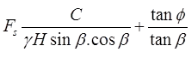
For soils having both cohesion and friction, the infinite-slope stability expression combines both contributions of C and tanφ (or tanφ′ when effective stresses are considered). The general relation for nondimensional stability uses the stability number Sη and includes dependence on the slope angle β and soil strength parameters.
6. Taylor's stability number
Taylor developed a stability number concept for cohesive soils. For cohesive soil the theoretical maximum value of the stability number is 0.5, while maximum practical values observed are around 0.261.
For C-∅ soils an expression for Sη relating slope and friction angle is:
Sη = [tanβ - tan∅] cos²β
Stability Analysis of Finite Slopes
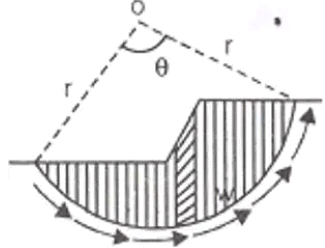
Finite (or localized) slope failures are those in which the failure surface is of finite extent and often approximated as circular (or non-circular) slip surfaces. Several classical methods assume circular failure surfaces and use limit equilibrium to compute factor of safety.
Fellenius (Swedish) Method - conventional name: Fellenius or Swedish Circle
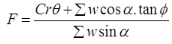
The Fellenius method is a simple limit equilibrium procedure assuming a circular failure surface and slices of the sliding mass. It is widely used for its simplicity, especially in homogeneous, purely cohesive soils or in general C-∅ soils when approximate results are acceptable.
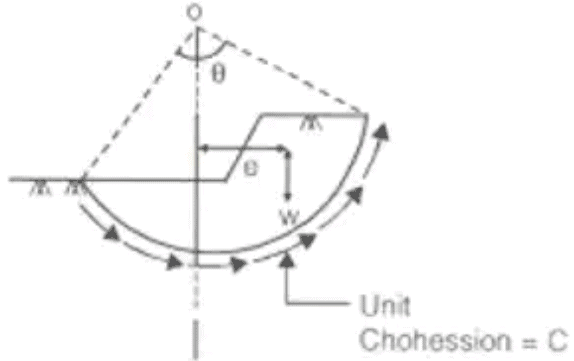
For purely cohesive soils the Fellenius expression may be written in a form:
F = C r² θ / w e
where F is the factor of safety, r is the radius of the rupture circle, θ is the angular extent of the slip arc, and w e denotes the appropriate weight or driving force term for the slice.
If tension cracks develop the expression modifies to:
F = C r² θ¹ / w e
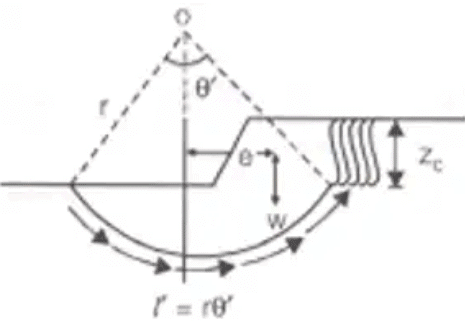
and the depth of tension crack may be estimated by zc = 2C / γ for cohesive soil.
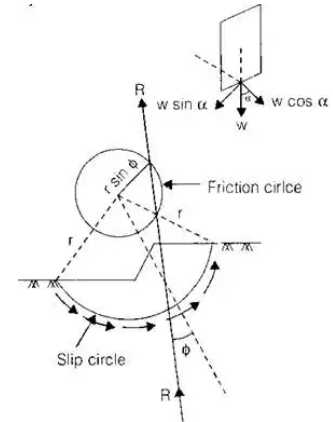
Friction Circle Method
The Friction Circle method is a graphical approach using the concept of resultant forces and their loci to determine the critical circle. The cohesion mobilisation factor and corresponding factor of safety can be expressed as:
Fc = C / Cm
Taylor's Stability Method (for C-∅ soils)
Taylor developed charts and nondimensional stability numbers for assessing slope stability using circular failure surfaces. Charts provide factors of safety or critical heights as a function of slope geometry and a stability number that incorporates C, γ and slope angle.
In submerged or saturated conditions one must use the submerged unit weight γ′ (or γsat where capillary saturation applies) in place of γ in the stability expressions and charts.

Notes and Practical Considerations
- Choice of method depends on required accuracy, available soil data, and geometry: infinite-slope analysis for shallow translational failures; circular methods (Fellenius, Taylor, Bishop's simplified, etc.) for localized circular slips; rigorous slice methods (Janbu, Morgenstern-Price, Spencer) when higher accuracy and force equilibrium are needed.
- Groundwater and seepage strongly reduce effective stress and therefore reduce slope stability; incorporate pore-water pressures as appropriate (use effective stresses and φ′ for drained conditions).
- Mobilised strength parameters (Cm, ∅m) are frequently lower than laboratory peak values; design should use conservative, mobilised values consistent with failure mechanism.
- Surface and subsurface drainage, benching, retaining works, anchors, vegetation and geometrical modifications are common remedial/stabilising measures.
References and further reading (recommended textbooks for students)
- Standard soil mechanics and geotechnical engineering textbooks that discuss slope stability, Fellenius and Taylor methods, and limit equilibrium analysis (consult course syllabus for specific recommended texts).
FAQs on Stability of Slopes