Civil Engineering (CE) Exam > Civil Engineering (CE) Notes > Design of Steel Structures > Beam Design & Plate Girders
Beam Design & Plate Girders

Beams
A beam is designed to resist the maximum bending moment and is checked for shear stress and deflection and also for web crippling and web buckling.
Design for Bending
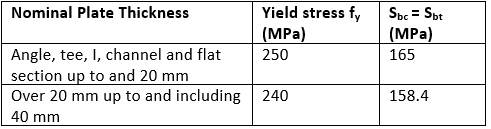
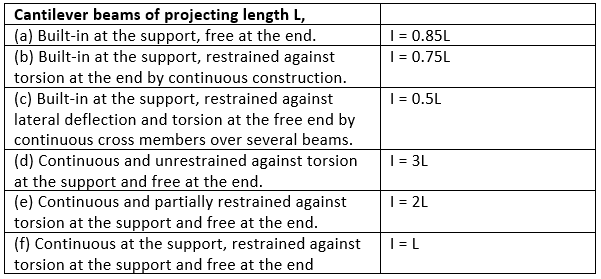
Effective Length of Compression Flange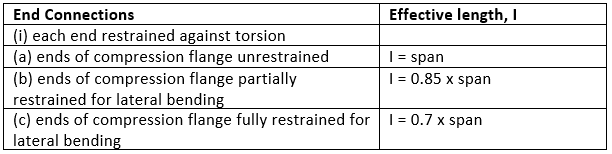
Check for Shear
- Max permissible, shear stress tvm = 0.45 fy
- For design purpose, the above condition is deemed to be satisfied if the average shear stress in an unstiffened member calculated on the cross-section of the web does not exceed the value Tva = 0.4 fy
Built‐up Beams
- Symmetrical built-up beams
each cover plate
where z1 = Section modulus of rolled I section available.
d = depth of the beam - Unsymmetrical built-up beams
The area of cover plates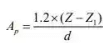
Gantry Girders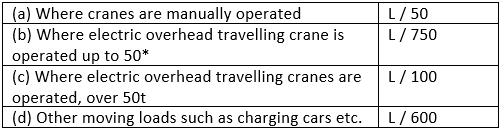
Where L = span of crane runway girder
Axial Compression + Bending
- Members subjected to axis! compression and bending are proportional to satisfy the Eq. (1)

However, if the ratio σac.cal/σac is less than 0.15, Eq (ii) may be used in lieu of Eq. (i)
Plate Girders
- Economic depth of the girder D = 1.1

Design of Web
- Average shear stress in the web
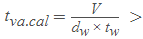 permissible average shear stress, tvα
Web stiffeners
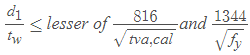 and 85. No stiffener is required.
 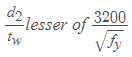 and 200. Vertical stiffeners are provided.
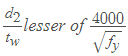 and 250. Vertical
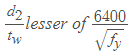 or 400.
Permissible Bending Stress
- The maximum tensile stress
 is calculated on the net flange area i.e.,
 permissible bending stress in tension, σbt
Curtailment of Flange Plates
- Length of the plate to be curtailed
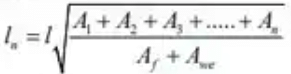
Where, I = span, n = no. of plates to be curtailed counting 1, 2, 3,.... from outer plate. Awe = effective web area
Web Stiffeners
- Bending moments on stiffener due to eccentricity of vertical loading with respect to vertical axis of the web.
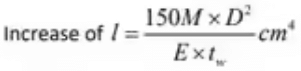
- Lateral loading on stiffener
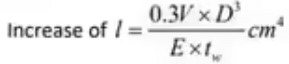
c = actual distance between vertical stiffeners - For second horizontal stiiener at the neutral axis.
I ≥ d2 x t3 - Stiffeners are connected to web to withstand a shearing force not less than
 kN/m, where h = outstand of stiffener in mm.
Load Bearing Stiffeners
- Bearing Stiffeners are provided at the points of concentrated loads and at supports.
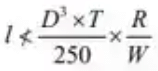
- Where these stiffeners are to provide restraints against torsion of the plate girder at the ends,
The document Beam Design & Plate Girders is a part of the Civil Engineering (CE) Course Design of Steel Structures.
All you need of Civil Engineering (CE) at this link: Civil Engineering (CE)
FAQs on Beam Design & Plate Girders
| 1. What is the difference between beams and plate girders? |  |
Ans. Beams are horizontal structural members that support loads by resisting bending, while plate girders are made up of steel plates that are welded together to form a larger, stronger beam.
| 2. How are beams and plate girders designed in civil engineering? | |
Ans. Beams and plate girders are designed in civil engineering using structural analysis and design principles to ensure they can safely support the expected loads and resist bending and deflection.
| 3. What are some advantages of using plate girders in construction? | |
Ans. Plate girders offer several advantages in construction, including their high strength-to-weight ratio, versatility in design, and ability to span long distances without requiring intermediate supports.
| 4. How are plate girders fabricated and installed on construction sites? | |
Ans. Plate girders are fabricated by welding steel plates together to create the desired shape and size. They are then transported to the construction site and installed using cranes or other lifting equipment.
| 5. What are some common applications of beams and plate girders in civil engineering projects? | |
Ans. Beams and plate girders are commonly used in various civil engineering projects such as bridges, buildings, industrial structures, and offshore platforms, where their strength and load-bearing capabilities are crucial.
About this Document

4.67/5 Rating

Apr 19, 2026 Last updated
Related Exams
Document Description: Beam Design & Plate Girders for Civil Engineering (CE) 2026 is part of Design of Steel Structures preparation. The notes and questions for Beam Design & Plate Girders have been prepared according to the Civil Engineering (CE) exam syllabus. Information about Beam Design & Plate Girders covers topics like and Beam Design & Plate Girders Example, for Civil Engineering (CE) 2026 Exam. Find important definitions, questions, notes, meanings, examples, exercises and tests below for Beam Design & Plate Girders.
Introduction of Beam Design & Plate Girders in English is available as part of our Design of Steel Structures for Civil Engineering (CE) & Beam Design & Plate Girders in Hindi for Design of Steel Structures course. Download more important topics related with notes, lectures and mock test series for Civil Engineering (CE) Exam by signing up for free. Civil Engineering (CE): Beam Design & Plate Girders
Description
Beam Design & Plate Girders of Design of Steel Structures covers all the important topics, helping you prepare for the Civil Engineering (CE) exam on EduRev.
Information about Beam Design & Plate Girders
In this doc you can find the meaning of Beam Design & Plate Girders defined & explained in the simplest way possible. Besides explaining types of Beam Design & Plate Girders theory, EduRev gives you an ample number of questions to practice Beam Design & Plate Girders tests, examples and also practice Civil Engineering (CE) tests



Related Searches
Semester Notes, study material, MCQs, past year papers, Sample Paper, video lectures, Viva Questions, practice quizzes, Extra Questions, Beam Design & Plate Girders, pdf , Previous Year Questions with Solutions, Free, shortcuts and tricks, Summary, Beam Design & Plate Girders, ppt, Objective type Questions, Important questions, mock tests for examination, Beam Design & Plate Girders, Exam;