Air & Noise Pollution | Environmental Engineering - Civil Engineering (CE) PDF Download
Introduction
Developmental activities such as construction, transportation, and manufacturing not only deplete the natural resources but also produce a large number of wastes that lead to pollution of air, water, soil, and oceans; global warming and acid rains.
Pollution & Pollutants
Automobiles emit from their tailpipes oxides of nitrogen, sulfur dioxide, carbon dioxide, carbon monoxide, and a complex mixture of unburnt hydrocarbons and black soot which pollute the atmosphere. Domestic sewage and run-off from agricultural fields, laden with pesticides and fertilizers, pollute water bodies. Effluents from tanneries contain many harmful chemicals and emit a foul smell.
- Pollution may be defined as the addition of undesirable material into the environment as a result of human activities. The agents which cause environmental pollution are called pollutants.
- Pollutants may be defined as a physical, chemical, or biological substance unintentionally released into the environment which is directly or indirectly harmful to humans and other living organisms.
Types of Pollution
Pollution may be of the following types:
- Air pollution
- Noise pollution
- Water pollution
- Soil pollution
- Thermal pollution
- Radiation pollution
Air Pollution
Air pollution may be defined as the presence of any solid, liquid, or gaseous substance including noise and radioactive radiation in the atmosphere in such concentration that may be directly and indirectly injurious to humans or other living organisms, plants, property or interferes with the normal environmental processes. Air pollutants are of two types
(i) suspended particulate matter, and
(ii) gaseous pollutants like carbon dioxide (CO2), NOx, etc.
Some of the major air pollutants, their sources and effects are given in the table: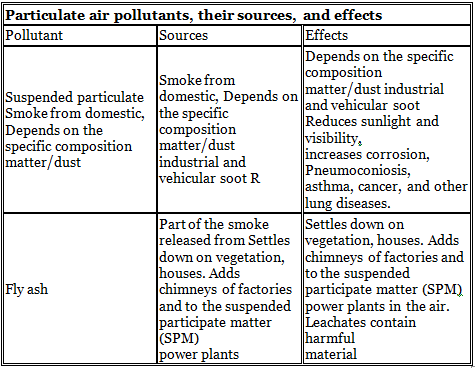
Particulate Pollutants
Particulate matter suspended in the air is dust and soot released from the industrial chimneys. Their size ranges from 0.001 to 500 µm in diameter. Particles less than 10µm float and move freely with the air current. Particles that are more than 10µm in diameter settle down. Particles less than 0.02 µm form persistent aerosols. The major source of SPM (suspended particulate matter) are vehicles, power plants, construction activities, oil refinery, railway yard, market place, industries, etc.
Fly ash
Fly ash is ejected mostly by thermal power plants as by-products of coal-burning operations. Fly ash pollutes air and water and may cause heavy metal pollution in water bodies. Fly ash affects vegetation as a result of its direct deposition on leaf surfaces or indirectly through its deposition on the soil. Fly ash is now being used for making bricks and as landfill material.
Lead and other Metals Particles
- Tetraethyl lead (TEL) is used as an anti-knock agent in petrol for the smooth and easy running of vehicles. The lead particles coming out from the exhaust pipes of vehicles is mixed with air.
- Lead mixed with water and food can create cumulative poisoning. It has long term effects on children as it lowers intelligence.
- Oxides of iron, aluminum, manganese, magnesium, zinc, and other metals have adverse effects due to the deposition of dust on plants during mining operations and metallurgical processes.
Gaseous Pollutants
Power plants, industries, different types of vehicles – both private and commercial use petrol, diesel as fuel and release gaseous pollutants such as carbon dioxide, oxides of nitrogen and sulfur dioxide along with particulate matter in the form of smoke. All of these have harmful effects on plants and humans.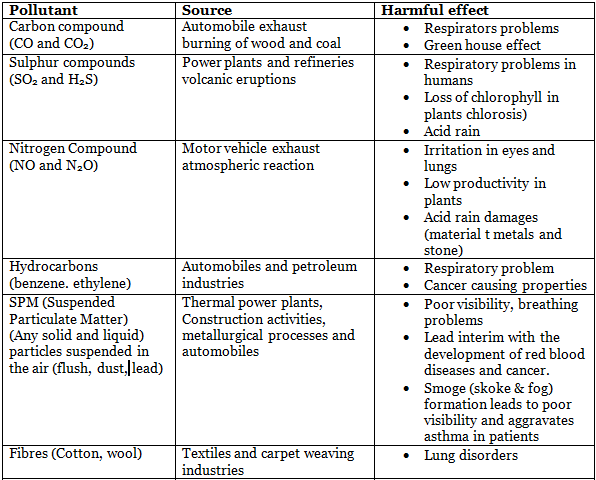
Air Pollution Control & its Principles
- Source Control Technology
(i) Air quality management sets the tools to control air pollutant emissions.
(ii) Control measurements describe the equipment, processes, or actions used to reduce air pollution.
(iii) The extent of pollution reduction varies among technologies and measures.
(iv) The selection of control technologies depends on environmental, engineering, economic factors, and pollutant type. - Settling Chambers
(i) Settling chambers use the force of gravity to remove solid particles.
(ii) The gas stream enters a chamber where the velocity of the gas is reduced. Large particles drop out of the gas and are recollected in hoppers. Because settling chambers are effective in removing only larger particles, they are used in conjunction with a more efficient control device.
- Cyclones
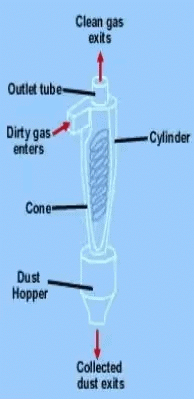
(i) The general principle of inertia separation is that the particulate-laden gas is forced to change direction. As gas changes direction, the inertia of the particles causes them to continue in the original direction and be separated from the gas stream.
(ii) The walls of the cyclone narrow toward the bottom of the unit, allowing the particles to be collected in a hopper.
(iii) The cleaner air leaves the cyclone through the top of the chamber, flowing upward in a spiral vortex, formed within a downward moving spiral.
Cyclones are efficient in removing large particles but are not as efficient with smaller particles. For this reason, they are used with other particulate control devices. - Venturi Scrubbers
(i) Venturi scrubbers use a liquid stream to remove solid particles.
(ii) In the venturi scrubber, gas laden with particulate matter passes through a short tube with flared ends and a constricted middle.
(iii) This constriction causes the gas stream to speed up when the pressure is increased.
(iv) The difference in velocity and pressure resulting from the constriction causes the particles and water to mix and combine.
(v) The reduced velocity at the expanded section of the throat allows the droplets of water containing the particles to drop out of the gas stream.
(vi) Venturi scrubbers are effective in removing small particles, with removal efficiencies of up to 99 percent.
(vii) One drawback of this device, however, is the production of wastewater. - Electrostatic Precipitators (ESPs)
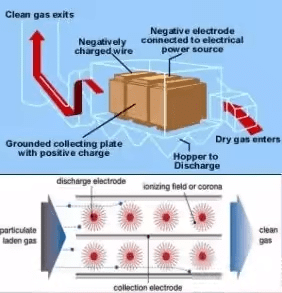
(i) An ESP is a particle control device that uses electrical forces to move the particles out of the flowing gas stream and onto collector plates.
(ii) The ESP places electrical charges on the particles, causing them to be attracted to oppositely charged metal plates located in the precipitator.
(iii) The particles are removed from the plates by "rapping" and collected in a hopper located below the unit.
(iv) The removal efficiencies for ESPs are highly variable; however, for very small particles alone, the removal efficiency is about 99 percent.
(v) Electrostatic precipitators are not only used in utility applications but also other industries (for other exhaust gas particles) such as cement (dust), pulp & paper (salt cake & lime dust), petrochemicals (sulfuric acid mist), and steel (dust & fumes). - Absorption
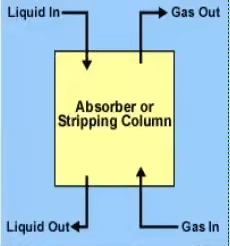
(i) The removal of one or more selected components from a gas mixture by absorption is probably the most important operation in the control of gaseous pollutant emissions.
(ii) Absorption is a process in which a gaseous pollutant is dissolved in a liquid.
(iii) As the gas stream passes through the liquid, the liquid absorbs the gas, in much the same way that sugar is absorbed in a glass of water when stirred.
(iv) Absorbers are often referred to as scrubbers, and there are various types of absorption equipment.
(v) The principal types of gas absorption equipment include spray towers, packed columns, spray chambers, and venturi scrubbers.
In general, absorbers can achieve removal efficiencies greater than 95 percent. One potential problem with absorption is the generation of waste-water, which converts an air pollution problem to a water pollution problem. - Adsorption
(i) When a gas or vapor is brought into contact with a solid, part of it is taken up by the solid. The molecules that disappear from the gas either enter the inside of the solid or remain on the outside attached to the surface. The former phenomenon is termed absorption (or dissolution) and the latter adsorption.
(ii) The most common industrial adsorbents are activated carbon, silica gel, and alumina because they have enormous surface areas per unit weight.
(iii) Activated carbon is the universal standard for purification and removal of trace organic contaminants from liquid and vapor streams.
Carbon adsorption systems are either regenerative or non-regenerative.
(a) Regenerative system usually contains more than one carbon bed. As one bed actively removes pollutants, another bed is being regenerated for future use.
(b) Non-regenerative systems have thinner beds of activated carbon. In a non-regenerative adsorber, the spent carbon is disposed of when it becomes saturated with the pollutant. - Condensation
(i) Condensation is the process of converting gas or vapor to liquid. Any gas can be reduced to a liquid by lowering its temperature and/or increasing its pressure.
(ii) Condensers are typically used as pretreatment devices. They can be used ahead of absorbers, absorbers, and incinerators to reduce the total gas volume to be treated by more expensive control equipment. Condensers used for pollution control are contact condensers and surface condensers.
(iii) In a contact condenser, the gas comes into contact with cold liquid.
(iv) In a surface condenser, the gas contacts a cooled surface in which cooled liquid or gas is circulated, such as the outside of the tube.
(v) Removal efficiencies of condensers typically range from 50 percent to more than 95 percent, depending on design and applications. - Incineration
(i) Incineration, also known as combustion, is mostly used to control the emissions of organic compounds from process industries.
(ii) This control technique refers to the rapid oxidation of a substance through the combination of oxygen with combustible material in the presence of heat.
(iii) When combustion is complete, the gaseous stream is converted to carbon dioxide and water vapor.
(iv) Equipment used to control waste gases by combustion can be divided into three categories:
(a) Direct combustion or flaring,
(b) Thermal incineration and
(c) Catalytic incineration.
Noise Pollution
- A musical clock may be nice to listen during the day, but maybe an irritant during sleep at night. Noise by definition is “sound without value” or “any noise that is unwanted by the recipient”.
- Noise level is measured in terms of decibels (dB). W.H.O. (World Health Organization) has prescribed an optimum noise level as 45 dB by day and 35 dB by night. Anything above 80 dB is hazardous.
- Noise in industries such as stone cutting and crushing, steel forgings, loudspeakers, shouting by hawkers selling their wares, movement of heavy transport vehicles, railways, and airports leads to irritation and increased blood pressure, loss of temper, decrease in work efficiency, loss of hearing which may be first temporary but can become permanent in the noise stress continues
Sources of some noises and their intensity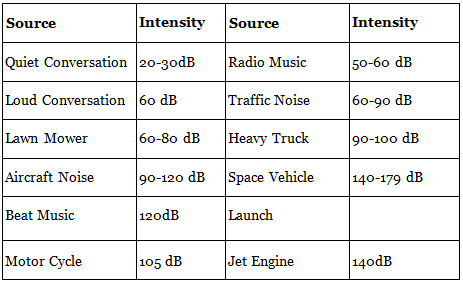
Sources of Noise Pollution
- Noise pollution is a growing problem. All human activities contribute to noise pollution to a varying extent. Sources of noise pollution are many and may be located indoors or outdoors.
- Indoor sources include noise produced by radio, television, generators, electric fans, air coolers, air conditioners, different home appliances, and family conflict.
- Outdoor sources of noise pollution include indiscriminate use of loudspeakers, industrial activities, automobiles, rail traffic, airplanes, and activities such as those at market place, religious, social, and cultural functions, sports, and political rallies.
Prevention and Control of Noise Pollution
The following steps can be taken to control or minimize noise pollution-
- Road traffic noise can be reduced by better designing and proper maintenance of vehicles.
- Noise abatement measures include creating noise mounds, noise attenuation walls, and well-maintained roads and smooth surfacing of roads.
- Retrofitting of locomotives continuously welded rail track, use of electric locomotives, or deployment of quieter rolling stock will reduce noises emanating from trains.
- Air traffic noise can be reduced by appropriate insulation and the introduction of noise regulations for take-off and landing of aircraft at the airport.
- Industrial noises can be reduced by soundproofing equipment like generators and areas producing a lot of noise.
- Power tools, very loud music, and land movers, public functions using loudspeakers, etc should not be permitted at night. The use of horns, alarms, refrigeration units, etc. is to be restricted. Use of firecrackers which are noisy and cause air pollution should be restricted.
- A green belt of trees is an efficient noise absorber.
|
14 videos|99 docs|98 tests
|
FAQs on Air & Noise Pollution - Environmental Engineering - Civil Engineering (CE)
| 1. What are the main sources of air pollution in civil engineering? |  |
| 2. How does air pollution affect human health in civil engineering projects? | |
| 3. What measures can be taken to reduce air pollution in civil engineering projects? | |
| 4. How does noise pollution impact the environment in civil engineering projects? | |
| 5. What strategies can be employed to mitigate noise pollution in civil engineering projects? | |

|
4.66/5 Rating |

|
Dec 22, 2024 Last updated |

|
Explore Courses for Civil Engineering (CE) exam
|

|
Air & Noise Pollution | Environmental Engineering - Civil Engineering (CE)
,MCQs
,Sample Paper
,shortcuts and tricks
,Previous Year Questions with Solutions
,mock tests for examination
,Free
,Semester Notes
,practice quizzes
,Air & Noise Pollution | Environmental Engineering - Civil Engineering (CE)
,Viva Questions
,past year papers
,Summary
,Extra Questions
,study material
,Important questions
,Exam
,video lectures
,ppt
,Air & Noise Pollution | Environmental Engineering - Civil Engineering (CE)
,Objective type Questions
;




Air & Noise Pollution Free PDF Download
Importance of Air & Noise Pollution
Air & Noise Pollution Notes
Air & Noise Pollution Civil Engineering (CE) Questions
Study Air & Noise Pollution on the App
|
© EduRev
|
Education Revolution
|


|


